

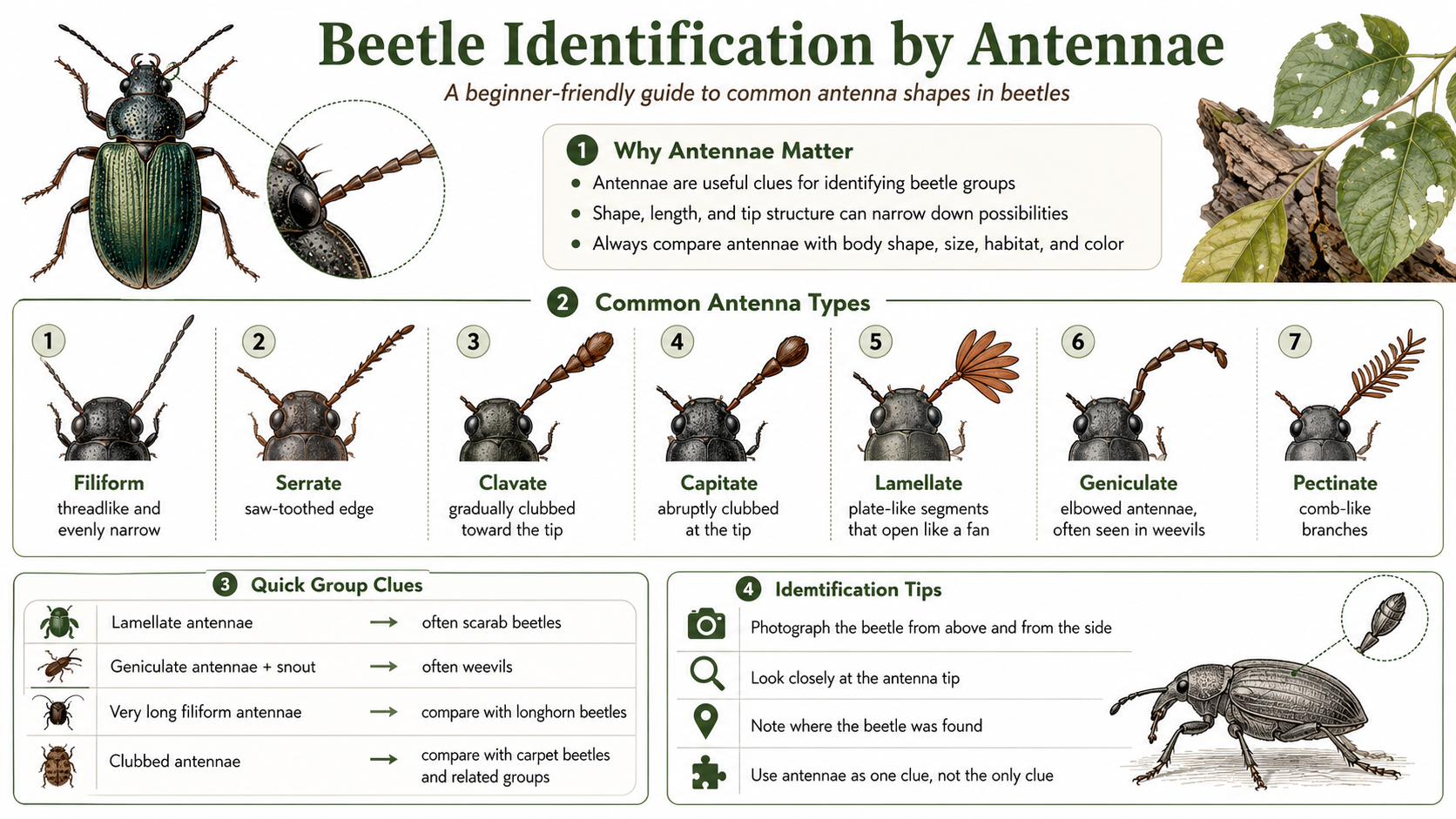
Beetle identification by antennae is one of the most useful first steps in understanding what kind of beetle you may be looking at. Antennae are not enough to identify every beetle to species, but they can often point you toward a beetle family, group, or general type. A beetle with fan-like antenna tips may suggest a scarab beetle. A beetle with elbowed antennae and a snout may suggest a weevil. A beetle with long, threadlike antennae may lead you toward longhorn beetles or several other slender-bodied groups.
Antennae are especially helpful because they are visible on the head, often keep their shape even in photographs, and vary greatly across beetle groups. Entomology references describe insect antennae as segmented sensory structures, and common forms include threadlike, beadlike, saw-toothed, clubbed, comb-like, fan-like, and elbowed shapes. In beetles, this variation can be an important clue, but it should always be used together with body shape, size, color, wing covers, habitat, behavior, season, and location.
his guide explains the main antenna shapes you may see in beetles, how to describe them, and how to use them responsibly for beginner-level beetle identification.
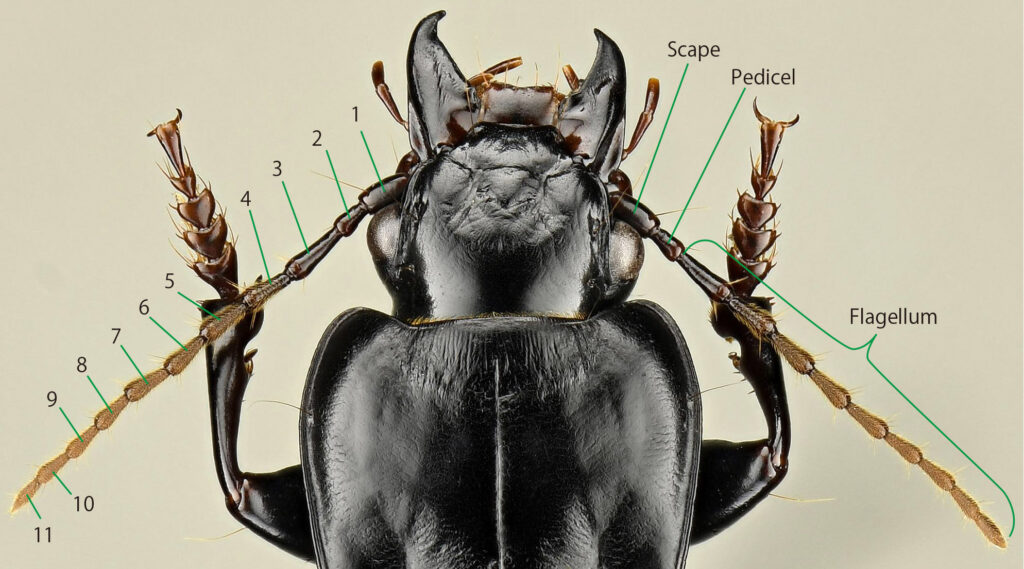
The Ground Beetle’s Antennae: A Multifunctional Sensory Tool
The next movable parts of a ground beetle’s head are the antennae (plural: antennae). In many insects, antennae primarily function as smelling organs, akin to our nose. However, for ground beetles, antennae have an additional critical role: they act as tactile feelers, compensating for the beetle’s poor eyesight. This dual function is vital for their survival as nocturnal creatures.
The Role of Antennae in Ground Beetles
Ground beetles rely heavily on their antennae to explore their surroundings. These beetles are often active at night and spend daylight hours hiding under rocks, logs, or leaf litter where light is minimal. Their compound eyes, while functional, don’t provide sharp vision, so the antennae take on the role of “scanning” the environment. You’ll notice ground beetles constantly moving their antennae, using them to detect smells and touch objects around them.
Insects have a variety of antenna shapes, but ground beetles feature long, thread-like antennae known as filiform antennae. This shape maximizes their sensory capabilities, making them well-suited for navigating dark, cluttered habitats. Filiform antennae are also seen in other beetles, such as long-horn beetles, and contrast sharply with the shorter, clubbed antennae of species like ladybugs.
About This Guide
This guide is designed for beginners, homeowners, gardeners, students, teachers, and nature enthusiasts who want a calm, practical way to understand beetles. It does not promise guaranteed species identification from antennae alone. Beetle identification can vary by region, life stage, season, sex, photo quality, and the angle from which the beetle is viewed.
For reliable identification, antennae should be treated as one clue among several. A responsible identification usually considers:
- Body size
- Body color and pattern
- Body shape
- Antenna shape
- Antenna length
- Elytra, or hardened wing covers
- Leg shape
- Head shape
- Habitat
- Behavior
- Season
- Geographic location
Museum collections, university extension publications, government agriculture resources, natural history references, and entomology field guides are all useful source types when confirming beetle identification. Large museum beetle collections, such as those maintained by the Smithsonian and the Natural History Museum in London, also show why beetle identification is a specialist field: Coleoptera is extremely diverse, with millions of specimens represented in major research collections.
Why Antennae Matter in Beetle Identification
Antennae matter because they are part of the beetle’s sensory system and often have distinctive shapes. Many beetles use antennae to detect chemical cues, find food, recognize mates, sense their surroundings, and navigate their environment. Insects generally have paired, segmented antennae on the head, and the number, length, and shape of the segments can differ widely between groups.
For beetle identification, antennae can help answer questions such as:
- Are the antennae long and threadlike?
- Are they short and clubbed?
- Do they end in flattened plates?
- Are they saw-toothed along one edge?
- Are they elbowed like a bent arm?
- Are they comb-like or fan-like?
- Are they longer than the body?
- Are they hidden, tucked, or difficult to see?
These questions can quickly narrow the possibilities. For example, scarab beetles are often associated with lamellate antennae, meaning the tip segments form flattened plates. Weevils often have elbowed, or geniculate, antennae, especially when combined with a snout-like rostrum.
Still, antennae should not be used in isolation. Many beetle families contain exceptions, and some antenna types occur in more than one group.
What Beetle Antennae Are and What They Do
Beetle antennae are paired appendages attached to the head. They are made of segments and are usually flexible. A simple way to understand them is to think of antennae as sensory tools rather than “feelers” only. They help beetles interpret the world.
In basic insect anatomy, an antenna is commonly described in three main parts:
- Scape: the basal segment attached to the head
- Pedicel: the second segment
- Flagellum: the remaining outer segments
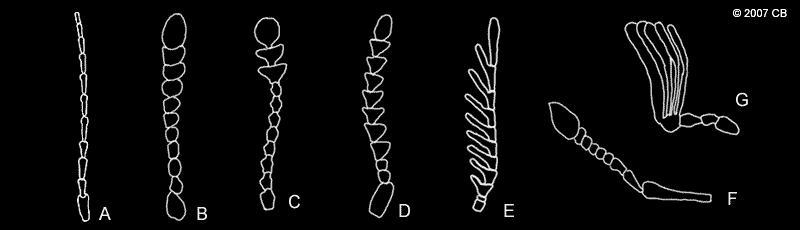
The exact shape of these segments creates the antenna type. In some beetles, the antennae look like a thin wire. In others, they form a club, comb, fan, saw, or elbow. Entomology references commonly use terms such as filiform, moniliform, serrate, pectinate, clavate, capitate, lamellate, flabellate, and geniculate to describe these forms.
For beginners, the scientific names can look intimidating. But the visual idea is simple: each term describes the shape.
How to Observe Beetle Antennae Safely
You do not need to handle a beetle to observe its antennae. In many cases, a clear photograph is enough.
Practical observation tips
- Use a phone camera in good natural light.
- Photograph the beetle from above and from the side.
- Try to capture the head clearly.
- Avoid shadows over the antennae.
- Include a size reference, such as a coin, ruler, leaf, or fingertip nearby.
- Note where you found it: window, pantry, flower, soil, tree bark, compost, garden bed, or porch light.
- Record the date and general location.
If the beetle is indoors, gently guide it into a container rather than crushing it. Many small beetles found indoors are harmless wanderers, while some may be associated with stored food, natural fibers, or damp organic material. Identification is easier when the specimen is intact.
Photo quality matters
Antennae can be very small, folded under the body, hidden by the angle of the photo, or blurred by movement. If you cannot see the antennae clearly, do not force an identification. Use other clues instead.
Main Beetle Antenna Types
Below are the most useful antenna forms for beetle identification by antennae.
Filiform Antennae: Threadlike Antennae
Filiform antennae are long, slender, and fairly even in width from base to tip. The word “filiform” means threadlike. This is one of the most basic and common antenna shapes in insects, including many beetles.
What they look like
- Thin and simple
- Often straight or gently curved
- Segments are similar in width
- May be short, medium, or very long
Beetle identification clues
Filiform antennae are common enough that they do not identify a beetle by themselves. However, when they are very long, they may suggest groups such as longhorn beetles, especially if the beetle has an elongated body and antennae that approach or exceed body length.
Beginner example
If you find a slender beetle on a flower or tree trunk with very long, threadlike antennae, you might first compare it with longhorn beetles. But you should also check body shape, leg length, markings, and habitat before reaching a conclusion.
Moniliform Antennae: Beadlike Antennae
Moniliform antennae look like a string of beads. Each segment is rounded or slightly swollen, giving the antenna a necklace-like appearance. Entomology references describe moniliform antennae as beadlike, though they are more commonly emphasized in some insect groups than in everyday beetle identification.
What they look like
- Rounded segments
- Beadlike appearance
- Usually not sharply clubbed
- Often shorter than strongly threadlike antennae
Beetle identification clues
In beetles, beadlike antennae may be seen in some small or dark beetles, but they are not usually enough for a confident identification. Use them as a supporting clue.
Common mistake
Beginners sometimes confuse moniliform antennae with clubbed antennae. The difference is that moniliform antennae look beadlike along much of the antenna, while clubbed antennae become enlarged mainly toward the tip.
Serrate Antennae: Saw-Toothed Antennae
Serrate antennae have segments that project to one side, creating a saw-like edge. The word “serrate” means toothed or saw-like. Some beetle guides use serrate antennae as a clue for families such as click beetles and other groups, though exact identification still depends on additional characters.
What they look like
- Saw-toothed outline
- Segment edges point outward
- Usually not feathery
- Often medium length
Beetle identification clues
Serrate antennae can be useful when paired with body shape. For example, a narrow beetle with a firm body and saw-toothed antennae may suggest a click beetle or a related group, but the clicking mechanism, body profile, and thorax shape also matter.
Beginner example
A brown beetle found near a porch light with a long, narrow body and serrated antennae might be compared with click beetles. However, porch lights attract many beetles, so antennae alone are not enough.
Pectinate Antennae: Comb-Like Antennae
Pectinate antennae look like a comb. Segments have longer projections on one side. When projections occur on both sides, the antenna may be described as bipectinate.
What they look like
- Comb-like branches
- Usually more dramatic than serrate antennae
- Often seen in males of some insects
- May help detect chemical signals
Beetle identification clues
Pectinate antennae occur in some beetles and may be especially noticeable in males. They are useful because their shape is visually distinctive. But they should be compared carefully with flabellate and lamellate antennae, which can also look fan-like.
Common mistake
Pectinate antennae are often confused with featherlike or fan-like antennae. A comb has separate projections like teeth; a fan has longer blade-like extensions or flattened plates.
Flabellate Antennae: Fan-Like Antennae
Flabellate antennae have long, flattened or blade-like extensions that spread like a fan. BugGuide notes that flabellate antennae are fan-shaped and should be compared with lamellate antennae, where mainly the outer part of the antenna forms the fan-like structure.
What they look like
- Fan-shaped
- Long flat projections
- Often dramatic and easy to notice
- Sometimes folded or partly closed
Beetle identification clues
Flabellate antennae are less common than simple threadlike antennae, so they can be a strong clue when visible. Some beetle groups have especially showy fan-like antennae.
Beginner example
If a beetle has antennae that look like small folding fans rather than simple clubs, take several photos from different angles. The distinction between flabellate and lamellate can matter.
Clavate Antennae: Gradually Clubbed Antennae
Clavate antennae gradually widen toward the tip, forming a club. The club is not abrupt; it develops slowly over several segments.
What they look like
- Slender near the base
- Gradually thicker toward the end
- Club is smooth rather than sudden
- Often short to medium length
Beetle identification clues
Clubbed antennae occur in many beetle groups, including several small beetles that may be found around homes, stored products, flowers, or decaying organic matter. Because many beetles have some kind of club, the exact body shape and habitat are important.
Common mistake
Do not assume every clubbed-antenna beetle is a carpet beetle. Carpet beetles are dermestid beetles, and many adult dermestids are small, often hairy or scaly, and may have clubbed antennae, but other beetles can also show clubbed forms. Utah State University Extension describes dermestid beetles as generally hairy, dark-colored, elongated, and having clubbed antennae, while also noting variation in color and size.
Capitate Antennae: Abruptly Clubbed Antennae
Capitate antennae have a more sudden knob or club at the tip. The club looks more abrupt than in clavate antennae.
What they look like
- Thin stalk-like base
- Enlarged terminal knob
- Club appears sudden
- Often short
Beetle identification clues
Capitate antennae may appear in several beetle groups. They are useful mainly as a descriptive feature. If you are using an identification key, the difference between gradually clubbed and abruptly clubbed may be important.
Beginner example
If the antenna looks like a thin stem with a small rounded end, describe it as “clubbed at the tip” rather than forcing a precise term too early.
Lamellate Antennae: Plate-Like Antennae
Lamellate antennae are among the most important antenna shapes for beetle identification. The end segments are flattened into movable plates or leaf-like structures. These plates can open and close like a small fan. The Amateur Entomologists’ Society describes lamellate antennae as having flattened, plate-like end segments, and North Carolina State University’s entomology resource describes scarab beetles as recognizable in part by lamellate antennae.
What they look like
- Flattened plates at the tip
- Fan-like ending
- Often compact when closed
- Commonly associated with scarab beetles
Beetle identification clues
Lamellate antennae are a strong clue for scarab beetles and related groups. Scarabs include many familiar beetles, such as June beetles, dung beetles, flower chafers, and rhinoceros beetles. However, the exact species depends on size, color, region, leg shape, and other body features.
Beginner example
A rounded beetle found near lights in summer with plate-like antenna tips may be a scarab-type beetle. If it is metallic green or brown and has a robust oval body, scarabs are worth comparing first.
Geniculate Antennae: Elbowed Antennae
Geniculate antennae are bent like an elbow or knee. BugGuide defines geniculate as elbowed or kneed, and broad beetle references note that weevils often have elbowed antennae.
What they look like
- Distinct bend
- Often resembles an arm with an elbow
- May have a club at the end
- Often associated with snouted beetles
Beetle identification clues
Geniculate antennae are especially helpful when combined with a snout-like head. Weevils, also called snout beetles, commonly have elbowed antennae arising from the snout or rostrum. Some entomology teaching materials describe weevils as having a pronounced snout and geniculate, clubbed antennae.
Beginner example
If you find a small beetle in stored grains, seeds, or around plants, and it has a snout with elbowed antennae, compare it with weevils. Some weevils are associated with stored foods, while others feed on plants outdoors.
Beetle Identification by Antennae: Quick Comparison Table
| Antenna Type | Simple Description | What to Look For | Beetle Identification Use |
|---|---|---|---|
| Filiform | Threadlike | Thin, even-width segments | Common in many beetles; useful with body shape |
| Moniliform | Beadlike | Rounded segments like beads | Supporting clue, not usually enough alone |
| Serrate | Saw-toothed | Angled projections along one edge | Helpful for some narrow-bodied beetles |
| Pectinate | Comb-like | Long comb teeth on one side | Distinctive, often more obvious in males |
| Flabellate | Fan-like | Long fan blades or extensions | Strong visual clue in certain groups |
| Clavate | Gradually clubbed | Antenna slowly thickens toward tip | Common; useful with habitat and body shape |
| Capitate | Abruptly clubbed | Sudden knob at tip | Useful in keys and close comparison |
| Lamellate | Plate-like club | Flattened plates at antenna tip | Strong clue for scarab-type beetles |
| Geniculate | Elbowed | Bent antenna, often with club | Strong clue for many weevils when paired with snout |
Antennae and Common Beetle Groups
Antennae can help you begin comparing a beetle with likely groups. The examples below are general starting points, not guaranteed identifications.
Scarab beetles
Scarab beetles often have lamellate antennae with plate-like tips. They are usually oval or robust beetles, and many are found around soil, dung, flowers, roots, lawns, compost, or lights. North Carolina State University notes that scarab beetles can be recognized partly by oval bodies, five-segmented tarsi, lamellate antennae, and scalloped front tibiae.
Weevils
Weevils often have elbowed antennae and a snout-like rostrum. This combination is one of the clearest beginner clues. Some weevils are plant feeders, and some stored-product weevils may appear around grains, rice, seeds, or pantry items.
Longhorn beetles
Longhorn beetles are known for long antennae, often near or longer than the body. Many have elongated bodies and are found on flowers, wood, bark, or near lights. Long antennae alone do not prove a beetle is a longhorn, but they are a strong reason to compare with that group.
Carpet beetles and dermestids
Adult dermestid beetles, including carpet beetles and larder beetles, may have clubbed antennae. Utah State University Extension describes dermestids as beetles in the family Dermestidae and notes that adults vary in color and size but are generally hairy, dark-colored, elongated, and have clubbed antennae.
Click beetles
Click beetles and related narrow-bodied beetles may have serrate antennae. However, the body shape and clicking behavior are also important. Many click beetles have a long, tapered body and a distinctive mechanism that can flip them when placed on their back.
Identification Clues Beyond Antennae
Antennae are useful, but beetle identification becomes much stronger when you combine several clues.
1. Body shape
Is the beetle round, oval, flattened, cylindrical, wedge-shaped, or long and narrow? Scarabs tend to be robust or oval. Weevils often have a compact body with a snout. Longhorn beetles are often elongated.
2. Elytra
Beetles are known for hardened forewings called elytra. These wing covers may be smooth, grooved, spotted, metallic, hairy, shortened, or patterned. Some beetles, such as rove beetles, have very short elytra, while most beetles have elytra covering much of the abdomen.
3. Size
Measure the beetle if possible. A 2 mm pantry beetle, a 6 mm carpet beetle, and a 25 mm scarab may all have clubbed or modified antennae, but their size points in different directions.
4. Color and markings
Color is useful but can mislead. Some beetles fade after death. Lighting can make brown beetles look black. Metallic beetles may appear green, blue, bronze, or black depending on angle.
5. Habitat
Where the beetle was found matters. A beetle on a flower, in flour, under bark, inside a closet, in lawn soil, or near a porch light may represent very different groups.
6. Behavior
Does it fly to lights? Does it jump or click? Does it hide in dry goods? Does it feed on flowers? Does it crawl slowly on windowsills? Behavior often helps confirm or reject a possible identification.
Common Mistakes When Using Antennae for Beetle Identification
Mistake 1: Using antennae alone
Antennae can narrow down possibilities, but many beetles share similar antenna shapes. Always combine antennae with body shape, size, habitat, and location.
Mistake 2: Confusing clubbed and lamellate antennae
A simple club is not the same as a lamellate club. Lamellate antennae have flattened plate-like tips. In a blurry photo, those plates may look like a normal club, so a side-view photo can help.
Mistake 3: Calling all long-antenna beetles “longhorn beetles”
Long antennae are common in longhorn beetles, but other beetles may also have long antennae. Look for body shape, eye shape, shoulder area, and where the antennae attach.
Mistake 4: Ignoring sex differences
In some beetles, males and females have different antenna shapes or lengths. Males may have larger comb-like, fan-like, or more sensitive antennae. This can make two beetles of the same species look surprisingly different.
Mistake 5: Relying on one photo
A single top-down image may hide the antenna joints. A side image, close-up head image, and full-body image are much more useful.
Habitat and Behavior Clues
Antennae become more meaningful when paired with habitat.
Beetles found around lights
Many beetles are attracted to outdoor lights at night. June beetles, scarabs, click beetles, longhorn beetles, ground beetles, and many others may appear near porches or windows. Antennae help narrow the group, but light attraction alone is not diagnostic.
Beetles found in pantries
Small beetles found in rice, flour, grain, spices, dried pet food, or seeds may include weevils or other stored-product beetles. If the beetle has a snout and elbowed antennae, weevils are worth considering.
Beetles found in closets or fabrics
Small beetles around wool, feathers, fur, dried insects, or stored natural materials may suggest dermestid beetles. Adult carpet beetles may be seen near windows, while larvae may be found near food sources such as natural fibers or dead insects. Extension resources often recommend careful identification before management decisions.
Beetles found on flowers
Flower-visiting beetles may include scarabs, longhorns, soldier beetles, tumbling flower beetles, and others. Antennae, body shape, flower type, and season all help.
Beetles found in soil or compost
Robust beetles with lamellate antennae may belong to scarab-related groups. Other beetles in soil may be predators, scavengers, or root feeders.
Diet and Life Cycle Connections
Antennae do not directly tell you what a beetle eats, but they can point toward a group with known habits.
Plant feeders
Many weevils, leaf beetles, and scarabs feed on plants as adults, larvae, or both. A snout with elbowed antennae may suggest a weevil, and many weevils are associated with specific plants, seeds, roots, or stored grains.
Wood-associated beetles
Some beetles with long antennae are associated with wood or trees, especially longhorn beetles. Their larvae may develop in dead, dying, or sometimes living wood depending on the species.
Scavengers and recyclers
Dermestid beetles feed on dry animal material, dead insects, natural fibers, or stored organic materials. Carpet beetles are often discussed in home settings because larvae may feed on wool, fur, feathers, or similar materials.
Dung, soil, and decaying matter
Many scarabs play roles in dung, soil, compost, or decaying organic matter. Their lamellate antennae are often used to detect chemical cues in the environment.
Home and Garden Relevance
Beetle identification by antennae is especially useful around homes and gardens because many beetles are small, fast-moving, or found unexpectedly.
Around the home
Use antennae to sort indoor beetles into rough groups:
- Clubbed antennae + small rounded body: compare with carpet beetles or other small household beetles.
- Elbowed antennae + snout: compare with weevils, especially near grains or seeds.
- Long antennae + slender body: compare with longhorn beetles or outdoor beetles that wandered inside.
- Lamellate antennae + oval body: compare with scarabs, especially if found near lights.
In the garden
In gardens, antennae can help distinguish plant feeders, flower visitors, decomposers, and predators. However, do not assume a beetle is harmful just because it is on a plant. Many beetles are harmless visitors, pollinators, predators, or recyclers.
Calm identification first
A calm approach is best. Photograph the beetle, note where it was found, compare multiple clues, and consult reliable sources. Avoid panic-based pest decisions from a single photo.
When to Seek Professional Help
Most beetle sightings do not require professional help. But expert identification may be useful when:
- Beetles appear repeatedly in stored food.
- Larvae are damaging wool, fur, feathers, museum specimens, or natural-fiber items.
- Large numbers of beetles are emerging indoors.
- You suspect wood-boring beetles in structural timber.
- You need identification for a school, museum, farm, garden, or collection.
- A photo is too blurry for confident identification.
For uncertain cases, consider contacting a local university extension office, museum entomology department, agriculture department, natural history society, or licensed pest professional. Identification depends strongly on region, and local experts are often best placed to recognize common species.
Suggested Internal Links for typesofbeetles.com
Use these as contextual internal links throughout the article:
- Beetle Identification →
/beetle-identification/
Place near the introduction or “Identification Clues Beyond Antennae.” - Types of Beetles →
/types-of-beetles/
Place in the section explaining major beetle groups. - Beetle Species →
/beetle-species/
Place near the section on species-level limits. - Beetle Facts →
/beetle-facts/
Place near the antenna function section. - Beetles Around the Home →
/beetles-around-the-home/
Place in the home relevance section. - Beetle Life Cycle →
/beetle-life-cycle/
Place in the diet and life cycle section. - Small Beetles in House →
/small-beetles-in-house/
Place in the indoor beetle section. - Black Beetle Identification →
/black-beetle-identification/
Place in common mistakes or body color discussion. - What Do Beetles Eat? →
/what-do-beetles-eat/
Place in the diet section. - Carpet Beetle Identification →
/carpet-beetle-identification/
Place in the dermestid/carpet beetle section. - Longhorn Beetles →
/longhorn-beetles/
Place in the filiform antennae or longhorn beetle section. - Scarab Beetles →
/scarab-beetles/
Place in the lamellate antennae section.
Image and Infographic Suggestions with Alt Text
- Infographic: Main Beetle Antenna Types
Alt text: “Illustration of beetle antenna types including filiform, serrate, clubbed, lamellate, and geniculate antennae” - Close-Up Photo: Lamellate Antennae on a Scarab Beetle
Alt text: “Close-up of scarab beetle with lamellate plate-like antennae” - Close-Up Photo: Weevil with Elbowed Antennae
Alt text: “Weevil showing snout and elbowed geniculate antennae” - Comparison Graphic: Clubbed vs Lamellate Antennae
Alt text: “Comparison of clubbed beetle antennae and lamellate beetle antennae” - Longhorn Beetle Antennae Photo
Alt text: “Longhorn beetle with long threadlike antennae on a tree branch” - Household Beetle Identification Chart
Alt text: “Beginner chart for identifying small household beetles by antennae, body shape, and habitat” - Garden Beetle Observation Guide
Alt text: “Garden beetle identification guide showing antennae, elytra, legs, and body shape” - Beetle Anatomy Diagram
Alt text: “Beetle anatomy diagram showing antennae, head, thorax, elytra, legs, and abdomen”
Recommended Source Types for Further Verification
For responsible beetle identification, consult:
- University extension resources
- Museum entomology collections
- Natural history museums
- Government agriculture departments
- Regional insect field guides
- Entomology textbooks and glossaries
- Peer-reviewed beetle taxonomy papers
- Local naturalist societies
- Expert-reviewed identification platforms
Major museum collections and university resources are especially useful because beetles are diverse, and many identifications require regional expertise or microscopic characters.
FAQ: Beetle Identification by Antennae
1. Can you identify a beetle by its antennae?
You can often narrow down a beetle group by its antennae, but antennae alone usually cannot confirm the exact species. Use antennae together with size, body shape, color, elytra, habitat, behavior, season, and location.
2. What beetles have fan-like antennae?
Scarab beetles often have lamellate antennae, which look like small flattened plates or a fan at the tip. Some other beetles may have fan-like or flabellate antennae, so body shape and location still matter.
3. What beetles have elbowed antennae?
Many weevils have elbowed, or geniculate, antennae. If the beetle also has a snout-like head, a weevil is a good group to compare.
4. What beetles have very long antennae?
Longhorn beetles are famous for long antennae, often as long as or longer than the body. However, other beetles can also have long antennae, so check body shape and habitat.
5. What does it mean if a beetle has clubbed antennae?
Clubbed antennae become thicker toward the tip. They occur in several beetle groups, including some small household beetles. The exact type of club—gradual, abrupt, or plate-like—can be an important clue.
6. Are carpet beetle antennae clubbed?
Adult dermestid beetles, including carpet beetles, often have clubbed antennae. They are usually small and may have hairy or scaly bodies, but identification should also consider larvae, habitat, and food source.
7. What are serrate beetle antennae?
Serrate antennae look saw-toothed, with segments projecting outward along one edge. They are seen in some beetle groups and can be helpful when combined with body shape.
8. What are lamellate antennae?
Lamellate antennae have flattened plate-like segments near the tip. They are commonly associated with scarab beetles and can open or close like a small fan.
9. Why do beetles have different antenna shapes?
Different antenna shapes help beetles sense their environment. Antennae can detect chemical cues, mates, food sources, and habitat signals. Their form varies across beetle groups.
10. Why are antennae hard to see in beetle photos?
Antennae may be tiny, folded, hidden under the body, blurred by movement, or lost in shadows. A clear side or front photo is often better than a single top-down image.
11. Do male and female beetles have different antennae?
In some beetles, yes. Males may have larger, longer, comb-like, or more elaborate antennae than females, especially when antennae are used to detect mates.
12. What should I photograph for beetle identification?
Photograph the beetle from above, from the side, and close to the head. Include a size reference and record where it was found. Antennae are helpful, but a full-body view is also important.
Conclusion
Beetle identification by antennae is a practical and rewarding way to begin understanding beetles. Antennae can be threadlike, beadlike, saw-toothed, comb-like, fan-like, clubbed, plate-like, or elbowed. These shapes can point toward groups such as scarab beetles, weevils, longhorn beetles, dermestids, and click beetles.
The most important lesson is to use antennae as one clue, not the only clue. A careful identification also considers size, color, body shape, elytra, legs, habitat, behavior, season, and geographic location. Beetles are incredibly diverse, and even experts often rely on detailed keys, museum specimens, and regional references.
For beginners, antennae offer a clear starting point. Look closely, photograph carefully, compare multiple features, and keep the process calm and curious. The more beetles you observe, the easier it becomes to recognize the quiet details that separate one group from another.
2 thoughts on “Beetle Identification by Antennae: A Beginner-Friendly Guide to Beetle Antenna Shapes”