

If you found a beetle with long antennae, there is a good chance you are looking at a longhorn beetle. Longhorn beetles are a large group of beetles known for their unusually long, often sweeping antennae. In many species, the antennae are nearly as long as the body. In some males, they may be even longer.
That said, not every beetle with noticeable antennae is a longhorn beetle. Some ground beetles, click beetles, darkling beetles, soldier beetles, and other insects can also appear “long-antenned” at first glance. The best identification comes from observing several clues together: body shape, size, color, antenna shape, wing covers, behavior, habitat, location, and season.
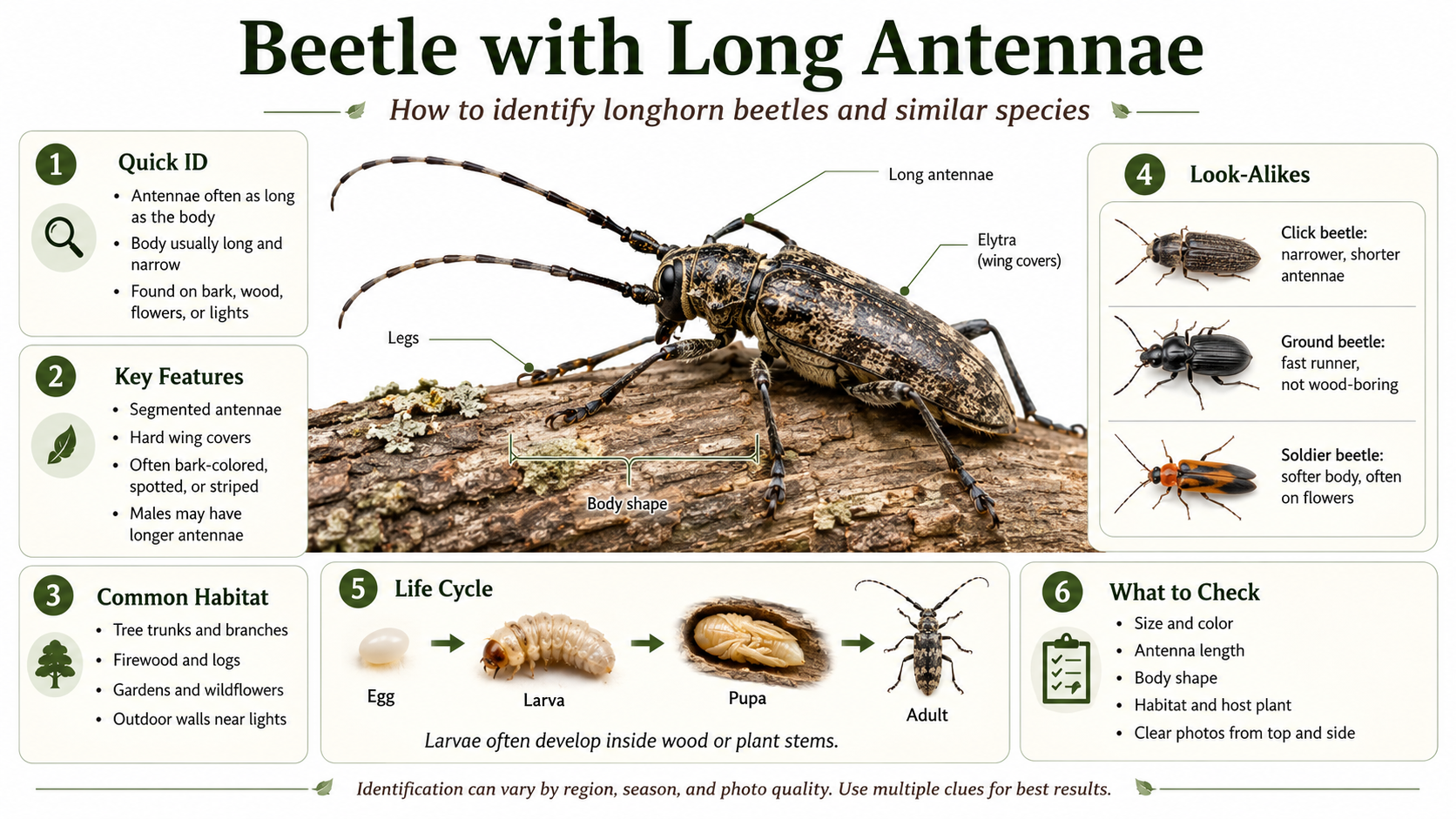
This guide will help you understand what a beetle with long antennae may be, how to recognize longhorn beetles, which similar beetles are commonly confused with them, and when a sighting may be worth reporting or checking with a local expert.
About This Guide
This guide is written for beginners, homeowners, gardeners, students, teachers, and nature observers who want a calm and practical way to identify a beetle with long antennae.
Beetle identification can vary by region, life stage, season, and photo quality. A single photo, especially one taken from above or in poor lighting, may not be enough for a confident species-level identification. Whenever possible, compare multiple clues instead of relying on antenna length alone.
For difficult or important sightings, especially possible invasive species or wood-boring beetles affecting trees, consult credible source types such as:
- University extension resources
- Museum identification pages
- Government agriculture or forestry resources
- Natural history field guides
- Regional entomology references
- Local insect identification services
This article is educational and does not replace professional pest, forestry, or agricultural advice.
Quick Answer: What Is the Beetle with Long Antennae?
A beetle with long antennae is most often a longhorn beetle, also called a long-horned beetle or longicorn beetle. These beetles belong to the family Cerambycidae. Many have long, slender bodies and antennae that may be as long as, or longer than, the body.
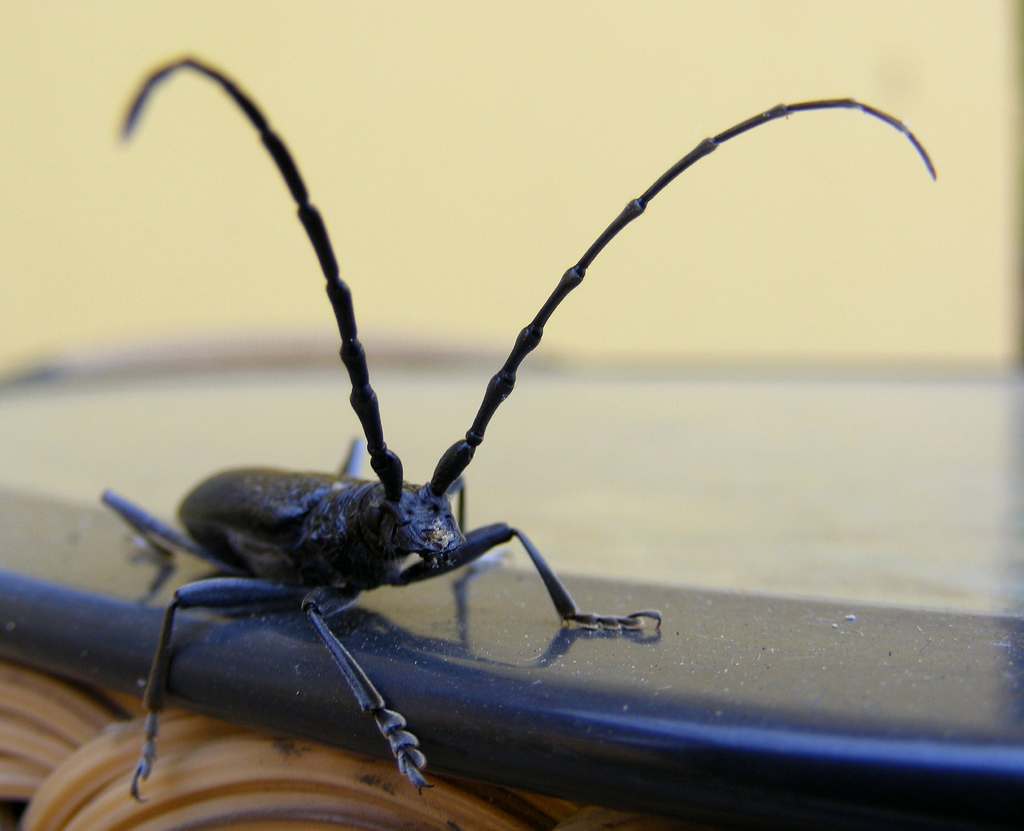
Common signs of a longhorn beetle include:
- Very long, segmented antennae
- Elongated or cylindrical body
- Hard wing covers, called elytra
- Long legs
- A habit of resting on tree trunks, logs, branches, flowers, firewood, or outdoor walls
- Larvae that usually develop in wood, stems, roots, or plant tissue
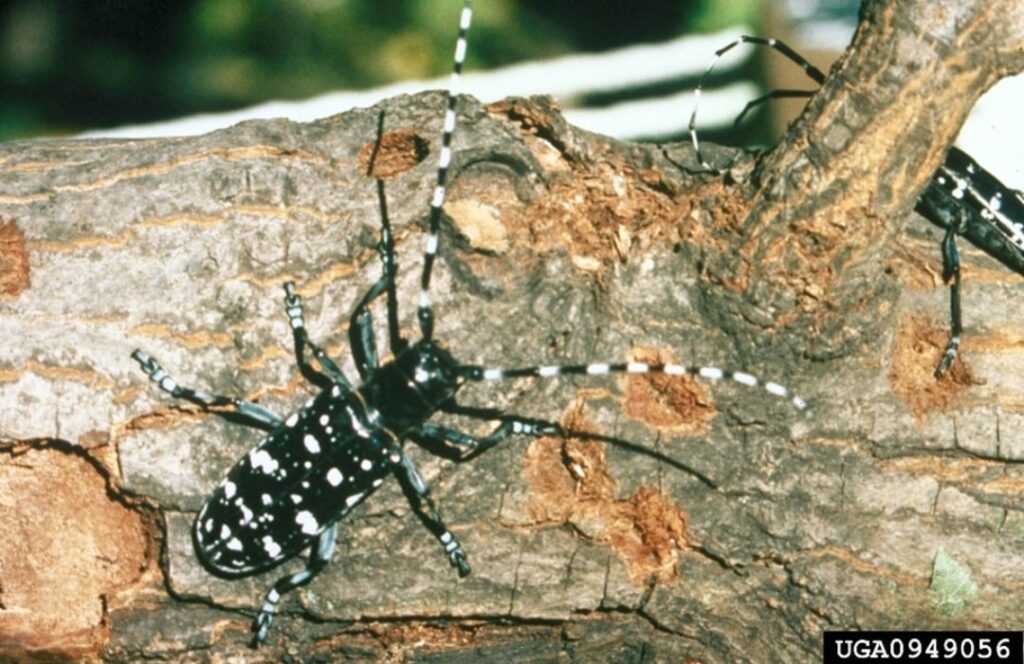
If the beetle is shiny black with white spots and black-and-white banded antennae, it may resemble the Asian longhorned beetle, an invasive species in some regions. Similar-looking native beetles also exist, so identification should be made carefully.
Why Beetle Antennae Matter in Identification
Antennae are one of the most useful features in insect identification. Beetles use their antennae to sense the world around them. Antennae can help them detect odors, locate mates, explore surfaces, recognize host plants, and respond to their environment.
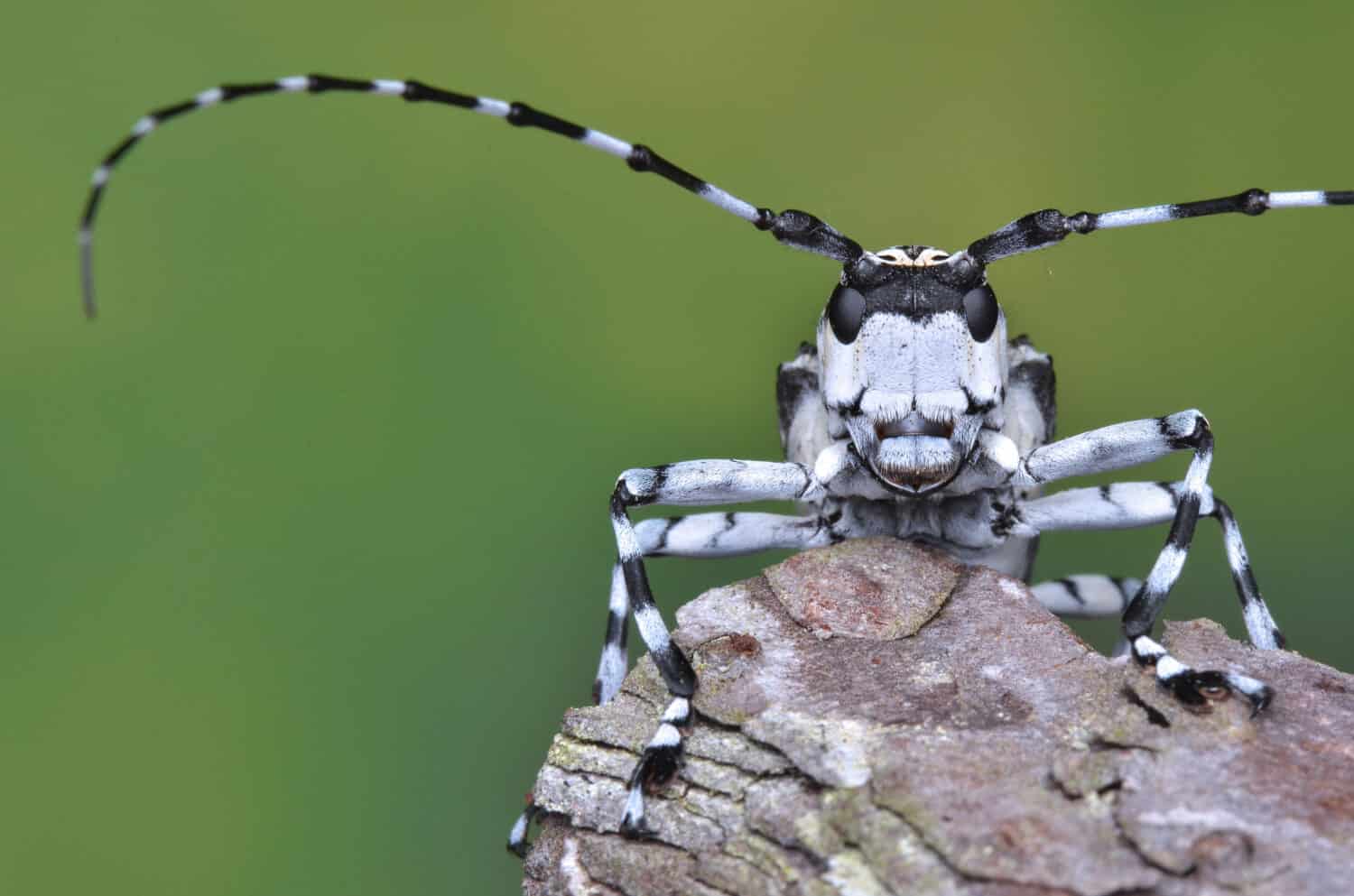
For beginners, antennae are useful because they are often visible even when the beetle is moving. The shape, length, thickness, and texture of the antennae can help narrow down the group.
However, antenna length alone is not enough. Two beetles can both have long antennae but belong to different families. Some beetles have antennae that look long only because the body is small. Others have antennae that are not very long but are thick, clubbed, saw-toothed, or fan-like.
When trying to identify a beetle with long antennae, look at:
- How long the antennae are compared with the body
- Whether they are straight, curved, thread-like, saw-toothed, or clubbed
- Whether the antennae are banded or plain
- Whether the beetle has a narrow, long body or a rounded body
- Whether it was found on wood, flowers, soil, fabric, food, or a wall
- Whether the wing covers meet in a straight line down the back
The Most Likely Identification: Longhorn Beetles
Longhorn beetles are the classic “beetle with long antennae.” Their name comes from the long antennae that resemble horns, though they are sensory organs rather than true horns.
Longhorn beetles are extremely diverse. Some are small and brown. Others are large, glossy, spotted, striped, or brightly colored. Many are excellent at blending into bark, twigs, or dead wood. Some visit flowers. Others are seen on tree trunks, stacked firewood, fence posts, or outdoor lights.
Basic Longhorn Beetle Features
Most longhorn beetles share several features:
- Long antennae, often close to body length or longer
- Elongated body shape
- Hard wing covers
- Strong legs
- Chewing mouthparts
- Wood-associated larvae
- Adults often found near trees, shrubs, flowers, dead wood, or lights
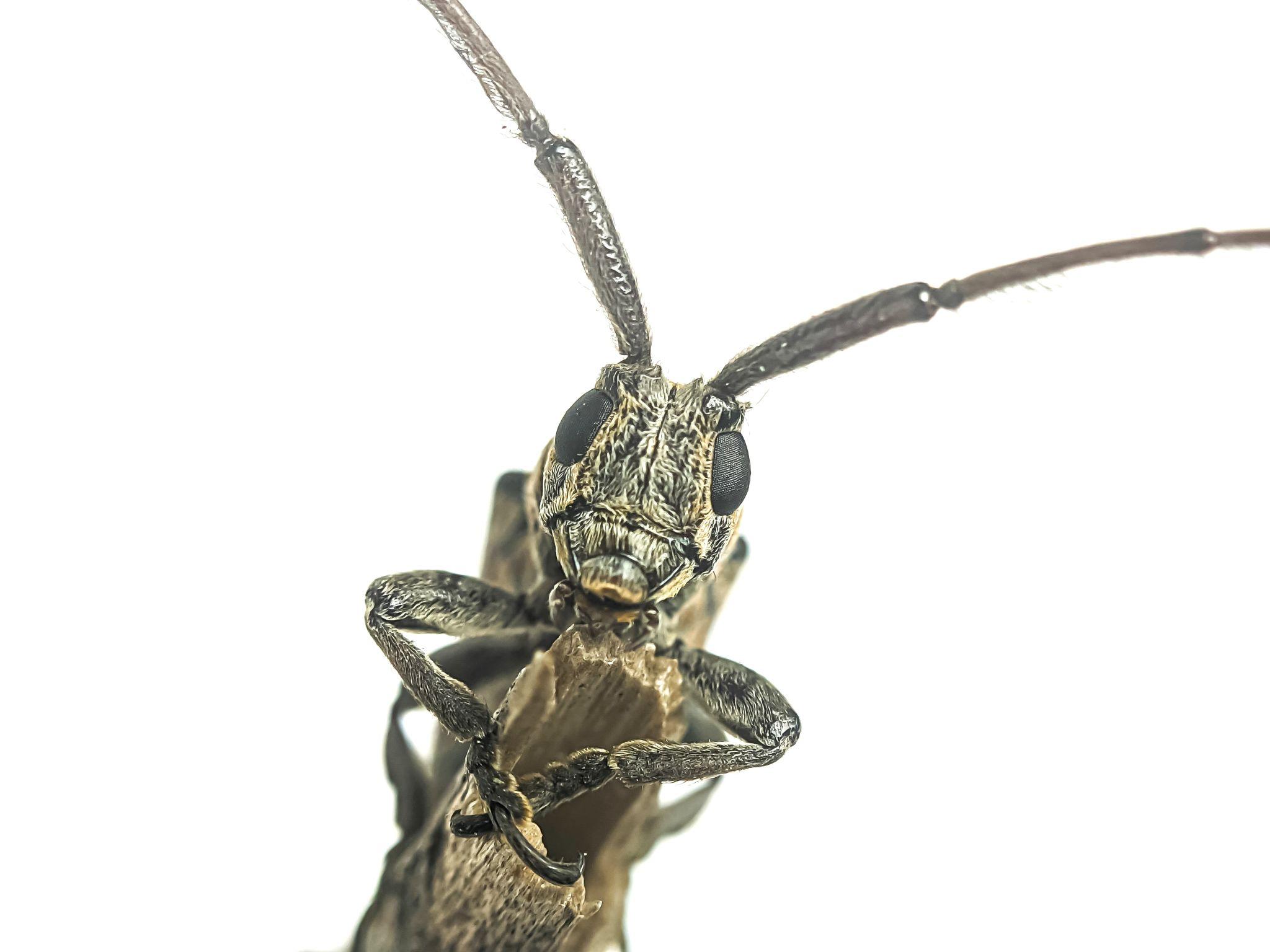
The antennae may be thread-like, slightly thickened, banded, curved, or longer in males than females. In some species, males have especially long antennae, while females may have shorter antennae and a heavier body.
Are All Beetles with Long Antennae Longhorn Beetles?
No. Many are, but not all.
A true longhorn beetle usually has more than just long antennae. The body is often slender or cylindrical, the legs may be relatively long, and the beetle is often associated with wood, bark, branches, flowers, or vegetation.
If the beetle is small, round, and has clubbed antennae, it is probably not a longhorn beetle. If it has saw-toothed antennae and a hard, narrow body, it may be a click beetle. If it has a soft-looking body and is found on flowers, it may be a soldier beetle or another flower-visiting beetle.
Key Identification Clues for a Beetle with Long Antennae
The most accurate beginner method is to build a simple identification profile. Instead of asking only “Does it have long antennae?”, ask several questions.
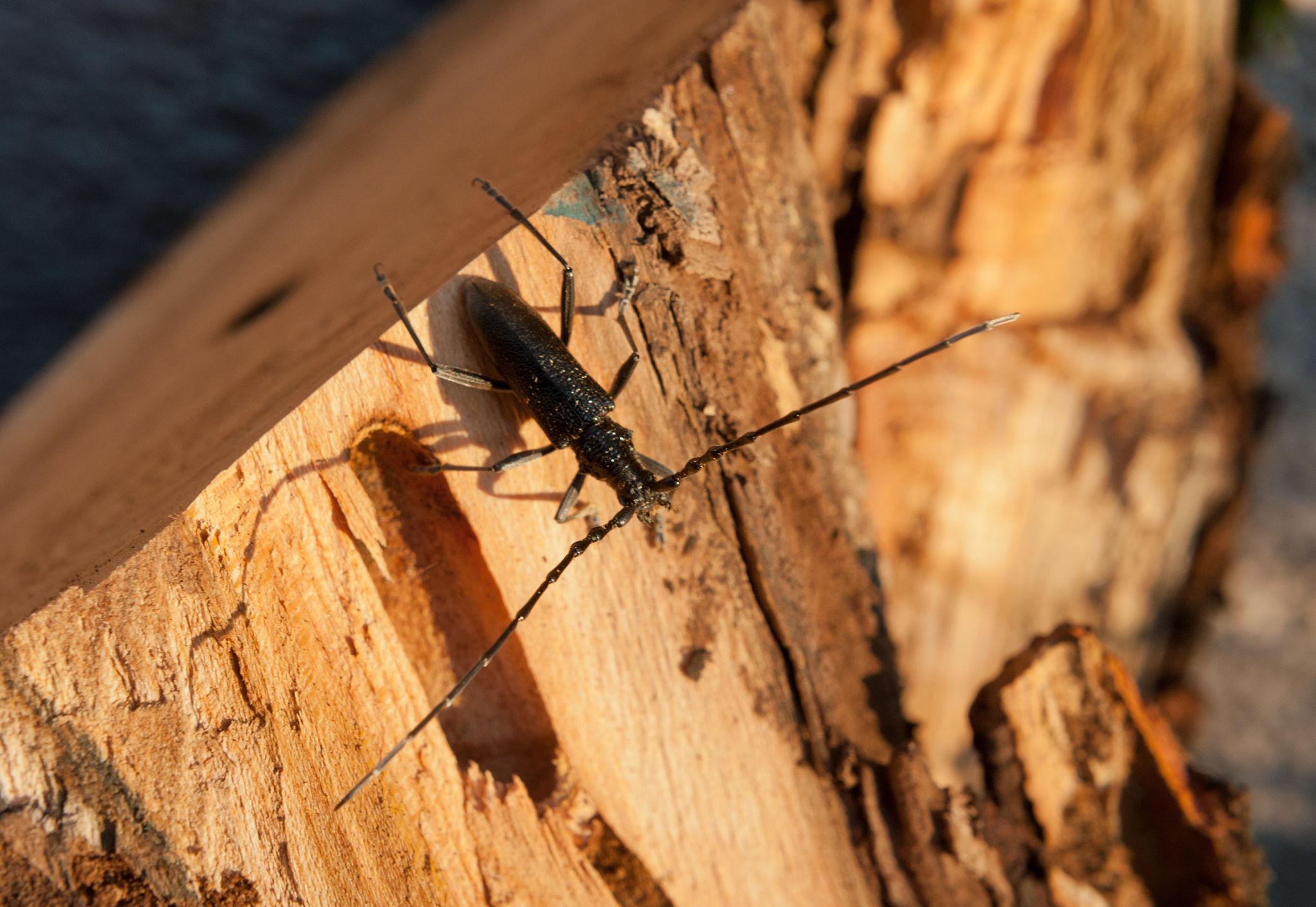
1. How Long Are the Antennae?
Compare the antennae to the beetle’s body length.
- Shorter than half the body: may not be a longhorn beetle
- About half to full body length: could be a longhorn beetle or similar beetle
- Longer than the body: strongly suggests a longhorn beetle, especially if the body is long and narrow
- Several times the body length: often a male longhorn beetle or a species with exaggerated antennae
Antennae may look longer in photos if they are stretched toward the camera, so use more than one angle when possible.
2. What Shape Is the Body?
Body shape is very important.
A longhorn beetle usually looks:
- Long rather than round
- Cylindrical or slightly flattened
- Narrow through the body
- Often bark-colored, striped, spotted, or patterned
A beetle with a round or oval body and short clubbed antennae is more likely to be a carpet beetle, lady beetle, leaf beetle, or another group.
3. What Color Is the Beetle?
Color can help, but it should not be used alone. Many unrelated beetles are black, brown, gray, or reddish.
Common colors among longhorn beetles include:
- Brown or tan, often bark-like
- Black or dark gray
- Black with white spots
- Red and black
- Yellow and black
- Metallic or blue-black in some species
- Striped or banded patterns
A black beetle with long antennae may be a longhorn beetle, but it could also be a ground beetle, darkling beetle, or another dark beetle if the body and antennae do not match longhorn features.
4. Are the Antennae Banded?
Some longhorn beetles have banded antennae, with alternating light and dark segments. This pattern is especially noticeable in some black-and-white species.
Banded antennae are helpful, but not enough for a final identification. Several beetles may show pale rings, dark joints, or reflective highlights that can appear banded in photos.
5. What Do the Wing Covers Look Like?
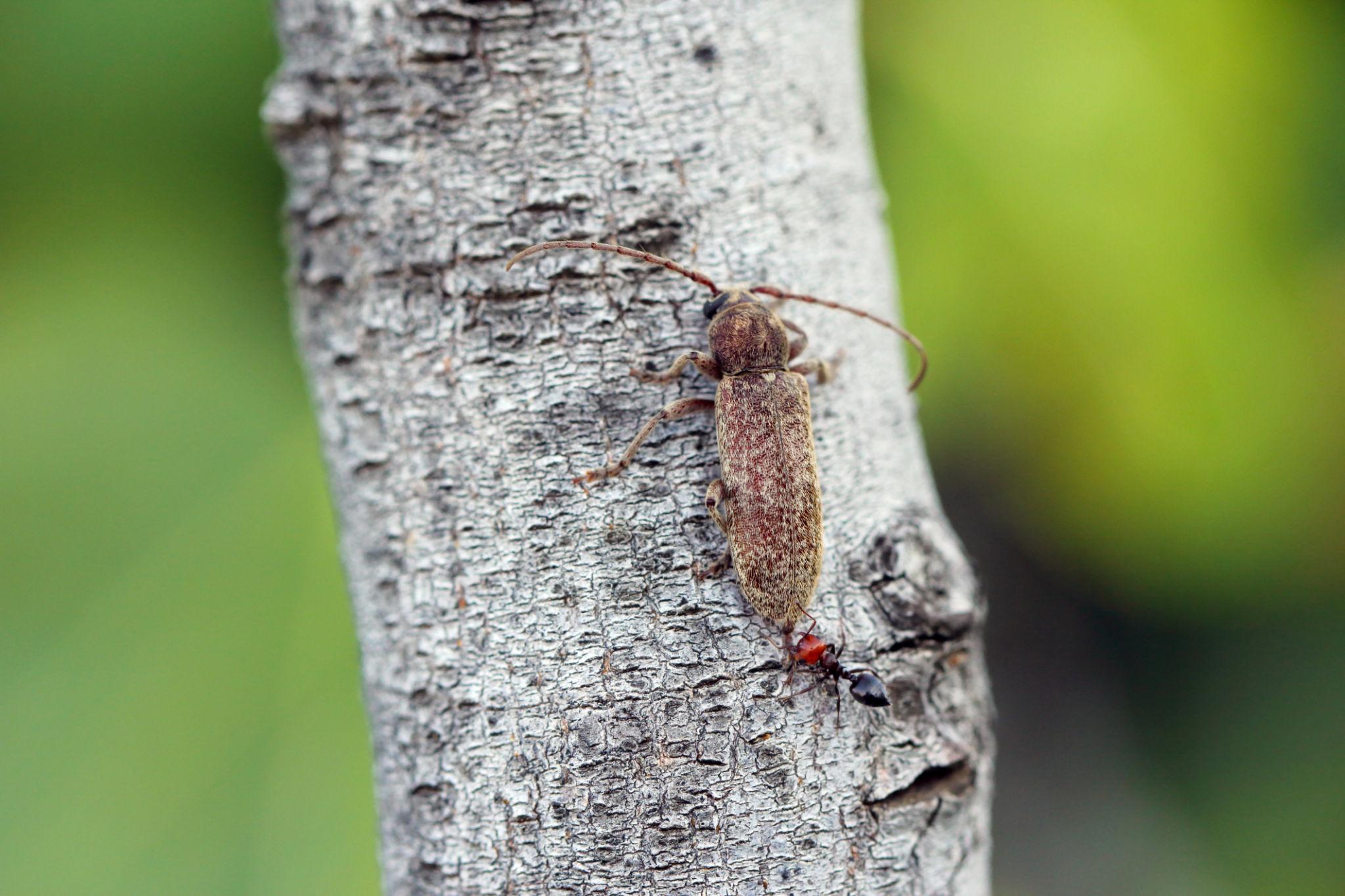
Beetles have hardened front wings called elytra. These form the visible wing covers on the back. In most beetles, the elytra meet in a straight line down the center of the back.
For identification, observe whether the elytra are:
- Smooth or textured
- Glossy or matte
- Spotted, striped, banded, or plain
- Fully covering the abdomen
- Shortened, leaving part of the abdomen exposed
Longhorn beetles often have long elytra that cover most of the abdomen. Patterns on the elytra can be important for identifying species.
6. Where Did You Find It?
Habitat may be the strongest clue.
A beetle with long antennae found on a tree trunk, log, firewood pile, branch, cut wood, or outdoor wall near trees is very likely to be a longhorn beetle.
A beetle found in stored food, carpets, clothing, or pantry areas is less likely to be a longhorn beetle. In that case, the antennae may only look long because the beetle is small.
7. What Was It Doing?
Behavior can also help.
Longhorn beetles may:
- Walk slowly on bark or wood
- Rest on tree trunks
- Visit flowers for pollen or nectar
- Come to outdoor lights at night
- Appear on firewood brought indoors
- Fly awkwardly or strongly depending on species
- Chew or emerge from wood as adults
A single beetle indoors may have wandered in from firewood, an open door, or a nearby outdoor light. A repeated pattern of beetles emerging from wood, furniture, logs, or structural materials deserves closer attention.
Common Types of Beetles with Long Antennae
There are many beetles with long or noticeable antennae. Below are the groups most likely to matter for beginners.
Longhorn Beetles
Longhorn beetles are the main group associated with very long antennae. Many species are harmless outdoor beetles from a homeowner’s point of view, though their larvae can be important in forests, orchards, landscapes, or wood products.
Typical signs:
- Antennae often as long as or longer than the body
- Slender or cylindrical body
- Found near trees, dead wood, flowers, or lights
- Larvae usually develop in wood or plant stems
Longhorn beetles can be beautiful and ecologically important. Many help recycle dead or dying wood. Some species, however, can damage trees, shrubs, or wood.
Asian Longhorned Beetle
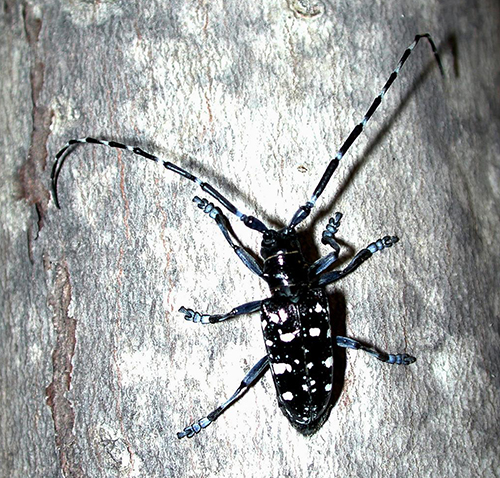
The Asian longhorned beetle is one of the most important longhorn beetles to recognize in places where it is regulated or monitored. It is a large, shiny black beetle with white spots and very long black-and-white banded antennae.
Key features often include:
- Glossy black body
- Irregular white spots on the wing covers
- Long black-and-white banded antennae
- Bluish or pale-toned legs in some individuals
- Large size compared with many household beetles
- Association with hardwood trees
Because some native beetles can look similar, do not assume every black-and-white longhorn beetle is this species. If you live in an area where Asian longhorned beetle is a concern, report suspicious sightings to your local agriculture, forestry, or extension office.
Brown Longhorn Beetles
Many longhorn beetles are brown, tan, gray, or bark-colored. These species often blend into tree bark or dead wood.
Typical signs:
- Brown, gray, or mottled coloration
- Long antennae
- Narrow body
- Found on logs, branches, bark, lumber, or firewood
- Often seen in wooded gardens or near outdoor lights
A brown beetle with long antennae found on firewood may simply be an outdoor species that emerged from wood brought inside.
Flower Longhorn Beetles
Some longhorn beetles are often seen on flowers. They may be more slender and active than the larger wood-associated species.
Typical signs:
- Long legs
- Narrow body
- Long antennae
- Often yellow, black, orange, red, or patterned
- Found on wildflowers, garden flowers, shrubs, or forest edges
These beetles may feed on pollen or nectar as adults, while their larvae develop in wood or plant material.
Click Beetles
Click beetles can be confused with longhorn beetles because some have long, narrow bodies and noticeable antennae. Their antennae may be saw-toothed rather than extremely long.
Typical signs:
- Narrow, hard body
- Antennae sometimes serrated or comb-like
- Pointed rear corners behind the head in many species
- Ability to “click” and flip when placed on the back
- Often found near lights, soil, plants, or decaying wood
If the beetle makes a clicking motion or snaps its body to jump, it is probably a click beetle rather than a longhorn beetle.
Ground Beetles
Ground beetles may have long legs and visible antennae, but their antennae are usually not as exaggerated as longhorn beetle antennae.
Typical signs:
- Fast-running behavior
- Often black, brown, or metallic
- Found on soil, under stones, in gardens, garages, or basements
- Antennae thread-like but usually not longer than the body
- Predatory habits
Ground beetles are often beneficial predators in gardens. They are not wood-boring beetles.
Darkling Beetles
Darkling beetles are often black or brown and may have moderate-length antennae. They are usually found on the ground, in dry habitats, stored products, or decaying organic matter.
Typical signs:
- Dark, matte body
- Slower movement than ground beetles
- Antennae not usually extremely long
- Found near dry soil, stored products, wood debris, or indoor edges
Many are harmless wanderers indoors.
Soldier Beetles
Soldier beetles are softer-bodied beetles often found on flowers. Some have fairly long antennae, but their body texture and behavior differ from longhorn beetles.
Typical signs:
- Soft-looking body
- Often orange, yellow, red, brown, or black
- Found on flowers and vegetation
- Active during daylight
- Antennae visible but usually not extremely long
Soldier beetles are often beneficial because adults visit flowers and some larvae feed on small insects.
Feather-Horned and Fan-Antenna Beetles
Some beetles have dramatic fan-like or comb-like antennae. These antennae may look “long,” but they are structurally different from the thread-like antennae of most longhorn beetles.
Typical signs:
- Wide, feather-like, fan-like, or comb-like antennae
- Often males have much larger antennae than females
- Antennae used for detecting mates
- Body may not match the long, cylindrical shape of longhorn beetles
These beetles can look surprising, but they are not the same as longhorn beetles.
Beetle with Long Antennae vs Similar-Looking Insects
Sometimes the insect is not a beetle at all. Several insects have long antennae and can be mistaken for beetles.
Beetle vs Cockroach
Cockroaches have long antennae, flattened bodies, and fast movement. They do not have the same hard wing-cover line typical of beetles.
A cockroach usually has:
- Very long, thin antennae
- Flattened oval body
- Fast running behavior
- Head often partly hidden from above
- No hard elytra seam like a typical beetle
A beetle usually has:
- Harder body
- Elytra meeting down the back
- More compact movement
- Body shape varying from round to cylindrical
- Clear beetle-like wing covers
Beetle vs True Bug
True bugs can have long antennae, but their wings and mouthparts differ. Many true bugs have a triangular or X-like wing pattern on the back rather than beetle-like elytra.
A true bug may have:
- Piercing-sucking mouthparts
- Wings forming an X-like pattern
- Slender or shield-shaped body
- Long antennae, depending on species
A beetle has chewing mouthparts and hard front wing covers.
Beetle vs Wasp or Ant
Some longhorn beetles mimic wasps or ants. A slender beetle with long antennae and yellow-black patterning may look wasp-like. Look for the hard wing covers and beetle body structure.
Habitat: Where Beetles with Long Antennae Are Found
A beetle with long antennae may appear in many places, but location tells you a lot.
On Tree Trunks and Branches
This is classic longhorn beetle habitat. Adults may rest, mate, lay eggs, or search for host plants on bark, branches, and trunks.
If you see a long-antenned beetle on a tree, note:
- Tree species if known
- Whether the tree looks healthy or stressed
- Any round exit holes
- Oozing sap
- Sawdust-like material
- Dead branches
- Bark scars or oval egg-laying marks
These signs may help determine whether the beetle is simply visiting or connected with wood-boring activity.
On Firewood
Firewood is a common place to find longhorn beetles. Larvae can develop inside cut logs, and adults may emerge later.
A beetle emerging from firewood does not automatically mean your house is infested. Many species need bark, moisture, or suitable wood conditions and will not reinfest dry indoor wood. However, firewood should be stored outdoors and brought inside only as needed.
In the Garden
Longhorn beetles may be found on shrubs, flowers, vines, tree trunks, garden edges, and dead stems. Many are part of the normal outdoor insect community.
Garden sightings are usually more interesting than alarming. Observe the plant, the beetle’s behavior, and whether there are repeated signs of plant damage.
Around Outdoor Lights
Many beetles are attracted to lights at night. Longhorn beetles, click beetles, scarabs, and ground beetles may all appear on porches, windows, walls, and screens.
If a beetle with long antennae appears near a porch light, it may simply have flown in from nearby vegetation.
Inside the House
A beetle with long antennae indoors may have entered through:
- Firewood
- Open windows
- Door gaps
- Outdoor lights
- Potted plants
- Stored wood or craft wood
- Recently moved furniture or lumber
One beetle indoors is usually not enough to identify a problem. Repeated sightings from the same wood source, visible exit holes, powdery frass, or active damage require closer inspection.
Diet: What Do Beetles with Long Antennae Eat?
Diet depends on the group and life stage.
Adult Longhorn Beetles
Adult longhorn beetles may feed on:
- Pollen
- Nectar
- Leaves
- Bark
- Sap
- Tender plant tissue
- Sometimes little or no food as adults, depending on species
Flower-visiting longhorn beetles are often seen feeding on pollen or nectar. Bark-associated species may chew plant tissue or focus mainly on reproduction.
Longhorn Beetle Larvae
The larvae are often more important ecologically and economically than adults. Many longhorn beetle larvae feed inside:
- Dead wood
- Dying trees
- Stressed trees
- Living trees
- Roots
- Stems
- Branches
- Logs
- Lumber, in some cases
Larvae are usually pale, segmented, grub-like, and hidden inside plant material. Because they are concealed, people often notice adults before they ever see larvae.
Do Long-Antenna Beetles Bite?
Most beetles with long antennae are not interested in biting people. Larger beetles have chewing mouthparts and may pinch if handled roughly, but they are not aggressive toward humans.
It is best not to handle unknown beetles. Use a container, paper, or gentle observation method if you need to move one outdoors.
Life Cycle of Longhorn Beetles
Longhorn beetles have complete metamorphosis, meaning they develop through four main stages:
- Egg
- Larva
- Pupa
- Adult
Egg Stage
Females usually lay eggs on or near suitable host material. Depending on the species, this may be bark, cracks in wood, stems, roots, or plant tissue.
Larval Stage
The larval stage is often spent hidden inside wood or plant material. Larvae tunnel and feed as they grow. This stage may last months or longer depending on species, climate, and host conditions.
Pupal Stage
After feeding, the larva transforms into a pupa. This stage is usually hidden inside wood, bark, soil, or plant tissue.
Adult Stage
Adults emerge, mate, disperse, and search for host plants. Many adults are noticed in warm months, especially around trees, flowers, woodpiles, and lights.
Home and Garden Relevance
A beetle with long antennae may be harmless, beneficial, mildly concerning, or important to report depending on the species and context.
When It Is Probably Just a Visitor
A single long-antenned beetle is often just a visitor if:
- It was found near a light
- It came in with firewood
- It was found near an open window
- There are no repeated sightings
- There is no wood dust, exit holes, or plant decline
- It is released outdoors and no others appear
Many longhorn beetles are simply part of the local outdoor ecosystem.
When It May Matter for Trees
A long-antenned beetle may deserve closer attention if you see:
- Repeated beetles on the same tree
- Round or oval exit holes
- Sawdust-like material near the trunk or branches
- Oozing sap
- Dead limbs
- Bark wounds
- Unusual egg scars
- Declining hardwood trees
- Large black beetles with white spots and banded antennae in areas where Asian longhorned beetle is monitored
In those cases, take clear photos and contact a local extension office, forestry agency, or agriculture department.
When It May Matter Indoors
Indoor concern increases if:
- Beetles repeatedly emerge from wooden furniture, beams, flooring, or stored lumber
- You see fresh exit holes
- Fine powder or pellets appear below wood
- The same room produces multiple beetles over time
- The wood is new, recently imported, or untreated
- The beetles are associated with structural wood
Do not panic. Many beetles emerging indoors came from firewood or old wood and cannot establish in dry, finished structural materials. But repeated emergence should be checked.
Common Mistakes When Identifying a Beetle with Long Antennae
Mistake 1: Assuming Long Antennae Always Mean Longhorn Beetle
Longhorn beetles are the most likely group, but not the only possibility. Antenna shape, body form, and habitat matter.
Mistake 2: Relying Only on Color
A black beetle with long antennae is not automatically an Asian longhorned beetle. A brown beetle with long antennae is not automatically harmless. Color is only one clue.
Mistake 3: Ignoring Size
Size helps separate many species. Always estimate body length without the antennae. A beetle may look large because the antennae are dramatic, while the body is actually small.
Mistake 4: Forgetting Regional Differences
Beetle species vary widely by region. A species common in one country or state may be absent in another. Regional field guides and extension pages are more reliable than general image matching alone.
Mistake 5: Using Blurry Photos
A blurry photo can make short antennae look long, hide wing-cover patterns, or distort colors. Multiple clear photos are much better than one dramatic close-up.
How to Photograph a Beetle with Long Antennae for Identification
Good photos can make identification much easier.
Try to capture:
- A top view showing the full body
- A side view showing body height and legs
- A close photo of the antennae
- The beetle next to a ruler, coin, leaf, or other size reference
- The habitat, such as tree bark, flower, woodpile, or indoor wall
- Any damage signs nearby, such as holes or sawdust
Avoid crushing or handling the beetle. A clear photo of a living beetle in place is often more useful than a damaged specimen.
FAQ: Beetle with Long Antennae
What is a beetle with long antennae called?
A beetle with long antennae is often called a longhorn beetle. Longhorn beetles belong to the family Cerambycidae and are known for antennae that may be as long as or longer than the body.
Are beetles with long antennae harmful?
Most are not harmful to people. Some longhorn beetle larvae can damage trees, shrubs, logs, or wood, but many species are simply part of the natural outdoor ecosystem.
Is a black beetle with long antennae an Asian longhorned beetle?
Not always. Asian longhorned beetles are shiny black with white spots and long black-and-white banded antennae, but some native beetles can look similar. Location, size, pattern, and host tree clues are important.
Why do longhorn beetles have such long antennae?
Their antennae help them sense their environment. They can help detect odors, locate mates, explore surfaces, and recognize suitable host plants or habitats.
Do longhorn beetles bite humans?
Longhorn beetles do not seek out people to bite. Large individuals may pinch if handled roughly, so it is better to observe them without touching.
Why did I find a long-antenned beetle in my house?
It may have come in through an open door or window, been attracted to light, or emerged from firewood brought indoors. A single beetle indoors is usually not enough to suggest an infestation.
Should I be worried if I find a longhorn beetle on firewood?
Usually not. Many longhorn beetles develop in logs and may emerge after firewood is brought inside. Store firewood outdoors and bring in only what you plan to use soon.
What does a longhorn beetle larva look like?
Longhorn beetle larvae are usually pale, soft, segmented, and grub-like. They are often hidden inside wood, stems, roots, or other plant material.
Are longhorn beetles good or bad for gardens?
It depends on the species. Some help break down dead wood, while others can damage stressed, dying, or living trees. Many garden sightings are harmless observations.
How can I identify a beetle with long antennae from a photo?
Use a clear top view, side view, close-up of antennae, and a size reference. Also record where it was found, what plant or wood it was on, and your region.
What beetles look like longhorn beetles but are not?
Click beetles, ground beetles, soldier beetles, darkling beetles, and some flower-visiting beetles may have noticeable antennae, but their body shape, behavior, and antenna structure differ.
When should I report a beetle with long antennae?
Report it if it resembles a regulated invasive species in your region, appears repeatedly on declining trees, or is associated with suspicious tree damage such as round exit holes, sawdust, sap flow, or bark wounds.
Conclusion
A beetle with long antennae is most likely a longhorn beetle, especially if it has a slender body, hard wing covers, and antennae as long as or longer than its body. Longhorn beetles are diverse, often beautiful insects that may be found on trees, flowers, logs, firewood, outdoor walls, and garden plants.
For identification, do not rely on antenna length alone. Look at the full set of clues: size, body shape, color, antenna pattern, wing covers, habitat, behavior, location, season, and any signs of wood or tree damage.
Most long-antenned beetles are simply outdoor insects going about their lives. Some, however, are important wood borers or invasive species in certain regions. When a beetle looks unusual, appears repeatedly, or is linked with tree decline or wood damage, take clear photos and consult a local extension office, museum, forestry agency, or entomology reference.
A careful, patient look will usually tell you much more than a quick glance. The long antennae are the first clue, but the whole beetle tells the story.