

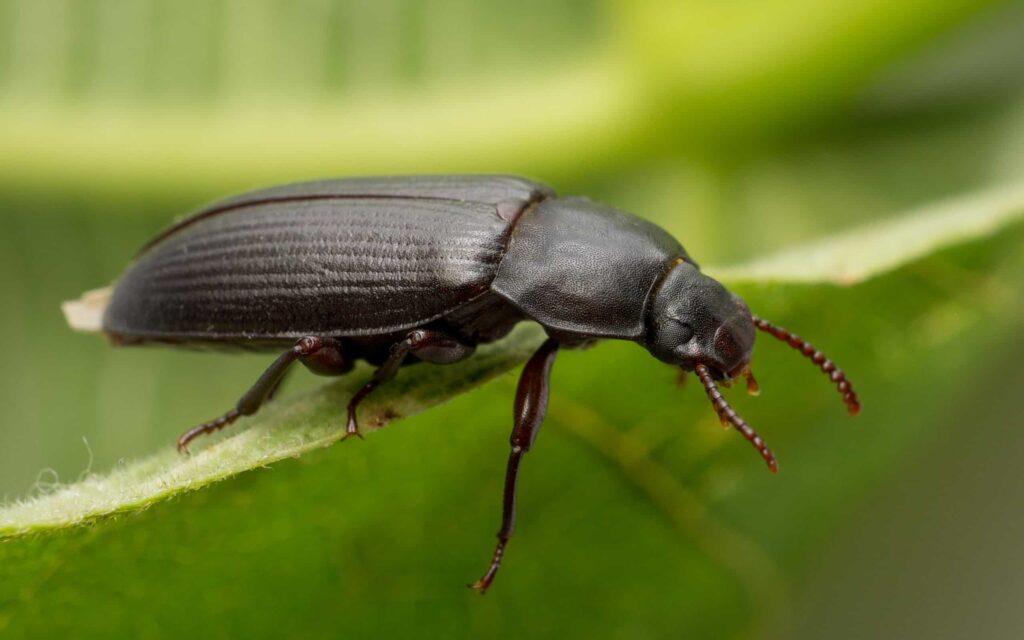
Finding a black beetle can be confusing because many unrelated beetles are dark, shiny, oval, or fast-moving. A small black beetle in the pantry, a large black beetle under a garden stone, and a long black beetle on a tree trunk may belong to completely different families.
The key to black beetle identification is not color alone. A better identification starts with several clues: size, body shape, antennae, wing covers, legs, movement, habitat, season, and where the beetle was found.
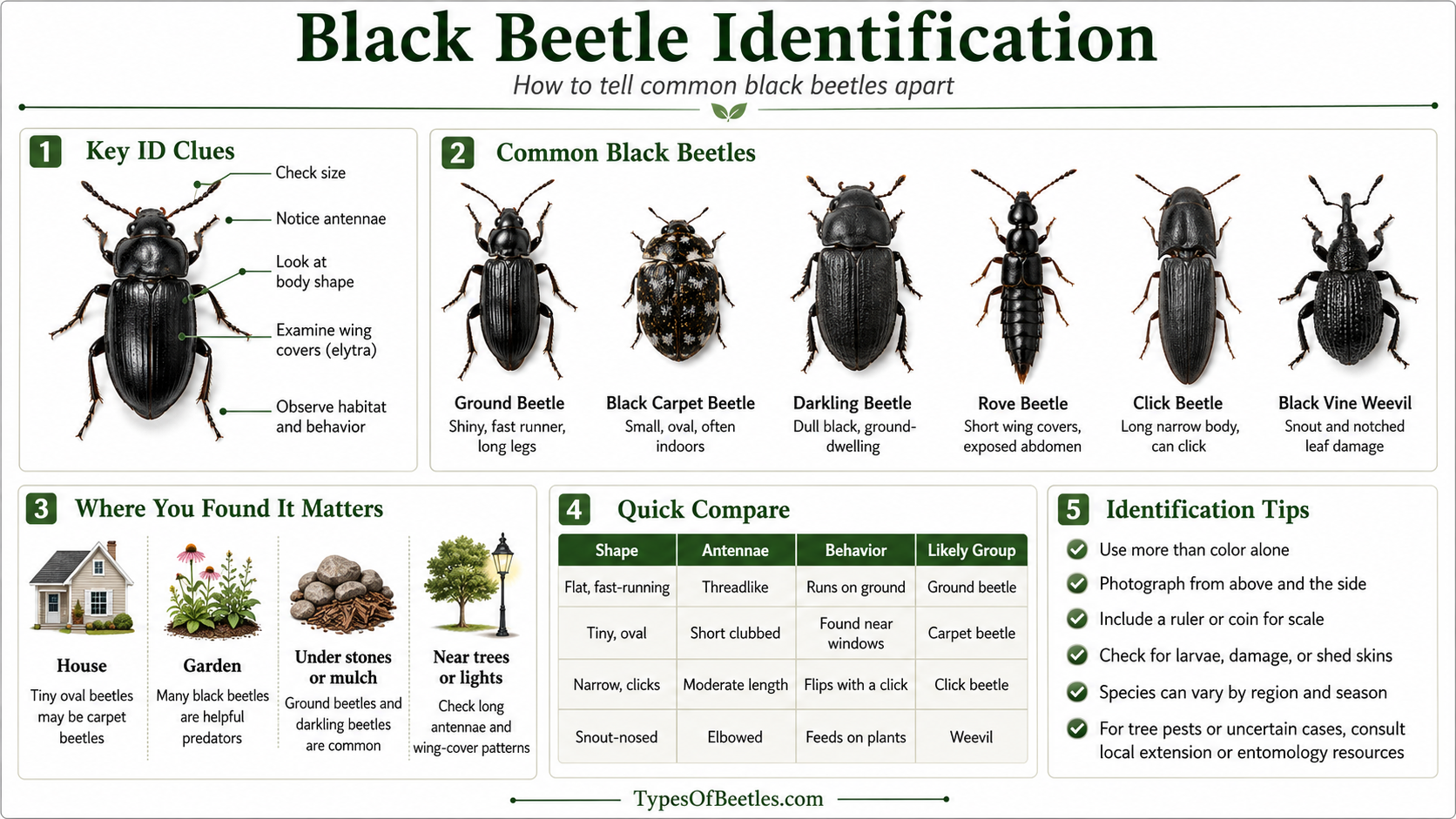
In many cases, you may be able to identify the beetle to a general group, such as a ground beetle, carpet beetle, darkling beetle, click beetle, rove beetle, or weevil. Species-level identification is more difficult and often requires a clear photo, local records, and expert confirmation.
This guide is designed for beginners, homeowners, gardeners, students, teachers, and nature enthusiasts who want a calm, practical way to understand the black beetle they found.
How This Guide Helps
This black beetle identification guide focuses on visible, beginner-friendly clues. It does not promise guaranteed species identification from a single photo or brief sighting.
Beetle identification can vary by:
- Region
- Season
- Life stage
- Sex
- Color variation
- Lighting in photos
- Photo angle and focus
- Whether the beetle is alive, dried, damaged, or partly hidden
For the most reliable result, observe more than one feature. Color is helpful, but it should be combined with body shape, size, antennae, wing covers, habitat, behavior, and location.
This page is educational and should not replace advice from a local extension office, museum, entomologist, agricultural authority, or licensed pest professional when a species may affect crops, stored products, trees, health, or property.
Quick Answer: How Do You Identify a Black Beetle?
To identify a black beetle, start by asking these questions:
- How large is it?
- Is the body oval, round, long, flat, narrow, or hump-backed?
- Are the wing covers smooth, ridged, shortened, spotted, or fused?
- Are the antennae long, clubbed, elbowed, threadlike, or saw-toothed?
- Does it run quickly, click, fly, hide, curl its abdomen, or chew leaves?
- Was it found indoors, in soil, near lights, in stored food, under bark, on flowers, or around fabric?
- Are there larvae, shed skins, fabric damage, notched leaves, holes in wood, or other signs nearby?
A shiny, fast-running black beetle on the floor or patio is often a ground beetle. A tiny oval beetle near windows or natural fabrics may be a carpet beetle. A dull black beetle under soil or debris may be a darkling beetle. A narrow beetle that flips with a click may be a click beetle. A slender beetle with very short wing covers may be a rove beetle.
Why “Black Beetle” Is Not One Species
“Black beetle” is a description, not a scientific name. Thousands of beetle species can appear black, dark brown, blue-black, smoky gray, or metallic black.
Some black beetles are predators. Some are scavengers. Some feed on plants. Some are associated with stored food, natural fabrics, dead insects, animal nests, garden soil, tree bark, or decaying organic matter. A few are important agricultural or forest pests, while many are harmless or even beneficial.
Beetles belong to the order Coleoptera. One of their most recognizable features is the pair of hardened front wings, called elytra. These wing covers often meet in a straight line down the back. In many black beetles, the elytra are the easiest feature to notice because they may be shiny, ridged, smooth, shortened, spotted, or leathery.
A good identification begins with careful observation rather than a quick conclusion.
Main Clues for Black Beetle Identification
1. Size
Size is one of the fastest ways to narrow your options.
Use a ruler or compare the beetle to a common object:
- Pinhead-sized: very tiny beetles, often hard to identify without magnification
- 2–4 mm: many carpet beetles and tiny household beetles
- 5–10 mm: small ground beetles, darkling beetles, weevils, and stored-product beetles
- 10–20 mm: larger ground beetles, click beetles, rove beetles, and some weevils
- Over 20 mm: large ground beetles, large click beetles, stag beetles, bess beetles, or longhorn beetles
A photo without scale can be misleading. A beetle that looks huge in a close-up image may be only a few millimeters long.
2. Body Shape
Body shape is often more useful than color.
Look for these forms:
- Oval and dome-shaped: carpet beetles, lady beetles, some leaf beetles
- Long and narrow: click beetles, rove beetles, some ground beetles
- Flat and fast-running: many ground beetles
- Rounded and heavy-bodied: some darkling beetles, dung beetles, bess beetles
- Snout-nosed: weevils
- Long-bodied with very long antennae: longhorn beetles
- Short wing covers with exposed abdomen: rove beetles
If you only remember one thing, remember this: black beetle identification improves when you describe shape first and color second.
3. Wing Covers
The wing covers, or elytra, are a major beetle clue.
Ask:
- Are they smooth or ridged?
- Do they fully cover the abdomen?
- Are they short, exposing much of the abdomen?
- Are they fused, making the beetle flightless?
- Are they shiny, dull, leathery, hairy, or patterned?
- Is there a pale band, spots, or mottled scales?
For example, many ground beetles have hard, full-length wing covers and may show fine grooves. Rove beetles have very short wing covers. Larder beetles have a pale band across the wing covers. Some longhorn beetles have dark wing covers with pale spots or markings.
4. Antennae
Antennae are especially important in beetle identification.
Common antenna shapes include:
- Threadlike antennae: thin, even segments; common in many ground beetles
- Clubbed antennae: segments become larger toward the tip
- Elbowed antennae: sharply bent, common in many weevils
- Saw-toothed antennae: segments look slightly triangular
- Very long antennae: common in longhorn beetles
- Short, hidden, or compact antennae: seen in some rounded beetles
A black beetle with a long snout and elbowed antennae is probably a weevil. A black beetle with very long antennae may be a longhorn beetle. A dark beetle with clubbed antennae may point toward a darkling beetle or another family, depending on shape.
5. Legs and Movement
Movement gives useful clues.
Notice whether the beetle:
- Runs quickly across the ground
- Walks slowly and steadily
- Flies toward lights
- Flips or clicks when placed on its back
- Raises the tip of its abdomen
- Drops from plants when disturbed
- Hides under stones, mulch, boards, or leaf litter
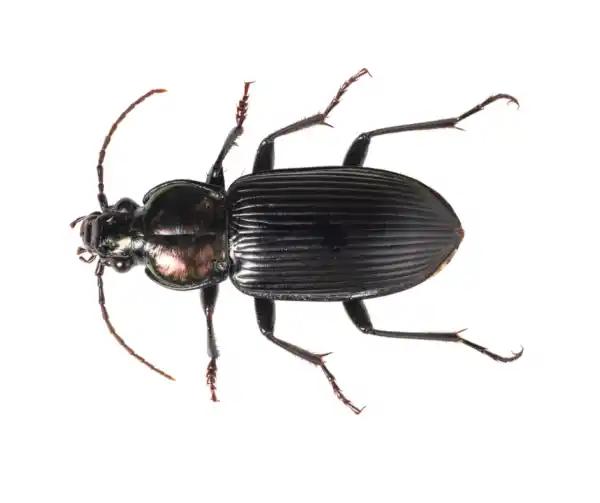
Fast-running black beetles on the ground are often ground beetles. Beetles that click and flip are click beetles. Slender beetles that raise the abdomen when disturbed may be rove beetles.
6. Habitat
Where you found the beetle matters.
A black beetle found:
- Under a stone may be a ground beetle or darkling beetle
- Near a window may be a carpet beetle or beetle attracted to light
- In a pantry may be associated with stored food
- In wool, lint, pet hair, or closets may suggest carpet beetles
- On rhododendrons, yews, or potted plants may suggest black vine weevil
- On tree bark may suggest bark beetles, longhorn beetles, or other wood-associated beetles
- In compost or decaying matter may be a scavenger beetle
Habitat does not identify the species by itself, but it helps eliminate unlikely choices.
7. Behavior
Behavior is often overlooked, but it can be very useful.
Examples:
- Ground beetles often run quickly and hide by day.
- Carpet beetle adults may appear near windows or lights, while larvae hide in dark places.
- Black vine weevils feed at night and leave notches on leaf edges.
- Click beetles may snap their bodies and jump when upside down.
- Rove beetles may curl the abdomen upward when disturbed.
- Darkling beetles often hide during the day and walk on the ground at night.
A beetle’s behavior can turn a vague description into a much clearer identification.
8. Season and Location
Many beetles appear seasonally. Adults may emerge in spring or summer, while larvae may be hidden for much longer.
Location also matters. A black beetle common in the eastern United States may not occur in California, the United Kingdom, Japan, Australia, or South Africa. Regional insect guides are therefore more reliable than a general global image search.
For serious identification, include your city, region, date, habitat, and clear photos from above and the side.
Common Types of Black Beetles
Below are some of the most common black or dark beetle groups people encounter around homes, gardens, and outdoor spaces.
1. Ground Beetles
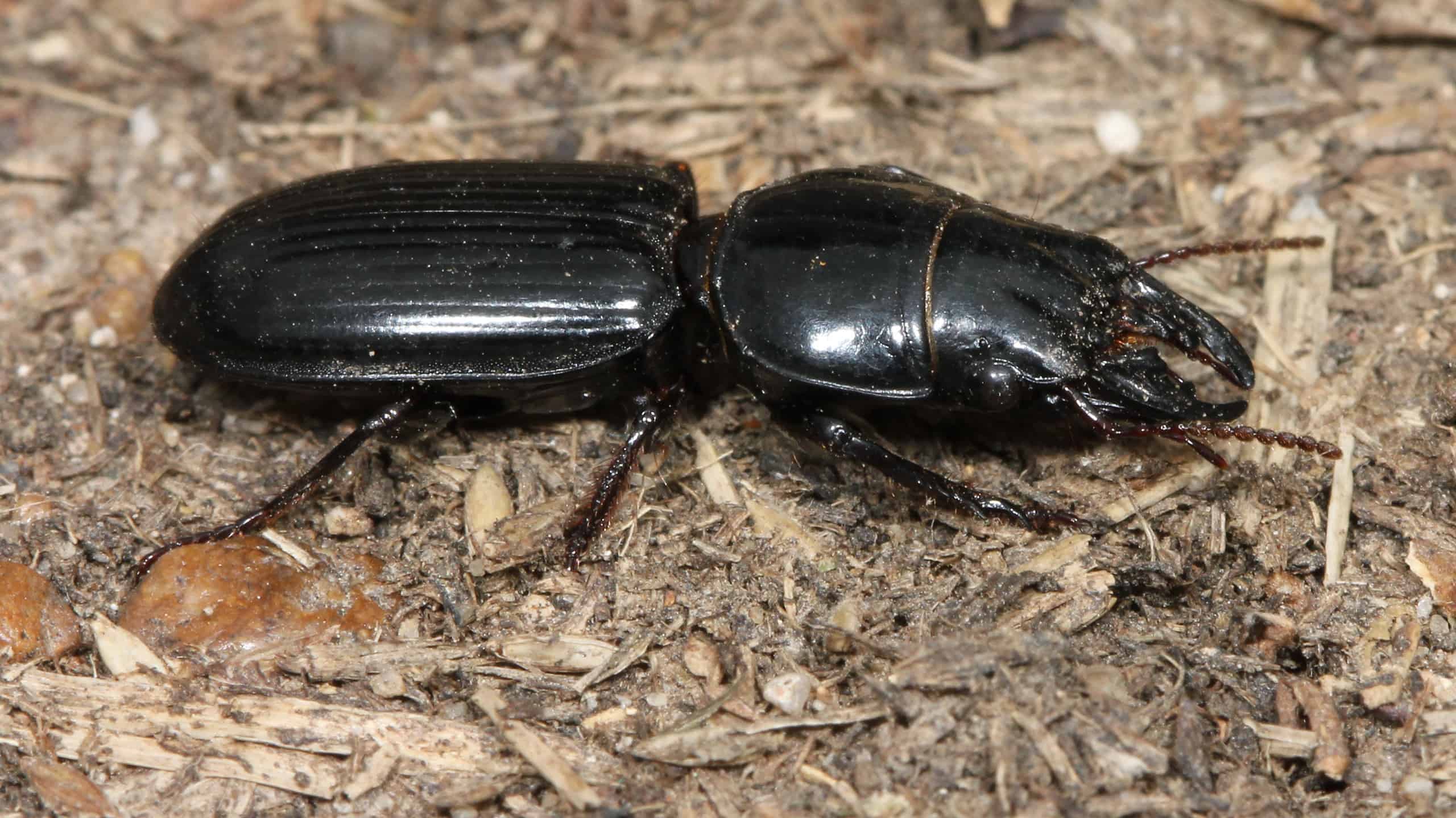
Ground beetles are among the most common black beetles seen around homes, patios, basements, garages, gardens, and sidewalks.
Identification Clues
Ground beetles often have:
- Shiny black, dark brown, bronze, or metallic bodies
- Long legs built for running
- A somewhat flattened body
- Full-length wing covers
- Long, threadlike antennae
- Strong jaws
- Fast movement
Many ground beetles are active at night. They may wander indoors by accident, especially around doors, garages, basements, or lights.
Habitat
Ground beetles are usually found:
- Under stones
- Under logs
- In mulch
- In garden beds
- Around foundations
- Along sidewalks
- In fields and wooded edges
Diet and Garden Role
Many ground beetles are predators. They feed on small insects, larvae, slugs, caterpillars, and other soft-bodied animals. Some species also eat seeds. In gardens and agricultural landscapes, many ground beetles are considered beneficial because they help regulate other small organisms.
Beginner Identification Tip
A black beetle that is shiny, flattened, long-legged, and running quickly across the ground is often a ground beetle.
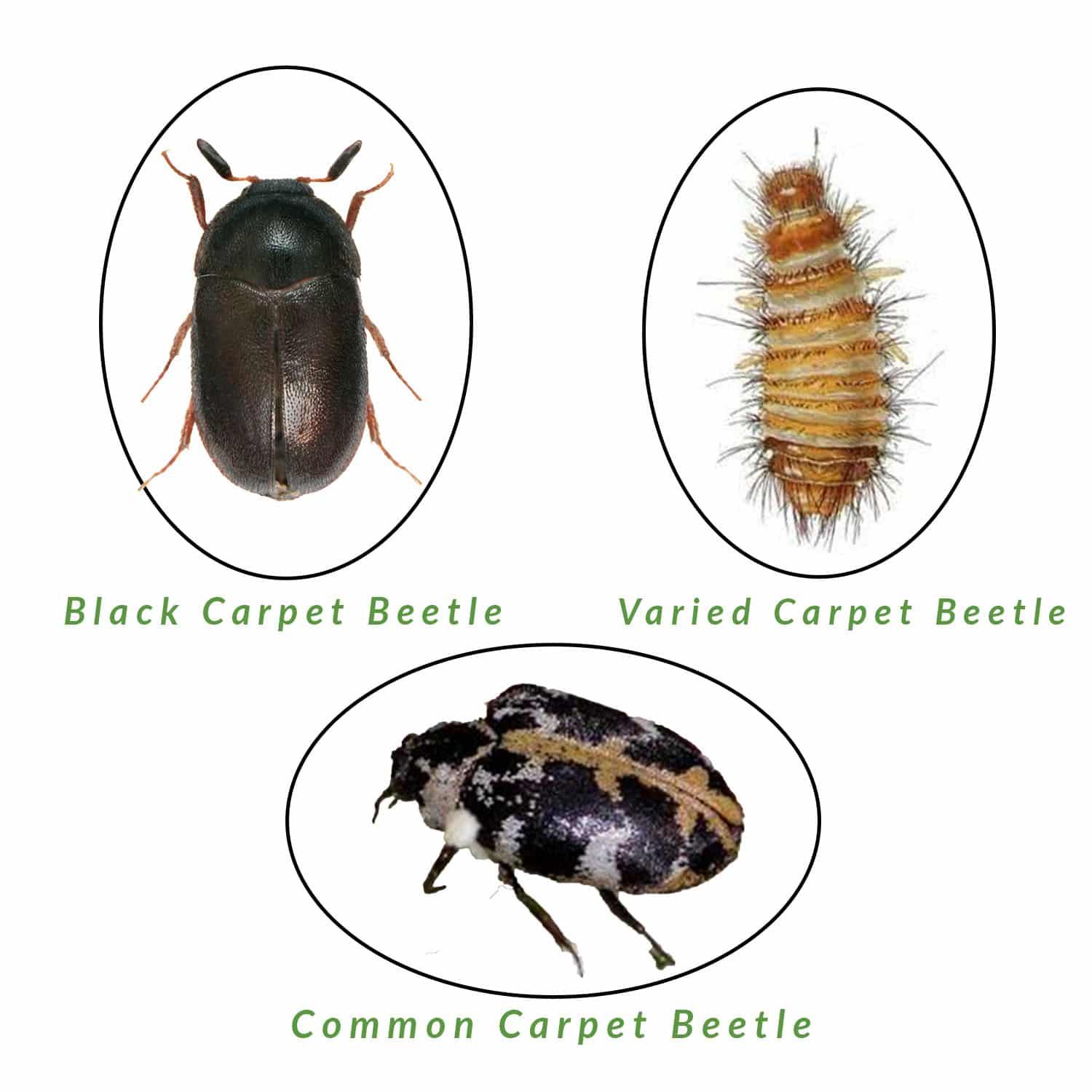
2. Black Carpet Beetles
Black carpet beetles are small household beetles that often concern homeowners because their larvae can feed on natural materials.
Identification Clues
Adult black carpet beetles are usually:
- Small
- Oval
- Dark brown to black
- Smooth-looking
- Often found near windows, light, or indoor edges
The larvae look very different from the adults. They are often carrot-shaped or tapered, hairy, and brownish.
Where They Are Found
Carpet beetles may be found:
- Near windows
- Along baseboards
- In closets
- Under furniture
- Around pet hair or lint
- Near wool, feathers, fur, silk, or other natural materials
- In stored items
- In bird or animal nests near the home
Why Larvae Matter
The adult beetles are often the visible stage, but the larvae are usually the stage associated with damage to natural fibers and organic debris. Larvae may feed on wool, feathers, hair, dead insects, lint, and similar materials.
Beginner Identification Tip
A tiny, oval black beetle indoors, especially near a window, may be a black carpet beetle. Look for larvae, shed skins, or fabric damage before assuming an infestation.
3. Darkling Beetles
Darkling beetles are a large group of often dark, ground-dwelling beetles. Many are black, brown-black, or dull brown.
Identification Clues
Darkling beetles often have:
- Dull black or brown bodies
- Oval or elongated forms
- Clubbed or slightly thickened antennae
- Ground-walking behavior
- A tendency to hide under debris, soil, stones, or organic matter
Some darkling beetles have ridged wing covers. Some resemble ground beetles, but many darkling beetles are slower and less flattened.
Habitat
They may be found in:
- Soil
- Leaf litter
- Dry debris
- Stored grain areas
- Animal bedding
- Compost-like material
- Gardens
- Dry outdoor shelters
Diet
Many darkling beetles are scavengers, feeding on decaying plant material, stored organic matter, fungi, seeds, or other detritus. Some may feed on seedlings or plant material.
Beginner Identification Tip
A dull black beetle walking slowly in dry soil, debris, or stored organic material may be a darkling beetle.
4. Rove Beetles
Rove beetles can look surprising because their wing covers are much shorter than most beetles.
Identification Clues
Rove beetles often have:
- Slender, elongated bodies
- Black or brown coloration
- Very short wing covers
- Much of the abdomen exposed
- Quick movement
- A habit of raising or curling the abdomen when disturbed
This abdomen-raising behavior sometimes makes people mistake rove beetles for tiny scorpions, but rove beetles do not have a scorpion tail.
Habitat
Rove beetles are often found in:
- Soil
- Leaf litter
- Compost
- Decaying matter
- Garden beds
- Under stones
- Around fungi or organic debris
Diet
Many rove beetles are predators or scavengers. They may feed on small insects, larvae, mites, eggs, or decaying organic matter. Some are beneficial in gardens and natural habitats.
Beginner Identification Tip
A narrow black beetle with short wing covers and an exposed, flexible abdomen may be a rove beetle.
5. Click Beetles
Click beetles are usually long, narrow beetles that can make a clicking movement when flipped onto their backs.
Identification Clues
Click beetles often have:
- Long, narrow bodies
- Brown, black, or dark coloration
- A somewhat flattened shape
- Backward-pointing corners on the shield behind the head in many species
- A clicking or flipping behavior when upside down
Some are attracted to lights at night.
Habitat
Click beetles may be found:
- Near lights
- In grass
- On vegetation
- Around soil
- In gardens and fields
- Around decaying wood
Larvae
The larvae of click beetles are called wireworms. They are hard-bodied, narrow, and wormlike. Some wireworms feed on roots, seeds, or underground plant parts and can be important in agriculture or gardens.
Beginner Identification Tip
A long, narrow black or brown beetle that clicks and flips when upside down is likely a click beetle.
6. Black Vine Weevils
Black vine weevils are dark, snout-nosed beetles associated with many ornamental plants.
Identification Clues
Adult black vine weevils often have:
- Dark, matte bodies
- A broad, oval form
- A short snout
- Elbowed antennae
- Fused wing covers
- Flightless behavior
- Nocturnal feeding
They are often noticed because of the damage they leave behind.
Plant Clues
Look for:
- Notched leaf edges
- Nighttime feeding
- Adults hiding by day
- Larvae in soil around plant roots
- Wilting or poor plant vigor in severe cases
Common Host Plants
They may be associated with ornamental plants such as yew, rhododendron, hemlock, and many container-grown plants, depending on region.
Beginner Identification Tip
A dark beetle with a snout and elbowed antennae, found near plants with notched leaf edges, may be a black vine weevil.
7. Larder Beetles
Larder beetles are not fully black, but they often appear dark at first glance. They are common household beetles associated with stored animal-based materials and organic debris.
Identification Clues
Adult larder beetles often have:
- Dark brown or blackish oval bodies
- A pale yellowish or cream band across the wing covers
- Dark spots within the pale band
- A compact, oval shape
Larvae are hairy and brownish.
Where They Are Found
Larder beetles may be found around:
- Stored food
- Dried meat or pet food
- Dead insects
- Animal products
- Bird nests
- Rodent nests
- Kitchen or storage areas
Beginner Identification Tip
A dark oval beetle with a pale band across its back is more likely to be a larder beetle than a plain black ground beetle.
8. Asian Longhorned Beetles
The Asian longhorned beetle is an important invasive wood-boring beetle in some regions. It is not just a casual household beetle and should be treated carefully where it is regulated.
Identification Clues
Asian longhorned beetles are often described as having:
- A shiny black body
- White spots on the wing covers
- Very long black-and-white banded antennae
- A body roughly the size of an almond
- Sometimes bluish-looking legs or feet
Tree Clues
Possible signs include:
- Round exit holes in trunks or branches
- Oval egg sites in bark
- Sap weeping from wounds
- Sawdust-like material near the tree
- Branch dieback
Beginner Identification Tip
A large shiny black beetle with white spots and very long banded antennae on or near hardwood trees should be checked against official local agriculture resources.
9. Dung Beetles
Dung beetles are often black, dark brown, or metallic. They are usually associated with animal dung and soil.
Identification Clues
Dung beetles may have:
- Compact, rounded bodies
- Strong legs
- A shovel-like head or front legs in some species
- Black, brown, or metallic coloration
- Ground-level activity
Some species roll dung into balls; others tunnel beneath it.
Ecological Role
Dung beetles help break down animal waste, recycle nutrients, improve soil structure, and support healthy ecosystems.
Beginner Identification Tip
A rounded black beetle found near animal dung, pasture, or manure-rich soil may be a dung beetle.
10. Burying Beetles and Carrion Beetles
Some black beetles associated with dead animals belong to groups often called carrion beetles or burying beetles.
Identification Clues
They may have:
- Black bodies
- Orange markings in some species
- Clubbed antennae
- Strong sense of smell
- Association with dead animals
Not all are entirely black, and many have bold orange or red markings.
Ecological Role
These beetles help recycle nutrients by feeding on or burying small dead animals. They are part of natural decomposition systems.
Beginner Identification Tip
A black beetle found near a dead animal may be a carrion beetle or burying beetle, especially if it has clubbed antennae or orange markings.
Black Beetle Identification by Location
Black Beetle Found in the House
A black beetle indoors may be:
- A ground beetle that wandered in
- A carpet beetle adult near a window
- A darkling beetle associated with stored organic material
- A larder beetle near food or animal-based material
- A stored-product beetle
- A click beetle attracted to light
- A rove beetle from damp organic matter or soil
What to Check Indoors
Look around:
- Windowsills
- Baseboards
- Closets
- Wool, fur, silk, feathers, or stored fabrics
- Pet bedding
- Pantry shelves
- Stored grains, flour, or dry goods
- Dead insects in light fixtures
- Firewood
- Potted plants
- Attics, chimneys, or vents near nests
One beetle indoors does not always mean infestation. Repeated sightings, larvae, damage, or a clear food source matter more.
Black Beetle Found in the Garden
A black beetle in the garden may be:
- A ground beetle
- A darkling beetle
- A rove beetle
- A black vine weevil
- A click beetle
- A leaf beetle
- A dung beetle
- A carrion beetle
What to Check Outdoors
Notice whether the beetle was:
- Under mulch
- Under stones
- On leaves
- On flowers
- Near compost
- Near animal droppings
- Near damaged seedlings
- Near notched leaves
- Around tree trunks
Many black garden beetles are beneficial predators or decomposers. Avoid assuming every beetle is harmful.
Black Beetle Found Near Lights
Beetles attracted to lights may include:
- Click beetles
- Ground beetles
- Longhorn beetles
- Scarab beetles
- Carpet beetle adults
- Other night-flying beetles
Light attraction alone is not enough for identification, but it helps explain why a beetle may suddenly appear on a porch, window, or wall.
Black Beetle Found Near Trees or Firewood
Black beetles near trees, bark, logs, or firewood may include:
- Bark beetles
- Longhorn beetles
- Bess beetles
- Click beetles
- Ground beetles
- Wood-boring beetles
- Predatory beetles hunting under bark
If you see fresh exit holes, sawdust-like material, tree decline, or large beetles with very long antennae, consult a local forestry, agriculture, or extension resource.
Black Beetle Identification by Size
Tiny Black Beetles
Tiny black beetles are often difficult to identify without magnification. Common possibilities include:
- Black carpet beetles
- Tiny stored-product beetles
- Small darkling beetles
- Small scavenger beetles
- Small leaf beetles
- Very small ground beetles
Clues for Tiny Black Beetles
Ask:
- Are they near windows?
- Are they near fabrics?
- Are they in the pantry?
- Are they near pet food?
- Are larvae present?
- Are they round, oval, or narrow?
- Are they flying or crawling?
Tiny beetles are often misidentified because their features are hard to see. A clear close-up photo with scale helps.
Small Black Beetles
Small black beetles around 5–10 mm may include:
- Ground beetles
- Darkling beetles
- Weevils
- Small click beetles
- Small rove beetles
- Stored-product beetles
- Leaf beetles
A small black beetle found outdoors is often less concerning than one repeatedly found in stored food or fabrics.
Large Black Beetles
Large black beetles may include:
- Large ground beetles
- Large click beetles
- Bess beetles
- Stag beetles
- Longhorn beetles
- Dung beetles
- Carrion beetles
Large beetles are often noticed because they look dramatic, but many are harmless when left alone.
Black Beetle Identification by Shape
Shiny Oval Black Beetle
A shiny oval black beetle may be:
- Black carpet beetle
- Ground beetle
- Darkling beetle
- Leaf beetle
- Small scarab beetle
Use size and habitat to narrow it. A tiny oval beetle indoors near fabric points in a different direction than a larger fast-running oval beetle under a log.
Long Narrow Black Beetle
A long narrow black beetle may be:
- Click beetle
- Rove beetle
- Ground beetle
- Longhorn beetle
- Soldier beetle-like beetle
Look at the wing covers. Full-length covers suggest click beetle or ground beetle. Very short covers suggest rove beetle. Very long antennae suggest longhorn beetle.
Black Beetle with Long Antennae
A black beetle with long antennae may be:
- Longhorn beetle
- Ground beetle
- Click beetle
- Some darkling beetles
If the antennae are longer than the body, longhorn beetle becomes more likely. If the antennae are long but not extreme, body shape and habitat are needed.
Black Beetle with a Snout
A black beetle with a snout is usually a weevil.
Clues include:
- Elbowed antennae
- A nose-like rostrum
- Plant feeding
- Leaf notching
- Slow walking
- Often flightless in some species
Black vine weevil is a common example, especially around ornamental plants.
Black Beetle with Short Wing Covers
A black beetle with very short wing covers and an exposed abdomen is likely a rove beetle.
This is one of the clearest visual clues because most beetles have wing covers that protect most or all of the abdomen.
Black Beetles in the Home: Should You Worry?
Most black beetles found indoors are accidental visitors or signs of a small local food source. The right response depends on the beetle and the pattern of sightings.
Usually Low Concern
A single ground beetle in a garage, basement, or entryway is usually an accidental visitor. It probably came from outdoors and does not indicate a household infestation.
A click beetle near a porch light may also be a temporary visitor.
Worth Investigating
Repeated sightings of tiny black beetles indoors may deserve closer inspection, especially if they are found:
- In closets
- Near wool rugs
- Near stored fabrics
- Around pet bedding
- In pantry goods
- Near dried food
- Around dead insects
- Near bird or rodent nests
In these cases, look for larvae, shed skins, damage, food sources, or organic debris.
Simple Observation Steps
Before taking action, collect information:
- Take a clear photo from above.
- Take a side photo if possible.
- Add a ruler or coin for scale.
- Note where it was found.
- Note the date and time.
- Check nearby food, fabric, plants, and windows.
- Look for larvae or damage.
This record helps with identification and avoids unnecessary alarm.
Black Beetles in the Garden: Helpful or Harmful?
Many black beetles in gardens are not harmful. Some are helpful predators or decomposers.
Beneficial Black Beetles
Ground beetles and many rove beetles can help regulate small insects, larvae, eggs, slugs, and other garden organisms. Dung beetles and carrion beetles help recycle organic matter.
A garden with beetles is often a living ecosystem, not a problem by default.
Plant-Feeding Black Beetles
Some black beetles feed on plants. For example:
- Black vine weevils notch leaf edges.
- Some darkling beetles may feed on seedlings or plant material.
- Some leaf beetles feed on leaves.
- Some wireworms feed on roots or seeds.
The key is to connect the beetle to the damage. Seeing a black beetle near a plant does not prove it caused the damage.
Check the Damage Pattern
Different feeding signs point to different causes:
- Notched leaf edges: possible weevil feeding
- Chewed seedlings near soil level: possible darkling beetles, cutworms, or other pests
- Holes in leaves: many possible insects
- Root damage: larvae may be involved
- Tree exit holes: possible wood-boring insects
- Fabric damage indoors: possible carpet beetle larvae, clothes moth larvae, or other causes
Good identification depends on matching the beetle, the damage, and the habitat.
Black Beetles Around Trees and Wood
Black beetles around trees may be harmless predators, bark-associated beetles, or wood-boring species. Some are important to identify because they affect trees.
Look for:
- Round exit holes
- Oval scars in bark
- Fine sawdust-like material
- Sap flow
- Dead branches
- Unusual beetles with long antennae
- Multiple beetles emerging from firewood
Firewood can carry insects, but many species inside dead wood do not attack healthy structural wood. Still, it is wise to store firewood outdoors and bring in only what you plan to burn soon.
If a beetle resembles a regulated invasive species in your area, contact a local extension service or agriculture department.
Black Beetle vs Cockroach vs True Bug
Black beetles are often confused with cockroaches and true bugs. Here is how to separate them.
Black Beetle vs Cockroach
Beetles usually have:
- Hard wing covers meeting in a straight line down the back
- More compact, hard-bodied form
- Chewing mouthparts
- Often visible division between body sections
Cockroaches usually have:
- Flattened, flexible bodies
- Long antennae
- Spiny legs
- A shield-like plate covering the head area
- Fast, darting movement
- No hard beetle-like elytra meeting in a straight central line
Ground beetles are especially often mistaken for cockroaches because they are dark and fast-moving.
Black Beetle vs True Bug
True bugs, such as stink bugs, assassin bugs, and plant bugs, have piercing-sucking mouthparts. Their wings are often partly leathery and partly membranous, rather than fully hardened into beetle-like wing covers.
Beetles have chewing mouthparts and hardened front wings.
Black Beetle vs Bed Bug
Carpet beetles are sometimes confused with bed bugs, but they are different insects.
Carpet beetles are usually:
- Small and oval
- Hard-bodied
- Often found near windows, fabrics, or larvae feeding areas
- Not blood-feeding insects
Bed bugs are:
- Flattened
- Reddish brown
- Wingless as adults
- Associated with sleeping areas and blood feeding
If there are bites or skin reactions, identification should be handled carefully because several insects and non-insect causes can be involved.
Common Black Beetle Identification Mistakes
Mistake 1: Using Color Alone
Many beetles are black. Color can help, but it rarely identifies a beetle by itself.
A black beetle could be a ground beetle, carpet beetle, darkling beetle, click beetle, rove beetle, weevil, longhorn beetle, or something else.
Mistake 2: Ignoring Size
A 3 mm black beetle and a 25 mm black beetle are unlikely to be the same kind of beetle. Always include size.
Mistake 3: Confusing Adults and Larvae
Beetle larvae often look nothing like the adults. Carpet beetle larvae are hairy and wormlike, while adults are small oval beetles. Click beetle larvae are wireworms. Darkling beetle larvae may be known as mealworms.
If you find both adults and larvae, photograph both.
Mistake 4: Assuming Indoor Means Infestation
Many beetles wander indoors by accident. A single ground beetle in a basement is not the same as repeated carpet beetle larvae in a closet.
Mistake 5: Assuming Garden Beetles Are Harmful
Many garden beetles are predators or recyclers. Before removing beetles from a garden, identify what they are and whether they are actually causing damage.
Mistake 6: Relying on One Photo
A blurry photo from one angle may hide the most important features. For identification, take photos from above, from the side, and near a scale object.
Diet and Life Cycle of Black Beetles
Black beetles do not all eat the same food. Their diets depend on family, species, and life stage.
Common Diet Types
Black beetles may feed on:
- Small insects
- Larvae
- Eggs
- Slugs
- Seeds
- Dead insects
- Decaying plant matter
- Fungi
- Stored food
- Natural fibers
- Animal products
- Roots
- Leaves
- Wood or inner bark
- Dung
- Carrion
This variety is one reason black beetle identification can be difficult.
Beetle Life Cycle
Most beetles develop through complete metamorphosis:
- Egg
- Larva
- Pupa
- Adult
The larva may live in a very different place from the adult and eat different food. This matters for identification.
For example:
- Carpet beetle adults may be seen near windows, but larvae feed in hidden areas.
- Click beetle adults may be seen near lights, while wireworm larvae live in soil.
- Black vine weevil adults feed on leaves, while larvae feed around roots.
- Many ground beetle adults hunt on the soil surface, while larvae also live in soil or leaf litter.
When trying to identify a black beetle, pay attention to both the adult insect and any larvae or damage nearby.
When to Seek Professional or Local Expert Help
Most black beetle encounters can be handled through observation and basic identification. However, expert help is useful in certain cases.
Seek Help If:
- You find repeated beetles in stored food.
- You find larvae and damage in wool, fur, feathers, or stored fabrics.
- You see serious plant damage and cannot identify the cause.
- You find large beetles with long antennae on trees.
- You see round exit holes, sawdust, sap, or tree decline.
- You suspect an invasive or regulated species.
- You are a school, museum, farm, nursery, or public garden needing reliable identification.
- You need pesticide, structural, agricultural, or quarantine advice.
- You have skin reactions and are unsure what organism is involved.
Who Can Help
Useful identification sources include:
- University extension offices
- Museum entomology departments
- Natural history museums
- Government agriculture departments
- Forestry agencies
- Local master gardener programs
- Entomology reference books
- Regional insect field guides
- Reputable citizen science platforms with expert review
- Licensed pest professionals when indoor infestations are involved
Local expertise matters because beetle species vary strongly by region.
How to Photograph a Black Beetle for Identification
A good photo can make identification much easier.
Try to capture:
- The top of the beetle
- The side view
- The head and antennae
- The wing covers
- The legs
- The underside if safely possible
- The beetle next to a ruler or coin
- The habitat where it was found
- Any damage, larvae, or shed skins nearby
Avoid crushing the beetle before photographing it, because body shape and antennae may be damaged.
If the beetle is alive, place it briefly in a clear container and photograph it in good light. Release harmless outdoor beetles where you found them when possible.
FAQ
What is the most common black beetle found in a house?
One common black beetle found indoors is the ground beetle, especially in basements, garages, and entryways. Tiny oval beetles near windows or fabrics may be carpet beetles. Identification depends on size, shape, and where the beetle was found.
Are black beetles harmful?
Most black beetles are not harmful to people. Some are beneficial predators or decomposers. A few can damage fabrics, stored food, plants, or trees, depending on the species and life stage.
How can I tell if a black beetle is a ground beetle?
Ground beetles are often shiny, dark, somewhat flattened, and fast-running. They usually have long legs and threadlike antennae and are commonly found on the ground, under stones, in mulch, or near foundations.
What are tiny black beetles near my window?
Tiny black beetles near windows may be adult carpet beetles, but other small beetles can also appear there. Check nearby fabrics, lint, pet hair, stored items, and larvae before making an identification.
What black beetle has a snout?
A black beetle with a snout is usually a weevil. Black vine weevil is a common dark weevil associated with ornamental plants and notched leaf edges.
What black beetle clicks when it jumps?
A long, narrow black or brown beetle that clicks and flips when placed on its back is likely a click beetle. The clicking movement helps it right itself.
What black beetle looks like a tiny scorpion?
A slender black beetle with short wing covers and an exposed abdomen may be a rove beetle. Some rove beetles raise the tip of the abdomen when disturbed, which can make them look scorpion-like, although they are not scorpions.
Are black beetles in the garden good or bad?
Many black beetles in gardens are beneficial, especially ground beetles and rove beetles that prey on small insects and larvae. Some black beetles feed on plants, so look for damage patterns before deciding whether they are a problem.
How do I identify a black beetle from a photo?
Use a clear photo from above and the side, include a ruler or coin for scale, and note where and when it was found. Focus on body shape, antennae, wing covers, legs, and behavior rather than color alone.
What black beetle has white spots and long antennae?
A shiny black beetle with white spots and very long banded antennae may resemble an Asian longhorned beetle or another longhorn beetle. Because some species are regulated invasive pests, check official local agriculture resources if you suspect this beetle.
Why do I keep finding black beetles indoors?
Repeated indoor sightings may mean beetles are entering from outdoors, being attracted to lights, or finding a food source indoors. Check windows, doors, stored food, natural fabrics, pet bedding, lint, dead insects, and nearby nests.
Can black beetles fly?
Some black beetles can fly, while others cannot. Ground beetles, darkling beetles, weevils, and other groups vary by species. Some have functional wings, while others have fused or reduced wing covers.
Conclusion
Black beetle identification works best when you look beyond color. A beetle’s size, shape, antennae, wing covers, legs, behavior, habitat, season, and location all help narrow the possibilities.
A shiny, fast-running black beetle on the ground may be a ground beetle. A tiny oval beetle indoors may be a carpet beetle. A dull ground-walking beetle may be a darkling beetle. A long narrow beetle that clicks may be a click beetle. A slender beetle with short wing covers may be a rove beetle. A dark beetle with a snout and notched plant leaves may be a black vine weevil.
The most responsible answer is not always a species name. Sometimes the best identification is a likely beetle family or group, followed by careful observation and local confirmation. When a beetle may affect stored food, fabric, crops, trees, or regulated plants, consult a university extension office, museum, agriculture department, forestry agency, or qualified local expert.
Black beetles are not all pests. Many are predators, recyclers, and important members of the ecosystem. A calm, clue-based approach helps you understand what you found and respond appropriately.
2 thoughts on “Black Beetle Identification: A Beginner-Friendly Guide to Common Black Beetles”