

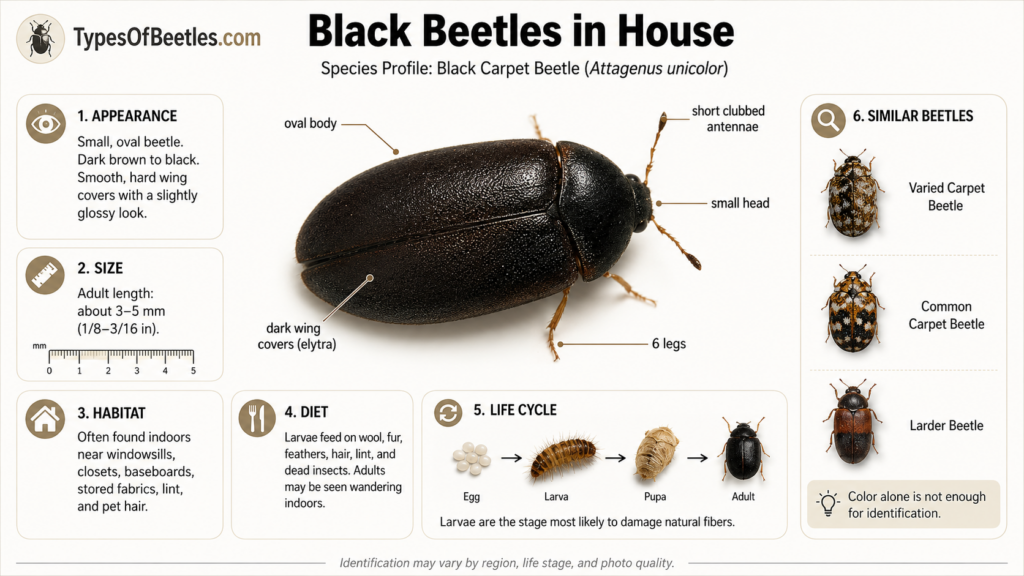
Finding black beetles in house areas such as carpets, windowsills, basements, kitchens, closets, or bathrooms can be confusing at first. The good news is that a black beetle indoors does not automatically mean there is a serious infestation or structural problem. Many beetles wander inside by accident, especially during warm months, while others may be connected to stored food, natural fibers, pet hair, dead insects, or hidden organic material.
The most important step is identification.
A “black beetle” can mean several different things. It might be a small black carpet beetle near a window. It might be a fast-moving ground beetle that slipped under a door. It might be a larder beetle near pet food, a pantry beetle in stored grains, or a darkling beetle that entered from outdoors. Some insects that look like beetles are not beetles at all.
This guide explains how to identify common black beetles in the house using simple clues: size, shape, color, antennae, wing covers, location, movement, season, and food source. It is written for beginners, homeowners, gardeners, students, teachers, and anyone who wants a calm, practical introduction to beetles found around homes.
What Does It Mean If You Find Black Beetles in Your House?
A black beetle inside the house usually means one of four things:
- It wandered indoors from outside.
- It is attracted to light, warmth, moisture, or shelter.
- It is feeding on a household food source, such as stored grains, pet food, lint, hair, feathers, wool, or dead insects.
- It is emerging from or near a hidden source, such as old pantry goods, stored fabrics, bird nests, rodent activity, or firewood.
Some beetles are only occasional indoor visitors. Ground beetles, for example, often enter homes by accident and usually do not reproduce indoors. Other beetles, such as carpet beetles or pantry beetles, may complete part of their life cycle inside if suitable food is available.
The key question is not simply, “Is it black?” A better question is:
Where did you find it, what size was it, what shape was it, and what was nearby?
A tiny oval beetle on a windowsill suggests something different from a large shiny beetle in a basement. A beetle in flour or rice points toward pantry pests. A beetle near wool clothing, pet hair, lint, or dead insects may suggest carpet beetles or related dermestid beetles.
How This Guide Helps
This guide is designed to help you narrow down common possibilities, not to guarantee a species-level identification from a single quick glance.
Beetle identification can vary by:
- Region
- Season
- Life stage
- Size
- Lighting
- Photo quality
- Whether the insect is an adult or larva
- Whether the beetle is alive, dead, damaged, or dried out
- Local species diversity
For a more reliable identification, observe several clues together:
- Size
- Body shape
- Color and pattern
- Antennae shape
- Wing covers
- Leg length
- Movement speed
- Whether it flies
- Where it was found
- What food sources are nearby
- Whether larvae, shed skins, holes, droppings, or damaged items are present
A single clue is rarely enough. A black color alone is especially unreliable because many unrelated beetles are dark brown, black, reddish black, or nearly black.
Quick Identification: Common Black Beetles in the House
Here are some of the most common possibilities when people search for black beetles in house areas.
1. Black Carpet Beetles
Black carpet beetles are small, dark beetles often found near windows, baseboards, closets, stored fabrics, lint, pet hair, or natural fibers. The adults are usually dark brown to black and oval. The larvae are more important to look for because they feed on materials such as wool, fur, feathers, hair, dead insects, and accumulated organic debris.
Look for:
- Small oval adult beetles
- Dark brown or black color
- Larvae that are hairy or carrot-shaped
- Shed larval skins
- Damage to wool, fur, feathers, or stored natural materials
- Adults near windows or light sources
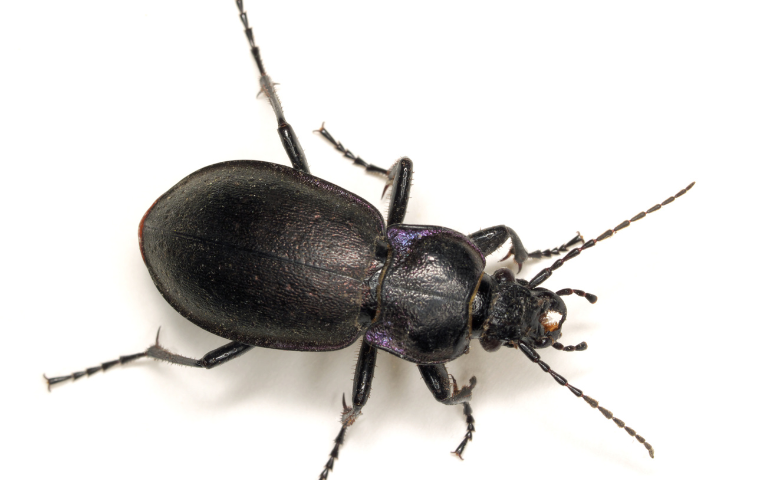
2. Ground Beetles
Ground beetles are often larger, shiny, fast-moving black or dark brown beetles. They commonly live outdoors under leaves, stones, logs, mulch, and garden debris. When found indoors, they usually entered by accident through gaps, cracks, door thresholds, basement windows, or foundation openings.
Look for:
- Fast movement
- Flattened or slightly elongated body
- Long legs
- Shiny black or dark brown surface
- Presence near doors, basements, garages, or ground-level rooms
- No obvious damage to food, fabric, or wood
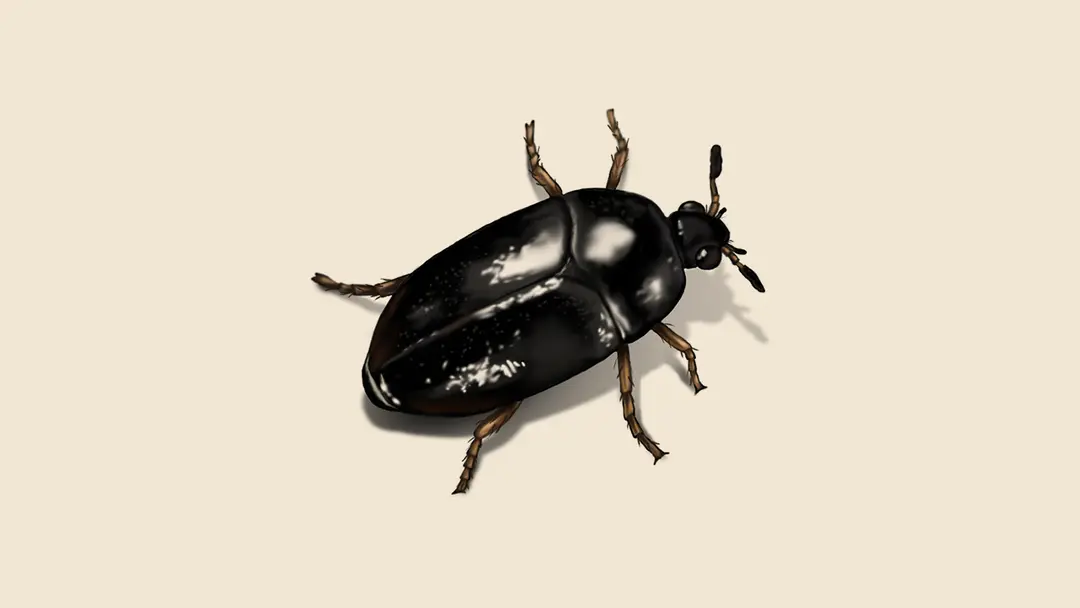
3. Larder Beetles
Larder beetles are dark beetles associated with high-protein materials. Adults are often dark brown to black with a pale band across the wing covers, although related species may appear darker. They may be found near pet food, stored animal products, dead insects, old nests, or hidden animal remains.
Look for:
- Oval dark body
- Pale yellowish or cream band across the wing covers
- Larvae that are hairy and brown
- Larvae with small spines at the rear
- Activity near dry pet food, animal products, preserved specimens, attic spaces, or wall voids
4. Pantry Beetles
Some pantry beetles are brown rather than truly black, but they may look black in dim light. These include flour beetles, drugstore beetles, cigarette beetles, sawtoothed grain beetles, and weevils. They are usually found in kitchens, cupboards, garages, or storage areas where grains, flour, cereals, spices, nuts, seeds, dried fruit, birdseed, or pet food are stored.
Look for:
- Very small beetles in or near dry food
- Beetles inside packages
- Beetles crawling on pantry shelves
- Larvae or webbing in stored food
- Multiple beetles appearing from one cabinet or food storage area
5. Darkling Beetles
Darkling beetles are usually dark, hard-bodied beetles. Some species may wander indoors from outside. Mealworms, which are the larvae of certain darkling beetles, are also familiar because they are used as animal feed.
Look for:
- Dark brown or black body
- Slow to moderate movement
- Outdoor entry points
- Association with stored feed, animal bedding, or dry organic material in some situations
6. Beetles from Firewood or Wood
Some beetles emerge from firewood brought indoors. These may be bark beetles, wood-boring beetles, or other insects associated with logs. They are usually not attacking the house itself; they are emerging from wood that was already inhabited before being brought inside.
Look for:
- Beetles near fireplaces, wood piles, or stored logs
- Small holes in bark or wood
- Fine sawdust-like material near firewood
- Seasonal appearance during indoor heating months
How to Identify Black Beetles Indoors
Before you try to name the beetle, gather basic observations. This is more useful than relying on color alone.
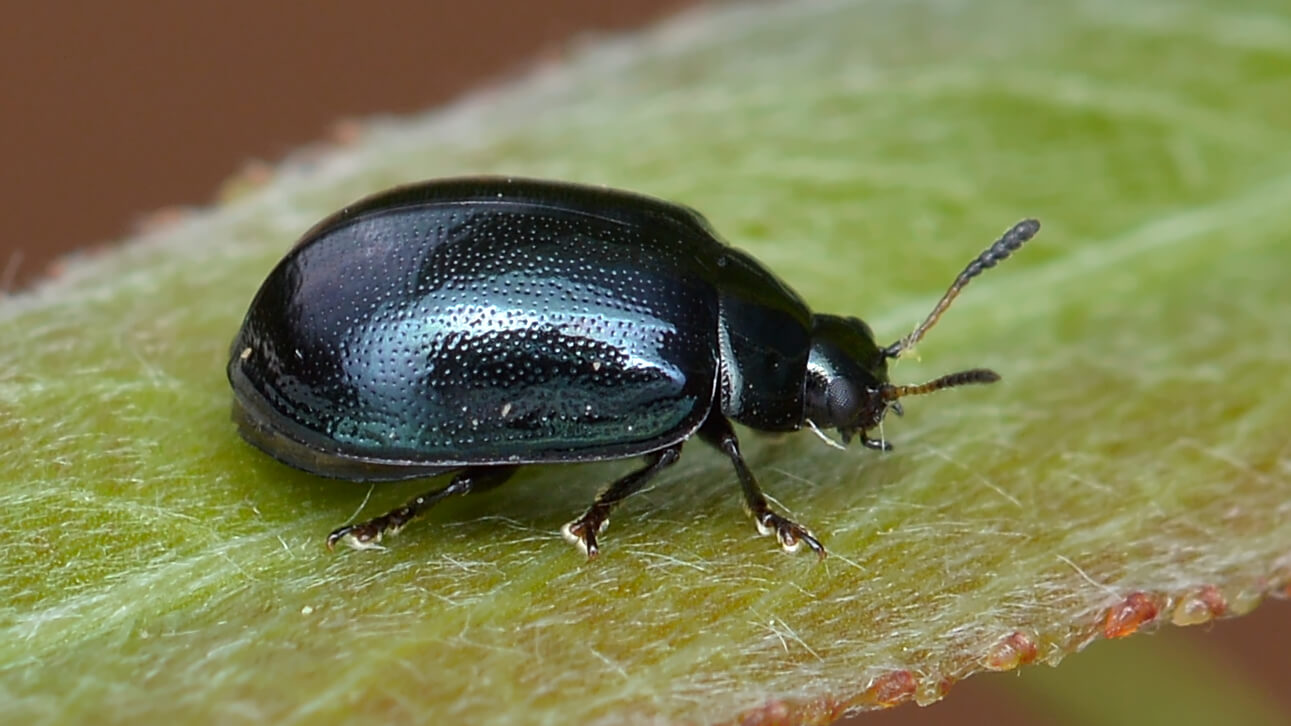
1. Size
Size is one of the best first clues.
Ask:
- Is it tiny, about the size of a sesame seed?
- Is it small, about 1/8 inch long?
- Is it medium-sized, around 1/4 to 1/2 inch?
- Is it large, closer to 1 inch?
Small black beetles in the house are often carpet beetles or pantry beetles. Larger black beetles are often ground beetles or other outdoor beetles that wandered inside.
2. Body Shape
Beetles have hardened front wings called wing covers, or elytra. These often form a visible line down the middle of the back.
Look at the overall shape:
- Round or oval: carpet beetles, some pantry beetles
- Long and narrow: some pantry beetles, ground beetles, darkling beetles
- Flattened and fast-moving: often ground beetles
- Dome-shaped: some beetles, including lady beetles and carpet beetles
- Snout-nosed: weevils
A snout is an especially helpful clue. If the insect has a small beak-like projection, it may be a weevil rather than a carpet beetle.
3. Color and Pattern
“Black” beetles may actually be:
- Dull black
- Shiny black
- Dark brown
- Reddish brown
- Mottled black, white, tan, or yellow
- Black with a pale band
- Brown but appearing black in poor light
A black carpet beetle may look uniformly dark. A larder beetle often has a pale band across the wing covers. Some pantry beetles are reddish brown but may appear dark indoors.
4. Antennae
Antennae can help separate beetle groups, although they are sometimes hard to see without a close photo.
Common antenna forms include:
- Thread-like antennae
- Clubbed antennae
- Saw-like antennae
- Elbowed antennae
- Short antennae tucked near the head
If you can safely take a close, well-lit photo, antenna shape may help with identification.
5. Location in the House
The room where you find the beetle matters.
Common clues:
- Windowsills: adult carpet beetles, pantry beetles, or beetles attracted to light
- Closets: carpet beetles or clothes-related pests
- Kitchen cabinets: pantry beetles
- Basement: ground beetles, moisture-associated insects, accidental invaders
- Bathroom: wandering insects, moisture-associated insects, or carpet beetles feeding on lint and hair
- Fireplace area: firewood-associated beetles
- Attic: beetles associated with nests, dead insects, stored items, or animal material
6. Behavior
Watch how the beetle moves.
- Fast runner: often ground beetle
- Slow crawler: carpet beetle, pantry beetle, or larder beetle
- Flying to windows or lamps: carpet beetles or pantry beetles may do this
- Hiding in dark cracks: larvae or ground beetles
- Emerging from a food package: pantry beetle
- Crawling from under baseboards: possible carpet beetle larvae, larder beetle larvae, or another hidden source
7. Life Stage
Adults and larvae can look completely different.
A beginner may see a hairy brown larva and not realize it belongs to a beetle. Carpet beetle larvae, for example, are often hairy and brownish, while the adults are small, oval beetles. Larder beetle larvae are also hairy and may have small spines at the rear.
When trying to identify black beetles in house areas, look for both:
- Adult beetles
- Larvae
- Shed larval skins
- Pupae
- Damaged food, fabric, or organic material
Common Types of Black or Dark Beetles Found in Homes
Black Carpet Beetles
Black carpet beetles are among the most common small dark beetles found indoors. They belong to a group of beetles known as dermestids. Dermestid beetles are natural recyclers. Outdoors, they help break down dry animal material such as dead insects, feathers, hair, and remains. Indoors, their larvae may feed on natural materials that people store or overlook.
What Black Carpet Beetles Look Like
Adult black carpet beetles are small, oval, and usually dark brown to black. They may be only a few millimeters long. They can be easy to miss unless they are crawling across a light-colored wall, window frame, or floor.
The larvae look very different. They are usually brownish, hairy, and somewhat tapered. They may be found in quiet, undisturbed places where lint, hair, pet fur, feathers, wool, or dead insects accumulate.
Where You May Find Them
Common locations include:
- Along baseboards
- Under furniture
- Around window frames
- In closets
- In drawers
- Under rugs
- In stored clothing
- In attics
- Near pet bedding
- Around old insect remains
- Near wool, fur, feathers, or taxidermy items
Are Black Carpet Beetles Harmful?
Black carpet beetles are not dangerous in the way many people fear. They do not bite like fleas or bed bugs. However, their larvae may damage natural fibers and stored animal-based materials. Some people may also experience skin irritation from contact with larval hairs or shed skins.
The key is to find what the larvae are feeding on.
Ground Beetles
Ground beetles are common outdoor beetles. Many are black, dark brown, or metallic. They are often beneficial in gardens because they feed on other insects and small invertebrates.
What Ground Beetles Look Like
Ground beetles are usually:
- Medium-sized to large
- Fast-moving
- Dark or shiny
- Flattened or elongated
- Long-legged
- Equipped with noticeable jaws
- Often found at ground level
Some species are almost entirely black. Others may show bronze, green, blue, or purple reflections under light.
Why Ground Beetles Enter Houses
Ground beetles usually enter by accident. They may come in through:
- Gaps under doors
- Basement windows
- Foundation cracks
- Garage doors
- Open doors at night
- Spaces around pipes or utility lines
They are often attracted to outdoor lights and may end up near entry points.
Are Ground Beetles a Problem Indoors?
Usually, no. Ground beetles do not normally damage clothing, stored food, furniture, or structural wood. They generally do not reproduce indoors and often die if they cannot return outside.
If you find one or two, it is usually enough to remove them and check entry points.
Larder Beetles
Larder beetles are another type of dermestid beetle. They were historically associated with stored meats, but in modern homes they are more often linked to dry pet food, dead insects, animal products, old nests, or hidden organic material.
What Larder Beetles Look Like
Adult larder beetles are usually dark brown to black and oval. A common identifying feature is a pale yellowish or cream-colored band across the wing covers, often with darker spots in the band.
The larvae are worm-like, hairy, and brownish. They may have a pair of small curved spines near the rear end.
Where You May Find Them
Larder beetles may appear near:
- Dry pet food
- Stored animal products
- Dead insects
- Attics
- Wall voids
- Crawl spaces
- Old bird nests
- Rodent activity
- Preserved specimens
- Areas where cluster flies or other overwintering insects have died
What Their Presence May Mean
A few adult larder beetles in spring may simply be indoor wanderers. Repeated larvae or large numbers of adults suggest a food source is present. That source may be obvious, such as pet food, or hidden, such as dead insects in an attic or wall void.
Pantry Beetles
Pantry beetles are not always black, but many are small and dark enough that homeowners describe them as black beetles. They include flour beetles, sawtoothed grain beetles, drugstore beetles, cigarette beetles, and weevils.
What Pantry Beetles Look Like
Pantry beetles are usually:
- Very small
- Brown, reddish brown, or dark
- Found near stored dry food
- Slow to moderate crawlers
- Sometimes able to fly
- Often seen in groups when a food source is infested
Some have narrow bodies. Others are rounded or cylindrical. Weevils often have a small snout.
Where You May Find Them
Check:
- Flour
- Rice
- Pasta
- Cereal
- Oats
- Dry beans
- Nuts
- Seeds
- Spices
- Dried fruit
- Birdseed
- Dry pet food
- Decorative dried flowers or wreaths
Pantry beetles often enter the home inside packaged goods. They can then spread from one stored item to another if dry foods are not sealed.
What to Do First
If you suspect pantry beetles, inspect one shelf or cabinet at a time. Look inside packages, not just on the shelf surface. Discard clearly infested items and store unaffected dry goods in tight containers.
Darkling Beetles
Darkling beetles are a large group of beetles, many of which are dark brown or black. Some are outdoor insects that wander indoors. Others may be associated with stored feed, animal areas, or dry organic matter.
What Darkling Beetles Look Like
They are often:
- Dark brown to black
- Hard-bodied
- Oval or elongated
- Less shiny than some ground beetles
- Slow to moderate moving
Mealworms are the larvae of certain darkling beetles. In homes, darkling beetles may appear where animal feed, birdseed, or dry organic material is stored.
Firewood and Wood-Associated Beetles
If black or dark beetles appear near a fireplace, wood stove, or indoor wood pile, they may have emerged from firewood. Many insects live in or under bark before wood is brought indoors.
What to Look For
- Beetles near firewood
- Small holes in bark
- Fine powder or sawdust
- Beetles appearing in winter after logs warm indoors
- No signs of activity away from stored wood
Most firewood beetles are not a major threat to the home. The practical solution is to store firewood outdoors and bring in only what you plan to use soon.
Black Beetles in House: Comparison Table
| Beetle Type | Common Size | Common Location | Key Clues | Usually Serious? |
|---|---|---|---|---|
| Black carpet beetle | Very small | Windowsills, closets, baseboards, stored fabrics | Small dark oval adults; hairy larvae; shed skins | Can damage natural fibers if larvae have food |
| Ground beetle | Medium to large | Basement, garage, doors, ground-level rooms | Fast runner; shiny black; long legs | Usually just an accidental visitor |
| Larder beetle | Small to medium | Pet food, attic, stored animal material, dead insects | Dark oval body; pale band; hairy larvae | May indicate hidden food source |
| Pantry beetle | Very small | Kitchen, pantry, dry food storage | Found in flour, rice, cereal, spices, seeds, pet food | Food source should be located and removed |
| Darkling beetle | Small to medium | Ground-level rooms, feed storage, dry organic material | Dark hard body; may wander indoors | Usually depends on food source and numbers |
| Firewood beetle | Variable | Fireplace, wood pile, nearby windows | Appears near logs; holes in bark | Usually linked to firewood, not house structure |
Where Black Beetles Commonly Appear Indoors
Black Beetles Near Windows
Small beetles near windows are often adults attracted to light. Adult carpet beetles are commonly noticed on windowsills because they move toward light after developing indoors or entering from outside. Pantry beetles may also fly toward windows or lamps.
A window sighting does not tell the whole story. The larvae or food source may be elsewhere.
Check:
- Nearby baseboards
- Under furniture
- Closets
- Stored fabrics
- Pet bedding
- Pantry shelves
- Dead insects in light fixtures
- Old dried flowers or wreaths
Black Beetles in Carpet
Black beetles in carpet may be carpet beetles, but do not assume this from the location alone. Adult beetles may simply be crossing the floor.
Look for larvae, shed skins, and feeding damage. Carpet beetle larvae often prefer quiet places where hair, lint, pet fur, and natural fibers collect. Edges of rugs, under furniture, and corners are more important than open walking areas.
Black Beetles in the Kitchen
Black or dark beetles in the kitchen often point to stored food insects. Inspect dry goods carefully.
Common sources include:
- Flour
- Rice
- Pasta
- Cereal
- Oats
- Crackers
- Spices
- Nuts
- Birdseed
- Dry pet food
Even a clean kitchen can have pantry beetles because infested products may be brought home from storage, transport, or retail environments.
Black Beetles in the Bathroom
A bathroom sighting may seem strange, but beetles can wander anywhere. Bathrooms also collect hair, lint, moisture, and small dead insects, which can attract some scavenging larvae.
Check:
- Baseboards
- Vent covers
- Under cabinets
- Behind laundry baskets
- Around windows
- Near stored towels or natural-fiber bath mats
Black Beetles in the Basement
Basements are common places for ground beetles and other outdoor insects to enter. They are usually closer to soil level, foundation gaps, garage connections, and damp hiding places.
Check:
- Door sweeps
- Foundation cracks
- Window wells
- Floor-wall joints
- Stored cardboard
- Firewood
- Moist corners
- Mulch or debris outside the foundation
Black Beetles in Closets
Closets are important when carpet beetles are suspected. The issue is usually not adult beetles feeding on clothes, but larvae feeding on natural materials.
Check:
- Wool sweaters
- Felt hats
- Fur trim
- Feather items
- Silk garments
- Stored blankets
- Old costumes
- Pet hair accumulation
- Undisturbed storage boxes
Clean synthetic fabrics are usually less attractive, but stained fabrics, blended materials, and debris can still support insects.
What Do Black Beetles in the House Eat?
Different beetles eat very different things. This is why identification matters.
Carpet Beetle Larvae
Carpet beetle larvae may feed on:
- Wool
- Fur
- Feathers
- Hair
- Felt
- Dead insects
- Pet hair
- Lint
- Dried animal material
- Some food crumbs or organic debris
Adult carpet beetles often feed outdoors on pollen and nectar. The larvae are the stage most associated with household damage.
Ground Beetles
Ground beetles are usually predators outdoors. They may feed on:
- Other insects
- Small invertebrates
- Larvae
- Slugs or similar soft-bodied prey, depending on species
Indoors, they usually do not find suitable food and do not remain long.
Larder Beetles
Larder beetles may feed on:
- Dry pet food
- Meat products
- Cheese
- Animal hides
- Feathers
- Dead insects
- Dead animals
- Stored animal-based items
The presence of larvae or many adults may indicate that a food source needs to be found.
Pantry Beetles
Pantry beetles may feed on:
- Flour
- Grains
- Cereal
- Pasta
- Rice
- Nuts
- Seeds
- Spices
- Dried fruit
- Dry pet food
- Birdseed
They are usually managed by finding and removing infested products, cleaning storage areas, and using tight containers.
Darkling Beetles
Darkling beetles vary widely, but some are associated with:
- Decaying plant material
- Stored feed
- Dry organic matter
- Grain products
- Animal bedding in some settings
Beetle Life Cycle Basics
Beetles undergo complete metamorphosis. This means they pass through four main life stages:
- Egg
- Larva
- Pupa
- Adult
This matters because the adult beetle you see crawling on a wall may not be the stage causing damage or feeding indoors.
Egg Stage
Female beetles lay eggs where larvae will have access to food. For pantry beetles, that may be stored food. For carpet beetles, it may be near lint, hair, dead insects, wool, feathers, or other organic material.
Larval Stage
The larval stage is often the feeding stage. Larvae may look like small worms, grubs, or hairy caterpillar-like insects. Carpet beetle larvae and larder beetle larvae are especially easy to mistake for something unrelated to beetles.
Pupal Stage
The pupa is the transformation stage. The insect changes from larva into adult. Pupae are often hidden in cracks, food material, fabric folds, or protected spaces.
Adult Stage
Adult beetles may disperse, mate, lay eggs, or move toward light. Adults are the stage most people notice, but the important clue may be where the larvae are developing.
Common Identification Mistakes
Mistake 1: Assuming Every Black Beetle Is a Carpet Beetle
Carpet beetles are common, but not every small black beetle indoors is a carpet beetle. Pantry beetles, ground beetles, darkling beetles, and other beetles may also appear dark.
Use location and food source as clues.
Mistake 2: Confusing Beetles with Cockroaches
Some dark beetles are mistaken for small cockroaches. Beetles usually have harder wing covers that meet in a straight line down the back. Cockroaches are generally flatter, faster, and have very long antennae.
Cockroaches are more strongly associated with kitchens, bathrooms, food residue, moisture, and nighttime activity. Beetles may appear in many different places depending on the species.
Mistake 3: Confusing Beetle Larvae with Worms
Hairy carpet beetle larvae or larder beetle larvae may be mistaken for worms or caterpillars. If you find hairy larvae indoors, especially near fabric, pet hair, lint, stored goods, or dead insects, beetles should be considered.
Mistake 4: Relying Only on Color
Color can be misleading. A reddish-brown pantry beetle may look black under poor lighting. A dark beetle may look brown in sunlight. Some beetles are patterned, but the pattern may be hard to see without magnification.
Use size, shape, location, and behavior together.
Mistake 5: Ignoring the Source
Removing visible beetles is helpful, but repeated sightings often mean something is attracting or supporting them.
Possible sources include:
- Infested dry food
- Dry pet food
- Birdseed
- Wool or feather items
- Pet hair under furniture
- Dead insects in wall voids or attics
- Firewood
- Old nests
- Entry gaps around doors and windows
What Should You Do If You Find Black Beetles Indoors?
The best response depends on the beetle and the situation. Start with calm observation.
Step 1: Save or Photograph the Beetle
If possible, take a clear photo from above and from the side. Include a size reference such as a coin, ruler, or fingertip nearby.
Try to capture:
- Body shape
- Antennae
- Legs
- Wing covers
- Any pattern or banding
- Location where it was found
Step 2: Note the Location
Write down where you found it:
- Kitchen
- Closet
- Bathroom
- Basement
- Window
- Floor
- Pantry
- Fireplace
- Pet feeding area
- Attic
- Near a door
This may be more useful than the photo alone.
Step 3: Look for More Clues
Check nearby areas for:
- Larvae
- Shed skins
- Damaged fabric
- Holes in wool or fur
- Insects in dry food packages
- Dead insects
- Pet hair buildup
- Birdseed or pet food spills
- Firewood holes
- Entry gaps
Step 4: Remove Individual Beetles
For occasional beetles, physical removal is often enough. You can use a cup and paper, a vacuum, or gentle outdoor release if the beetle is an outdoor species.
Step 5: Clean Likely Food Sources
Depending on the suspected beetle, clean:
- Pantry shelves
- Baseboards
- Closet corners
- Under furniture
- Pet bedding areas
- Window tracks
- Fireplace areas
- Storage boxes
- Attic or basement edges
Vacuuming is especially useful because it removes beetles, larvae, shed skins, lint, hair, crumbs, and dead insects.
Step 6: Store Vulnerable Items Properly
Use tight containers for:
- Flour
- Rice
- Grains
- Cereal
- Spices
- Dry pet food
- Birdseed
- Wool garments
- Feather items
- Fur or felt items
- Stored blankets
Step 7: Seal Entry Points
If the beetles appear to be coming from outside, check:
- Door sweeps
- Window screens
- Foundation cracks
- Utility openings
- Basement windows
- Gaps around pipes
- Garage door seals
Outdoor lights can also attract some beetles. Switching bright white exterior lights to warmer or yellow-toned lights may reduce insect attraction near doors.
When to Seek Professional Help
Most occasional black beetles in house spaces do not require professional help. However, expert assistance may be useful if:
- You keep finding larvae.
- You find large numbers of beetles repeatedly.
- Beetles keep emerging from the same wall, attic, or room.
- You suspect a dead animal, old nest, or hidden source in a wall void.
- Stored food infestations keep returning after cleaning.
- Natural-fiber clothing, rugs, or museum-like specimens are being damaged.
- You cannot identify the insect from photos.
- You are concerned about termites, cockroaches, or wood-boring insects rather than beetles.
For identification, consider contacting:
- Local university extension offices
- Natural history museums
- Entomology departments
- Government agriculture resources
- Local insect identification services
- Licensed pest professionals when indoor infestations are persistent
Educational Disclaimer
This guide is for general education and beginner-level identification. Beetle identification can vary by region, species, life stage, and photo quality. For a confident identification, use multiple clues and consult a qualified local expert, university extension service, museum resource, or entomology reference when needed.
FAQ
Why are there black beetles in my house?
Black beetles may enter your house by accident, especially through gaps around doors, windows, basements, or foundations. Others may be attracted to stored food, natural fibers, pet hair, lint, dead insects, or hidden organic material.
What are the most common black beetles in the house?
Common possibilities include black carpet beetles, ground beetles, larder beetles, pantry beetles, darkling beetles, and beetles emerging from firewood. The best clue is where you found them and what food sources are nearby.
Are black beetles in the house harmful?
Most black beetles found indoors are not harmful to people. Some may damage stored food or natural materials such as wool, fur, feathers, or dry pet food. Ground beetles are usually harmless accidental visitors.
Do black beetles bite?
Most common indoor beetles do not bite people. Some larger beetles may pinch if handled roughly, but they are not seeking people as food. Avoid handling unknown insects with bare hands.
Are small black beetles carpet beetles?
They might be, but not always. Small black beetles may also be pantry beetles, drugstore beetles, cigarette beetles, weevils, or other beetles. Check whether they are near windows, carpets, closets, stored food, or natural fibers.
Why do I find black beetles near windows?
Adult beetles may move toward light, so windowsills are common places to notice them. The source may still be elsewhere, such as a closet, pantry, attic, baseboard, or outdoor entry point.
Why are black beetles in my kitchen?
Black or dark beetles in the kitchen may be pantry beetles. Check flour, rice, cereal, pasta, spices, nuts, seeds, birdseed, and dry pet food. Infested items should be removed, and dry goods should be stored in tight containers.
What do black beetles in the house eat?
It depends on the beetle. Carpet beetle larvae may feed on wool, fur, feathers, hair, lint, and dead insects. Pantry beetles feed on dry stored food. Larder beetles feed on high-protein animal materials. Ground beetles usually feed outdoors on other small animals.
How do I tell a beetle from a cockroach?
Beetles usually have hard wing covers that meet in a straight line down the back. Cockroaches are generally flatter, often have very long antennae, and are more strongly associated with moisture, food residue, and nighttime activity.
Do black beetles mean my house is dirty?
No. Beetles can enter clean homes through open doors, windows, packages, flowers, firewood, pet food, birdseed, or outdoor gaps. Cleanliness helps reduce food sources, but beetles can appear in any home.
Should I call pest control for black beetles?
You may not need professional help for one or two beetles. Consider help if you find large numbers, repeated larvae, damaged fabrics, recurring pantry infestations, or a suspected hidden source such as dead animals, old nests, or insects in wall voids.
How can I prevent black beetles from coming inside?
Seal gaps, repair screens, store dry food in tight containers, vacuum baseboards and under furniture, reduce lint and pet hair buildup, inspect secondhand items, store firewood outdoors, and keep outdoor debris away from the foundation.
Conclusion
Finding black beetles in house spaces is common, and it does not always mean there is a serious problem. The most useful approach is careful observation. Look at the beetle’s size, shape, color, movement, antennae, location, and nearby food sources. A tiny dark beetle near a window may suggest carpet beetles. A fast, shiny beetle in the basement may be a ground beetle. A beetle in flour or pet food points toward pantry pests. A dark beetle with a pale band may be a larder beetle.
The main lesson is simple: do not identify a beetle by color alone.
Use multiple clues, look for larvae or damaged materials, and consider the room where the beetle appears. Many black beetles are harmless outdoor visitors, while others are manageable once their food source is found. When identification is uncertain or beetles keep appearing in large numbers, a local extension office, museum resource, entomology reference, or qualified pest professional can help provide a more confident answer.
For more beginner-friendly guides, explore related pages on beetle identification, beetle life cycles, carpet beetles, ground beetles, pantry beetles, and other beetles found around homes and gardens.