

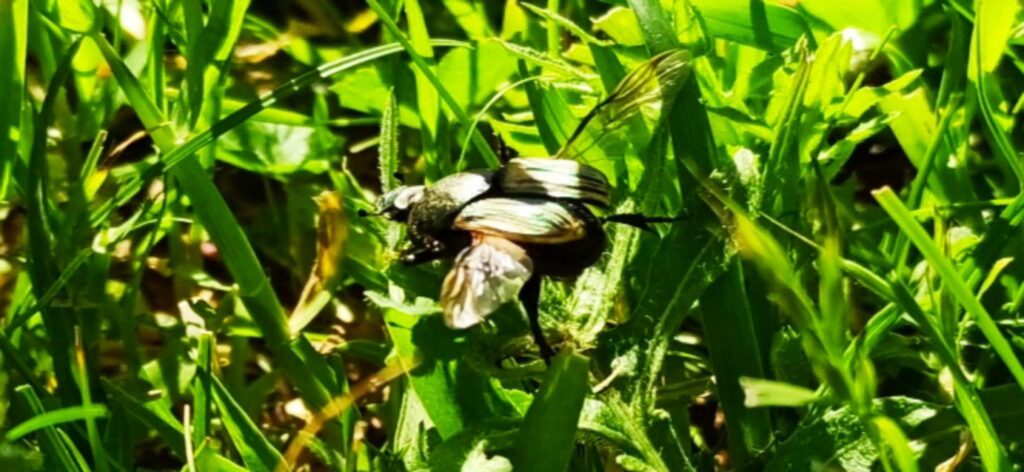
Flying beetles are adult beetles that use hidden hind wings to move through the air. Some fly strongly and deliberately. Others buzz clumsily around porch lights, bump into windows, or suddenly appear near houseplants, pantry shelves, garden flowers, or lawns.
The most important thing to know is this: seeing a flying beetle does not automatically mean you have a serious pest problem. Many flying beetles are harmless visitors. Some are useful predators. Some are seasonal garden feeders. A few can become household or plant pests when their larvae, food source, or breeding site is indoors or nearby.
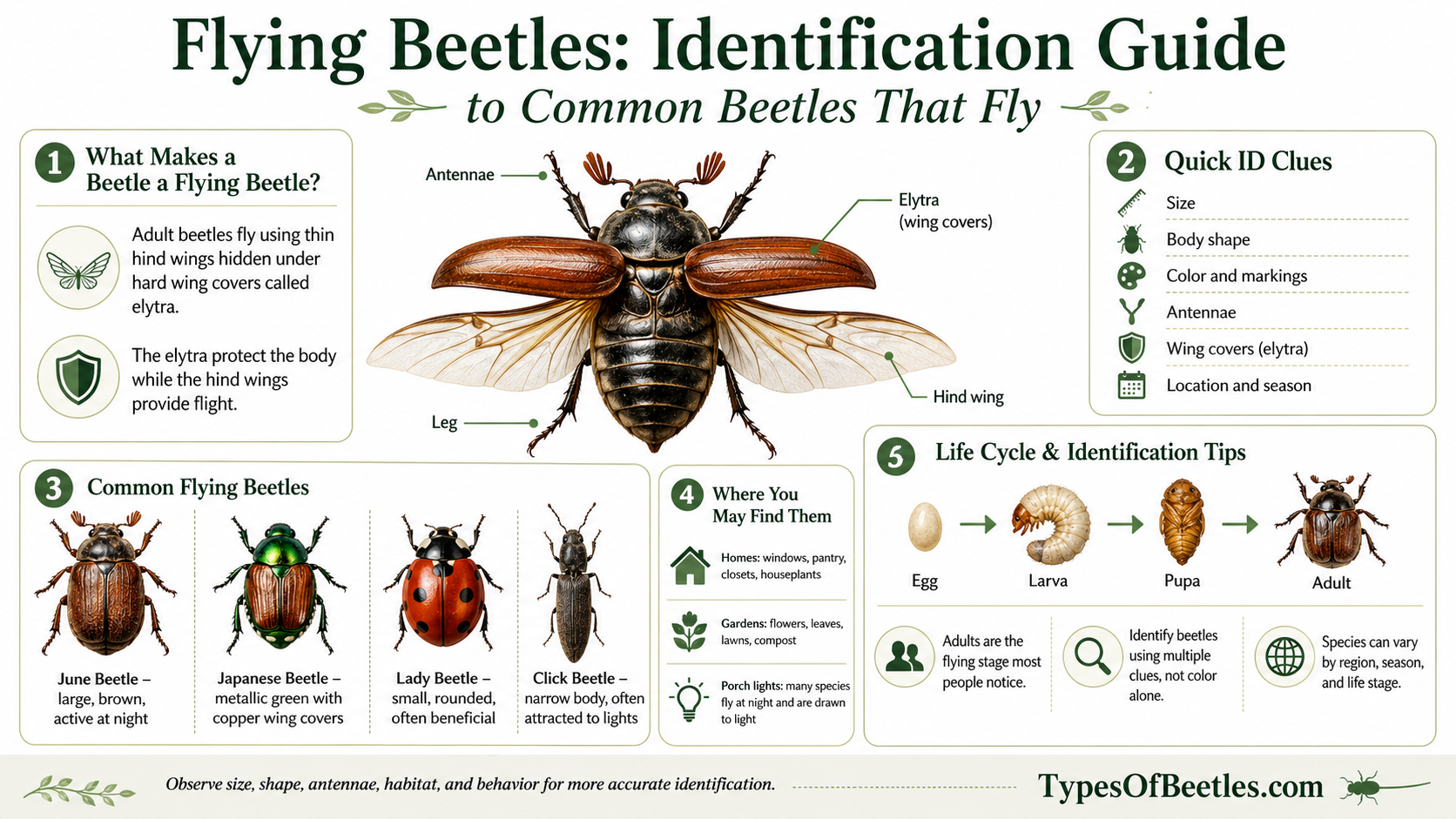
To identify flying beetles, look at more than flight alone. Check the beetle’s size, color, body shape, antennae, wing covers, legs, location, season, time of day, and behavior. A small round beetle on a windowsill tells a different story from a large brown beetle circling a porch light at night or a metallic green beetle feeding on rose leaves in midsummer.
This guide explains how flying beetles work, how to recognize common types, and how to think through beetle identification in a calm, practical way.
About This Guide
This guide is designed for beginners, homeowners, gardeners, students, teachers, and nature enthusiasts who want to understand flying beetles without jumping to conclusions.
Beetle identification can vary by region, life stage, season, and photo quality. Many beetles look similar at first glance, and some species can only be confirmed by an entomologist or a specialist using close examination. This article can help you narrow the possibilities, but it should not be treated as a guaranteed species identification tool.
For the most reliable identification, observe several clues together:
- Approximate size
- Overall body shape
- Color and markings
- Antennae shape
- Hard wing covers
- Leg shape
- Where the beetle was found
- Whether it was indoors or outdoors
- Time of year
- Time of day
- Feeding or damage signs
- Whether many beetles are present or only one
For difficult cases, compare your observations with university extension resources, museum guides, natural history references, government agriculture resources, and entomology references.
What Are Flying Beetles?
Flying beetles are beetles in the adult stage that are capable of flight. Beetles belong to the insect order Coleoptera, one of the largest groups of animals on Earth. Their most recognizable feature is a pair of hardened front wings called elytra.
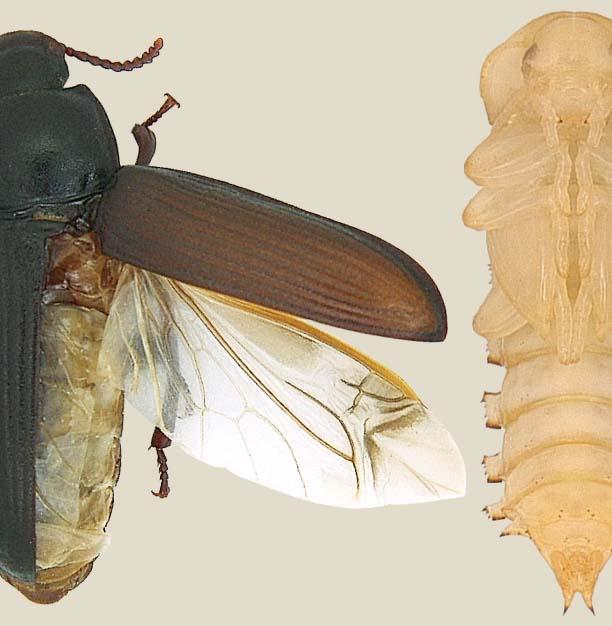
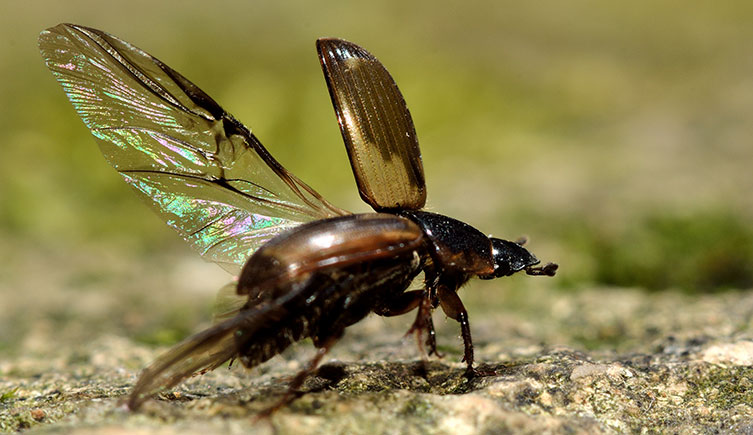
The elytra are not the main flying wings. Instead, they form protective covers over the more delicate hind wings. When many beetles prepare to fly, they lift or open the elytra and unfold the thin hind wings underneath. These hind wings do the actual flying.
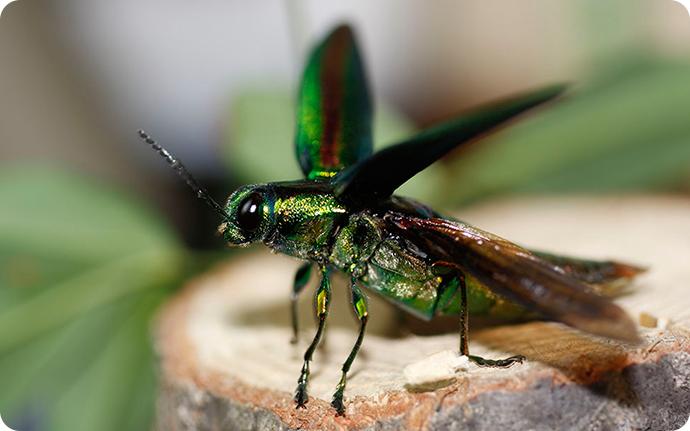
A flying beetle may look awkward compared with a fly, bee, or butterfly because its flight wings are partly hidden until takeoff. Some beetles make a loud buzzing sound. Others fly only short distances. Some fly strongly between flowers, trees, lawns, or lights.
Not all beetles fly well. Some beetles have reduced wings. Some have fused wing covers. Some spend most of their lives walking, burrowing, climbing, or hiding, even if related species can fly.
Are Flying Beetles Really Beetles?
A flying insect is not always a beetle. Many insects fly, including flies, moths, wasps, true bugs, ants, termites, and cockroaches. To decide whether the insect is a beetle, look for beetle traits.
Key Signs of a Beetle
Most adult beetles have:
- Six legs
- A head, thorax, and abdomen
- A pair of antennae
- Chewing mouthparts
- Hardened front wing covers
- A straight line down the back where the wing covers meet
- A firm or armored appearance
The straight seam down the back is often one of the easiest clues. When a beetle is resting, the two wing covers usually meet along the center of the body like two closed doors.
Beetle Wings: Elytra and Hind Wings
Beetle wings are different from many other insect wings.
The hardened front wings are called elytra. They protect the body and the folded hind wings underneath. The hind wings are usually thinner, more flexible, and used for flight.
In simple terms:
- Elytra = protective wing covers
- Hind wings = flight wings
This is why a beetle may look like it has a hard shell when resting, then suddenly unfold delicate wings when it flies.
Why Do Beetles Fly?
Beetles fly for several reasons. Flight helps adult beetles find food, mates, shelter, and suitable places to lay eggs.
Common reasons beetles fly include:
- Searching for flowers, leaves, fruit, pollen, fungi, dung, or other food
- Finding mates during the adult season
- Moving away from the place where they developed as larvae
- Reaching host plants or trees
- Escaping disturbance
- Finding new habitat
- Responding to lights at night
- Emerging seasonally after rain, warm weather, or soil development
For many beetles, the adult stage is the most visible stage. The larvae may live hidden in soil, wood, stored food, fabric, leaf litter, or plant roots. When adults emerge and begin flying, people suddenly notice them.
Quick Flying Beetle Identification Checklist
Use this checklist before trying to name a flying beetle.
1. Size
Estimate the beetle’s body length, not including antennae.
Helpful size categories:
- Tiny: under 3 mm
- Small: 3–6 mm
- Medium: 7–15 mm
- Large: 16–30 mm
- Very large: over 30 mm
A tiny beetle flying near a window may be a carpet beetle or pantry beetle. A large brown beetle thudding against a porch light may be a June beetle or another scarab beetle.
2. Body Shape
Look at the overall outline.
Common beetle body shapes include:
- Round or dome-shaped
- Oval
- Elongated and narrow
- Cylindrical
- Flattened
- Humpbacked
- Snout-nosed
- Long-legged
- Broad and heavy-bodied
Shape is often more useful than color because many unrelated beetles can be black, brown, or metallic.
3. Color and Markings
Note the main color and any patterns.
Flying beetles may be:
- Black
- Brown
- Reddish brown
- Metallic green
- Metallic blue
- Coppery
- Yellow and black
- Spotted
- Striped
- Mottled
- Pale or tan
Color can help, but it should not be the only clue. Lighting, camera quality, age, dust, and wear can change how a beetle looks.
4. Antennae
Antennae are very important for beetle identification.
Look for:
- Long threadlike antennae
- Clubbed antennae
- Saw-toothed antennae
- Elbowed antennae
- Feather-like or fan-like antennae
- Short hidden antennae
- Very long antennae longer than the body
Longhorn beetles, for example, often have very long antennae. Scarab beetles may have clubbed or fan-like antennae. Weevils often have elbowed antennae attached to a snout.
5. Wing Covers
Look at the elytra.
Ask:
- Are the wing covers smooth or ridged?
- Are they shiny or dull?
- Do they fully cover the abdomen?
- Are they short, exposing part of the body?
- Do they have spots, stripes, grooves, or bumps?
- Do they open during flight?
The wing covers can help separate beetles from flies, true bugs, moths, and cockroaches.
6. Location
Where did you find the beetle?
Important locations include:
- Windowsill
- Porch light
- Kitchen pantry
- Closet
- Carpet edge
- Firewood pile
- Houseplant
- Rose bush
- Lawn
- Compost pile
- Flower bed
- Tree trunk
- Dead branch
- Stored grain or pet food
- Garden soil
A beetle’s location often gives a better clue than color alone.
7. Season and Time of Day
Many flying beetles are seasonal.
Examples:
- June beetles often appear in late spring and early summer.
- Japanese beetles are often seen in summer on garden plants.
- Carpet beetle adults may be noticed indoors near windows.
- Click beetles and longhorn beetles may come to lights at night.
- Fireflies are most noticeable on warm evenings.
Record the month and whether the beetle was active during the day, dusk, or night.
8. Behavior
Observe what the beetle is doing.
Useful behavior clues include:
- Flying toward lights
- Crawling on windows
- Feeding on leaves
- Chewing flower petals
- Visiting flowers
- Emerging from firewood
- Walking across floors
- Clicking or jumping
- Clustering on plants
- Appearing in pantry goods
- Moving slowly on fabric or carpet edges
Behavior can point to a beetle’s family, food source, or habitat.
Common Types of Flying Beetles
Many beetles can fly, but some groups are especially common around homes, gardens, lawns, and lights.
June Beetles and May Beetles
June beetles, also called May beetles in some regions, are among the most familiar flying beetles. They are usually brown, reddish brown, or dark, with oval, heavy bodies.
They are often noticed at night because many are attracted to lights. They may bump into screens, doors, walls, windows, or people. Their flight can seem loud and clumsy.
Identification Clues
June beetles often have:
- Medium to large oval bodies
- Brown, reddish brown, or black coloration
- Hard wing covers
- Clubbed antennae
- Nocturnal activity
- Strong attraction to porch lights
- A buzzing, heavy flight
Where They Are Found
Adults may be seen around:
- Porch lights
- Lawns
- Trees
- Shrubs
- Gardens
- Fields
- Sidewalks after dark
Their larvae are white grubs that live in soil and feed on roots. In small numbers, they may not cause obvious problems. In high numbers, grubs can contribute to turf damage.
Japanese Beetles
Japanese beetles are well-known garden beetles in many parts of North America. Adults are small but conspicuous, with metallic green bodies and coppery wing covers. They often feed in groups on leaves, flowers, and fruit.
Identification Clues
Japanese beetles often have:
- Metallic green head and thorax
- Copper-brown wing covers
- Oval body
- Small white hair tufts along the sides of the abdomen
- Daytime activity
- Group feeding on plants
- Skeletonized leaf damage
Skeletonized leaves look like the soft tissue has been eaten between the veins, leaving a lace-like pattern.
Where They Are Found
Adults are often found on:
- Roses
- Grapes
- Linden trees
- Fruit trees
- Beans
- Flowers
- Ornamental shrubs
- Garden plants
The larvae are white grubs that live in soil and feed on grass roots. Adult feeding damage and larval lawn damage are separate parts of the same life cycle.
Green June Beetles and Flower Chafers
Some large metallic green flying beetles belong to scarab groups such as green June beetles and flower chafers. They may look impressive because of their bright color, loud buzzing flight, and large size.
Identification Clues
These beetles may have:
- Metallic green, bronze, or gold tones
- Broad oval bodies
- Strong buzzing flight
- Activity during warm sunny weather
- Attraction to ripe or damaged fruit
- Visits to flowers or sap flows
Some flower chafers can fly with their wing covers partly closed, which makes their flight look different from beetles that lift the elytra widely.
Where They Are Found
They may occur around:
- Fruit trees
- Compost
- Lawns
- Garden beds
- Flowers
- Sap flows
- Ripe fruit
- Decaying organic material
Large metallic beetles are often harmless to observe, but some species can feed on fruit or ornamental plants.
Lady Beetles
Lady beetles, often called ladybugs, are flying beetles too. Many are beneficial predators of aphids, scale insects, and other soft-bodied pests.
Identification Clues
Lady beetles often have:
- Small rounded bodies
- Dome-shaped backs
- Red, orange, yellow, black, or spotted markings
- Short antennae
- Smooth wing covers
- Slow crawling behavior between flights
Not all lady beetles are red with black spots. Some are black with red spots, yellow with black spots, or nearly plain.
Where They Are Found
Lady beetles may be found on:
- Garden plants
- Trees and shrubs
- Aphid colonies
- Windows
- Walls
- Fields
- Greenhouses
Some species gather on buildings in autumn and may enter homes to overwinter. Indoors, they are usually nuisance visitors rather than insects that breed in household materials.
Carpet Beetles
Carpet beetles are tiny flying beetles that often confuse homeowners. Adults may fly to windows and lights, while the larvae hide in darker places and feed on animal-based materials.
Identification Clues
Adult carpet beetles may be:
- Very small
- Round or oval
- Black, mottled, brown, white, yellow, or patterned
- Found near windows
- Seen crawling slowly on walls or sills
- Associated with fabrics, stored items, dead insects, lint, feathers, wool, fur, or old nests
The adults do not cause the main fabric damage. The larvae are the feeding stage. Carpet beetle larvae are usually elongated, bristly, and brownish.
Where They Are Found
Adults may be seen:
- On windowsills
- Near lights
- Around flowers outdoors
- On walls
- Near closets
- In attics
- Near baseboards
Larvae may be found:
- Under furniture
- Along carpet edges
- In closets
- In stored woolens
- In lint accumulations
- Near pet hair
- Around dead insects
- In old bird or rodent nests
Finding one adult carpet beetle does not automatically mean a large infestation. Repeated adults plus larvae, shed skins, or fabric damage deserve closer inspection.
Pantry Beetles
Several small beetles can fly around kitchens, cupboards, pantries, or stored foods. These may include drugstore beetles, cigarette beetles, flour beetles, grain beetles, and related stored-product beetles.
Identification Clues
Pantry beetles are often:
- Tiny to small
- Brown or reddish brown
- Oval or cylindrical
- Found near dry foods
- Seen crawling in cupboards
- Sometimes flying near lights
- Associated with damaged packaging or fine powdery food debris
Where They Are Found
Check stored items such as:
- Flour
- Rice
- Pasta
- Cereal
- Spices
- Dried herbs
- Pet food
- Birdseed
- Nuts
- Dried fruit
- Old grains
- Decorative seed items
If many tiny beetles are flying in the kitchen, inspect stored foods carefully before assuming they entered from outdoors.
Click Beetles
Click beetles are slender beetles that can jump by snapping part of their body against the ground. This movement makes a clicking sound and can flip the beetle into the air.
Identification Clues
Click beetles often have:
- Long narrow bodies
- Brown, black, gray, or patterned coloration
- Tapered ends
- A hard body
- A clicking or snapping behavior
- Attraction to lights at night
Where They Are Found
Adults may appear around:
- Porch lights
- Fields
- Lawns
- Gardens
- Windows
- Doors
- Outdoor walls
The larvae are called wireworms. Some wireworms feed on roots and seeds in soil, while many adults are simply noticed as nighttime visitors.
Longhorn Beetles
Longhorn beetles are named for their long antennae. Many adults can fly, and some come to lights at night. Their larvae usually develop in wood, stems, or woody plant material.
Identification Clues
Longhorn beetles often have:
- Very long antennae
- Elongated bodies
- Distinct patterns or bands
- Strong legs
- A wood-associated life cycle
- Occasional attraction to lights
- Possible emergence from firewood
Where They Are Found
They may be found around:
- Firewood
- Logs
- Dead branches
- Trees
- Woodpiles
- Porch lights
- Forest edges
- Recently cut wood
Most longhorn beetles found emerging from firewood do not attack finished indoor wood. However, some wood-boring beetles and invasive species are important enough to identify carefully, especially if they are associated with living trees or fresh exit holes.
Soldier Beetles
Soldier beetles are soft-bodied beetles, often found on flowers. They can fly and are usually beneficial or harmless in gardens.
Identification Clues
Soldier beetles often have:
- Elongated soft-looking bodies
- Orange, yellow, black, brown, or red markings
- Long legs
- Activity on flowers
- Daytime movement
- A narrow shape compared with lady beetles or scarabs
Where They Are Found
They are commonly found on:
- Flower heads
- Meadows
- Gardens
- Native plants
- Pollen-rich blooms
Adults may feed on pollen, nectar, or small insects. Larvae are often predators in soil or leaf litter.
Fireflies
Fireflies are beetles. They belong to a beetle family known for light-producing organs. Many adult fireflies fly at dusk or night and use flashing signals to find mates.
Identification Clues
Fireflies often have:
- Soft-looking bodies
- Dark wing covers with pale or orange markings
- A visible glowing light in many species
- Evening activity
- Slow, floating flight
- Presence near moist meadows, lawns, woods, or water edges
Where They Are Found
Fireflies may occur around:
- Lawns
- Meadows
- Gardens
- Wet areas
- Forest edges
- Shrubby habitats
- Tall grass
Fireflies are generally appreciated as beneficial or harmless beetles. Reducing unnecessary outdoor lighting and maintaining natural habitat can support them.
Ground Beetles
Ground beetles are usually known as fast-running predators, but some species can fly. Others are flightless or rarely fly.
Identification Clues
Ground beetles often have:
- Shiny black, brown, bronze, or metallic bodies
- Long legs
- Fast running behavior
- Strong jaws
- Flattened or elongated shape
- Nocturnal activity
Where They Are Found
They may appear in:
- Gardens
- Mulch
- Leaf litter
- Under stones
- Near foundations
- Garages
- Basements
- Porch lights
Most ground beetles are beneficial predators. They may enter homes by accident, especially during seasonal movement or after outdoor conditions change.
Weevils
Weevils are beetles with snout-like mouthparts. Some can fly, while others cannot. Many are associated with plants, seeds, grains, or stored food.
Identification Clues
Weevils often have:
- A noticeable snout
- Elbowed antennae
- Small to medium body size
- Hard wing covers
- Slow crawling behavior
- Association with seeds, grains, nuts, plants, or roots
Where They Are Found
Depending on the species, weevils may be found in:
- Gardens
- Stored grains
- Pantry goods
- Houseplants
- Tree fruit
- Seeds
- Soil
- Agricultural crops
A snout is one of the best clues that a small beetle may be a weevil.
Flying Beetles by Color and Size
Color alone cannot confirm species, but it can help narrow the search.
Small Flying Beetles in the House
Small flying beetles indoors are often linked to windows, stored foods, fabrics, houseplants, or outdoor entry points.
Possible groups include:
- Carpet beetles
- Pantry beetles
- Drugstore beetles
- Cigarette beetles
- Small weevils
- Fungus-associated beetles
- Tiny leaf beetles that entered from outdoors
Look for the source. A beetle on a windowsill may have flown in from outside. Beetles around dry food may indicate a pantry source. Beetles near closets, lint, pet hair, or woolens may point toward carpet beetles.
Large Brown Flying Beetles
Large brown flying beetles are often scarab beetles, including June beetles and related species. They are commonly seen at night and may fly noisily around lights.
Clues include:
- Oval, heavy body
- Brown or reddish-brown color
- Nocturnal activity
- Attraction to lights
- Seasonal appearance in late spring or summer
- Grubs in soil as larvae
A few large brown beetles may be normal seasonal visitors. Repeated lawn damage may require closer inspection for grubs, but brown patches in grass can also come from drought, disease, shade, or other causes.
Black Flying Beetles
Black flying beetles may include many different groups.
Possible examples include:
- Ground beetles
- Carpet beetles
- Click beetles
- Darkling beetles
- Rove beetles
- Some longhorn beetles
- Some scarab beetles
Because many beetles are black, body shape matters. A tiny round black beetle at a window is very different from a long narrow black beetle at a porch light or a fast-running black beetle in a garage.
Metallic Green Flying Beetles
Metallic green flying beetles are often among the easiest to notice.
Possible examples include:
- Japanese beetles
- Green June beetles
- Flower chafers
- Jewel beetles
- Some leaf beetles
- Some ground beetles
Look at size, body shape, plant association, and markings. Japanese beetles are small with coppery wing covers and white side tufts. Green June beetles are larger and heavier. Jewel beetles are often more elongated and associated with wood or trees.
Spotted or Striped Flying Beetles
Spots and stripes can be helpful but are not enough by themselves.
Examples include:
- Lady beetles with spots
- Longhorn beetles with bands
- Leaf beetles with stripes
- Carpet beetles with mottled scales
- Cucumber beetles in gardens
- Some soldier beetles with contrasting markings
When describing markings, note whether the pattern is on the wing covers, thorax, head, or abdomen.
Flying Beetles in the House
Finding a flying beetle indoors can be surprising, but it is common. Many beetles enter homes accidentally through doors, windows, gaps, vents, firewood, plants, or stored goods.
Common Reasons Flying Beetles Appear Indoors
Flying beetles may enter homes because they are:
- Attracted to lights
- Coming through open doors or windows
- Emerging from firewood
- Emerging from stored food
- Associated with fabrics or animal-based materials
- Overwintering in wall voids or attics
- Accidentally carried in on flowers, plants, furniture, or boxes
- Escaping outdoor heat, cold, dryness, or heavy rain
One beetle indoors is usually not enough to diagnose a problem. Repeated sightings in the same room are more meaningful.
How to Inspect Calmly
Start with the place where you see the beetles.
If they are near windows:
- Check window tracks
- Inspect screens
- Look for dead insects nearby
- Check curtains and sills
- Note whether they are tiny and round
If they are in the kitchen:
- Inspect dry goods
- Look inside old flour, rice, cereal, spices, pet food, and birdseed
- Check packaging seams
- Look for larvae, webbing, powder, or holes
If they are near closets or carpets:
- Check woolens, silk, fur, feathers, felt, and stored fabrics
- Inspect carpet edges and under furniture
- Vacuum lint, pet hair, and dead insects
- Look for shed larval skins
If they are near firewood:
- Remove indoor firewood storage
- Store firewood outside until needed
- Inspect logs for holes or emerging beetles
- Avoid moving firewood long distances
Flying Beetles in Gardens and Yards
Many flying beetles are part of normal garden life. Some pollinate, some prey on pests, some recycle organic matter, and some feed on leaves, flowers, fruit, or roots.
Garden Beetles That May Be Beneficial
Beneficial or mostly helpful flying beetles include:
- Lady beetles
- Soldier beetles
- Many ground beetles
- Fireflies
- Some rove beetles
- Some flower-visiting beetles
- Many beetles that recycle dung, fungi, or dead plant material
Avoid treating a garden simply because beetles are present. Identification matters.
Garden Beetles That May Damage Plants
Some flying beetles can feed on plants as adults or larvae.
Examples include:
- Japanese beetles feeding on leaves and flowers
- Cucumber beetles feeding on cucurbits
- Flea beetles making small holes in leaves
- Rose chafers feeding on flowers and foliage
- June beetle grubs feeding on roots
- Weevils feeding on leaves, seeds, or roots
- Leaf beetles feeding on specific host plants
The level of concern depends on plant type, beetle numbers, plant health, time of year, and visible damage.
Lawn Beetles and White Grubs
Some flying beetles have soil-dwelling larvae called white grubs. These larvae feed on roots and may contribute to turf damage when abundant.
Common adult beetles connected with white grubs include:
- Japanese beetles
- June beetles
- Masked chafers
- Green June beetles
- Related scarab beetles
Signs that may suggest grub activity include:
- Irregular brown turf patches
- Turf that lifts easily like loose carpet
- Increased digging by birds, raccoons, or skunks
- C-shaped white larvae in the root zone
However, brown lawn patches are not always caused by grubs. Drought, fungal disease, poor soil, pet urine, mowing stress, and irrigation problems can look similar.
Habitat and Behavior of Flying Beetles
Flying beetles live in many habitats. Their behavior depends on the species, life stage, and season.
Common Flying Beetle Habitats
Flying beetles may be associated with:
- Lawns
- Meadows
- Forest edges
- Flower gardens
- Vegetable gardens
- Orchards
- Compost piles
- Dead wood
- Firewood
- Soil
- Leaf litter
- Streams and ponds
- Stored food
- Closets and fabrics
- Animal nests
- Tree trunks
- Decaying fruit
- Dung or carrion
This variety is one reason beetle identification requires context.
Why Some Beetles Fly at Night
Many beetles are nocturnal. Flying at night may help them avoid heat, reduce predation, or find mates. Artificial lights can confuse or attract some night-flying beetles, which is why porch lights often collect June beetles, click beetles, longhorn beetles, and other insects.
If many beetles are gathering at outdoor lights, consider:
- Turning off unnecessary lights
- Using motion sensors
- Closing curtains at night
- Repairing screens
- Moving lights away from doors
- Using warmer, less attractive outdoor lighting where appropriate
Why Some Beetles Fly During the Day
Day-flying beetles often search visually for food, flowers, mates, or host plants. Japanese beetles, lady beetles, soldier beetles, flower chafers, and many leaf beetles are commonly active in daylight.
Daytime activity is especially common around:
- Flowers
- Vegetable plants
- Fruit trees
- Sunny foliage
- Aphid colonies
- Meadows
- Shrubs
What Do Flying Beetles Eat?
Beetle diets are extremely diverse. Adult beetles and larvae may eat very different foods.
Adult Beetle Diets
Adult flying beetles may feed on:
- Leaves
- Flowers
- Pollen
- Nectar
- Fruit
- Fungi
- Sap
- Other insects
- Dung
- Carrion
- Seeds
- Stored grains
- Wood-associated fungi
- Nothing or very little in some short-lived adults
Larval Beetle Diets
Beetle larvae may feed on:
- Roots
- Wood
- Stored food
- Wool, fur, feathers, or dead insects
- Soil organic matter
- Leaves
- Stems
- Seeds
- Other insects
- Fungi
- Dung
- Decaying material
This difference is important. Adult carpet beetles may be seen at windows, but larvae cause fabric damage. Adult Japanese beetles chew foliage, while their grubs feed on roots. Adult longhorn beetles may be visible on logs, while larvae tunnel through wood.
Flying Beetle Life Cycle
Beetles develop through complete metamorphosis. This means they pass through four main life stages:
- Egg
- Larva
- Pupa
- Adult
The adult is usually the stage that flies. The larva is usually the stage that feeds and grows heavily. The pupa is a resting transformation stage before the adult emerges.
Why the Life Cycle Matters for Identification
A flying adult may be only one part of the story.
Examples:
- A flying carpet beetle adult may point to hidden larvae feeding on natural fibers.
- A flying June beetle adult may come from soil-dwelling grubs.
- A flying longhorn beetle may have developed inside dead wood or firewood.
- A flying lady beetle may be searching for aphid colonies.
- A flying pantry beetle may suggest larvae developing in stored food.
When you see adult beetles repeatedly, ask where the larvae might be feeding.
Similar-Looking Insects Often Mistaken for Flying Beetles
Many flying insects are mistaken for beetles. Here are common comparisons.
Beetles vs. True Bugs
True bugs often have piercing-sucking mouthparts and wings that fold differently. Some have a triangular or X-shaped wing pattern on the back.
Beetles usually have chewing mouthparts and hardened wing covers that meet in a straight line down the back.
Beetles vs. Flies
Flies usually have one pair of functional wings and often move quickly. Beetles have hardened wing covers and hidden hind wings.
A tiny flying insect in the kitchen may be a small fly, not a beetle. Look for hard wing covers before deciding.
Beetles vs. Moths
Moths have scaly wings and often appear powdery or fuzzy. Beetles have hard wing covers and a more armored body.
Small pantry moths and pantry beetles can both appear near stored food, but their body shape and wings are different.
Beetles vs. Cockroaches
Cockroaches are usually flattened, fast-moving insects with long antennae and a shield-like area behind the head. Some cockroaches have wings and may fly or glide.
Beetles usually have more obvious hard wing covers and a straight central seam down the back.
Beetles vs. Termite Swarmers
Termite swarmers have long equal-sized wings and soft bodies. Beetles have hard wing covers and a more compact body.
If winged insects are emerging in large numbers indoors, especially near wood, windows, or foundations, careful identification is important.
Common Mistakes When Identifying Flying Beetles
Mistake 1: Identifying by Color Alone
Color is useful, but it is not enough. Many unrelated beetles are black, brown, or metallic green. Always combine color with size, shape, antennae, location, and behavior.
Mistake 2: Assuming Every Flying Beetle Is Harmful
Many flying beetles are harmless. Some are beneficial. A beetle in a garden may be a predator, pollinator, recycler, or temporary visitor.
Mistake 3: Ignoring the Larval Stage
The adult beetle may not be the damaging stage. In carpet beetles, the larvae damage fabrics. In many scarab beetles, the grubs feed on roots. In longhorn beetles, the larvae develop in wood.
Mistake 4: Confusing Beetles with Other Insects
Flying insects are easy to misidentify. Before calling something a beetle, look for wing covers, chewing mouthparts, and the straight line where the elytra meet.
Mistake 5: Overreacting to One Beetle
A single beetle indoors may have flown in through a door or window. Repeated sightings, larvae, damage, or a clear food source are more meaningful.
Mistake 6: Using a Blurry Photo
Many beetles cannot be identified from a blurry image. Try to photograph the beetle from above, from the side, and with a size reference.
How to Photograph a Flying Beetle for Identification
Good photos make identification much easier.
Try to capture:
- Top view of the whole body
- Side view
- Close-up of antennae
- Close-up of wing covers
- Legs and body shape
- Size reference, such as a coin or ruler
- The plant, wall, window, or surface where it was found
- Any feeding damage or larvae nearby
Also write down:
- Date
- Time of day
- City, state, province, or region
- Indoor or outdoor location
- Weather if relevant
- Plant name if known
- Whether many beetles were present
Avoid crushing the beetle if identification is your goal. If you need to collect it, use a small container and avoid direct handling, especially if you do not know the insect.
What to Do If Flying Beetles Are Around Your Home
The right response depends on the beetle.
For Occasional Outdoor Beetles
If a few beetles fly to lights or enter by accident:
- Repair window screens
- Seal obvious gaps around doors
- Turn off unnecessary porch lights
- Use door sweeps
- Keep outdoor lights away from entrances
- Gently remove indoor beetles with a cup and paper
For Pantry Beetles
If beetles are found near food:
- Inspect dry goods
- Discard infested items
- Clean shelves and cracks
- Store grains and pet food in sealed containers
- Check old spices, birdseed, and forgotten packages
- Avoid mixing new food with old food before inspection
For Carpet Beetles
If you suspect carpet beetles:
- Vacuum edges, closets, baseboards, and under furniture
- Remove lint, pet hair, and dead insects
- Wash or dry clean susceptible fabrics
- Store wool, silk, fur, feathers, and felt in sealed containers
- Inspect attics, vents, and old nests if accessible
- Look for larvae and shed skins, not only adults
For Firewood Beetles
If beetles emerge from firewood:
- Store firewood outdoors
- Bring in only what you will burn soon
- Do not spray firewood indoors
- Avoid moving firewood long distances
- Inspect logs before bringing them inside
Most beetles emerging from firewood are associated with the wood before it entered the home and do not infest finished indoor wood. Still, repeated wood-boring insects indoors should be checked carefully.
For Garden Beetles
If beetles are feeding on plants:
- Identify the beetle before acting
- Check whether damage is light or severe
- Handpick larger beetles when practical
- Support plant health with proper watering and care
- Encourage beneficial insects
- Avoid broad pesticide use without identification
- Consult local extension guidance for serious infestations
Garden ecosystems include both helpful and harmful insects. A calm identification-first approach protects beneficial beetles and avoids unnecessary treatment.
When to Seek Professional Help
Professional help or expert identification may be useful when:
- Large numbers of beetles appear indoors repeatedly
- Beetles are emerging from walls, flooring, beams, or structural wood
- You see fresh exit holes, fine powder, or wood dust
- Pantry beetles keep returning after cleaning
- Fabric damage continues despite careful inspection
- Lawn damage is severe and grubs are confirmed
- You suspect an invasive beetle species
- Beetles are associated with valuable trees
- Identification affects treatment decisions
- Someone in the home has irritation that may be linked to insect hairs or shed skins
For possible invasive beetles, contact your local agriculture department, university extension service, forestry agency, or plant health authority. Do not move firewood, logs, or infested plant material from one area to another.
FAQ: Flying Beetles
Do all beetles fly?
No. Many adult beetles can fly, but not all beetles fly well. Some beetles have reduced wings, fused wing covers, or habits that keep them mostly on the ground, in soil, or inside wood.
What are the flying beetles in my house?
Flying beetles in a house may be carpet beetles, pantry beetles, lady beetles, click beetles, longhorn beetles from firewood, or outdoor beetles attracted to lights. Check where they appear, their size, their shape, and whether food, fabric, plants, or firewood are nearby.
Why do beetles fly toward lights?
Many night-flying beetles are attracted to artificial lights. Porch lights, window lights, and indoor lamps can draw beetles from outdoors, especially during warm seasons.
Are flying beetles dangerous?
Most flying beetles are not dangerous to people. Some may be nuisance visitors, some may damage plants or stored materials, and some may pinch or release defensive odors if handled. Identification is important before deciding whether there is a real problem.
Do flying beetles bite?
Most flying beetles do not bite people in a meaningful way. Some larger beetles have strong jaws and may pinch if handled roughly. It is best to avoid handling unknown beetles with bare hands.
What are the large brown beetles flying at night?
Large brown beetles flying at night are often June beetles, May beetles, or related scarab beetles. They are commonly attracted to porch lights and may have larvae that live as white grubs in soil.
What are the small flying beetles near my windows?
Small flying beetles near windows may be carpet beetle adults, pantry beetles, or small outdoor beetles that entered accidentally. Carpet beetle adults are often tiny, oval, and attracted to light, while their larvae hide in darker areas.
What are metallic green flying beetles in the garden?
Metallic green flying beetles may include Japanese beetles, green June beetles, flower chafers, jewel beetles, or leaf beetles. Look at size, copper wing covers, white side tufts, plant damage, and season to narrow the identification.
Are flying beetles good or bad for gardens?
They can be either. Lady beetles, soldier beetles, fireflies, and many ground beetles are beneficial or harmless. Japanese beetles, cucumber beetles, flea beetles, and some scarab beetles may damage plants. Identify the beetle before taking action.
How can I tell a beetle from a cockroach?
Beetles usually have hard wing covers that meet in a straight line down the back. Cockroaches are flatter, faster, and usually have very long antennae with a shield-like area behind the head. Body shape and wing structure are the best clues.
How do I identify a flying beetle from a photo?
Use a clear photo from above and the side, include a size reference, and note where and when the beetle was found. Antennae shape, wing covers, body outline, color, habitat, and behavior are all important.
When should I call a professional about flying beetles?
Consider professional help if many beetles appear indoors repeatedly, if they emerge from wood or stored food, if fabric or pantry damage continues, if lawn grubs are confirmed at damaging levels, or if you suspect an invasive wood-boring beetle.
Conclusion
Flying beetles are not a single species or even one small group. They include scarab beetles, lady beetles, carpet beetles, pantry beetles, click beetles, longhorn beetles, soldier beetles, fireflies, ground beetles, weevils, and many others.
The best way to identify flying beetles is to slow down and observe multiple clues. Look at size, color, shape, antennae, wing covers, habitat, season, behavior, and possible food sources. A beetle flying near a porch light, a beetle crawling on a windowsill, and a beetle feeding on garden leaves may have very different meanings.
Most flying beetles are simply part of the natural world around homes and gardens. Some are beneficial. Some are harmless visitors. A few require closer attention when they are linked to stored food, natural fibers, plant damage, lawn grubs, firewood, or invasive tree pests.
When identification matters, use credible regional resources and expert guidance. A careful, evidence-based approach will help you understand flying beetles without unnecessary alarm.
1 thought on “Flying Beetles: Identification Guide to Common Beetles That Fly”