

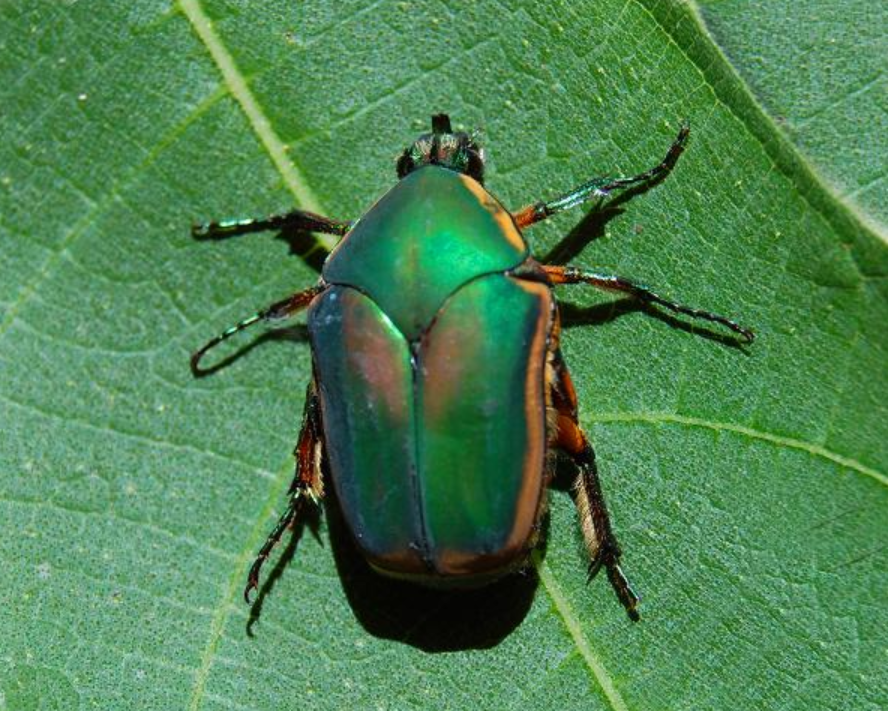
Green beetles are among the most eye-catching insects you may notice in a garden, lawn, forest trail, orchard, or even near porch lights. Some are bright emerald green. Others are olive, yellow-green, blue-green, or metallic green with bronze, copper, gold, or reddish reflections. A green beetle may be a garden visitor, a plant feeder, a fast-moving predator, a wood-boring beetle, or a harmless species resting on a leaf.
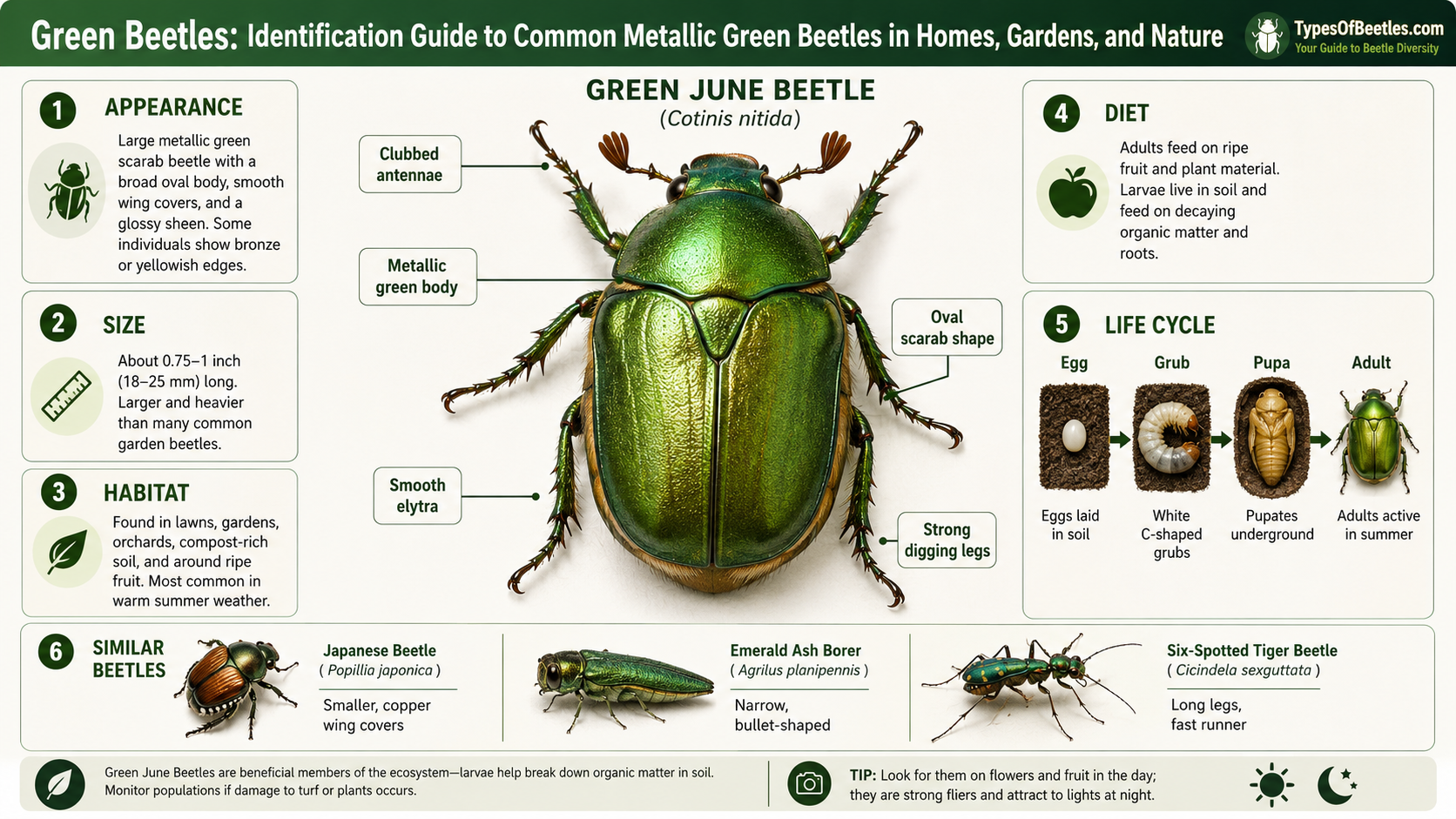
The most important thing to know is this: “green beetle” is a description, not a single species. Many unrelated beetles can appear green, and they may belong to very different beetle families. A large, heavy green beetle flying around fruit trees in summer is not the same as a small metallic green beetle on an ash tree, a spotted green beetle on cucumbers, or a fast green tiger beetle running across a sunny trail.
This guide will help you identify green beetles by looking at practical clues: size, body shape, color pattern, antennae, wing covers, legs, habitat, season, feeding behavior, and location.
About This Guide
This guide is designed for beginners, homeowners, gardeners, students, teachers, and nature enthusiasts who want a calm, practical way to understand green beetles.
Beetle identification can vary by:
- Region
- Season
- Life stage
- Lighting
- Photo quality
- Whether the beetle is alive, dead, damaged, or partly hidden
- Whether you are looking at an adult beetle, larva, or pupa
For that reason, this article does not promise guaranteed species identification from color alone. Instead, it teaches you how to observe multiple clues and narrow down the most likely possibilities.
For high-confidence identification, especially if you suspect an invasive pest or tree-damaging beetle, consult credible sources such as university extension services, museum resources, natural history references, government agriculture departments, and entomology guides.
What Are Green Beetles?
Green beetles are beetles with green, yellow-green, olive, blue-green, or metallic emerald coloring. The term may refer to many different species, including:
- Scarab beetles
- Leaf beetles
- Wood-boring beetles
- Tiger beetles
- Ground beetles
- Cucumber beetles
- Longhorn beetles
- Jewel beetles
Some green beetles are easy to recognize because they have strong markings, such as copper wing covers or black spots. Others are more difficult because several unrelated beetles can look shiny green at first glance.
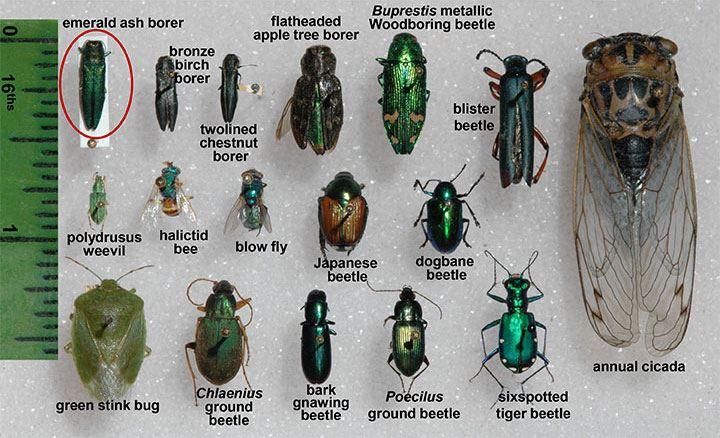
A good identification starts with one question:
Is the beetle simply green, or is it metallic green?
Metallic green beetles often look polished or jewel-like. Their color may shift when the beetle moves or when light hits it from a different angle. Non-metallic green beetles may appear flatter, softer, or more yellow-green.
Why Are Some Beetles Green or Metallic?
Many green beetles get their color from pigments, surface structure, or a combination of both. In some shiny beetles, the metallic appearance comes from microscopic structures in the outer shell that reflect light in special ways. This is called structural color.
A simple way to understand it:
- Pigment color works like paint.
- Structural color works more like light reflecting from tiny layered surfaces.
- Iridescence means the color may change slightly depending on the viewing angle.
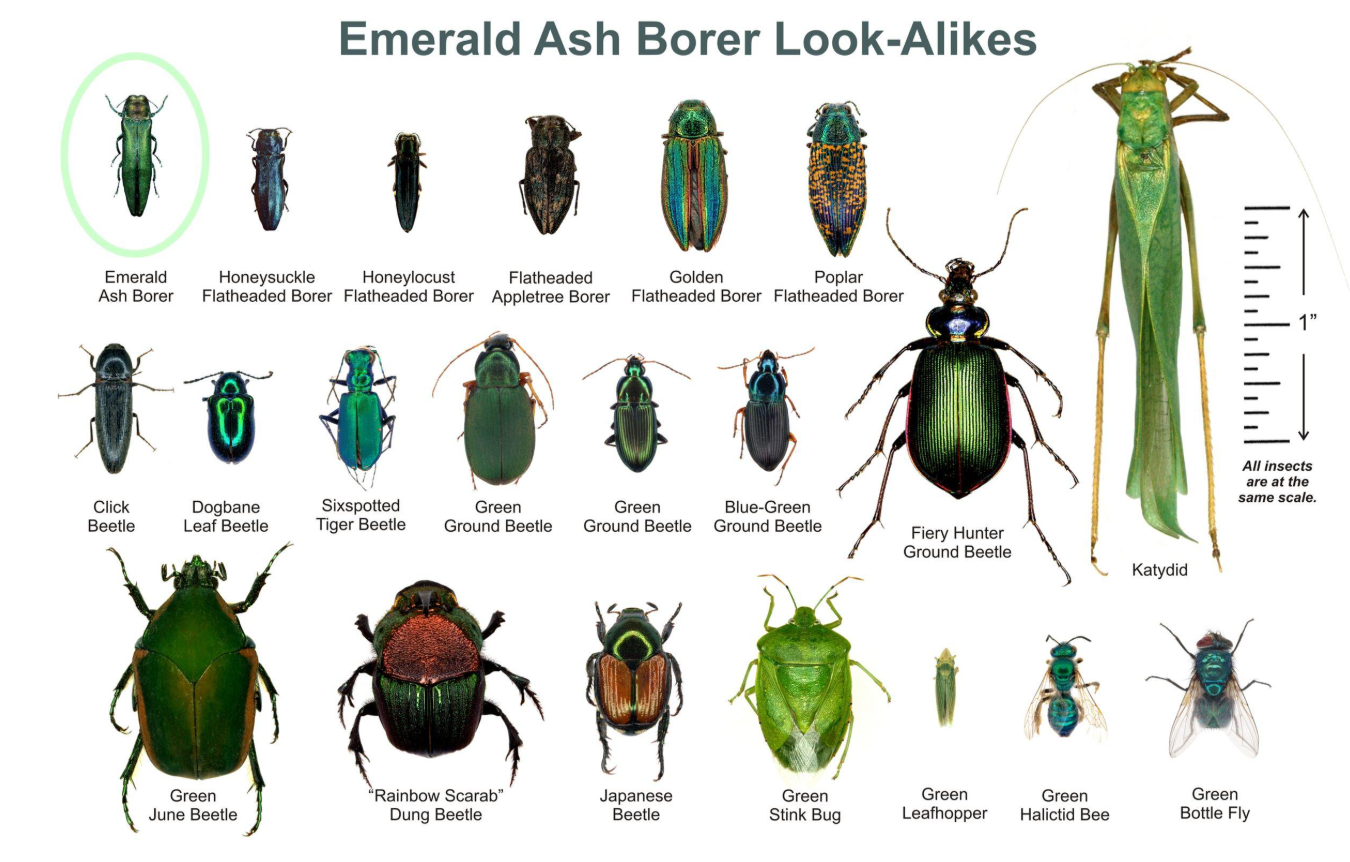
This is why some beetles look green from one direction, blue-green from another, and copper or gold when the light shifts.
Green coloring may help beetles blend with leaves, signal to other beetles, confuse predators, or simply result from the beetle’s natural body structure. It is not always a warning sign, and it does not automatically mean the beetle is dangerous.
Quick Green Beetle Identification Checklist
When you find a green beetle, observe more than color. Use this checklist:
- Size: Is it tiny, rice-sized, pea-sized, or nearly an inch long?
- Body shape: Is it oval, narrow, long, flat, rounded, or bullet-shaped?
- Wing covers: Are they copper, spotted, striped, smooth, ridged, or metallic?
- Antennae: Are they short, threadlike, clubbed, or long?
- Legs: Are they long and fast-moving, or short and sturdy?
- Head: Are the eyes large? Are the jaws obvious?
- Habitat: Was it on a flower, vegetable plant, tree trunk, lawn, trail, porch, or inside the house?
- Behavior: Was it feeding, flying clumsily, running quickly, resting, or boring into wood?
- Season: Did you see it in spring, early summer, midsummer, or fall?
- Location: What country, state, or region are you in?
Color is only the beginning. The full pattern gives a much better identification.
Common Types of Green Beetles
Below are some of the green beetles most often noticed by gardeners, homeowners, and nature observers.
Green June Beetle
The green June beetle is a large, shiny scarab beetle often seen flying during warm summer months. It is usually metallic green, sometimes with bronze or yellowish margins along the body.
How to Recognize a Green June Beetle
Look for:
- Large size, often close to 1 inch long
- Metallic green body
- Broad, oval, heavy shape
- Bronze, yellowish, or reddish tones near the edges
- Loud or clumsy flight
- Activity around lawns, fruit trees, compost, or ripe fruit
Green June beetles often attract attention because they are large and noticeable. Their flight can seem awkward, and they may bump into objects while flying.
Where You May Find It
Green June beetles may appear around:
- Lawns
- Pastures
- Gardens
- Fruit trees
- Compost piles
- Decaying organic matter
- Areas with rich soil
The larvae, often called grubs, live in the soil and feed on organic matter and roots. They are sometimes noticed when they move across the soil surface.
Is the Green June Beetle Harmful?
In small numbers, green June beetles are often just part of the summer insect community. In larger numbers, adults may feed on ripe fruit, and grubs may disturb turf or garden soil. The level of concern depends on the number of beetles and the setting.
Japanese Beetle
The Japanese beetle is one of the most commonly recognized metallic green beetles in gardens. It has a shiny green head and thorax, copper-brown wing covers, and small white hair patches along the sides of the abdomen.
How to Recognize a Japanese Beetle
Look for:
- Small to medium size, usually under 1/2 inch long
- Metallic green head and thorax
- Copper-brown wing covers
- White hair tufts along the sides of the abdomen
- Feeding groups on leaves, flowers, or fruit
The white side patches are one of the most useful clues. Many beetles are green or bronze, but Japanese beetles have a distinctive combination of metallic green, copper wing covers, and white tufts.
Where You May Find It
Japanese beetles are commonly seen on:
- Roses
- Grapes
- Fruit trees
- Linden
- Birch
- Beans
- Garden ornamentals
- Many broadleaf plants
They often feed in groups and may skeletonize leaves, leaving the veins behind.
Is the Japanese Beetle Harmful?
Japanese beetles can be significant garden pests where established. Adults feed on leaves, flowers, and fruit, while larvae live in soil and feed on grass roots. In small numbers, they may be a minor nuisance. In large numbers, they can cause visible plant damage.
Avoid panic-based control. A calm, practical approach starts with correct identification, monitoring, and local extension guidance.
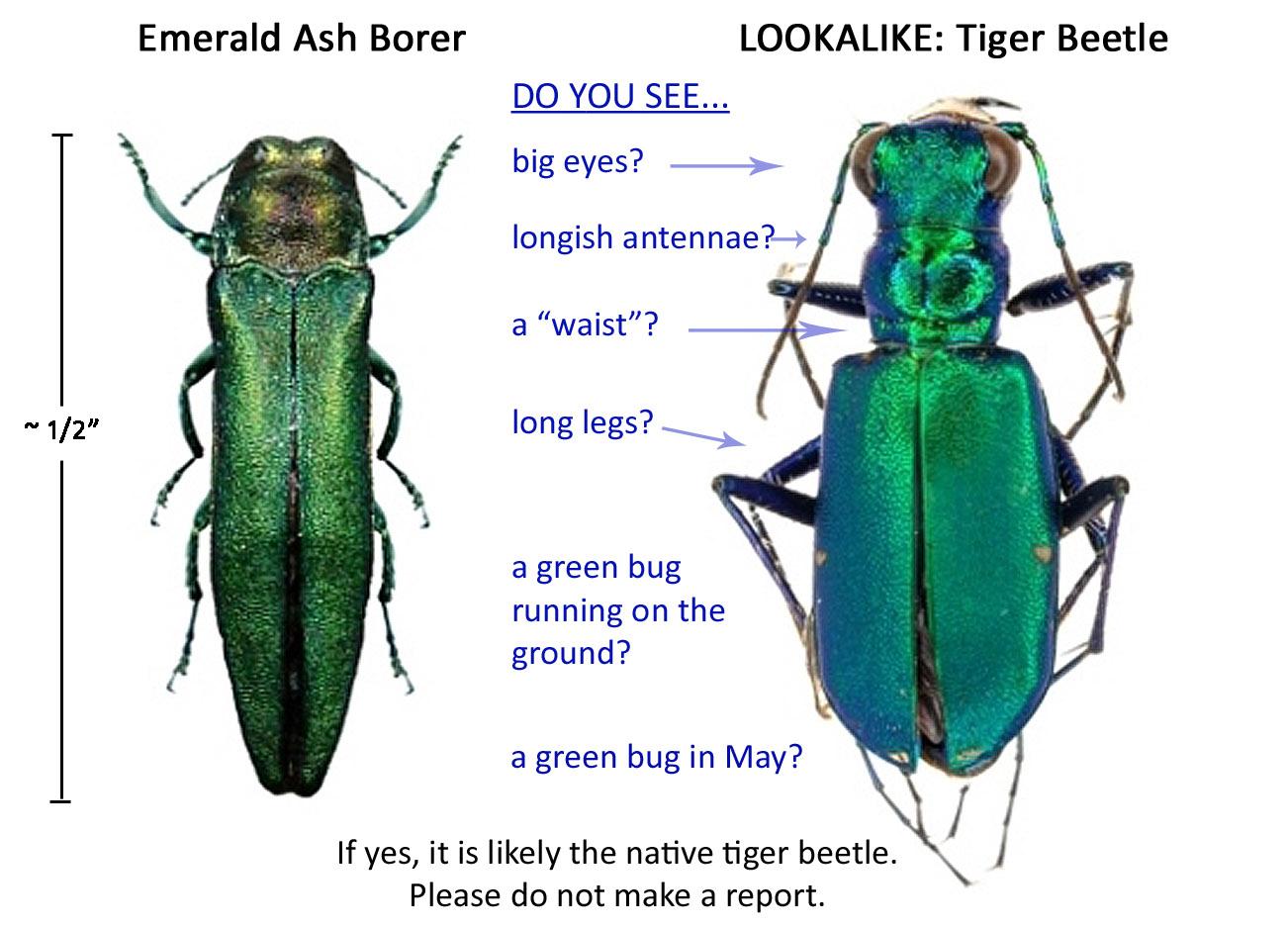
Emerald Ash Borer
The emerald ash borer is a small metallic green wood-boring beetle that attacks ash trees. It is important because it can seriously damage or kill ash trees in areas where it is established.
How to Recognize an Emerald Ash Borer
Look for:
- Small size, often around 3/8 to 1/2 inch long
- Narrow, bullet-shaped body
- Bright metallic green color
- Coppery-red or purplish abdomen under the wing covers
- Association with ash trees
- D-shaped exit holes in bark
- Winding larval galleries under bark
The emerald ash borer is sometimes confused with other shiny green beetles. Size and host tree matter. A large green beetle on a lawn is not an emerald ash borer. A fast green beetle running along a trail is more likely a tiger beetle. A true emerald ash borer is small, narrow, metallic, and strongly associated with ash trees.
Where You May Find It
Emerald ash borers are associated with:
- Ash trees
- Woodlots
- Urban street trees
- Parks
- Firewood movement
- Areas with declining ash trees
Why Identification Matters
If you suspect emerald ash borer, it is worth checking local government or extension guidance. This is one of the green beetles where professional confirmation may be important, especially if ash trees are declining.
Six-Spotted Tiger Beetle
The six-spotted tiger beetle is a bright metallic green predator often seen running quickly on sunny forest paths, trails, and open ground. Despite its name, it may have six spots, fewer spots, more spots, or no visible spots.
How to Recognize a Six-Spotted Tiger Beetle
Look for:
- Bright metallic green or blue-green body
- Long legs
- Large eyes
- Sickle-shaped jaws
- Fast running behavior
- Activity on sunny trails or open woodland paths
- Small white spots along wing cover edges, though spots may vary
Tiger beetles are hunters. They run, pause, and run again, often flying a short distance when approached.
Where You May Find It
Six-spotted tiger beetles are often seen in:
- Deciduous forests
- Woodland edges
- Dirt paths
- Trails
- Open sunny patches
- Sandy or bare soil areas
Is It Beneficial?
Yes. Tiger beetles are predators that feed on other small insects and arthropods. They are not garden pests, and they should usually be left alone.
Dogbane Beetle
The dogbane beetle is a beautiful iridescent leaf beetle with shifting green, blue, copper, gold, and reddish tones. It is closely associated with dogbane plants and sometimes milkweed relatives.
How to Recognize a Dogbane Beetle
Look for:
- Small, oval leaf beetle shape
- Brilliant metallic or iridescent surface
- Green, blue-green, copper, gold, or crimson reflections
- Presence on dogbane plants
- Calm feeding or resting behavior on leaves
This beetle is often admired because of its jewel-like color. It may look different depending on the light.
Where You May Find It
Dogbane beetles are usually found on or near:
- Dogbane
- Meadows
- Roadsides
- Fields
- Prairie-like habitats
- Native plant areas
Is It a Problem?
Usually not. Dogbane beetles feed on specific host plants and are mostly of interest to naturalists, photographers, and insect enthusiasts.
Spotted Cucumber Beetle
The spotted cucumber beetle is yellow-green rather than deep metallic green. It has black spots on the wing covers and is often found on vegetable plants.
How to Recognize a Spotted Cucumber Beetle
Look for:
- Small size, usually around 1/4 to 1/3 inch long
- Yellow-green wing covers
- Twelve black spots
- Black head
- Activity on cucumbers, squash, melons, pumpkins, or related plants
This beetle is not usually metallic like a Japanese beetle or emerald ash borer. Its green is softer and more yellowish.
Where You May Find It
Spotted cucumber beetles may appear on:
- Cucumbers
- Squash
- Melons
- Pumpkins
- Gourds
- Beans
- Garden flowers
- Vegetable beds
Garden Relevance
Cucumber beetles can chew leaves, flowers, and fruit. Some species can also spread plant diseases. In vegetable gardens, early identification is useful because young seedlings can be more vulnerable than mature plants.
Green Ground Beetles and Other Look-Alikes
Some ground beetles are green, bronze-green, or blue-green. These beetles are often found running on soil, under stones, in leaf litter, or around garden beds.
How to Recognize Many Green Ground Beetles
Look for:
- Flattened or oval body
- Long legs
- Fast running behavior
- Ground-level activity
- Usually not feeding openly on leaves
- Often seen at night or when disturbed
Many ground beetles are beneficial predators. They may eat other insects, larvae, and small invertebrates. Because many species look similar, identification to exact species may require a regional beetle guide or expert confirmation.
Green Beetles Compared
| Beetle | Typical Color | Shape | Common Habitat | Main Clue |
|---|---|---|---|---|
| Green June beetle | Metallic green with bronze or yellowish edges | Large, oval, heavy | Lawns, fruit trees, compost, gardens | Large size and clumsy summer flight |
| Japanese beetle | Metallic green with copper wing covers | Small oval scarab | Roses, grapes, ornamentals, gardens | White hair tufts along abdomen |
| Emerald ash borer | Bright metallic green | Small, narrow, bullet-shaped | Ash trees | Small size, ash association, D-shaped exit holes |
| Six-spotted tiger beetle | Metallic green or blue-green | Long-legged predator | Sunny woodland trails | Fast running, large eyes, strong jaws |
| Dogbane beetle | Iridescent green, blue, copper, gold | Small oval leaf beetle | Dogbane plants, meadows | Jewel-like color on dogbane |
| Spotted cucumber beetle | Yellow-green with black spots | Small leaf beetle | Vegetable gardens | Twelve black spots on yellow-green wings |
How to Identify Green Beetles Step by Step
Step 1: Estimate the Size
Size immediately narrows the possibilities.
- Nearly 1 inch long: green June beetle or another large scarab
- Around 1/2 inch: tiger beetle, Japanese beetle, some ground beetles
- Around 1/4 inch: cucumber beetle, small leaf beetle, small wood-boring beetle
- Rice-sized and narrow: possible emerald ash borer or another small metallic borer
Do not rely on memory alone. If possible, photograph the beetle near a coin, ruler, leaf, or fingertip for scale.
Step 2: Look at the Body Shape
Green beetles vary greatly in shape.
- Round and heavy: often scarabs
- Narrow and bullet-shaped: often wood-boring beetles
- Long-legged and fast: often tiger beetles or ground beetles
- Small and oval: often leaf beetles
- Flat and ground-running: often ground beetles
Body shape is often more reliable than color.
Step 3: Check the Wing Covers
A beetle’s hardened wing covers are called elytra. They form the shell-like back of the beetle.
Look for:
- Solid green wing covers
- Copper wing covers
- Black spots
- Black stripes
- White edge spots
- Ridges or grooves
- Metallic shine
- Matte texture
For example, Japanese beetles have coppery wing covers, while spotted cucumber beetles have yellow-green wing covers with black spots.
Step 4: Notice the Antennae
Antennae can help identify beetle groups.
- Scarab beetles often have clubbed antennae.
- Longhorn beetles have very long antennae.
- Leaf beetles usually have shorter, threadlike antennae.
- Ground beetles often have medium-length, threadlike antennae.
If the antennae are longer than the body, the beetle may belong to a longhorn beetle group rather than one of the common garden scarabs.
Step 5: Observe Behavior
Behavior is one of the most practical identification clues.
Ask:
- Is it flying loudly and clumsily?
- Is it feeding in a group?
- Is it running quickly and stopping suddenly?
- Is it boring into wood?
- Is it resting on a specific plant?
- Is it attracted to lights?
- Is it walking on the ground at night?
A bright green beetle sprinting along a sunny path is probably not the same kind of beetle as a green beetle feeding on roses.
Step 6: Identify the Plant or Habitat
Many beetles are easier to identify when you know where they were found.
- On ash trees: consider emerald ash borer or look-alikes.
- On cucumbers or squash: consider cucumber beetles.
- On roses or grapes: consider Japanese beetles.
- On dogbane: consider dogbane beetles.
- On forest trails: consider tiger beetles.
- In lawns or around ripe fruit: consider green June beetles.
The plant is often the clue that turns a vague “green beetle” into a likely identification.
Common Mistakes When Identifying Green Beetles
Mistake 1: Assuming Every Metallic Green Beetle Is an Emerald Ash Borer
Many insects are metallic green. The emerald ash borer is small, narrow, and associated with ash trees. Larger green beetles, tiger beetles, green ground beetles, and other metallic insects are often mistaken for it.
Mistake 2: Ignoring Size
A beetle that is nearly 1 inch long is not the same as a beetle that is 1/4 inch long. Size is one of the fastest ways to avoid a wrong identification.
Mistake 3: Relying Only on Color
Green is a broad color category. Some beetles look green only in certain light. Others shift between green, blue, copper, and gold. Always combine color with shape, size, behavior, and habitat.
Mistake 4: Confusing Beetles with True Bugs
Not every green insect is a beetle. Some green insects are:
- Stink bugs
- Leafhoppers
- Plant bugs
- Katydids
- Grasshoppers
- Shield bugs
Beetles have hardened wing covers that meet in a straight line down the back. True bugs often have a different wing shape and piercing-sucking mouthparts.
Mistake 5: Forgetting Regional Differences
A beetle common in one state or country may be absent in another. Regional checklists, extension resources, and local natural history groups can be very helpful.
Habitat and Behavior of Green Beetles
Green beetles live in many habitats. Their behavior depends on the species.
Gardens
In gardens, green beetles may feed on leaves, flowers, fruit, or pollen. Japanese beetles and cucumber beetles are common examples of garden-relevant green beetles.
Lawns
Green June beetle grubs may live in soil and organic matter. Adult beetles may fly over lawns in summer.
Forests and Trails
Tiger beetles may run across sunny paths. Ground beetles may hide under logs, stones, or leaf litter.
Trees
Some metallic green beetles are wood-borers. The emerald ash borer is the best-known example because of its impact on ash trees.
Meadows and Roadsides
Dogbane beetles and other leaf beetles may be found on specific host plants in open habitats.
Around Homes
Green beetles may come near homes because of lights, nearby plants, open doors, or seasonal movement. A green beetle indoors is often accidental unless there is a plant, stored material, or structural issue attracting insects.
What Do Green Beetles Eat?
There is no single green beetle diet. Different species eat different things.
Green beetles may feed on:
- Leaves
- Flowers
- Fruit
- Pollen
- Nectar
- Plant roots
- Decaying organic matter
- Wood or inner bark
- Other insects
- Specific host plants
Examples:
- Japanese beetles feed on leaves, flowers, and fruit of many plants.
- Green June beetle adults may feed on ripe fruit and plant material.
- Emerald ash borer larvae feed under the bark of ash trees.
- Six-spotted tiger beetles are predators.
- Dogbane beetles feed on dogbane plants.
- Spotted cucumber beetles feed on cucurbit crops and other plants.
To understand what a green beetle eats, identify the beetle first.
Life Cycle of Green Beetles
Most beetles go through complete metamorphosis. This means they have four main life stages:
- Egg
- Larva
- Pupa
- Adult
The larva often looks nothing like the adult. For example, a shiny adult scarab beetle may begin life as a pale grub in the soil. A wood-boring beetle may have a larva hidden under bark. A leaf beetle larva may live on or near host plants.
Egg Stage
Female beetles lay eggs in places where the young can survive. This may be soil, bark crevices, plant stems, leaf surfaces, or near host plant roots.
Larval Stage
The larva is often the main feeding stage. Beetle larvae may live:
- In soil
- Under bark
- Inside wood
- On leaves
- In plant roots
- In decaying matter
Pupal Stage
The pupa is the transformation stage. During this stage, the beetle changes from larva into adult form.
Adult Stage
The adult beetle is the stage most people notice. Adult beetles may fly, mate, feed, disperse, or search for host plants.
Green Beetles in the Home
Finding a green beetle inside the house does not always mean there is an infestation. Many beetles enter homes by accident.
Common reasons include:
- Attraction to porch lights
- Open doors or windows
- Nearby garden plants
- Firewood brought indoors
- Seasonal movement
- Beetles resting on clothing, plants, or outdoor items
What to Do If You Find One Indoors
A calm approach is usually enough:
- Capture it gently with a cup and paper.
- Release it outside if appropriate.
- Photograph it before release if you want identification help.
- Check nearby windows, doors, screens, and lights.
- Avoid assuming the beetle is harmful without more evidence.
If you repeatedly find beetles indoors, note the date, location, room, and number of insects. Repeated sightings may justify closer inspection.
Green Beetles in the Garden
Green beetles in the garden can be beneficial, neutral, or plant-feeding.
Potentially Beneficial Green Beetles
Some green beetles are predators. Tiger beetles and many ground beetles can help reduce populations of smaller insects and larvae.
Plant-Feeding Green Beetles
Some green beetles chew leaves, flowers, fruit, roots, or stems. Japanese beetles and cucumber beetles are common examples.
How to Assess Garden Impact
Ask:
- Are leaves only lightly chewed?
- Are beetles present in large numbers?
- Are flowers or fruit being damaged?
- Are seedlings wilting?
- Are several plants affected?
- Is the damage spreading?
- Are beneficial insects also present?
A few beetles do not always require action. Healthy gardens often contain many insects, including beetles.
When to Seek Professional Help
Professional or expert help may be useful when:
- You suspect emerald ash borer or another regulated invasive beetle.
- An ash tree is declining and has possible borer symptoms.
- Beetles are appearing indoors repeatedly.
- A garden crop is being damaged quickly.
- You cannot identify the beetle from photos.
- A school, public garden, orchard, nursery, or landscape planting is affected.
- You are unsure whether treatment is necessary.
For tree issues, consult a certified arborist, local extension office, or relevant agriculture or forestry agency. For garden issues, university extension resources are often the best starting point.
How to Photograph a Green Beetle for Identification
Good photos can make identification much easier.
Try to capture:
- Top view
- Side view
- Front view if safe and possible
- Antennae
- Legs
- Wing covers
- Plant or surface where it was found
- A size reference
- Any damage to leaves, bark, fruit, or flowers
Use natural light when possible. Avoid using a flash that washes out metallic color. Take several photos because beetle color can change with angle.
Credible Sources to Consult
- University extension publications
- Museum insect collections
- Natural history field guides
- Government agriculture departments
- Forestry agencies
- Entomology departments
- Regional insect checklists
- Local cooperative extension offices
- Reputable citizen science platforms with expert review
FAQ
Are green beetles harmful?
Some green beetles can damage plants or trees, but many are harmless or beneficial. The answer depends on the species. Japanese beetles and cucumber beetles can affect gardens, emerald ash borers can damage ash trees, and tiger beetles are beneficial predators.
What is the shiny green beetle in my garden?
A shiny green beetle in the garden may be a Japanese beetle, green June beetle, dogbane beetle, tiger beetle, ground beetle, or another species. Check its size, wing cover color, markings, plant host, and behavior.
How do I identify a green beetle?
Start with size, body shape, wing covers, antennae, legs, habitat, and behavior. A large oval beetle may be a green June beetle, while a small metallic beetle on ash trees may suggest emerald ash borer. A fast green beetle on a trail may be a tiger beetle.
What beetle is metallic green with copper wings?
A metallic green beetle with copper-brown wing covers is often a Japanese beetle, especially if it also has small white hair tufts along the sides of the abdomen.
What is a large green beetle flying around my yard?
A large metallic green beetle flying in summer may be a green June beetle or a related scarab. These beetles are often broad, shiny, and somewhat clumsy in flight.
What is a small green beetle on my ash tree?
A small narrow metallic green beetle on or near an ash tree may raise concern for emerald ash borer, but there are many look-alikes. Check for ash tree symptoms, D-shaped exit holes, bark splitting, canopy thinning, and local extension guidance.
Are green beetles attracted to light?
Some beetles are attracted to outdoor lights, especially at night. If a green beetle appears near a porch or window, it may have wandered in because of lighting rather than because of an indoor infestation.
Do green beetles bite?
Most green beetles do not bite people in any meaningful way. Some beetles have jaws and may pinch if handled roughly, but they are not trying to attack humans. Avoid handling unknown beetles with bare hands.
Are green beetles good for gardens?
Some are good for gardens because they are predators. Others feed on plants. Tiger beetles and many ground beetles are beneficial predators, while Japanese beetles and cucumber beetles may damage certain plants.
What do green beetles eat?
Green beetles may eat leaves, flowers, fruit, roots, wood tissue, pollen, nectar, decaying matter, or other insects. Their diet depends on the species.
Why do some beetles look metallic green?
Some beetles look metallic green because their outer shell reflects light through microscopic surface structures. This can create iridescent colors that shift between green, blue, copper, gold, or red.
Should I kill green beetles?
Do not kill green beetles automatically. First identify the beetle and understand whether it is beneficial, harmless, or damaging. If it is an invasive or serious plant pest, follow local extension or agriculture guidance.
Conclusion
Green beetles are not one single kind of beetle. They are a visually striking group of many different beetles that happen to share green, blue-green, yellow-green, or metallic coloring. Some are large summer scarabs, some are garden leaf feeders, some are fast predators, some are wood-borers, and some are harmless jewels of meadows and native plants.
To identify green beetles accurately, look beyond color. Study the beetle’s size, body shape, antennae, wing covers, legs, behavior, habitat, season, and location. A metallic green beetle on an ash tree, a copper-winged beetle on roses, a yellow-green spotted beetle on cucumbers, and a fast green beetle on a woodland trail all tell different stories.
The best identification comes from patient observation. Take clear photos, note the plant or habitat, compare multiple features, and consult reliable regional sources when needed. With a careful eye, green beetles become much easier to understand—and often far more interesting than they first appear.
1 thought on “Green Beetles: Identification Guide to Common Metallic Green Beetles in Homes, Gardens, and Nature”