

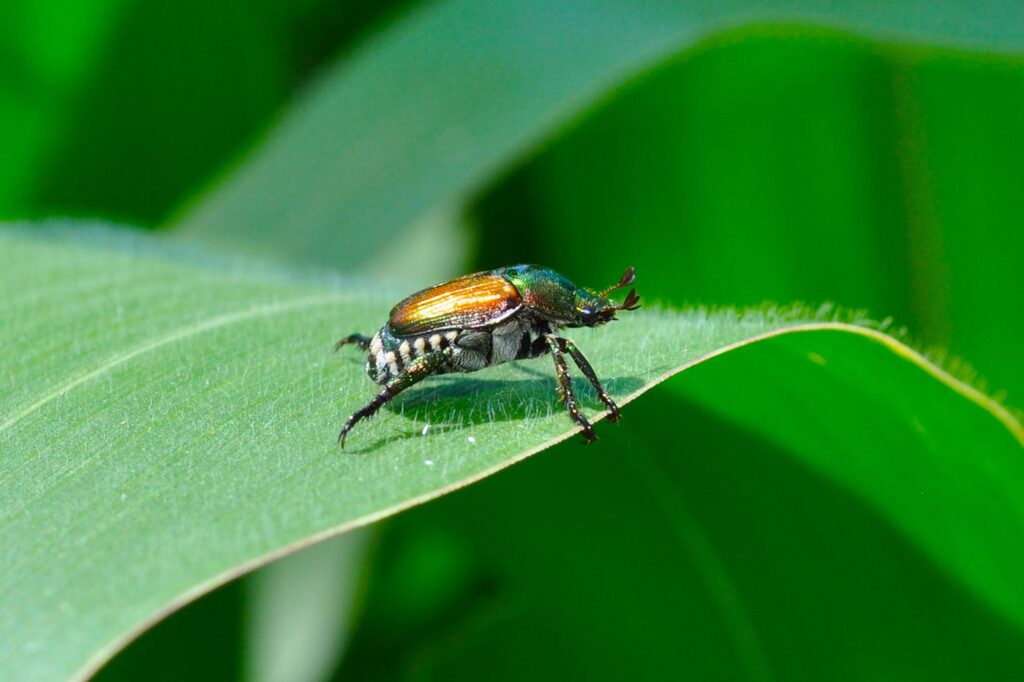
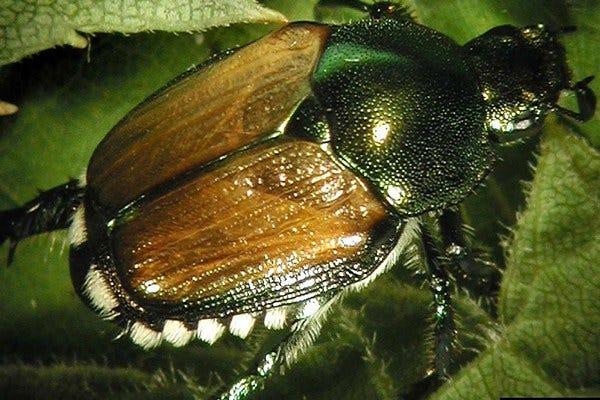
Japanese beetle identification is usually based on a combination of clues: a shiny metallic green head and thorax, copper-brown wing covers, a small oval body, and distinctive white hair patches along the sides and rear of the abdomen. The Japanese beetle life cycle includes four stages: egg, larva, pupa, and adult. In many regions where this beetle is established, it completes one generation per year.
For beginners, the most important point is this: do not rely on color alone. Several beetles can look green, bronze, brown, or shiny in sunlight. A responsible identification should consider body size, body shape, wing covers, antennae, white side patches, season, host plant, behavior, and location.
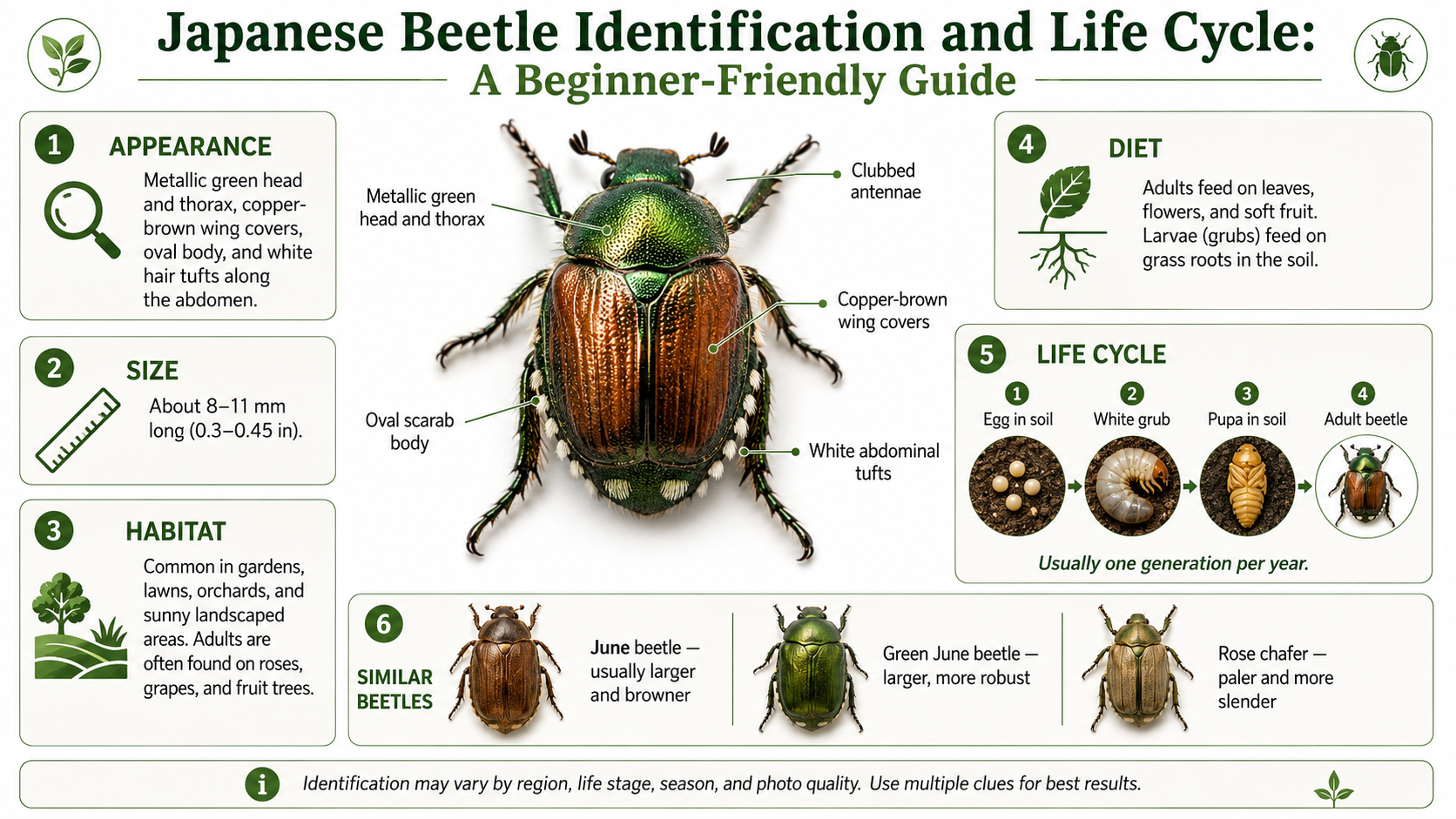
This guide is written for homeowners, gardeners, students, teachers, and nature enthusiasts who want a calm, practical explanation of what Japanese beetles look like, how they develop, where they live, and why they often appear around gardens and lawns in summer.
About This Guide
This guide is designed to help beginners understand Japanese beetle identification and the Japanese beetle life cycle without needing advanced entomology knowledge. It explains scientific terms in simple language and focuses on visible clues that can be observed in the field, garden, or classroom.
Beetle identification can vary by region, life stage, season, lighting, and photo quality. A small, blurry photo of a beetle on a leaf may not show the details needed for confident identification. Whenever possible, observe several clues together:
- Approximate size
- Body color and shine
- Body shape
- Antennae shape
- Wing cover color and texture
- White hair patches along the abdomen
- Host plant or habitat
- Time of year
- Feeding behavior
- Geographic location
This article is educational and should not be treated as a guaranteed species diagnosis in every case. For official reporting, pest management decisions, or regional confirmation, consult credible sources such as university extension resources, museum collections, government agriculture departments, natural history references, and entomology guides.
What Is a Japanese Beetle?
The Japanese beetle, scientifically known as Popillia japonica, is a species of scarab beetle. Scarab beetles are a large beetle family that includes many rounded, compact beetles with clubbed antennae and larvae commonly known as white grubs.
Adult Japanese beetles are best known for their bright metallic green and copper appearance. They are often seen feeding on leaves, flowers, and fruit during warm summer weather. Their larvae live underground as white grubs, where they feed mainly on roots, especially in grassy areas.
Although many people first notice Japanese beetles because of garden feeding damage, this species is also interesting from a natural history perspective. Its life cycle shows complete metamorphosis, meaning the beetle changes through very different body forms as it grows.
Japanese Beetle Identification: Key Features
The easiest way to identify an adult Japanese beetle is to look for a specific combination of features rather than one single trait.
Adult Japanese Beetle Quick ID
- Size: Usually about 1/3 to 1/2 inch long.
- Body shape: Oval, compact, and slightly rounded.
- Head and thorax: Shiny metallic green.
- Wing covers: Copper-brown or bronze.
- White side patches: Small white tufts of hair along the sides of the abdomen.
- Rear patches: Additional white hair patches near the tip of the abdomen.
- Antennae: Short antennae with clubbed tips, typical of scarab beetles.
- Behavior: Often feeds in groups on sunny plant surfaces.
Color
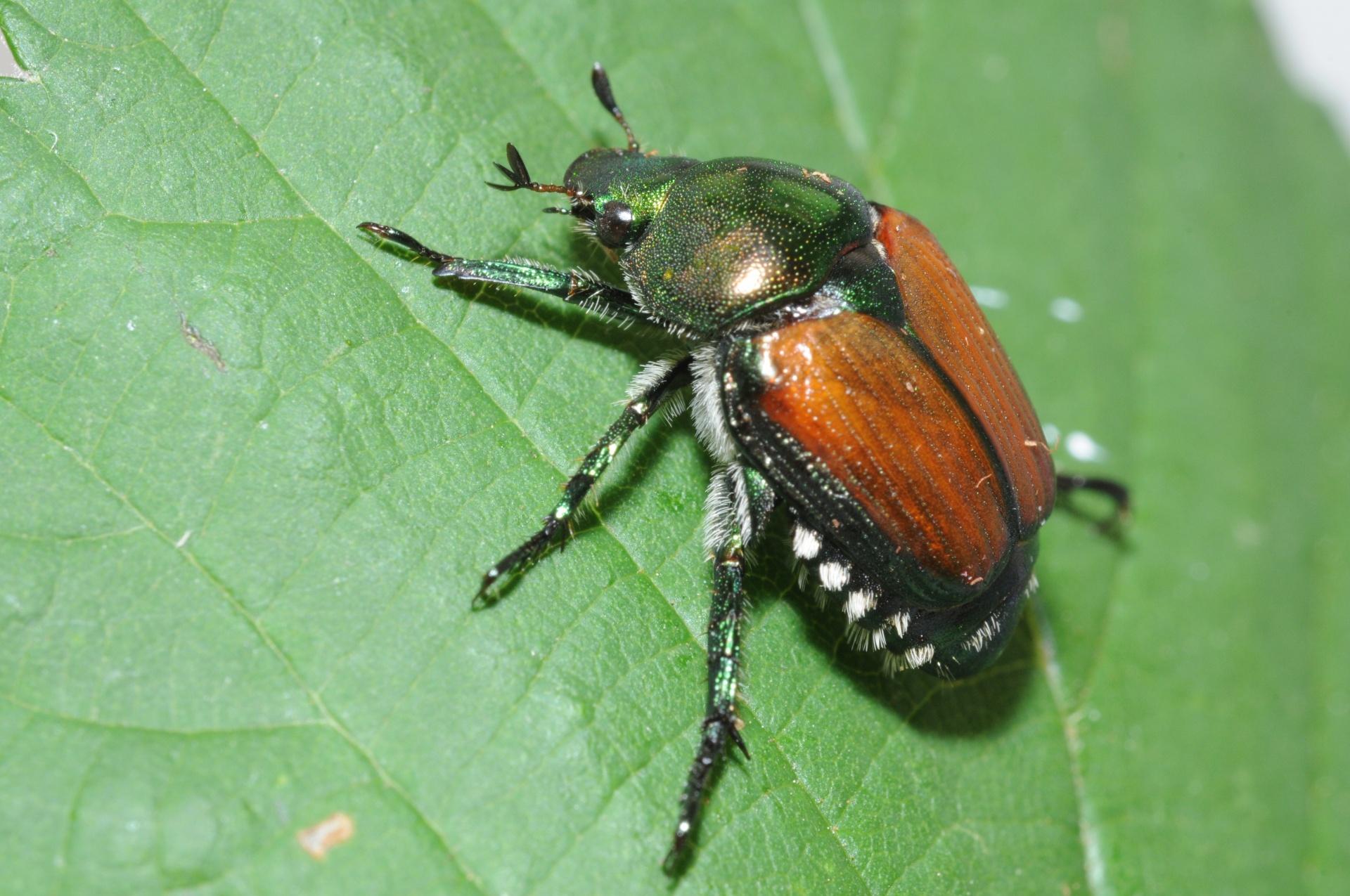
Japanese beetles have a metallic green head and thorax. The thorax is the body section just behind the head. Their wing covers, called elytra, are coppery brown to bronze. In bright sunlight, the beetle can look jewel-like, but color alone is not enough for identification.
Some beetles are also green, bronze, or shiny. Always check the white hair patches along the sides of the abdomen. These are among the most useful field marks for Japanese beetle identification.
Wing Covers
The wing covers of a Japanese beetle are copper-brown and do not completely hide the sides and tip of the abdomen. This is important because the exposed edges of the abdomen show the small white tufts of hair that help separate Japanese beetles from many look-alikes.
White Hair Patches
One of the strongest identification clues is the row of white hair patches along the sides of the abdomen, plus additional patches near the rear. These patches can look like small white dots or tufts when viewed from above or slightly from the side.
If a beetle looks metallic green and copper but does not show these white side patches, be careful. It may be another scarab beetle or a different shiny beetle species.
Body Size and Shape
Japanese beetles are small but not tiny. They are usually less than half an inch long, with an oval body that looks compact and rounded. They are much smaller than large green beetles such as green June beetles or figeater beetles.
Antennae
Japanese beetles have short antennae with small clubbed ends. In scarab beetles, these clubbed tips can sometimes open slightly like tiny fans. This feature is easier to see in close photographs than in casual garden observation.
How to Identify Japanese Beetle Grubs
Japanese beetle larvae are commonly called white grubs. They live in soil and are very different from the adult beetles. Instead of being shiny and green, they are pale, soft-bodied, and curved.
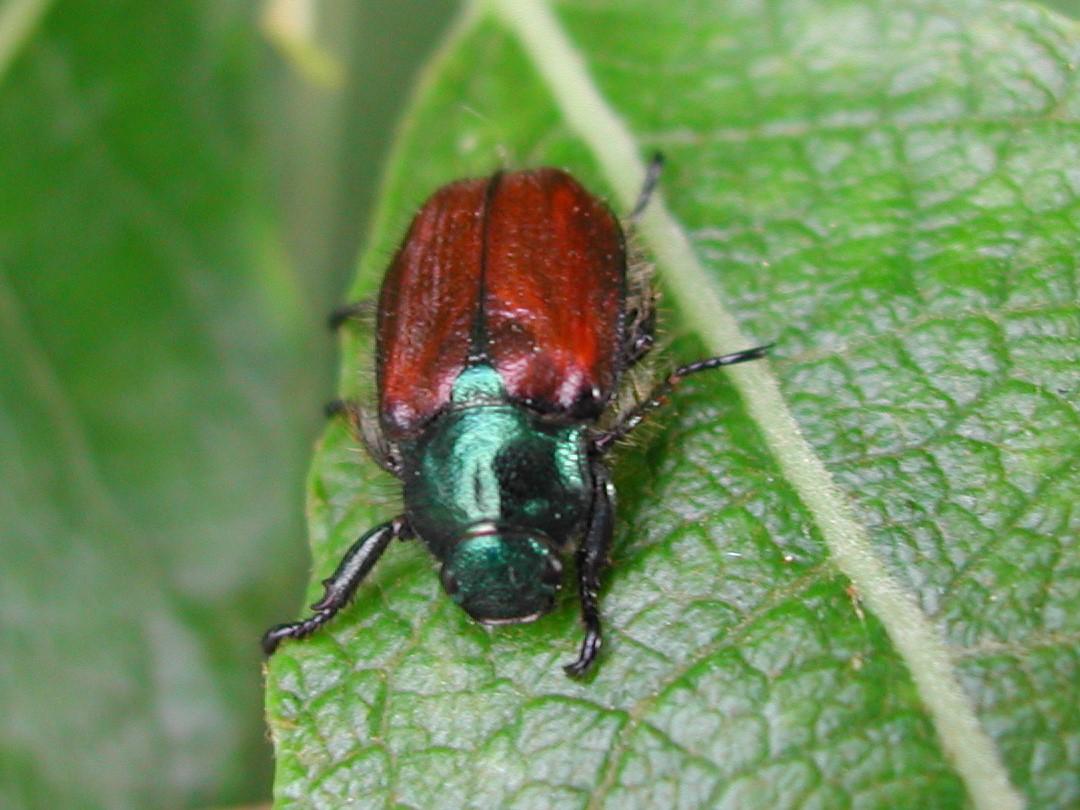
Japanese Beetle Grub Quick ID
- Shape: C-shaped when resting or disturbed.
- Color: White to cream-colored body.
- Head: Tan or light brown head capsule.
- Legs: Three pairs of visible legs near the front of the body.
- Size: Small when young, growing up to about one inch long.
- Habitat: Found in soil, especially under turfgrass or grassy areas.
Many scarab beetle larvae look similar. Japanese beetle grubs, masked chafer grubs, June beetle grubs, and other white grubs can be difficult to separate without examining the pattern of hairs and spines on the underside of the abdomen. For a beginner, it is often safer to identify them as “white grubs” unless expert confirmation is available.
Japanese Beetle Life Cycle
The Japanese beetle life cycle has four main stages: egg, larva, pupa, and adult. This is called complete metamorphosis. The young beetle does not look like a smaller version of the adult. Instead, it passes through a grub stage and a pupal stage before becoming a winged beetle.
1. Egg Stage
After mating, female Japanese beetles burrow into soil and lay eggs. They often choose moist soil in grassy areas, lawns, pastures, or mulched areas. The eggs are small and pale, and they are usually hidden underground where most people never see them.
Eggs generally hatch after a short period, often around one to two weeks depending on conditions. Soil moisture and temperature can affect survival and development.
2. Larval Stage
The larval stage is the white grub stage. This stage is spent underground. Young grubs feed on roots, especially grass roots. As they grow, they pass through several growth stages called instars. An instar is simply a stage between molts, when an insect sheds its outer covering and grows larger.
By late summer or fall, the grubs are larger and more mature. As soil temperatures cool, they move deeper into the soil to overwinter.
3. Pupal Stage
In spring, grubs move back toward the root zone and feed for a period before pupating. The pupa is a resting transformation stage. During this stage, the grub changes into an adult beetle inside a small chamber in the soil.
The pupa may look pale at first and gradually develop features of the adult beetle. This stage is usually hidden underground, so it is not commonly seen by casual observers.
4. Adult Stage
Adult Japanese beetles emerge from the soil in late spring or summer, depending on region and weather. In many areas, adults are most noticeable from late June through August. They feed, mate, and lay eggs, beginning the cycle again.
Adult beetles are often active on warm, sunny days. They may gather on preferred plants, feeding on leaves, flowers, and sometimes fruit.
Seasonal Timeline of the Japanese Beetle Life Cycle
The exact timing of the Japanese beetle life cycle can vary by climate, soil temperature, and region. However, a general yearly pattern is useful for beginners.
Spring
- Overwintered grubs move upward in the soil as temperatures rise.
- They feed on roots for several weeks.
- Mature grubs pupate in the soil.
Early to Mid-Summer
- Adult beetles emerge from the ground.
- Adults begin feeding on leaves, flowers, and fruit.
- Mating begins soon after emergence.
Mid to Late Summer
- Females lay eggs in soil.
- Eggs hatch into small grubs.
- Young grubs begin feeding on roots.
- Adults may continue feeding for several weeks.
Fall
- Grubs continue feeding and growing.
- As soil cools, grubs move deeper underground.
Winter
- Grubs remain inactive deeper in the soil.
- They survive the cold season underground and resume development in spring.
Habitat and Behavior
Japanese beetles are strongly associated with gardens, lawns, orchards, landscapes, parks, and agricultural areas. Adults are found above ground on host plants, while larvae are found below ground in soil.
Adult Habitat
Adult Japanese beetles are often seen on sunny plant surfaces. They may gather on roses, grapes, fruit trees, shrubs, vegetables, and ornamental plants. They tend to feed on leaves, flowers, and sometimes fruit.
Adults may cluster together on a single plant while nearby plants are less affected. This can happen because feeding beetles and damaged leaves can attract more beetles.
Larval Habitat
Larvae live underground, especially in grassy soil. Lawns, pastures, golf courses, parks, and other turf areas can provide suitable habitat for grubs. The grubs feed on roots and move deeper or shallower in the soil depending on temperature and season.
Daily Behavior
Adult Japanese beetles are often most active during warm, sunny conditions. They are less active in cool, windy, rainy, or cloudy weather. In gardens, they are usually easiest to spot during daylight when they are feeding openly on leaves and flowers.
What Do Japanese Beetles Eat?
Japanese beetles have different diets depending on their life stage.
Adult Diet
Adult Japanese beetles feed on leaves, flowers, and fruit of many plants. They are known to feed on a wide range of ornamental and agricultural plants. Commonly reported host plants include:
- Roses
- Grapes
- Apples
- Crabapples
- Cherries
- Plums
- Raspberries
- Linden trees
- Birch
- Elm
- Basil
- Virginia creeper
- Soybean
- Corn silks
They often skeletonize leaves. This means they eat the softer tissue between the leaf veins, leaving a lace-like pattern behind.
Larval Diet
Japanese beetle grubs feed underground on plant roots. They are especially associated with grass roots. Heavy grub feeding can reduce the ability of turfgrass to take up water and nutrients, which may lead to brown patches in lawns.
Signs of Japanese Beetles in Gardens and Lawns
Because Japanese beetles have both above-ground and below-ground stages, signs may appear in different places.
Signs on Garden Plants
- Lace-like or skeletonized leaves
- Irregular holes between leaf veins
- Damaged rose petals or blossoms
- Feeding groups of shiny green and copper beetles
- Beetles gathering on sunny upper leaves
- Damage on fruit, especially already injured or soft fruit
Signs in Lawns
- Brown or thinning turf patches
- Grass that pulls back easily like loose carpet
- White C-shaped grubs in the soil
- Skunks, raccoons, birds, or other animals digging for grubs
These signs do not always prove Japanese beetles are present. Other insects, soil problems, drought stress, disease, or different grub species can cause similar lawn symptoms.
Japanese Beetle vs Similar-Looking Beetles
Several beetles may be confused with Japanese beetles, especially if the photo is blurry or the beetle is seen only briefly. The best way to avoid mistakes is to compare size, shape, color, and white hair patches.
Japanese Beetle vs Green June Beetle
Green June beetles are generally much larger than Japanese beetles. They may appear green, bronze, or brownish, but they are more robust and do not show the same neat row of white side tufts that Japanese beetles have.
Japanese Beetle vs Figeater Beetle
Figeater beetles are also larger and greener overall. They are usually much bigger than Japanese beetles and have a different body shape. In areas where figeater beetles occur, size is one of the most helpful clues.
Japanese Beetle vs False Japanese Beetle
The false Japanese beetle can be similar in size, but it is usually less brightly metallic and more uniformly brownish. It also lacks the same strong combination of metallic green head, copper wing covers, and white abdominal hair patches.
Japanese Beetle vs Dogbane Beetle
Dogbane beetles are shiny and colorful, sometimes with green, copper, blue, or gold tones. However, they are shaped differently and are not scarab beetles. They also do not have the same white abdominal tufts as Japanese beetles.
Common Japanese Beetle Identification Mistakes
Mistake 1: Using Color Alone
Many beetles are shiny, green, copper, or bronze. Color is helpful, but it should not be the only clue. Check size, shape, wing covers, white side patches, and behavior.
Mistake 2: Assuming Every White Grub Is a Japanese Beetle
Many scarab beetle larvae are white, C-shaped grubs. Japanese beetle grubs can be difficult to distinguish from other white grubs without close examination. For general garden observation, it may be more accurate to say “white grub” unless the identification is confirmed.
Mistake 3: Ignoring Location
Japanese beetle distribution varies by region. In some places, the beetle is common and established. In other places, it may be absent, restricted, or subject to official monitoring. Location matters.
Mistake 4: Confusing Damage With Identification
Skeletonized leaves can suggest Japanese beetle activity, but leaf damage alone is not enough. Other insects can chew leaves too. Look for the beetles themselves whenever possible.
Mistake 5: Overlooking Season
Adult Japanese beetles are most often noticed in summer. If you see a similar beetle in a different season, it may still be possible in some climates, but you should be cautious and compare other clues carefully.
Home and Garden Relevance
Japanese beetles are often discussed in home and garden settings because adults feed on many common landscape plants and grubs may feed on grass roots. However, the level of concern depends on the situation.
Small numbers of adult beetles may cause visible leaf damage without seriously harming healthy, established plants. Young plants, stressed plants, small fruiting crops, and heavily defoliated ornamentals may be more affected.
In lawns, a few grubs may not cause noticeable damage. More serious turf problems are more likely when grub numbers are high, the grass is already stressed, or animals dig into the turf while searching for grubs.
How to Observe Japanese Beetles Responsibly
If you are trying to identify a Japanese beetle, take a calm and careful approach.
- Photograph the beetle from above and from the side.
- Include a size reference if possible.
- Record the host plant.
- Note the date and location.
- Look for white hair patches along the abdomen.
- Observe whether there are multiple beetles feeding together.
- Check whether the leaves show lace-like skeletonizing.
For students or teachers, Japanese beetles can be used to discuss insect life cycles, complete metamorphosis, invasive species, plant-insect relationships, and the difference between adult and larval habitats.
When to Seek Professional Help
Most casual sightings do not require professional help. However, there are situations where expert guidance is useful.
Contact a Local Extension Office or Agriculture Department If:
- You live in a region where Japanese beetles are not known to be established.
- You believe you found Japanese beetles in a quarantine or monitoring area.
- You need confirmation before making garden or turf management decisions.
- You find many grubs but are unsure which species they are.
- You manage a nursery, orchard, vineyard, farm, public garden, or large landscape.
Consult a Lawn or Plant Professional If:
- Turf can be rolled back easily and grubs are present.
- Young trees or shrubs are repeatedly defoliated.
- Damage is severe across a large property.
- You need a region-specific management plan.
Always use local guidance when decisions involve pesticides, quarantine rules, or official reporting. Product labels and regional regulations can change, and recommendations may differ by location.
Quick Identification Checklist
Use this checklist when comparing a suspected Japanese beetle:
- Is the beetle about 1/3 to 1/2 inch long?
- Does it have a metallic green head and thorax?
- Does it have copper-brown wing covers?
- Are there small white hair patches along the sides of the abdomen?
- Are there white patches near the rear of the abdomen?
- Is it feeding on leaves, flowers, or fruit in summer?
- Is the leaf damage lace-like or skeletonized?
- Is it found in a region where Japanese beetles are known to occur?
If most of these clues match, the beetle may be a Japanese beetle. If several clues are missing, compare it with similar beetles or consult a local expert.
FAQ: Japanese Beetle Identification and Japanese Beetle Life Cycle
What does a Japanese beetle look like?
A Japanese beetle is a small oval beetle with a metallic green head and thorax, copper-brown wing covers, and small white hair patches along the sides and rear of the abdomen.
How big is a Japanese beetle?
Adult Japanese beetles are usually about 1/3 to 1/2 inch long. They are much smaller than large green beetles such as green June beetles or figeater beetles.
What is the easiest way to identify a Japanese beetle?
The easiest way is to look for the full combination of metallic green body, copper-brown wing covers, oval shape, small size, and white hair patches along the abdomen.
What are the stages of the Japanese beetle life cycle?
The Japanese beetle life cycle has four stages: egg, larva, pupa, and adult. The larval stage is the white grub stage that lives in soil.
How long is the Japanese beetle life cycle?
In many regions where Japanese beetles are established, they complete one generation per year. Timing can vary with climate, soil temperature, and local conditions.
Where do Japanese beetles lay eggs?
Female Japanese beetles lay eggs in soil, often in moist grassy areas such as lawns, turf, pastures, or similar habitats where young grubs can feed on roots.
What do Japanese beetle grubs look like?
Japanese beetle grubs are white to cream-colored, C-shaped larvae with tan heads and visible legs near the front of the body. They live underground and feed on roots.
Can Japanese beetle grubs be identified easily?
Not always. Many white grubs look similar. Confident identification may require examining small hair and spine patterns on the underside of the abdomen, which is usually difficult for beginners.
What do Japanese beetles eat?
Adult Japanese beetles feed on leaves, flowers, and fruit of many plants. Their grubs feed mainly on roots, especially grass roots in lawns and other grassy areas.
Why do Japanese beetles make leaves look like lace?
Japanese beetles often eat the softer tissue between leaf veins. The remaining veins create a lace-like or skeletonized appearance.
Are Japanese beetles active all year?
Adults are mainly seen in summer. During colder months, the beetle is usually underground as a grub, inactive or slowly developing depending on soil temperature.
Should I report a Japanese beetle sighting?
Reporting depends on your location. In areas where Japanese beetles are not established or are under monitoring, suspected sightings may need to be reported to local agriculture or extension authorities.
Conclusion
Japanese beetle identification is most reliable when you use several clues together: metallic green head and thorax, copper-brown wing covers, small oval body, white abdominal hair patches, summer activity, host plants, and feeding behavior. The Japanese beetle life cycle includes egg, larva, pupa, and adult stages, with the grub stage hidden underground and the adult stage visible on plants during warm months.
For beginners, the goal is not to guess quickly, but to observe carefully. Look at size, color, body shape, antennae, wing covers, habitat, behavior, season, and location. When identification matters for garden decisions, official reporting, or pest management, compare your observation with trusted references from university extensions, museums, natural history resources, government agriculture agencies, and entomology guides.
By understanding both Japanese beetle identification and the Japanese beetle life cycle, readers can better recognize this beetle, understand its role in gardens and lawns, and make more informed observations throughout the year.