

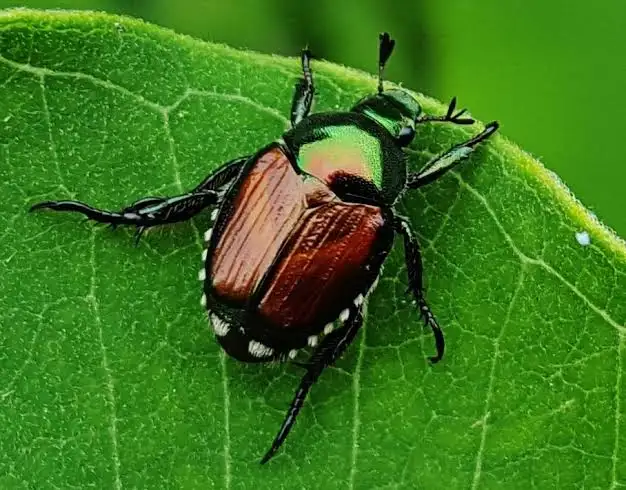
The Japanese beetle is a small but easy-to-recognize scarab beetle — shiny metallic green with copper-colored wing covers and rows of tiny white hair tufts along the sides of its abdomen. For many homeowners and gardeners, it’s one of the most familiar beetles of summer, showing up on roses, grapes, fruit trees, ornamental shrubs, and lawns.
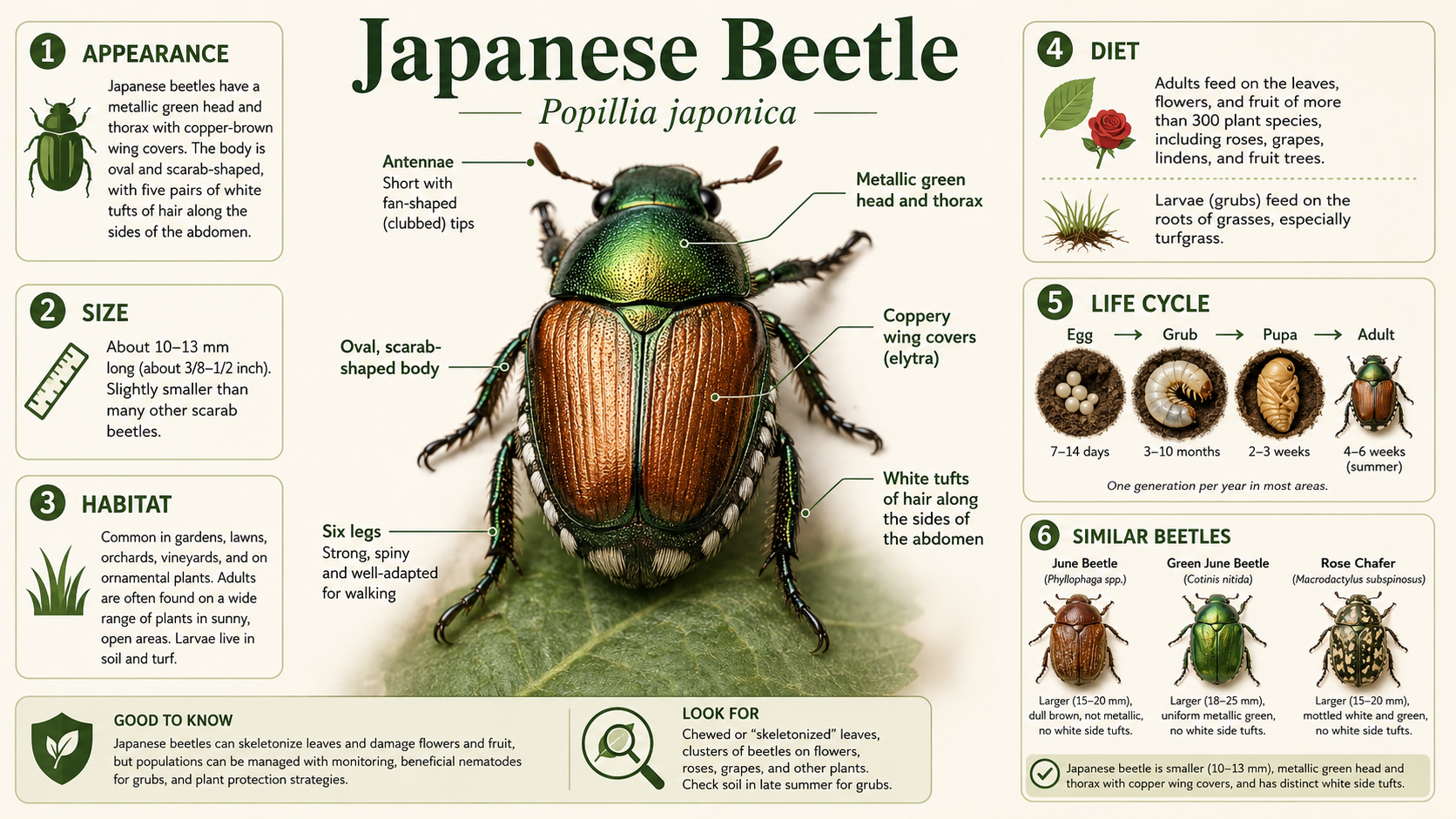
Scientifically known as Popillia japonica, the Japanese beetle is native to Japan but has become established across much of North America. It was first detected in the United States in New Jersey in 1916 and has since spread through many eastern and Midwestern states.
This guide explains how to identify a Japanese beetle, how its life cycle works, what it eats, why it turns up in gardens, how to recognize its larvae, and how to avoid confusing it with similar-looking beetles.
What Is a Japanese Beetle?
The Japanese beetle is a plant-feeding member of the scarab beetle family. Adults feed on leaves, flowers, and fruit above ground, while the larvae live in soil and feed on grass roots. The adults are often seen in clusters on garden plants during warm summer weather.
In North America, the Japanese beetle is considered an introduced species. In its native range, natural ecological pressures help keep populations in check. In areas where it has established outside that range, it can become locally common in gardens, orchards, vineyards, and turfgrass.
For identification purposes, the adult Japanese beetle is beginner-friendly because it has several distinctive features:
- A shiny metallic green head and thorax
- Coppery or bronze wing covers
- An oval, scarab-like body
- Small white hair tufts along each side of the abdomen
- A habit of feeding openly on leaves and flowers during summer
About This Guide
This guide is written for beginners, homeowners, gardeners, students, teachers, and nature enthusiasts who want a clear, practical explanation of the Japanese beetle without technical jargon.
Beetle identification depends on several factors: region, season, life stage, photo quality, lighting, and viewing angle. A beetle photographed from above may look different from one seen from the side. A larva found in soil is far harder to identify than an adult on a flower.
For a responsible ID, look at several clues together:
- Size and body shape
- Color pattern
- Antennae
- Wing covers
- White side tufts
- Host plant and location
- Behavior and season
- Whether you’re seeing an adult or a larva
This article can help you make a solid beginner-level identification. For confirmed species ID, consult a local extension office, university entomologist, or official agricultural resource.
Japanese Beetle Quick Identification
The adult stage is the easiest to identify. Here’s what to look for.
Quick ID Checklist
- Body length: about 3/8 to 1/2 inch (roughly 10–13 mm)
- Head and thorax: metallic green
- Wing covers: coppery brown or bronze
- Body shape: oval, compact, scarab-like
- White tufts: small patches of white hair along the sides of the abdomen
- Season: most active in summer
- Behavior: often feeds in groups on leaves, flowers, and fruit
- Common plants: roses, grapes, fruit trees, lindens, birches, beans, and many ornamentals
Kansas State University Extension describes adults as about 10–13 mm long, metallic green, with coppery-brown wing covers and white hair tufts along the abdomen.
Fast Answer for Beginners
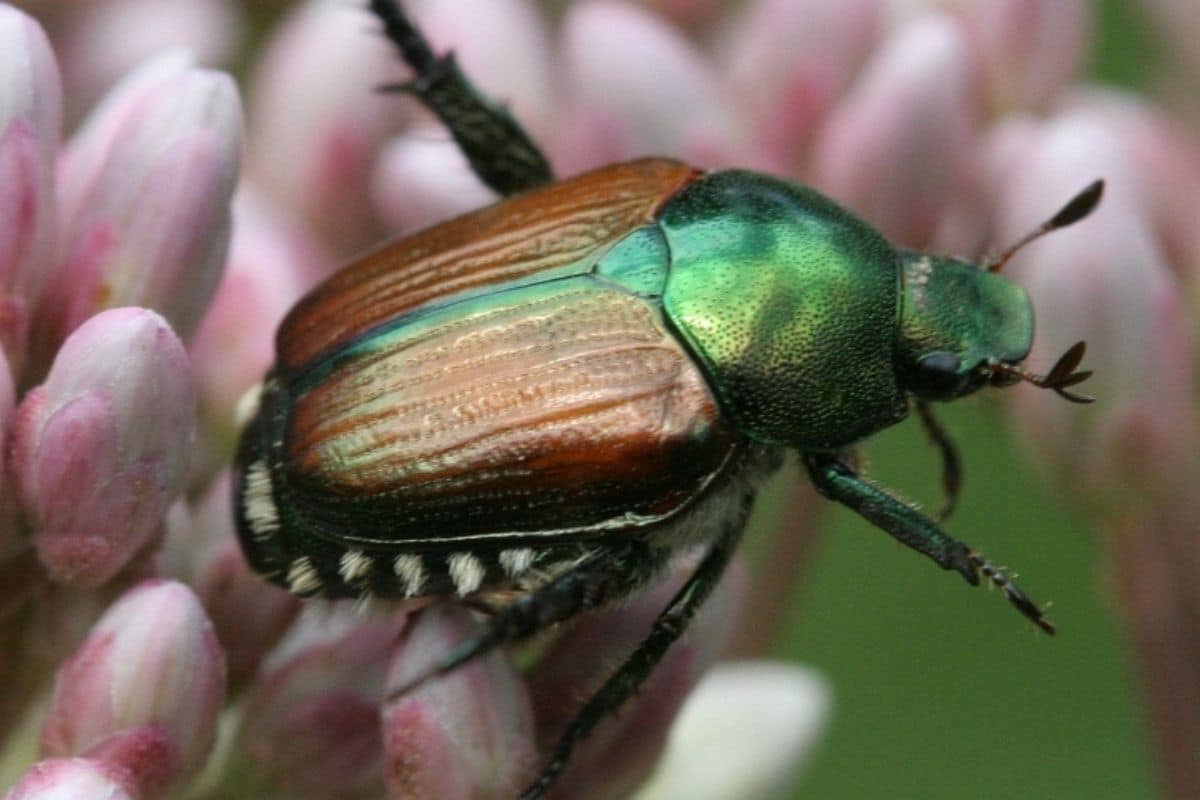
If you see a shiny green-and-copper beetle feeding on rose or grape leaves in summer, and it has small white tufts along the sides of its abdomen, it’s a reasonable candidate for a Japanese beetle.
What Does a Japanese Beetle Look Like?
The adult Japanese beetle has a polished, almost jewel-like appearance. Its colors can make it look attractive at first glance — which makes its feeding habits all the more surprising to new gardeners.
Head and Thorax
The head and thorax are metallic green. In direct sunlight, they may appear bright emerald, dark green, or greenish bronze depending on the angle.
Wing Covers
The hardened wing covers — called elytra — are coppery brown or bronze. Elytra are the protective outer shells found in beetles, covering the delicate flight wings underneath.
Abdomen and White Tufts
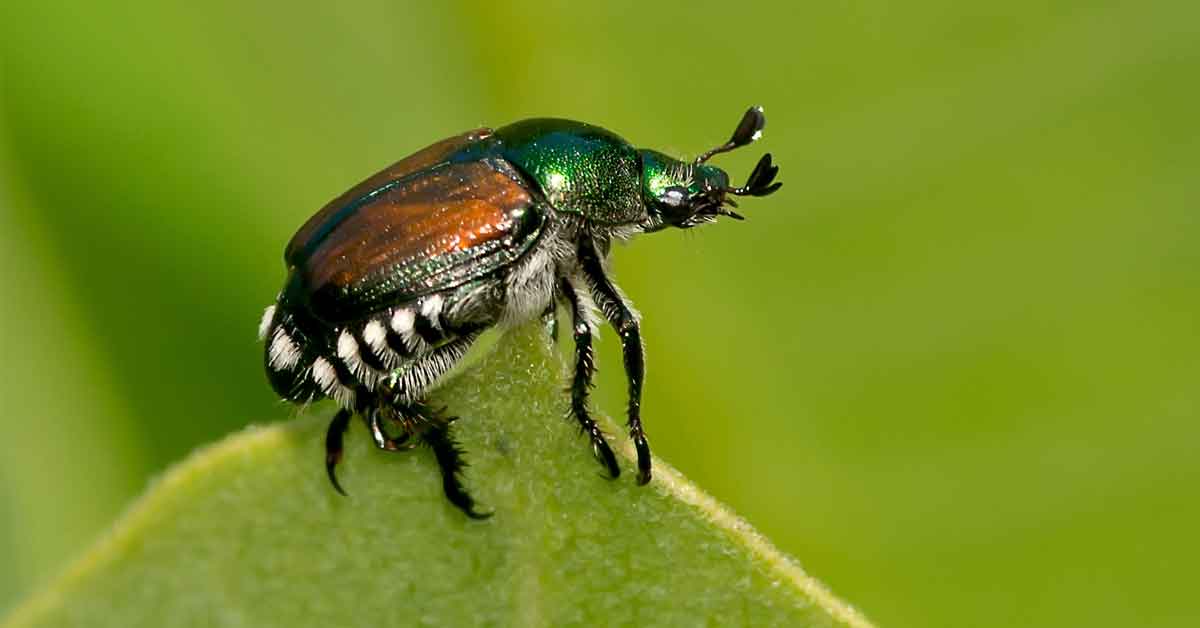
One of the most useful identification clues is the row of white hair tufts along the sides of the abdomen. These small white patches help separate Japanese beetles from many other metallic or brown scarabs.
Legs and Antennae
Japanese beetles have six legs and the short, clubbed antennae typical of scarab beetles. They don’t have the long antennae you’d see on a longhorn beetle.
Overall Shape
The body is oval, compact, and slightly rounded — not the elongated shape of a ground beetle, and without the very long antennae of wood-boring beetles.
Japanese Beetle Size, Color, and Body Shape
Size can be a helpful starting point, but it shouldn’t be your only clue. Many beetles are small and oval, and field estimates can be unreliable.
Typical Adult Size
Adults are commonly listed as about 3/8 to 1/2 inch long — smaller than many June beetles, larger than tiny pantry beetles, roughly the size of a small fingernail, and easy to see without magnification.
Color Pattern
The color combination is one of the best identification clues:
- Metallic green head and thorax
- Coppery bronze wing covers
- White hair tufts along the abdomen
- Darker green legs
Body Shape
Japanese beetles are scarab beetles: robust, oval, and slightly domed. They don’t look flat, narrow, or soft-bodied.
Japanese Beetle Life Cycle
The Japanese beetle has a complete life cycle with four stages: egg, larva (grub), pupa, and adult. Many extension sources describe the species as producing one generation per year across most of its established range.
Egg Stage
Female Japanese beetles lay eggs in soil, often in grassy areas. University of Minnesota Extension notes that after mating, females tunnel into the soil to lay their eggs.
Larval Stage
The larvae are white grubs that live underground, feeding on roots — especially grass roots. A Japanese beetle grub is typically:
- White or cream-colored
- C-shaped when disturbed
- Soft-bodied with a brownish head
- Found in soil, lawns, or turfgrass areas
Pupal Stage
After completing larval development, grubs pupate in the soil. The pupa is the transitional stage between larva and adult.
Adult Stage
Adult beetles emerge from the soil in summer. In many northern areas, they are most visible in July and August, though timing varies by region and weather. University of Minnesota Extension notes that adults often emerge in late June or early July, with peak feeding in July and August and some activity continuing into September.
Where Japanese Beetles Live
Japanese beetles are closely associated with landscapes that offer both food plants for adults and suitable soil for larvae.
Common Adult Habitats
Adults may be found in gardens, orchards, vineyards, rose beds, flower borders, fruit trees, shrub plantings, vegetable gardens, parks, yards, and field edges.
Common Larval Habitats
Larvae are usually found in soil beneath grassy areas — lawns, pastures, turfgrass, golf course turf, and grassy garden edges. They overwinter underground and move closer to the surface in spring to resume feeding.
Regional Variation
Japanese beetle abundance varies widely. In some areas it’s common and expected every summer. In others, detections may be limited, actively monitored, or regulated. Since the beetle’s distribution changes over time, it’s worth checking your local university extension or state agriculture department for region-specific information.
What Do Japanese Beetles Eat?
Adult Japanese beetles are broad feeders. They are known to consume many plant species, including ornamentals, fruits, vegetables, field crops, and wild plants.
University of Missouri Extension states that Japanese beetles feed on over 300 plant species. Ohio State University Extension notes that adults are general herbivores known to feed on over 400 species of broad-leaved plants, though only some are strongly preferred.
Common Adult Food Plants
Japanese beetles are frequently reported on roses, grapes, raspberries, apples, plums, cherries, linden trees, birch trees, beans, corn silks, zinnias, hibiscus, and many other ornamentals and broad-leaved plants.
How Adults Feed
Adult beetles often eat the soft tissue between leaf veins, leaving a lace-like or “skeletonized” appearance. They may also feed on flower petals, ripening fruit, and soft plant tissue — particularly on leaves exposed to full sun.
What Larvae Eat
Japanese beetle larvae feed underground, primarily on grass roots. This can contribute to brown or weakened patches in lawns, especially when grub numbers are high and turf is already stressed.
Japanese Beetle Damage in Gardens and Lawns
Damage looks different depending on whether you’re dealing with adults or larvae.
Adult Beetle Damage
Adults feed above ground. Their damage is usually visible on leaves, flowers, and fruit. Common signs include skeletonized leaves, ragged flowers, clusters of beetles on sunny plant surfaces, damaged rose petals, chewed grape leaves, and feeding on ripening fruit.
Lawn and Turf Damage
Larvae feeding on roots can cause brown patches, turf that lifts easily from the ground, increased bird or animal digging, and weak grass during dry periods.
That said, brown lawn patches have many possible causes — drought, disease, soil compaction, pet urine, and other grub species among them. Don’t assume Japanese beetle larvae are the culprit without inspecting the soil or consulting a local expert.
Does Japanese Beetle Feeding Kill Plants?
Not always. Light feeding on established ornamentals is often cosmetic. Heavy feeding, repeated defoliation, or damage to young plants, fruit crops, or already-stressed plants can be more serious.
The impact depends on the plant species, its overall health, how many beetles are present, the timing of feeding, weather conditions, and whether flowers or fruit are being targeted.
Japanese Beetle Larvae and White Grubs
The larval stage of the Japanese beetle is a type of white grub — the immature form of a scarab beetle that lives in soil.
What Japanese Beetle Grubs Look Like
A Japanese beetle grub is typically white or cream-colored, C-shaped when disturbed, soft and wrinkled, brown-headed, and found in soil near grass roots. University of Georgia Extension describes Japanese beetle larvae as small white grubs that curl into a C-shape when disturbed.
Why Grub Identification Is Difficult
Many scarab beetle larvae look nearly identical. Japanese beetle grubs can be confused with larvae of June beetles, masked chafers, green June beetles, and other scarabs.
Accurate grub ID often requires examining the raster pattern — a specific arrangement of hairs and markings near the rear end of the larva. This is generally beyond casual observation for beginners.
Beginner-Friendly Grub Advice
If you find a white grub in your lawn, take note of where it was found, how many were present, whether turf roots appear damaged, whether adult Japanese beetles were spotted earlier in summer, and whether your region has known Japanese beetle populations.
For exact identification, consult a local extension office or an entomology reference.
Japanese Beetle vs. Similar-Looking Beetles
The Japanese beetle is distinctive, but it can still be confused with other beetles. Here’s how to tell them apart.
Japanese Beetle vs. June Beetle
June beetles are usually larger, dull brown, and lack the Japanese beetle’s metallic green body and white side tufts. June beetles are also commonly attracted to outdoor lights at night, while Japanese beetles are daytime feeders.
Japanese Beetle vs. Green June Beetle
Green June beetles can look shiny and greenish, but they’re generally larger and more robust. Their color pattern and body proportions differ from the compact green-and-copper Japanese beetle.
Japanese Beetle vs. Rose Chafer
Rose chafers may also feed on flowers and leaves, including roses. They tend to be more tan or grayish and lack the strong metallic green-and-copper contrast of Japanese beetles.
Japanese Beetle vs. False Japanese Beetle
Some regions have scarab beetles that resemble Japanese beetles. The white abdominal tufts, body size, color contrast, and local distribution are the most useful clues — but exact identification may require a regional field guide.
Common Identification Mistakes
Mistake 1: Identifying by Plant Damage Alone
Skeletonized leaves can suggest Japanese beetle feeding, but other insects skeletonize leaves too. Look for the beetle itself when possible.
Mistake 2: Assuming Every White Grub Is a Japanese Beetle
Many scarab beetles produce white, C-shaped grubs. Finding one in your soil doesn’t automatically mean it’s a Japanese beetle.
Mistake 3: Ignoring Regional Distribution
If Japanese beetles aren’t established in your area, another beetle is more likely. Local distribution matters a lot.
Mistake 4: Relying on a Single Photo
A blurry photo can hide key features. For a reliable ID, try to capture multiple angles: from above, from the side, up close on the abdomen, and on the host plant with the surrounding habitat visible.
Mistake 5: Missing the White Side Tufts
The white hair tufts along the abdomen are among the most useful beginner-level clues. If you can’t see them clearly, hold off on a definitive identification.
Are Japanese Beetles Dangerous?
Japanese beetles are not dangerous to people the way stinging insects or disease-carrying pests are. They don’t sting, and they’re not known for biting people aggressively.
Their main significance is to plants, gardens, lawns, and agriculture.
Are Japanese Beetles Poisonous?
Japanese beetles are not generally considered poisonous to humans in standard garden identification resources. That said, they shouldn’t be eaten, handled unnecessarily, or given to pets without expert guidance.
Do Japanese Beetles Bite?
They have chewing mouthparts designed for plant tissue, not people. They’re not considered a biting threat. If handled roughly, many beetles may scratch or pinch slightly, but that’s not the same as a medically significant bite.
Are Japanese Beetles Bad for Gardens?
They can cause real damage, especially when large numbers of adults feed together. Their larvae can also affect turfgrass. How much concern is warranted depends on the specific plant, the number of beetles, and whether the damage is cosmetic or genuinely affecting plant health.
What to Do If You Find Japanese Beetles
This site is educational rather than a pest-control service. Still, most readers want practical next steps.
Step 1: Confirm the Identification
Look for: metallic green head and thorax, coppery wing covers, white side tufts, summer activity, feeding on leaves or flowers, and group feeding behavior.
Step 2: Note the Plant and Location
Write down the plant species, number of beetles, date, location, type of damage, and whether you’re seeing adults or larvae.
Step 3: Decide Whether the Damage Is Serious
A handful of beetles on a mature ornamental may not warrant major action. Heavy feeding on young plants, fruit crops, or valued ornamentals deserves closer attention.
Step 4: Consult Local Guidance
Because management depends on region, timing, plant type, and local regulations, reach out to university extension resources, your local agriculture department, government invasive species pages, or an entomologist.
USDA resources emphasize integrated pest management, which may combine cultural, biological, mechanical, and chemical strategies rather than relying on a single approach.
Japanese Beetles Around Homes and Gardens
Japanese beetles are most often noticed outdoors, not inside homes.
In Gardens
Adults may gather on roses, grapes, fruit trees, flowering shrubs, vegetable plants, and sunny foliage. They tend to feed in groups, and damaged leaves can attract more beetles. University of Minnesota Extension notes that beetle-damaged leaves can emit odors that draw in additional beetles, contributing to the clusters gardeners often see on certain plants.
In Lawns
The larval stage lives underground and may feed on grass roots. Lawn damage is most likely when grub numbers are high and the turf is already under stress.
Near Houses
Japanese beetles may occasionally land on walls, patios, screens, or outdoor furniture near gardens. They’re not typical indoor pests and don’t infest stored food the way some small household beetles do.
When to Seek Professional Help
Consider reaching out to a professional or local extension office if you’re seeing severe plant defoliation, if fruit crops or valuable ornamentals are affected, if turf lifts easily and grubs are present, or if you’re uncertain whether the insect is actually a Japanese beetle.
You may also want expert help if you live in an area where Japanese beetle detections are regulated, or if you’re managing a school garden, community garden, orchard, vineyard, or commercial landscape.
For pesticide or treatment decisions, always follow the product label and local regulations. University extension resources are often the best starting point, since recommendations vary by state, crop, season, and environmental conditions.
Educational Disclaimer
This article is for general beetle education and beginner-level identification. It is not a substitute for professional pest diagnosis, agricultural inspection, pesticide advice, or official invasive species reporting guidance.
For confirmed identification or management decisions, consult credible regional sources: university extension offices, government agriculture agencies, natural history museums, and entomology references.
Credible Source Types to Consult
- University extension publications (Minnesota, Missouri, Kansas State, Ohio State, Penn State, Illinois, Georgia, and others)
- USDA and national invasive species resources
- State or provincial agriculture departments
- Museum entomology references
- Peer-reviewed entomology literature
- Natural history field guides
- Local master gardener programs
Frequently Asked Questions
What does a Japanese beetle look like? An adult Japanese beetle is about 3/8 to 1/2 inch long with a metallic green head and thorax, coppery brown wing covers, and small white hair tufts along the sides of the abdomen.
When are Japanese beetles active? Adults are most active in summer, typically July and August in northern areas, though timing varies by region and weather.
What do Japanese beetles eat? Adults feed on the leaves, flowers, and fruit of many plant species. Larvae feed underground on grass roots.
How can I tell Japanese beetle grubs from other white grubs? It can be difficult. Japanese beetle grubs are white, C-shaped, and soft-bodied, but so are grubs from many other scarab beetles. Exact identification may require examining the raster pattern or consulting an extension specialist.
Are Japanese beetles harmful to people? No. They don’t sting and aren’t considered a biting threat to people. Their concern is primarily to plants and gardens.
What should I do if I find Japanese beetles in my garden? Confirm the identification, note the plant and extent of damage, assess whether action is needed, and consult your local university extension office for management guidance appropriate to your region.
2 thoughts on “Japanese Beetle Identification, Life Cycle, Damage, and Garden Guide”