

A rhinoceros beetle is a large, strong-bodied beetle best known for the horn-like projections found on many males. These beetles belong to the broader scarab beetle group, and many species are harmless decomposers whose larvae live in rotting wood, compost, leaf litter, or rich organic soil. If you have found a big beetle with a horn, a shiny body, and powerful legs near a porch light, woodpile, garden bed, or forest edge, there is a good chance you are looking at a rhinoceros beetle or one of its close relatives.
The name “rhinoceros beetle” can be confusing because it does not always refer to one single species. In many places, it is used for beetles in the subfamily Dynastinae, a group that includes Hercules beetles, ox beetles, elephant beetles, and several other impressive horned scarab beetles. In other regions, “rhinoceros beetle” may refer to one local species, such as the European rhinoceros beetle or the coconut rhinoceros beetle.
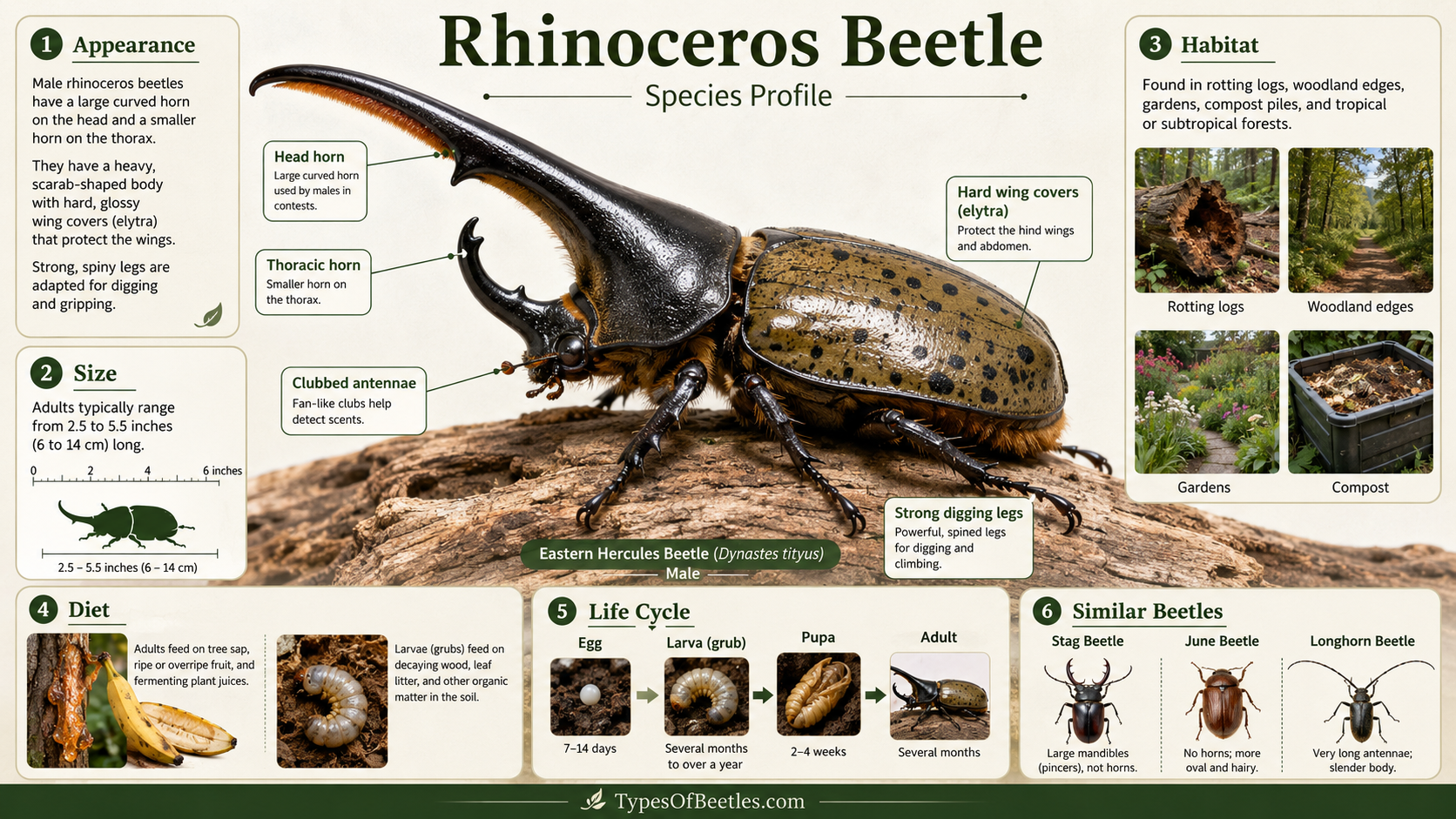
For beginners, the best way to identify a rhinoceros beetle is to look at several clues together: body size, body shape, horn structure, color, antennae, wing covers, legs, habitat, season, behavior, and location. One feature alone is rarely enough for a confident identification.
How This Guide Helps
This guide is designed for homeowners, gardeners, students, teachers, and nature enthusiasts who want a calm, practical way to understand rhinoceros beetles. It explains what these beetles look like, where they live, what they eat, how their life cycle works, and why they are often more ecologically useful than alarming.
Beetle identification can vary by region, season, life stage, and photo quality. A beetle photographed at night under a porch light may look darker or shinier than it does in daylight. A female may look very different from a male. A larva found in compost may be difficult to separate from other large scarab grubs without expert help.
This article can help you narrow down the most likely identification, but it should not be treated as a guaranteed species diagnosis. For difficult cases, compare your beetle with local university extension resources, museum collections, natural history guides, government agriculture resources, and entomology references.
Quick Answer: How Do You Identify a Rhinoceros Beetle?
A rhinoceros beetle is usually identified by its large, oval, heavy body; hardened wing covers; scarab-like shape; strong legs; and horn-like projections on the male’s head or thorax. Many species are black, brown, gray, greenish, or yellowish with darker markings. Females are often hornless or have only small bumps, so they may look less dramatic than males.
Common signs include:
- A stout, oval, armored-looking beetle body
- One or more horns on males
- Short, clubbed antennae typical of scarab beetles
- Strong legs with small claws
- Hardened wing covers called elytra
- Adults often seen at night or near lights
- Larvae found in rotting wood, compost, mulch, or rich organic matter
- Harmless behavior toward people in most common garden encounters
The exact appearance depends on the species. Some rhinoceros beetles are glossy black. Others are tan, greenish-gray, yellowish, or reddish-brown. Some are strongly horned, while others look more like large, rounded scarab beetles.
What Is a Rhinoceros Beetle?
A rhinoceros beetle is a type of scarab beetle known for its horned appearance, especially in males. The “rhinoceros” name comes from the horn-like structures that can look somewhat like the horn of a rhinoceros.
In scientific terms, many rhinoceros beetles belong to the scarab beetle family, Scarabaeidae, and the subfamily Dynastinae. This group includes some of the largest and most recognizable beetles in the world.
Rhinoceros beetles are insects, so they have:
- Six legs
- Three main body parts: head, thorax, and abdomen
- A hard outer skeleton
- Antennae
- A beetle life cycle with egg, larva, pupa, and adult stages
Like other beetles, rhinoceros beetles have hardened front wings called elytra. These wing covers protect the softer flying wings underneath. When the beetle flies, the elytra open and the hindwings unfold.
Why Are Rhinoceros Beetles So Strong?
Rhinoceros beetles are famous for their strength. Their compact bodies, powerful legs, and strong exoskeletons allow them to push through soil, leaf litter, and decaying wood. Male beetles also use their horns in contests with other males, usually over mates or breeding sites.
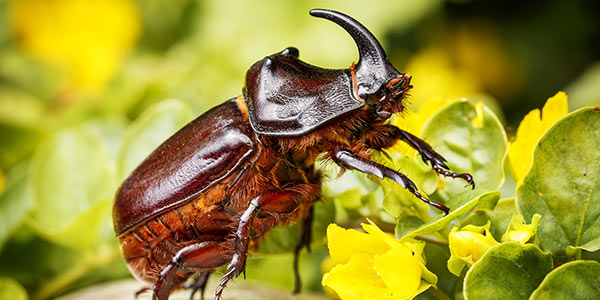
This strength is not used to attack people. In ordinary encounters, a rhinoceros beetle is much more likely to cling, crawl, dig, or try to escape than to behave aggressively. If handled, its claws may feel scratchy, but the beetle is not using its horn as a weapon against humans.
Rhinoceros Beetle Identification Clues
Correct identification depends on observing several traits together. Use the following clues as a beginner-friendly checklist.
1. Body Shape
Most rhinoceros beetles have a heavy, oval, compact body. They often look thick, rounded, and armored. Compared with many longhorn beetles or ground beetles, a rhinoceros beetle usually appears broader and more robust.
The body may look almost polished in some species. In others, the surface may be slightly matte, rough, pitted, or covered in fine hairs.
2. Horns
The horn is the most famous clue, but it is not always present.
Males may have:
- A single horn on the head
- A horn on the head and another on the thorax
- Multiple horn-like projections
- Short, upright horns
- Long, forward-pointing horns
Females may have:
- No obvious horn
- A small bump instead of a horn
- A less dramatic body shape than males
This is one reason people often misidentify female rhinoceros beetles. A female can belong to the same species as a horned male but look much plainer.
3. Color
Rhinoceros beetles vary widely in color. Depending on the species and condition, they may be:
- Black
- Dark brown
- Reddish-brown
- Grayish
- Greenish-gray
- Yellowish or tan with dark markings
- Glossy blue-black in some regional species
Moisture, age, lighting, and the beetle’s condition can affect how colors appear in photos. A beetle found in damp soil or rotting wood may look darker than one photographed in dry daylight.
4. Antennae
Rhinoceros beetles have scarab-style antennae with small clubbed ends. These are not long, threadlike antennae like those of longhorn beetles. If the beetle has very long antennae, it is probably not a rhinoceros beetle.
5. Legs and Feet
The legs are strong and built for gripping, digging, and crawling through rough surfaces. The feet have small claws that can cling tightly to bark, clothing, gloves, or skin. This can feel prickly, but it is not the same as biting or stinging.
6. Wing Covers
The hard wing covers, or elytra, form the smooth back of the beetle. On some species, the elytra are patterned with dark spots. On others, they are plain, glossy, ridged, or pitted.
7. Habitat
Rhinoceros beetles are often linked to:
- Decaying wood
- Old stumps
- Fallen logs
- Compost piles
- Leaf litter
- Mulch
- Forest edges
- Gardens with mature trees
- Warm, humid summer nights
- Porch lights and outdoor lamps
Habitat is important because many large scarab beetle larvae live underground or in organic material. Finding a huge grub in a rotting stump is a different clue from finding a beetle feeding openly on garden flowers.
Male vs Female Rhinoceros Beetles
Male and female rhinoceros beetles can look surprisingly different.
Male rhinoceros beetles are usually more dramatic. They often have large horns used in contests with other males. These contests are usually pushing or lifting battles rather than fights designed to injure. The male with the better leverage may force the other male away from a feeding site, mate, or breeding area.
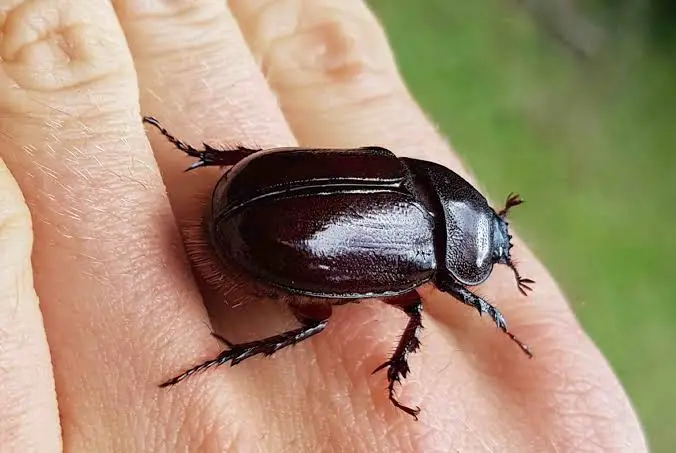
Female rhinoceros beetles are often hornless or have only small bumps. Their bodies may be similar in size but less ornamented. This can make females harder to identify, especially for beginners.
When trying to identify a rhinoceros beetle, do not assume that a hornless beetle cannot be part of this group. Look at the body shape, antennae, legs, habitat, and location as well.
Common Types of Rhinoceros Beetles
The exact species depends heavily on where you live. Here are several well-known examples.
Eastern Hercules Beetle
The eastern Hercules beetle is one of the best-known rhinoceros beetles in the eastern United States. Males have large forward-pointing horns, while females lack the dramatic horns. Adults are often greenish, grayish, tan, or yellowish with dark spots, although color and spotting can vary.
Larvae develop in decaying wood, especially old logs and stumps. Adults may be seen near lights at night or in wooded areas during warm months.
Western Hercules Beetle
The western Hercules beetle is a close relative found in parts of the southwestern United States. It can look similar to the eastern Hercules beetle but differs in range and some physical features.
Because eastern and western Hercules beetles can be visually similar, location is one of the most useful clues.
Ox Beetles
Ox beetles are large brown rhinoceros beetles found in parts of the southern United States and nearby regions. Males can have multiple horn-like projections. They are often attracted to lights and may be found around yards, gardens, and warm night lighting.
European Rhinoceros Beetle
The European rhinoceros beetle is a glossy dark beetle associated with old wood, compost, sawdust, and decaying plant material. Males have a noticeable horn, while females have a much smaller bump.
Coconut Rhinoceros Beetle
The coconut rhinoceros beetle is a special case because it can be a serious invasive pest in some tropical and island regions. Adults can damage coconut palms and other palms by boring into the crown area. Its larvae develop in decaying organic matter such as dead palms, logs, compost, or mulch.
For most readers, a rhinoceros beetle in the garden is not a crisis. But if you live in a region where coconut rhinoceros beetle is monitored, especially parts of Hawaii, Guam, or other Pacific areas, report suspicious beetles or palm damage to local agriculture authorities or extension offices.
Rhinoceros Beetle Habitat
Rhinoceros beetles are strongly connected to organic matter. Many species depend on dead wood or decomposing plant material during the larval stage. This makes them part of the natural recycling system in forests, parks, gardens, and wooded neighborhoods.
Common habitats include:
- Deciduous forests
- Tropical forests
- Woodland edges
- Old orchards
- Parks with mature trees
- Gardens with wood mulch
- Compost-rich areas
- Dead logs and stumps
- Rotting tree cavities
- Palm debris in tropical regions
Adults may be found above ground, especially during warm seasons. Many are active at night. They may come to porch lights, security lights, garage lights, or illuminated windows.
Larvae are usually hidden. They live in rotting wood, soil, compost, or other organic material, depending on the species.
Rhinoceros Beetle Behavior
Rhinoceros beetles are generally slow-moving, deliberate insects. They may seem clumsy when walking on smooth surfaces, but they are well adapted for bark, soil, leaf litter, and rough wood.
Common behaviors include:
- Flying at night
- Coming to outdoor lights
- Hiding under logs or leaf litter during the day
- Feeding on sap, fruit, or plant material
- Digging into soil or decaying organic matter
- Males pushing or lifting rival males
- Larvae tunneling through decaying wood or compost
A rhinoceros beetle may hiss or squeak when disturbed. This sound is usually produced by rubbing body parts together, not by vocal cords. It is a defensive warning or stress response, not a sign that the beetle is dangerous.
What Do Rhinoceros Beetles Eat?
Most rhinoceros beetles are plant-feeding insects, but their diet changes between larval and adult stages.
Adult Diet
Adult rhinoceros beetles may feed on:
- Tree sap
- Ripe fruit
- Fermenting fruit
- Nectar
- Bark fluids
- Soft plant material
Some adult feeding habits are not fully known for every species. In many cases, adults feed lightly or seasonally.
Larval Diet
Rhinoceros beetle larvae usually feed on decomposing organic material, such as:
- Rotting wood
- Dead leaves
- Compost
- Decaying plant matter
- Rotten stumps
- Organic-rich soil
- Palm debris in some species
This larval feeding can be ecologically useful because it helps break down dead plant material and return nutrients to the soil.
Rhinoceros Beetle Life Cycle
Like all beetles, rhinoceros beetles go through complete metamorphosis. This means they develop through four main stages:
- Egg
- Larva
- Pupa
- Adult
Egg Stage
Female beetles lay eggs in places where the larvae will have food after hatching. Depending on the species, this may be soil near rotting wood, compost, decaying logs, old stumps, or other organic material.
Larval Stage
The larva is a large, C-shaped grub. This is often the longest part of the life cycle. The grub feeds, grows, molts, and remains hidden in its food source.
In many rhinoceros beetles, the larval stage may last many months. In some species and climates, development can take a year or more.
Pupal Stage
After reaching full size, the larva forms a pupal chamber. Inside, the insect transforms from a grub into an adult beetle. The pupa may look pale, soft, and beetle-like, with developing legs, wings, and horns visible.
Adult Stage
The adult emerges when conditions are suitable. Adults often appear in warm months and may be seen flying at night, visiting sap flows, coming to lights, or searching for mates.
Rhinoceros Beetle Larvae: What Do the Grubs Look Like?
Rhinoceros beetle larvae are large, pale, C-shaped grubs. They usually have:
- A curved body
- Creamy white or yellowish color
- A brownish head capsule
- Chewing mouthparts
- Soft body segments
- A much larger size than many lawn grubs
Because many scarab beetle larvae look similar, it can be difficult to identify a rhinoceros beetle larva to species from appearance alone. Location and habitat help. A large grub inside a rotting stump or decaying log is more likely to be a wood-feeding scarab than a turf-damaging lawn grub, but expert confirmation may still be needed.
Avoid destroying grubs automatically unless there is clear evidence of plant damage or an invasive species concern. Many large beetle grubs are decomposers.
Are Rhinoceros Beetles Harmful?
Most rhinoceros beetles encountered by homeowners and nature enthusiasts are not harmful to people. They do not sting. They are not aggressive. They do not chase humans. If picked up, their claws may feel scratchy as they grip the skin, but this is not dangerous.
In gardens, many rhinoceros beetles are more beneficial than harmful because their larvae help decompose dead wood and organic material.
However, there are exceptions. Some species can damage plants in certain regions. The coconut rhinoceros beetle is the most important example because it can damage palms and crops in places where it is invasive.
The key is context. A single Hercules beetle near a porch light in a wooded neighborhood is usually a harmless wildlife sighting. Repeated palm crown damage in a region where coconut rhinoceros beetle is established should be handled through local reporting and professional guidance.
Rhinoceros Beetles in the Home
A rhinoceros beetle inside a home is usually an accidental visitor. It may have flown toward indoor light, entered through an open door, or been brought in with firewood, potted plants, or garden material.
If you find one indoors:
- Do not panic.
- Gently place a cup or container over it.
- Slide paper or cardboard underneath.
- Release it outside near vegetation, leaf litter, or a wooded area.
- Avoid releasing suspected invasive species in regions where reporting is required.
Rhinoceros beetles do not normally infest houses the way pantry pests, carpet beetles, or wood-boring structural pests can. Their larvae need organic material such as rotting wood, compost, or soil-like substrates, not dry household walls or clean indoor spaces.
Rhinoceros Beetles in the Garden
In gardens, rhinoceros beetles are often linked to soil health, compost, mulch, and decaying wood. A mature garden with old logs, leaf piles, or natural mulch can support beetle larvae and other decomposers.
They may be found:
- In compost heaps
- Under old logs
- In decaying stumps
- Around wood mulch
- Near outdoor lights
- In tree cavities
- Around fruiting trees
In most ordinary garden situations, seeing a rhinoceros beetle is not a reason to use pesticides. These beetles are part of the larger community of insects that recycle organic matter.
The exception is when a specific pest species is known in your region, or when beetles are associated with clear plant damage.
Rhinoceros Beetle vs Similar-Looking Beetles
Large beetles are easy to confuse. Here are the most common lookalikes.
| Beetle Type | Key Features | How It Differs from a Rhinoceros Beetle |
|---|---|---|
| Stag beetle | Large jaws, especially in males | The “antlers” are enlarged mandibles, not head or thorax horns |
| June beetle | Rounded scarab body, often brown or green | Usually smaller and lacks dramatic horns |
| Grapevine beetle | Tan or orange-brown with spots | More softly patterned and usually without horns |
| Longhorn beetle | Very long antennae | Rhinoceros beetles have shorter clubbed antennae |
| Ground beetle | Fast-running, often black | Usually flatter, longer-legged, and without scarab antennae |
| Ox beetle | Large brown rhinoceros beetle relative | Actually belongs near rhinoceros beetles; identification depends on horn pattern and range |
| Flower chafer | Often colorful scarab beetle | Usually smaller, flatter, and flower-associated |
Rhinoceros Beetle vs Stag Beetle
Rhinoceros beetles and stag beetles are often confused because both can be large and impressive.
The easiest difference is the “horns” versus “jaws.”
A rhinoceros beetle has horn-like projections on the head or thorax. These horns are not mouthparts.
A stag beetle has enlarged mandibles. These are modified jaws, and they sit at the front of the head like antlers.
Stag beetles are often more elongated, while rhinoceros beetles are usually more oval, bulky, and scarab-like.
Rhinoceros Beetle vs June Beetle
June beetles are also scarab beetles, so they can look similar in body shape. However, June beetles are usually smaller, lack large horns, and are more often seen swarming around lights in late spring or summer.
A horned male rhinoceros beetle is easy to separate from a June beetle. A female rhinoceros beetle can be more difficult because she may lack obvious horns. In that case, size, habitat, and local species range become more important.
Rhinoceros Beetle vs Longhorn Beetle
Longhorn beetles have long antennae, often as long as or longer than the body. Rhinoceros beetles do not. Their antennae are shorter and clubbed.
If your beetle has extremely long antennae, it is probably not a rhinoceros beetle, even if it is large and dark.
Common Identification Mistakes
Mistake 1: Assuming Every Horned Beetle Is the Same Species
Many beetles have horns or horn-like structures. The exact species depends on region, size, horn shape, color, and habitat.
Mistake 2: Ignoring Females
Female rhinoceros beetles may be hornless. A hornless beetle can still be a rhinoceros beetle, especially if it has the right scarab body shape and was found in the right habitat.
Mistake 3: Identifying from Color Alone
Color can vary within a species. Lighting, moisture, age, and photo quality can all change how the beetle appears.
Mistake 4: Confusing Larvae with Lawn Pests
Large C-shaped grubs are not all the same. Some feed on living roots, while others feed mainly on decaying wood or organic matter. Habitat matters.
Mistake 5: Treating Every Large Beetle as a Pest
Many large beetles are harmless or beneficial decomposers. Identification should come before control.
When to Seek Professional Help
Most rhinoceros beetle sightings do not require professional help. A single adult beetle near a porch light, garden, or woodpile is usually just a wildlife observation.
Consider contacting a local extension office, natural history museum, agriculture department, arborist, or licensed pest professional if:
- You live in a region where coconut rhinoceros beetle is monitored.
- You see repeated damage to coconut palms, oil palms, or other palms.
- Palm fronds show V-shaped cuts or boring damage near the crown.
- You find many large grubs in nursery stock, potting media, or commercial growing material.
- You are responsible for a school, public garden, farm, nursery, or landscape site.
- You need a species-level identification for reporting or management.
- The beetle may be part of an invasive species alert.
For ordinary home and garden sightings, photos are often enough for a local expert to offer guidance. Take clear images from above, the side, and the front, and include an object for scale.
How to Photograph a Rhinoceros Beetle for Identification
Good photos make identification much easier.
Try to capture:
- Top view showing body shape and wing covers
- Side view showing horn structure
- Front view showing head and antennae
- A close-up of the horn or bumps
- The beetle next to a ruler, coin, or common object
- The habitat where it was found
- Location and date
Avoid using flash so close that it washes out the color. Natural shade or soft indoor light often works better.
Educational Disclaimer
This guide is intended for general beetle education and beginner identification. It cannot guarantee species-level identification from a written description alone. Rhinoceros beetle identification may depend on location, season, sex, life stage, body size, horn shape, and detailed anatomical features.
For confirmed identification, consult regional entomology references, university extension services, museum collections, government agriculture resources, or trained insect specialists.
FAQ About Rhinoceros Beetles
What is a rhinoceros beetle?
A rhinoceros beetle is a type of scarab beetle known for the horn-like structures found on many males. The name may refer to several related horned beetles, not just one species.
Are rhinoceros beetles dangerous?
Most rhinoceros beetles are not dangerous to people. They do not sting, and they are not aggressive. Their feet may feel scratchy if they grip your skin.
Do rhinoceros beetles bite?
Rhinoceros beetles have chewing mouthparts, but they are not known for biting people in ordinary encounters. They are much more likely to crawl away or cling tightly.
Why do rhinoceros beetles have horns?
Male rhinoceros beetles use their horns mainly in contests with other males. The horns help them push, lift, or move rivals away from mates or breeding sites.
Do female rhinoceros beetles have horns?
Females often lack large horns. Some have only small bumps or raised areas. This makes female rhinoceros beetles harder to identify than males.
What do rhinoceros beetles eat?
Adults may feed on sap, fruit, nectar, or soft plant material. Larvae usually feed on decaying wood, compost, dead leaves, or other organic matter.
Where do rhinoceros beetles live?
They may live in forests, gardens, parks, compost areas, old stumps, fallen logs, leaf litter, and tropical habitats. The exact habitat depends on the species.
Why did I find a rhinoceros beetle near my porch light?
Many adult beetles fly at night and are attracted to artificial lights. A beetle near a porch light is often an accidental visitor.
Are rhinoceros beetles good for the garden?
Many rhinoceros beetles are useful decomposers because their larvae help break down dead wood and organic material. Some species, however, can be pests in specific regions or crops.
Are rhinoceros beetle larvae bad for plants?
Not always. Many larvae feed on decaying wood rather than living roots. Large grubs in rotting logs or compost may be decomposers, not garden pests.
What is the difference between a rhinoceros beetle and a stag beetle?
Rhinoceros beetles have horn-like projections on the head or thorax. Stag beetles have enlarged jaws that look like antlers.
Can rhinoceros beetles fly?
Yes. Adult rhinoceros beetles can fly, although their heavy bodies may make their flight look slow or awkward.
Should I remove rhinoceros beetles from my garden?
Usually, no removal is needed. If the beetle is a harmless native or local decomposer, it can be left alone. If you suspect an invasive species or plant damage, contact a local expert.
What should I do if I find a large rhinoceros beetle grub?
Note where it was found. If it was in rotting wood or compost, it may be a beneficial decomposer. If it was damaging plant roots or found in nursery material, ask a local extension office for identification.
Is the coconut rhinoceros beetle the same as other rhinoceros beetles?
It is one species of rhinoceros beetle, but it has special importance because it can damage palms and tropical crops in regions where it is invasive.
Conclusion
The rhinoceros beetle is one of the most memorable beetles a person can find. Its heavy body, strong legs, hardened wing covers, and horned males make it look almost prehistoric. Yet in most home and garden encounters, this beetle is not something to fear. Many rhinoceros beetles are quiet decomposers, spending much of their lives as larvae in rotting wood, compost, or rich organic matter.
For identification, do not rely on the horn alone. Look at the whole beetle: size, shape, color, antennae, wing covers, legs, behavior, habitat, season, and location. Remember that females may be hornless and that similar beetles, such as stag beetles, June beetles, ox beetles, and longhorn beetles, can cause confusion.
A rhinoceros beetle sighting is often a sign that your area has mature trees, decaying wood, or natural organic material that supports insect life. Treat the observation as a chance to understand one of nature’s most impressive beetle groups. For uncertain identifications, especially in regions with invasive coconut rhinoceros beetle alerts, consult local entomology or agriculture experts before taking action.