

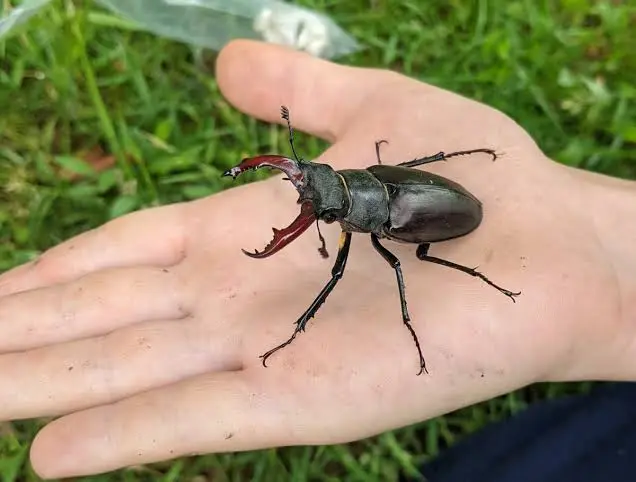
A stag beetle is one of the most distinctive beetles a person can find in a garden, woodland, park, or near outdoor lights. The males are famous for their large, antler-like jaws, which make them look dramatic but are mainly used for wrestling other males rather than attacking people.
For beginners, the easiest way to recognize a stag beetle is to look for a large, sturdy beetle with a dark brown to reddish-brown body, hard wing covers, elbowed antennae, and, in males, oversized mandibles that resemble deer antlers. Females usually have smaller jaws, but they are still strong beetles with a broad, glossy body.
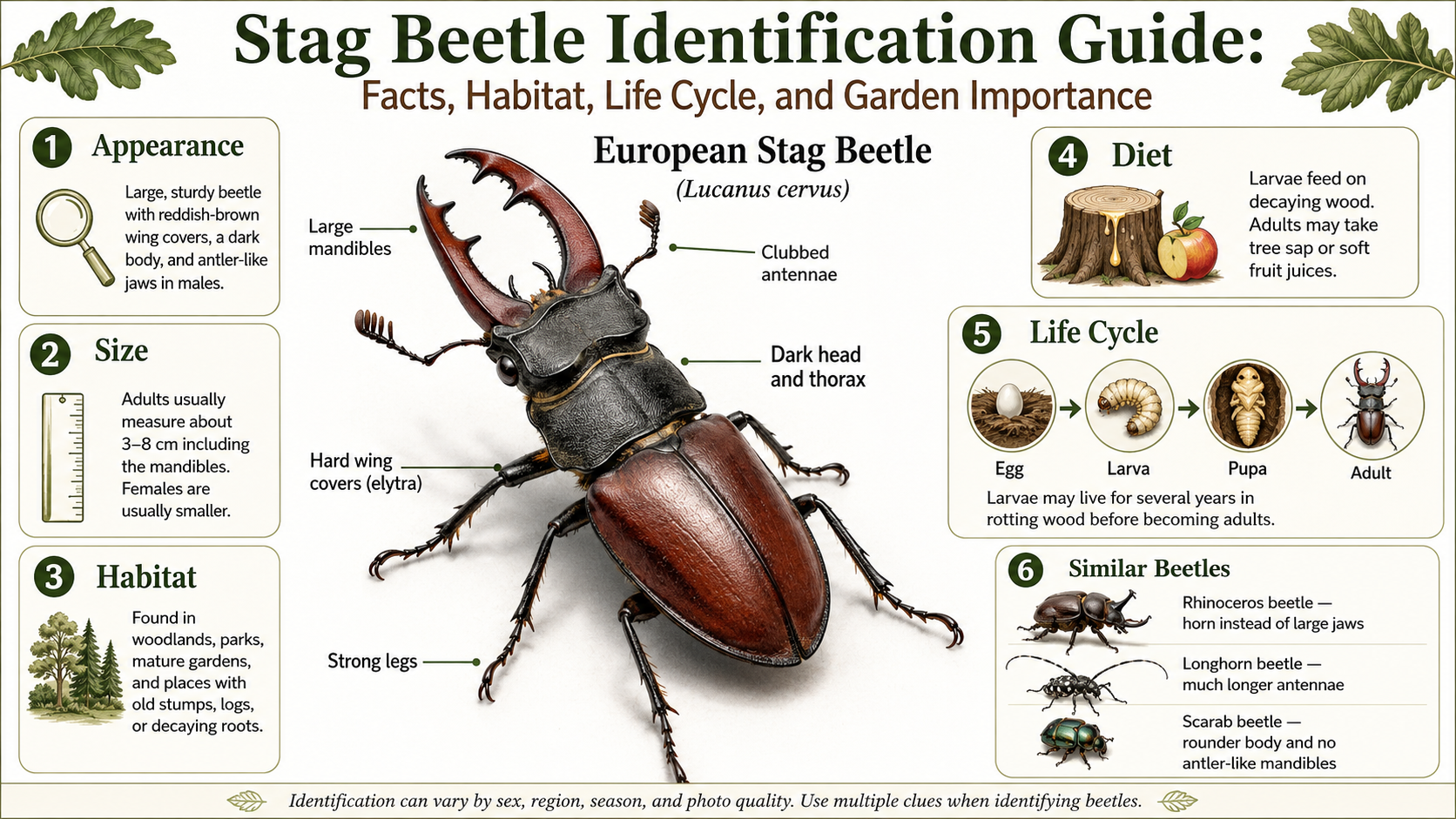
Despite their powerful appearance, stag beetles are not household pests in the usual sense. Their larvae develop in decaying wood, where they help break down dead plant material. Adults are short-lived and are usually seen during warm months when they emerge to find mates.
This guide explains how to identify a stag beetle, how to tell males and females apart, where stag beetles live, what they eat, how their life cycle works, and what their presence means around homes and gardens.
What Is a Stag Beetle?
A stag beetle is a beetle in the family Lucanidae. This family includes many species around the world, from small, dark woodland beetles to large tropical species with spectacular jaws.
The name “stag beetle” comes from the male beetle’s enlarged mandibles. A stag is a male deer, and the jaws of many male stag beetles look a little like deer antlers. These jaws are not true horns. They are modified mouthparts called mandibles.
In beetles, mandibles are jaw-like structures near the mouth. In many insects, they are used for biting, cutting, or holding food. In male stag beetles, the mandibles have become enlarged and are often used in courtship and combat with other males.
Stag beetles belong to the same insect order as all beetles: Coleoptera. Like other beetles, they have hardened front wings called elytra. These wing covers protect the softer flying wings underneath.
How This Guide Helps
This guide is designed for beginners, homeowners, gardeners, teachers, students, and nature observers who want a calm, practical way to understand stag beetles.
Beetle identification can vary by region, species, life stage, season, and photo quality. A beetle found in Europe may not be the same species as a similar-looking beetle found in North America, Asia, or Australia. A male may look very different from a female. A larva may look nothing like the adult.
For better identification, observe several clues together:
- Size
- Color
- Body shape
- Mandible shape
- Antennae
- Wing covers
- Legs
- Habitat
- Behavior
- Season
- Geographic location
A single feature, such as “large jaws,” is helpful but not always enough for a confident species-level identification.
Quick Stag Beetle Identification Summary
Use this quick checklist when you are trying to decide whether you have found a stag beetle.
A stag beetle often has:
- A sturdy, oval to elongated beetle body
- Dark brown, reddish-brown, black, or mahogany coloring
- Hard, glossy wing covers
- Noticeable mandibles, especially in males
- Elbowed or clubbed antennae
- A slow, deliberate walking style
- A tendency to appear near dead wood, logs, tree stumps, gardens, parks, woodland edges, or outdoor lights
- Adults that are most often seen in warmer months
Male stag beetles are usually easier to recognize because of their oversized jaws. Females can be harder to identify because their jaws are smaller and their body shape may resemble other large dark beetles.
How to Identify a Stag Beetle
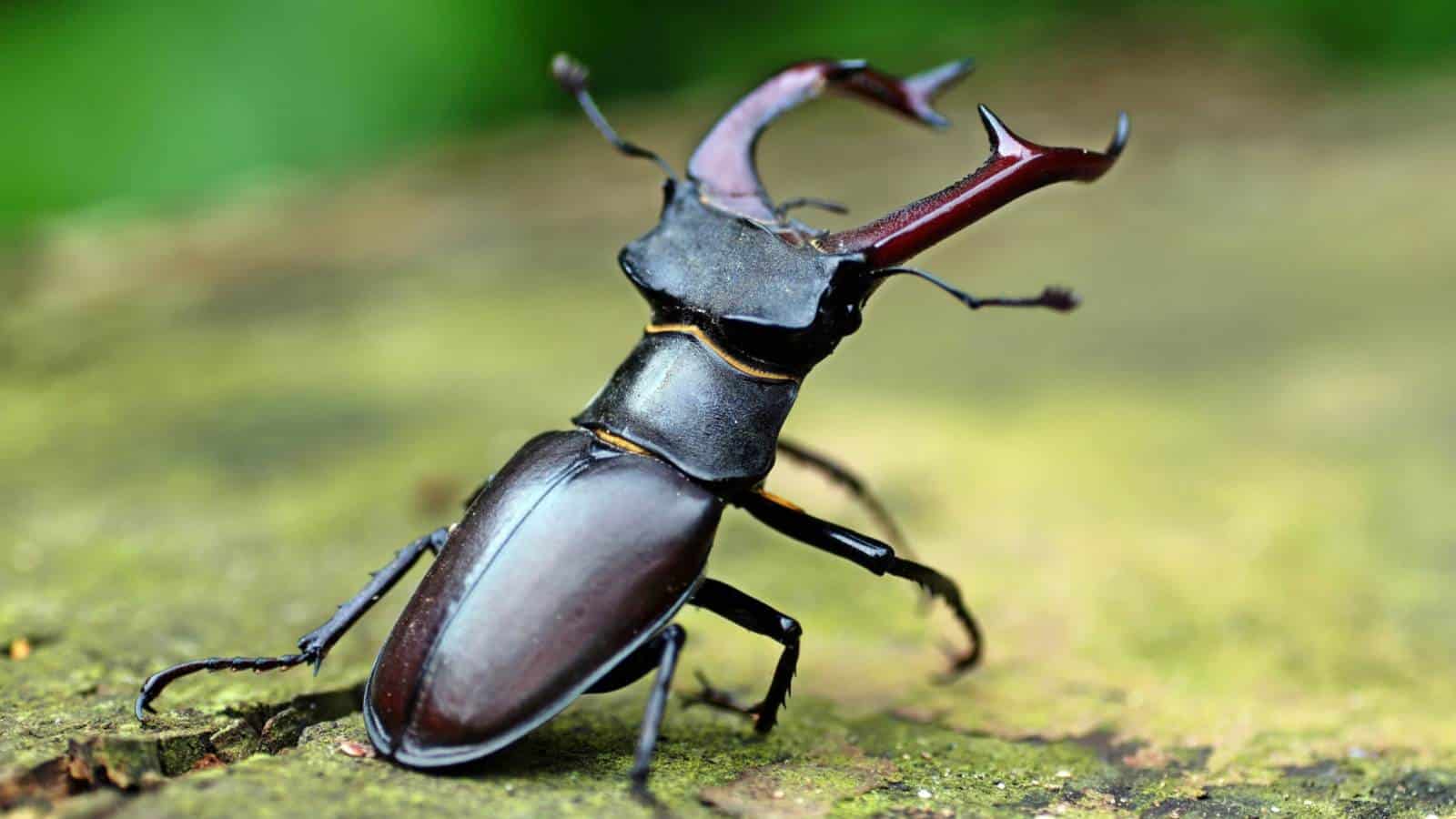
Stag beetle identification works best when you look at the whole beetle rather than focusing on one dramatic feature.
Body Shape
Most stag beetles are robust beetles with a strong, compact body. They are not soft-bodied insects. Their body has the typical beetle structure:
- Head
- Thorax
- Abdomen
- Hard wing covers
- Six legs
- A pair of antennae
The body often looks slightly flattened from top to bottom, especially compared with rounder scarab beetles. Many stag beetles have a broad head and a smooth, polished appearance.
Mandibles
The mandibles are the most famous feature of a stag beetle.
In males, the mandibles may be long, curved, toothed, or antler-like. They can look intimidating, but in many species they are used mainly to grip, push, lift, or wrestle other males.
In females, the mandibles are usually shorter and more practical-looking. Female stag beetles may not have the dramatic “antler” appearance, but their jaws can be strong.
This difference between males and females is called sexual dimorphism. That simply means males and females of the same species can look noticeably different.
Color
Many stag beetles are dark brown, reddish-brown, chestnut, blackish, or mahogany. Some have a glossy surface, while others may look more matte.
Color alone is not enough for identification. Lighting, age, soil, wear, and camera quality can change how a beetle appears in a photo. A beetle that looks black indoors may show reddish tones in sunlight.
Antennae
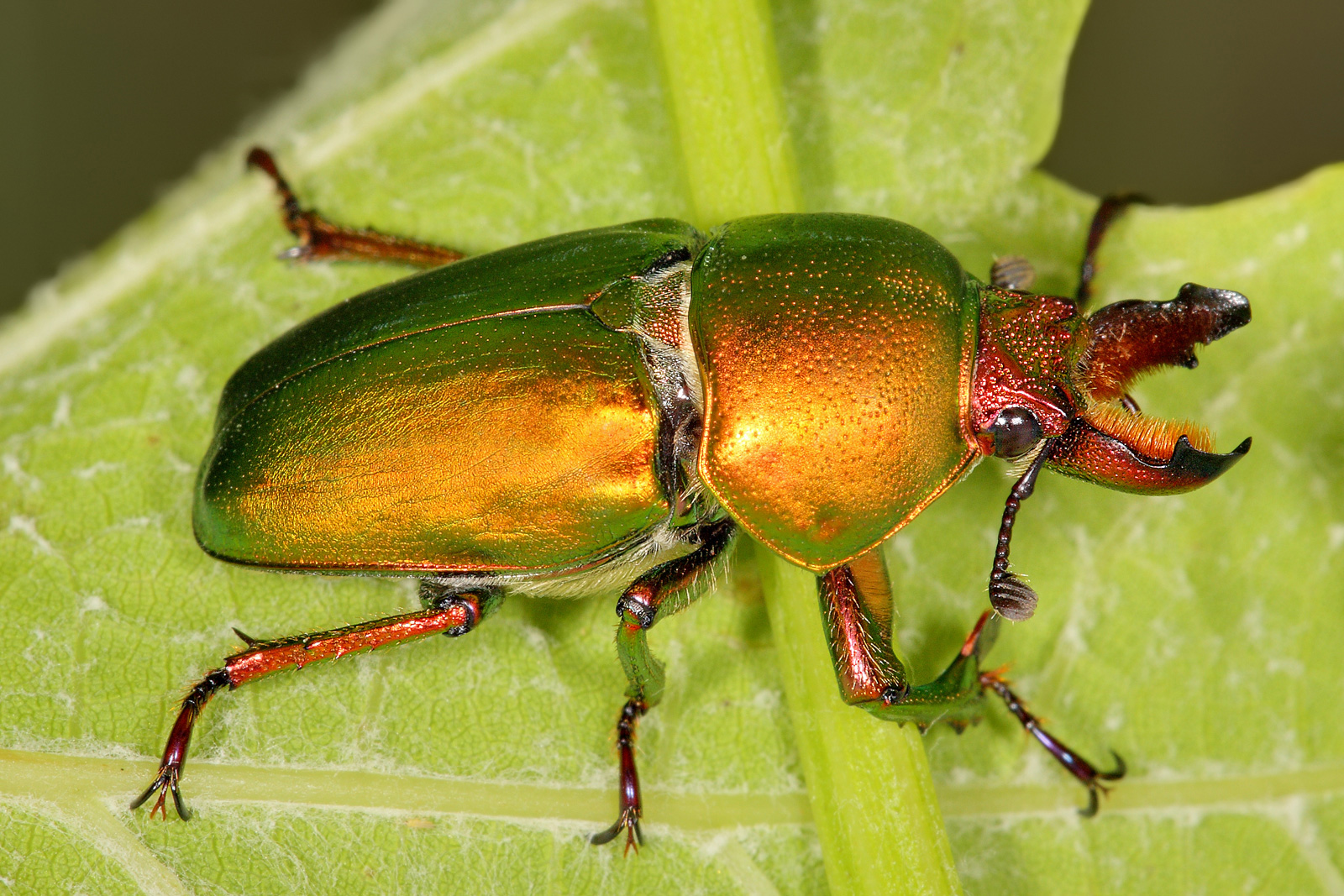
Stag beetles often have distinctive antennae with club-like tips. The antennae may look elbowed or bent, and the end segments may open slightly like a small fan or comb.
Antennae are useful because they help separate stag beetles from some other large beetles. However, antenna details can be hard to see unless you have a close, sharp photo.
Wing Covers
Like all beetles, stag beetles have hardened front wings called elytra. These form the smooth wing covers visible on the back.
The elytra may be dark brown, reddish, or black. In some species they look polished and smooth. Underneath these wing covers are the delicate flight wings.
Some stag beetles fly well, although they may look awkward in flight. Males can seem especially heavy and clumsy when flying because of their large mandibles.
Size
Stag beetles vary widely in size depending on species, sex, and region.
Some are modest-sized beetles, while others are among the larger beetles in their local area. In many familiar species, males are larger or more visually dramatic than females because of the mandibles.
When estimating size, include whether you are measuring the body alone or the body plus mandibles. For male stag beetles, the jaws can add noticeably to the total length.
Male vs Female Stag Beetles
Male stag beetles usually have:
- Larger mandibles
- A more “antlered” appearance
- More obvious head structures
- A dramatic profile when viewed from above
- Behavior linked to searching for mates or wrestling rivals
Female stag beetles usually have:
- Smaller mandibles
- A broader, less antler-like head
- A more compact body shape
- Stronger-looking functional jaws
- A greater chance of being found near suitable egg-laying sites such as decaying wood
Beginners often recognize male stag beetles quickly but may mistake females for other dark beetles. If you find a large brown or black beetle near old wood, tree roots, stumps, or compost, a female stag beetle is worth considering.
Why Do Male Stag Beetles Have “Antlers”?
Male stag beetles use their large mandibles mainly in competition with other males. In many species, males grapple, push, lift, or flip rivals during contests over access to females or favorable mating sites.
The mandibles are not antlers in a biological sense. They are jaws. But because they resemble deer antlers, the common name “stag beetle” has remained popular.
These mandibles are a good example of how animal body parts can evolve for display and competition. They may help a male appear larger, compete with rivals, or gain better access to mating opportunities.
Large mandibles can also come with trade-offs. A male with very large jaws may look impressive but may not be as agile as a smaller beetle. In nature, dramatic structures often reflect a balance between attraction, combat, movement, and survival.
Common Types of Stag Beetles
There are many stag beetles worldwide. The species you are most likely to encounter depends heavily on where you live.
European Stag Beetle
The European stag beetle, often associated with the scientific name Lucanus cervus, is one of the best-known stag beetles. It is especially famous in parts of Europe and the United Kingdom.
Male European stag beetles have large, reddish-brown mandibles and a dark body. Females are smaller and have shorter jaws. Adults are often seen in late spring and summer, especially around dusk.
This species is strongly associated with decaying wood. The larvae feed underground on rotting wood from old roots, stumps, logs, and similar material.
Giant Stag Beetle
The giant stag beetle, Lucanus elaphus, is one of the notable stag beetles of eastern North America. Adult males can be especially impressive because of their long mandibles.
It is usually associated with woodland habitats and damp, decaying wood. Like other stag beetles, the larvae develop in dead or rotting wood rather than sound, healthy timber.
Reddish-Brown Stag Beetle
The reddish-brown stag beetle, Lucanus capreolus, is another North American species. It is often reddish brown to mahogany in color and may be encountered near woods, homes, gardens, or lights.
Its appearance can vary, and males may have noticeable jaws. Females are less dramatic but still have the robust body typical of stag beetles.
Lesser Stag Beetles and Related Species
Some regions also have smaller stag beetles or related species that do not show the extreme mandibles seen in famous large males. These species can be harder to identify from casual photos.
For difficult identifications, regional field guides, museum collections, university extension pages, and insect identification communities can be useful.
Stag Beetle vs Similar-Looking Beetles
Stag beetles are sometimes confused with other large beetles. Here are common lookalikes.
Stag Beetle vs Rhinoceros Beetle
Rhinoceros beetles are also large and impressive, but their horns are usually on the head or thorax rather than forming antler-like jaws.
Stag beetles have enlarged mandibles, especially in males. Rhinoceros beetles often have horn-like projections used in pushing and wrestling.
Stag Beetle vs Scarab Beetle
Scarab beetles can be large, oval, and dark, which may cause confusion. Many scarabs have a more rounded, domed shape. Their antennae often have compact fan-like clubs.
Stag beetles usually have a more elongated, flattened look and more obvious mandibles.
Stag Beetle vs Click Beetle
Click beetles are typically narrower and more elongated. They have a special clicking mechanism that can flip them into the air when they are on their backs.
Stag beetles are generally broader and heavier-looking, with stronger jaws and a more robust body.
Stag Beetle vs Ground Beetle
Ground beetles are often dark, shiny, and fast-moving. They usually have long legs and strong jaws but do not have the antler-like male mandibles of stag beetles.
Ground beetles also tend to run quickly, while stag beetles often move more slowly and deliberately.
Stag Beetle vs Longhorn Beetle
Longhorn beetles are known for very long antennae, sometimes longer than the body. Stag beetles may have noticeable antennae, but their main feature is the mandibles, not extremely long antennae.
If the “horns” are actually antennae, the beetle may be a longhorn beetle rather than a stag beetle.
Where Do Stag Beetles Live?
Stag beetles are closely linked with deadwood habitats. They may live in or near:
- Decaying logs
- Old tree stumps
- Rotting roots
- Woodland edges
- Parks
- Mature gardens
- Orchards
- Hedgerows
- Compost-rich areas
- Soil around old trees
- Fallen branches
- Dead or partly buried wood
Many people imagine stag beetles only in wild forests, but some species can occur in gardens and suburban areas if suitable deadwood remains available.
Deadwood is not “waste” from the point of view of a beetle. It is habitat. For stag beetle larvae, rotting wood can be food, shelter, and a nursery.
Adult stag beetles may also appear near outdoor lights. A beetle found on a porch, driveway, patio, or sidewalk may simply have been attracted by light or warmth.
Stag Beetle Diet: What Do They Eat?
The diet of a stag beetle depends on its life stage.
Stag beetle larvae feed mainly on decaying wood. They do not eat fresh, healthy wood in the way many people imagine. Instead, they live in softened, decomposing wood that is already being broken down by fungi and other natural processes.
Adult stag beetles generally feed very little compared with the larval stage. Depending on species, adults may take in moisture or sugary fluids from sources such as:
- Tree sap
- Rotting fruit
- Soft fruit juices
- Plant fluids
- Moist surfaces
Some adults may rely heavily on energy stored from their larval development. This is one reason the larval stage is so important: it is when the beetle does most of its growing.
Stag Beetle Life Cycle
Stag beetles undergo complete metamorphosis. This means they pass through four main stages:
- Egg
- Larva
- Pupa
- Adult
This is the same broad life cycle pattern seen in many beetles, butterflies, moths, flies, and bees.
Eggs
After mating, a female stag beetle searches for a suitable place to lay eggs. This is often near decaying wood, underground roots, old stumps, or soil rich in decomposing woody material.
The female’s choice matters because the larvae need the right food and moisture conditions after hatching.
Larvae
The larval stage is the longest and most important growth stage.
Stag beetle larvae are often pale, soft-bodied, and C-shaped. They may look like large white grubs. They usually have a darker head capsule and visible legs near the front of the body.
Larvae feed on decaying wood for several years in many species. The exact time varies depending on species, temperature, climate, food quality, and local conditions.
During this stage, larvae help break down deadwood and return nutrients to the ecosystem. This makes stag beetles part of the natural recycling system in woodland and garden habitats.
Pupae
When the larva is fully grown, it enters the pupal stage. The pupa is a transformation stage between larva and adult.
In this stage, the insect reorganizes its body into the adult beetle form. Legs, wings, antennae, mandibles, and adult body structures become fully developed.
Adults
Adult stag beetles are usually short-lived compared with the larval stage. Their main purpose is to emerge, find mates, reproduce, and continue the life cycle.
Adults are most often seen in warm months. In some areas, they are especially active around dusk or at night. Males may fly in search of females, while females may stay closer to egg-laying sites.
Are Stag Beetles Dangerous?
Stag beetles are not dangerous in the way their appearance might suggest.
Male stag beetles may look alarming because of their large jaws, but those mandibles are mainly used against other males. They are not built for chasing or attacking people.
A stag beetle may pinch if handled carelessly, especially a female with strong functional jaws. However, they are not venomous, they do not sting, and they are not aggressive household invaders.
The best approach is simple: observe them without picking them up. If one must be moved from a road, path, or dangerous surface, gently encourage it onto a leaf, piece of cardboard, or small container and place it near vegetation or deadwood away from traffic.
Stag Beetles in Homes and Gardens
Finding a stag beetle near your home does not mean your house is infested.
Most stag beetles are outdoor insects. Adults may wander onto patios, porches, garages, or doorways, especially at night. They may be attracted to lights or may simply be moving through the area.
In gardens, stag beetles are generally a positive sign. Their larvae use decaying wood, not healthy furniture or structural timber. They are part of the natural decomposition process.
Garden features that may support stag beetles include:
- Old tree stumps
- Log piles
- Partly buried deadwood
- Mature trees
- Undisturbed soil
- Leaf litter
- Compost areas
- Native planting
- Minimal pesticide use
If you want to make a garden more wildlife-friendly, keeping some deadwood in a safe location can help beetles, fungi, mosses, woodlice, centipedes, solitary bees, and many other organisms.
What to Do If You Find a Stag Beetle
If you find a stag beetle, the best response is usually to leave it alone.
You can:
- Watch it quietly
- Take a clear photo from above and from the side
- Note the date and location
- Record the habitat where it was found
- Move it only if it is in immediate danger
- Avoid using pesticides around it
- Keep pets and children from disturbing it
- Submit a record to a local wildlife recording project if available in your region
If the beetle is on a road, driveway, or footpath, move it carefully to nearby vegetation. Do not carry it far away from the area unless necessary. Beetles are part of local populations, and moving them too far may reduce their chance of finding mates or suitable habitat.
When to Seek Professional Help
Most stag beetle encounters do not require pest control.
Consider professional help only if:
- You are finding many large beetles indoors repeatedly
- You suspect structural timber damage from another wood-boring insect
- You are unsure whether the insect is a stag beetle or a pest species
- You find larvae inside processed timber, flooring, furniture, or house beams
- You need a local identification for property, school, or safety reasons
Even then, the goal should be accurate identification first. Many insects are misidentified as pests simply because they are large or unfamiliar.
A qualified local extension office, museum, entomologist, or pest professional can help distinguish stag beetles from termites, powderpost beetles, longhorn beetles, wood-boring beetles, cockroaches, or other insects.
Responsible Identification Notes
Stag beetle identification is not always guaranteed from a single photo. Many species vary by sex, region, and size. Some females and smaller species can resemble other beetles.
When sharing a photo for identification, include:
- Country, state, province, or region
- Approximate size
- Date or season
- Habitat
- Whether it was indoors or outdoors
- View from above
- Side view if possible
- Close-up of antennae and mandibles if safe
Do not handle beetles unnecessarily for photographs. A calm, clear observation is more useful than a stressed insect in a hand.
For more detailed
FAQ
What is a stag beetle?
A stag beetle is a beetle in the family Lucanidae. Many male stag beetles have enlarged mandibles that look like deer antlers, which is where the name “stag beetle” comes from.
How do I identify a stag beetle?
Look for a sturdy beetle with hard wing covers, dark brown to reddish-brown coloring, clubbed or elbowed antennae, and noticeable jaws. Male stag beetles often have large antler-like mandibles.
Are stag beetles dangerous?
Stag beetles are not dangerous to people. They do not sting and are not venomous. They may pinch if handled carelessly, so it is best to observe them without picking them up.
Can stag beetles bite?
A stag beetle can pinch with its jaws, especially if it feels threatened or is handled. Female stag beetles may have smaller but stronger jaws. Most encounters are harmless if the beetle is left alone.
Why do male stag beetles have big jaws?
Male stag beetles use their large jaws to compete with other males, often by wrestling, lifting, or pushing rivals. The jaws are also part of their dramatic mating-season appearance.
What do stag beetles eat?
Stag beetle larvae eat decaying wood. Adults may take in moisture or sugary fluids from tree sap, rotting fruit, or similar natural sources, depending on the species.
Do stag beetles damage houses?
Stag beetles usually do not damage houses. Their larvae develop in rotting wood, old roots, stumps, and decaying logs rather than dry structural timber. If insects are emerging from house timbers, get a proper identification.
Why did I find a stag beetle in my garden?
A garden may attract stag beetles if it has old trees, stumps, logs, buried deadwood, compost, or nearby woodland. Adults may also wander through gardens during mating season.
Can stag beetles fly?
Yes, many adult stag beetles can fly. Males may fly at dusk or at night while searching for females, although their flight can look heavy or awkward.
Are stag beetles good for the garden?
Stag beetles are generally beneficial in gardens. Their larvae help break down decaying wood and support nutrient cycling. They are part of a healthy deadwood ecosystem.
What should I do if I find a stag beetle on the road?
Move it gently to nearby vegetation or a safe spot away from traffic. Use a leaf, piece of cardboard, or small container rather than handling it directly.
Are stag beetles rare?
Stag beetle status depends on the species and region. Some are locally common, while others are declining or protected in certain areas. Check local conservation or natural history resources for regional information.
Conclusion
The stag beetle is one of the most memorable beetles in the natural world. With its strong body, glossy wing covers, and, in males, antler-like mandibles, it is easy to understand why this insect captures attention.
But behind the dramatic appearance is a quiet woodland and garden recycler. Stag beetle larvae spend much of their lives hidden in decaying wood, helping break down dead plant material and supporting healthy soil and habitat cycles. Adults appear briefly, often in warm months, to mate and begin the next generation.
If you find a stag beetle, observe it calmly, avoid unnecessary handling, and consider the habitat around it. Old logs, tree stumps, leaf litter, and undisturbed garden corners can be valuable places for beetles and many other forms of wildlife.
A stag beetle is not something to fear. It is a sign of the hidden life within deadwood, and a reminder that even old logs and rotting roots can support an entire world of living creatures.
1 thought on “Stag Beetle Identification Guide: Facts, Habitat, Life Cycle, and Garden Importance”