

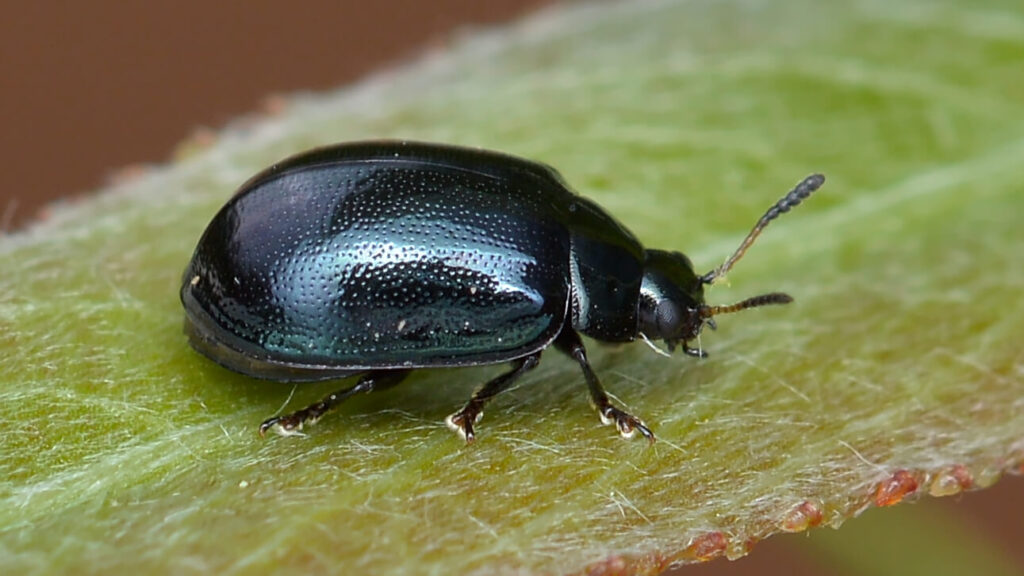
Finding tiny black beetles in house areas such as windowsills, carpets, kitchens, closets, or baseboards can be confusing at first. Most people notice a small dark insect crawling slowly across the floor, resting near a window, or appearing inside a pantry cabinet — and the first question is simple: What is it?
In many homes, the most likely explanation is a type of carpet beetle, especially if the beetles are small, oval, dark brown to black, and found near windows, baseboards, fabrics, lint, pet hair, or stored natural materials. Adult carpet beetles are often only about 1/8 inch long, and their larvae are usually the stage that feeds on wool, fur, feathers, lint, dead insects, and other organic material. UC IPM notes that adult carpet beetles are small, round-bodied beetles with short antennae, and that larvae look like fuzzy or hairy maggots.
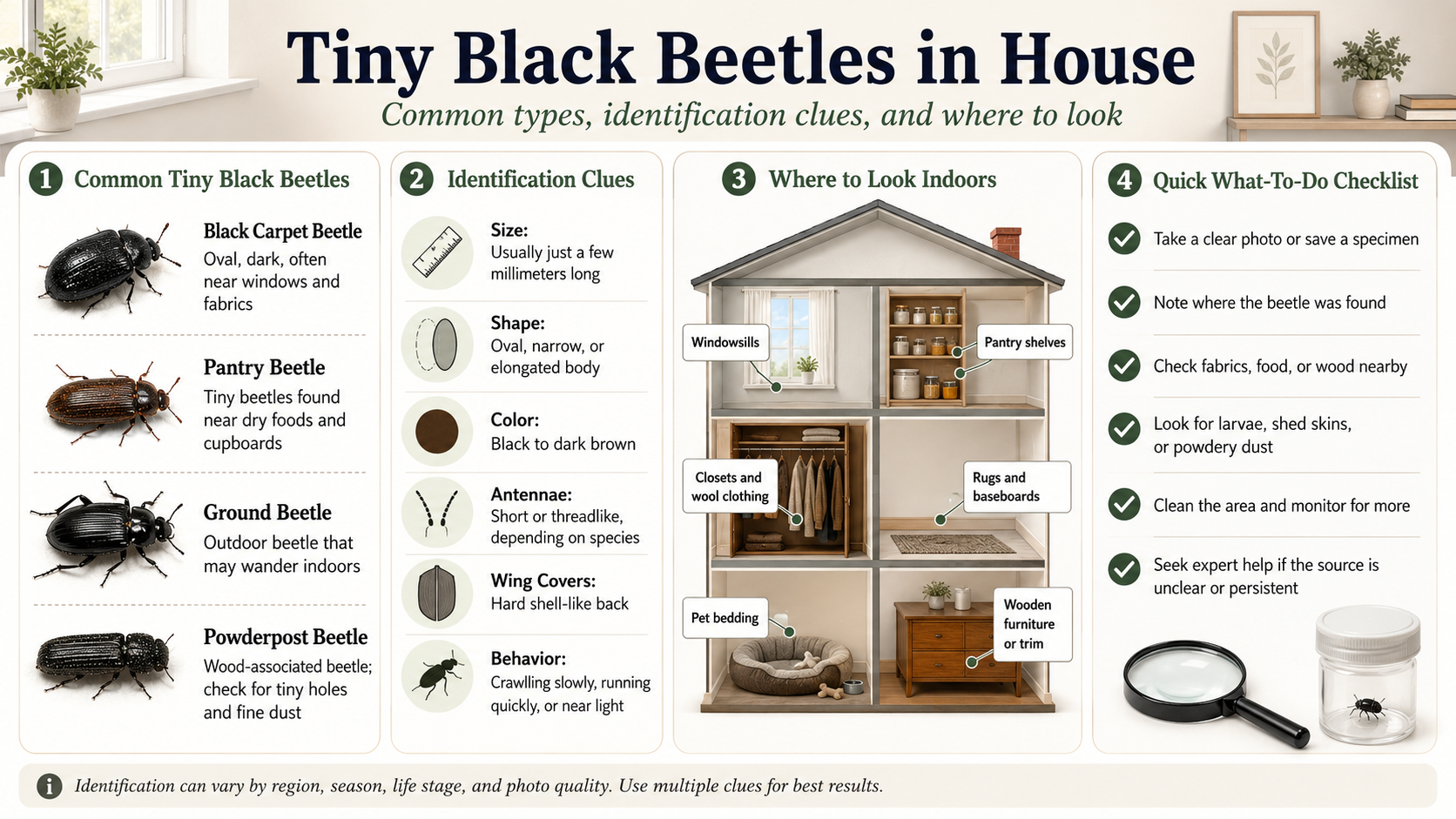
However, not every tiny black beetle indoors is a carpet beetle. Some small beetles are linked to stored food, some wander in from outdoors by accident, and a few are associated with wood products. The key is to observe several clues together: size, shape, color, antennae, wing covers, location, behavior, season, and what is nearby.
This guide will help you narrow down the most common possibilities calmly and responsibly, without assuming every small beetle is a serious household problem.
About This Guide
This guide is written for beginners, homeowners, gardeners, students, teachers, and nature enthusiasts who want to understand tiny black beetles in house settings without panic or guesswork.
Beetle identification can vary by:
- Region
- Season
- Indoor environment
- Beetle life stage
- Photo quality
- Lighting
- Body angle
- Whether you are seeing an adult beetle or a larva
A single photo or quick glance is not always enough for a confident species identification. Instead, this guide encourages you to observe multiple clues: body shape, size, color, antennae, wing covers, where the beetle was found, how it moved, and what materials were nearby.
For difficult cases, compare your observations with credible sources such as university extension resources, museum identification guides, natural history references, government agriculture resources, and entomology references.
Educational note: This page is for general identification and learning. It does not replace an inspection by a qualified entomologist, local extension office, museum specialist, or licensed pest professional when exact identification or structural assessment is needed.
Quick Answer: What Are Tiny Black Beetles in the House?
The most common tiny black beetles found in houses are often carpet beetles, especially black carpet beetles or dark-colored adult carpet beetles. They are usually small, oval, dark brown to black, and may appear near windows, baseboards, closets, rugs, upholstered furniture, or areas where lint and pet hair collect.
But there are several other possibilities.
Tiny black beetles in a house may include:
- Black carpet beetles
- Dark carpet beetles or varied carpet beetles
- Pantry beetles
- Ground beetles that wandered indoors
- Powderpost beetles associated with wood
- Larder beetles or other dermestid beetles
- Small weevils or flour beetles in stored foods
The most important first step is to ask: Where did you find them?
- Near windows? Carpet beetles are possible.
- In flour, rice, cereal, spices, pet food, or dried goods? Pantry beetles are possible.
- Near wool, feathers, fur, taxidermy, old textiles, or pet hair? Carpet beetle larvae or dermestids are possible.
- Around doors, garages, basements, or lights? Outdoor beetles may have wandered in.
- Near wood with tiny holes and powdery dust? Powderpost beetles may need closer inspection.
The University of Minnesota Extension notes that pantry pest signs include small beetles in dried food products, beetles on counters or cupboards, and beetles around windows.
Why Tiny Black Beetles Appear Indoors
Tiny beetles usually enter homes for one of several reasons. Some are attracted to food, some are drawn indoors by light or warmth, and others are already developing inside stored materials.
1. They are feeding on natural materials
Carpet beetle larvae can feed on materials of animal origin, including wool, fur, feathers, hair, and other organic debris. The University of Minnesota Extension explains that adult carpet beetles feed on pollen and are not by themselves pests in homes, while larvae can damage fibers of animal origin.
Common indoor food sources may include:
- Wool rugs
- Wool coats
- Fur trim
- Feather pillows
- Taxidermy
- Pet hair
- Lint
- Dead insects in light fixtures
- Dust behind furniture
- Forgotten natural-fiber items in storage
2. They came from stored food
Some beetles develop in pantry goods. These may not always look truly black; many are reddish brown, dark brown, or nearly black depending on lighting.
Possible food sources include:
- Flour
- Rice
- Cereal
- Pasta
- Dried beans
- Spices
- Bird seed
- Pet food
- Dried fruit
- Nuts
- Grain-based products
UC IPM explains that pantry pests include certain moths and beetles that attack stored foods, and that they often enter homes inside infested food packages.
3. They wandered in from outdoors
Not all indoor beetles are living or breeding inside the home. Some beetles simply enter through gaps, doors, windows, garages, basements, or damaged screens.
Ground beetles are a good example. Iowa State University Extension describes ground beetles as common outdoor insects that may wander into homes by mistake and states that they do not damage household structures or furniture and are harmless to people and pets.
4. They are attracted to light
Some beetles fly toward indoor lights or gather near windows after entering. If you mostly find them near windowsills, doors, or light fixtures, that location is an important identification clue.
5. They are emerging from hidden materials
Sometimes adults appear after larvae developed unnoticed in a hidden source. Examples include:
- Old woolens in a closet
- Bird nests near vents or eaves
- Dead insects in attic spaces
- Forgotten pet food
- Stored dry goods
- Organic debris under heavy furniture
How to Identify Tiny Black Beetles in Your House
Accurate identification starts with careful observation. A tiny dark beetle may look like a “black dot” at first, but small details matter.
1. Size
Use a ruler if possible. Many household beetles are only a few millimeters long.
Ask:
- Is it about 1–3 mm?
- Around 3–5 mm?
- Larger than 6 mm?
- Is it tiny like a pinhead, or more like a small grain of rice?
Adult carpet beetles are often around 1/16 to 1/8 inch long, depending on species, according to University of Kentucky Entomology.
2. Body shape
Look at the outline from above.
Common shapes include:
- Round or oval
- Elongated and narrow
- Hump-backed
- Rice-grain-shaped
- Flattened
- Shiny and hard-bodied
Carpet beetles are usually oval or rounded. Powderpost beetles are more narrow and elongated. Ground beetles are often longer-legged and more active.
3. Color
“Black” can mean several things in real indoor lighting.
A beetle may be:
- Jet black
- Dark brown
- Reddish brown
- Black with brown legs
- Mottled with white, tan, yellow, or brown scales
- Shiny black
- Dull black
Varied carpet beetles, for example, may look dark at a distance but have mottled patterns up close.
4. Antennae
Antennae can help separate beetle groups.
Look for:
- Short clubbed antennae
- Threadlike antennae
- Sawlike antennae
- Antennae hidden under the body
- Long antennae
Some pantry beetles have a rounded, hooded appearance, with the head partly tucked downward. Virginia Tech describes drugstore beetles and cigarette beetles as small reddish-brown stored-product beetles that resemble each other.
5. Wing covers
Beetles have hardened front wings called elytra. These are the shell-like wing covers on the back.
Observe:
- Are the wing covers smooth?
- Do they have lines or grooves?
- Are they shiny?
- Are they covered in tiny scales or hairs?
- Do they meet in a straight line down the back?
6. Location
Where you find the beetle may be more useful than color alone.
| Location | Possible clue |
|---|---|
| Windowsill | Adult carpet beetles, outdoor beetles attracted to light |
| Closet | Carpet beetles, fabric-feeding larvae |
| Pantry | Pantry beetles, flour beetles, weevils |
| Bathroom | Accidental invaders, moisture-associated insects, beetles near lights |
| Basement | Ground beetles, carpet beetles, stored-material insects |
| Near wood | Powderpost beetles, wood-associated beetles |
| Near pet bedding | Carpet beetles, dermestids, fleas or non-beetle insects |
| Around dead insects | Dermestid beetles or larvae |
7. Behavior
Watch how it moves.
Ask:
- Does it crawl slowly?
- Does it run quickly?
- Does it fly?
- Does it play dead when touched?
- Does it appear mostly at night?
- Does it gather near light?
- Is it found alone or in groups?
8. Life stage
Adult beetles and larvae can look completely different.
For carpet beetles, the larvae are often more important than the adults because larvae do the feeding damage. Michigan State University Extension notes that carpet beetle larvae develop in dark, undisturbed locations and that larvae are responsible for feeding damage.
Common Tiny Black Beetles Found in Houses
Below are the most common possibilities when someone searches for tiny black beetles in house.
1. Black Carpet Beetles
Black carpet beetles are among the most common suspects when small dark beetles appear indoors.
What they look like
Adult black carpet beetles are usually:
- Small
- Oval or elongated-oval
- Dark brown to black
- Hard-bodied
- Often found near windows or indoor edges
The Conservation Center for Art & Historic Artifacts describes adult black carpet beetles as 3–5 mm long and dark brown to black, with brown, carrot-shaped larvae that have a tuft of hair at one end.
Where they are found
Look near:
- Windowsills
- Baseboards
- Closets
- Wool rugs
- Stored clothing
- Upholstered furniture
- Pet bedding
- Air vents
- Dead insects in light fixtures
Why they matter
Adult black carpet beetles are often noticed first, but larvae are usually the stage feeding on animal-based materials. The larvae may feed on wool, fur, feathers, hair, dead insects, and similar organic matter.
Beginner identification clue
If you see tiny dark adult beetles near windows and also find fuzzy, brownish larvae or shed larval skins near baseboards, closets, or rugs, carpet beetles become a strong possibility.
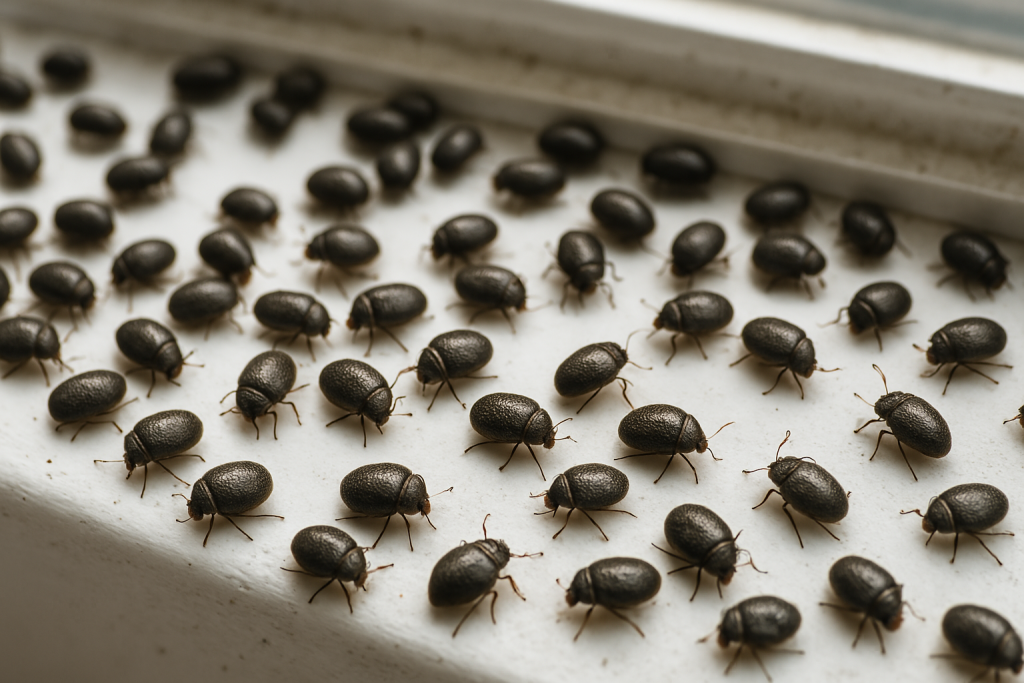
2. Varied Carpet Beetles and Other Carpet Beetles
Not all carpet beetles are solid black. Some are mottled with white, brown, tan, yellow, or orange scales. From a distance, they may still look like tiny black or dark beetles.
What they look like
Adult carpet beetles may be:
- Small and oval
- Rounded
- Mottled or speckled
- Black, brown, white, yellow, or mixed in pattern
- Often seen near windows
UC IPM states that adult carpet beetles are small, about 1/8 to 1/10 inch long, with round bodies and short antennae; their color ranges from black to mixed white, brown, and yellow, depending on species and age.
Larvae
Carpet beetle larvae may look like:
- Tiny hairy worms
- Brownish or tan larvae
- Fuzzy rice grains
- Tapered or carrot-shaped bodies
- Larvae with bristly hairs at the rear
The University of Maryland Extension describes black carpet beetle larvae as 3–7 mm long, carrot-shaped, golden-brown-haired, and with a “tail” of long hairs at the rear.
Why adults appear at windows
Adult carpet beetles often move toward light. Seeing adults near windows does not always mean the main source is at the window. The larvae may be feeding somewhere darker and more hidden.
3. Pantry Beetles
If the tiny beetles are appearing in the kitchen, pantry, cupboards, or near dry foods, consider pantry beetles.
Common pantry beetles
Possible pantry beetles include:
- Drugstore beetles
- Cigarette beetles
- Flour beetles
- Grain beetles
- Weevils
- Bean beetles
- Other stored-product beetles
Some are not truly black, but they may appear very dark indoors.
What they look like
Pantry beetles are often:
- Tiny
- Brown to reddish brown
- Oval or elongated
- Found in or near food packaging
- Seen on shelves, counters, or cupboard walls
University of Illinois Extension describes cigarette and drugstore beetles as very small, about 1/8 inch, reddish brown, and rounded to oval in shape.
Where to inspect
Check:
- Flour
- Rice
- Cereal
- Pasta
- Crackers
- Pet food
- Bird seed
- Spices
- Tea
- Dried herbs
- Dried flowers
- Nuts
- Stored grains
- Old forgotten packages
North Carolina State Extension notes that cigarette beetles can attack a wide range of foodstuffs, including paprika, dog food, coffee beans, dried fruits and vegetables, peanuts, rice, yeast, dried fish, and dried insects.
Beginner identification clue
If beetles are appearing in dry food containers, crawling in cupboards, or found inside packaging, treat the pantry as the first investigation area.
4. Ground Beetles
Ground beetles are usually outdoor beetles. Some are black or dark brown and may enter homes accidentally.
What they look like
Ground beetles often have:
- Longer legs than carpet beetles
- A more flattened or elongated body
- Shiny black or dark brown coloring
- Fast running behavior
- Stronger outdoor-beetle appearance
Where they are found
They may appear near:
- Doors
- Garages
- Basements
- Sliding doors
- Foundation gaps
- Porch lights
- Ground-level windows
Why they enter
They may wander in while searching for shelter or following light. Iowa State University Extension recommends vacuuming or sweeping up indoor ground beetle invaders and reducing entry points by sealing cracks, repairing doors, windows, and screens.
Beginner identification clue
If the beetle is larger, fast-moving, and appears near entry points rather than fabrics or food, it may be an accidental outdoor beetle rather than a household-feeding species.
5. Powderpost Beetles
Powderpost beetles are not the first answer for every tiny black beetle indoors, but they matter when beetles are associated with wood.
What they look like
Powderpost beetles are often:
- Small
- Narrow
- Elongated
- Reddish brown to dark brown or black
- Associated with wood, not carpets or pantry food
University of Kentucky Entomology describes lyctid powderpost beetles as small, narrow, elongated reddish-brown to black beetles, with round emergence holes about the size of a pinhead and fine powdery dust that may accumulate near holes.
Where to inspect
Look at:
- Hardwood flooring
- Furniture
- Trim
- Wooden antiques
- Stored lumber
- Bamboo or wicker items
- Wooden picture frames
- Wood with small round holes
Beginner identification clue
If you see small round holes in wood and fine powder that feels like flour or talc, a wood-boring beetle should be considered. This is a situation where expert identification is especially useful.
6. Larder Beetles and Other Dermestid Beetles
Dermestids are a group of beetles that includes carpet beetles and larder beetles. Many feed on dried animal materials, dead insects, skins, feathers, pet hair, or stored organic debris.
What they look like
Depending on the species, dermestid beetles may be:
- Oval
- Dark brown or black
- Patterned
- Covered with tiny scales or hairs
- Found as hairy larvae in hidden areas
Where they may appear
They may be found near:
- Pet food
- Dead insects
- Bird nests
- Rodent nests
- Taxidermy
- Stored animal products
- Natural history collections
- Forgotten organic debris
Museum and collection resources often pay close attention to dermestid beetles because larvae can damage preserved specimens, textiles, and natural materials.
Tiny Black Beetles vs Similar-Looking Household Bugs
Not every tiny black insect is a beetle. Some household insects are mistaken for beetles because they are small, dark, and fast-moving.
Beetles usually have:
- Six legs
- Hard wing covers
- A clear line down the back where wing covers meet
- Chewing mouthparts
- A compact body
Similar-looking insects may include:
- Fleas
- Bed bugs
- Ticks
- Cockroach nymphs
- Booklice
- Springtails
- Ants
- True bugs
- Small flies
- Mites
Quick comparison table
| Insect type | Beetle-like? | Key difference |
|---|---|---|
| Carpet beetle | Yes | Oval adult; hairy larva |
| Pantry beetle | Yes | Found in dry foods |
| Ground beetle | Yes | Fast runner; usually outdoor invader |
| Flea | Sometimes | Jumps; flattened side-to-side |
| Bed bug | Sometimes | Flat, oval, no hard wing covers |
| Tick | Sometimes | Eight legs as adults, not insects |
| Cockroach nymph | Sometimes | Long antennae, flattened body |
| Ant | Sometimes | Narrow waist, social trails |
Where to Look for Tiny Black Beetles Indoors
A good inspection is calm and methodical. Start where you first saw the beetles, then move outward.
If beetles are near windows
Check:
- Windowsills
- Curtains
- Dead insects in tracks
- Nearby baseboards
- Indoor plants
- Light fixtures
- Air vents
Adult carpet beetles are often seen near windows because they move toward light. However, the source may be elsewhere.
If beetles are near carpets or furniture
Check:
- Under rugs
- Along carpet edges
- Behind furniture
- Under sofas
- Pet sleeping areas
- Baseboards
- Dusty corners
- Old wool or natural-fiber textiles
If beetles are in closets
Check:
- Wool sweaters
- Coats
- Scarves
- Felt hats
- Feather items
- Fur trim
- Storage boxes
- Old textiles
- Items not moved for a long time
If beetles are in the pantry
Check:
- Opened dry food
- Unopened cardboard boxes
- Bulk foods
- Pet food
- Bird seed
- Spices
- Old grains
- Shelf cracks
- Behind containers
If beetles are near wood
Check:
- Tiny round holes
- Powdery dust
- Hardwood surfaces
- Furniture joints
- Wood trim
- Bamboo or wicker
- Stored firewood
- Wooden antiques
What Tiny Black Beetles Eat
The diet depends on the beetle.
Carpet beetle larvae may feed on:
- Wool
- Fur
- Feathers
- Hair
- Silk
- Dead insects
- Pet hair
- Lint with organic material
- Stored natural-history items
Adult carpet beetles may feed on:
- Pollen
- Nectar
- Outdoor flowers
Adult carpet beetles are often not the damaging stage indoors. The larvae are the stage to look for if fabrics or natural materials are being affected.
Pantry beetles may feed on:
- Grains
- Flour
- Rice
- Pasta
- Cereal
- Spices
- Dried fruit
- Nuts
- Pet food
- Bird seed
- Dried plant materials
Ground beetles may feed on:
- Other small insects
- Soil-dwelling invertebrates
- Outdoor prey
Ground beetles are generally not feeding on household materials.
Powderpost beetles may feed on:
- Hardwood
- Wood starches
- Bamboo
- Wood products
- Certain furniture or structural wood, depending on species
Life Cycle: Why Larvae Matter
Beetles have complete metamorphosis. That means they develop through four main stages:
- Egg
- Larva
- Pupa
- Adult
The larval stage often looks very different from the adult. This is especially important for household beetles.
Carpet beetle life cycle
For carpet beetles:
- Adults may be seen near windows or flowers.
- Females lay eggs near suitable larval food.
- Larvae feed in hidden, undisturbed places.
- Larvae may shed skins as they grow.
- Adults eventually emerge and may move toward light.
The larvae are often the stage responsible for feeding damage. Michigan State University Extension notes that carpet beetle larvae develop in dark, undisturbed locations and that the larvae are responsible for feeding damage.
Pantry beetle life cycle
For pantry beetles:
- Eggs are laid in or near stored food.
- Larvae feed inside food products.
- Adults emerge and may crawl or fly around cupboards.
- Infested packages can continue producing beetles until removed.
Why this matters
If you only remove adult beetles but ignore the source, more adults may appear later. That does not mean they are “coming from nowhere.” It usually means eggs, larvae, food sources, or hidden materials have not been located yet.
Are Tiny Black Beetles Harmful?
Most tiny black beetles in the house are not dangerous to people. They are usually a household nuisance or a sign that something indoors needs cleaning, inspection, or storage improvement.
Do tiny black beetles bite?
Most common indoor beetles, including carpet beetles, do not bite people. Some people may react to carpet beetle larval hairs, but that is different from a bite.
Do they damage clothes?
Carpet beetle larvae can damage animal-based materials such as wool, fur, feathers, and similar natural fibers. Adults are usually not the damaging stage.
Do they damage food?
Pantry beetles can infest stored dry foods. The usual response is to identify and remove infested food, then clean and store dry goods in sealed containers.
Do they damage wood?
Powderpost beetles and some wood-boring beetles can damage wood products. If you see beetles plus small round holes and powdery dust, that deserves closer inspection.
Are they bad for the garden?
Many beetles are part of healthy outdoor ecosystems. Some are predators, scavengers, pollinators, or decomposers. A beetle found indoors is not automatically a harmful garden pest.
Home and Garden Relevance
For a beetle-focused nature site, it is useful to understand that “house beetles” often have outdoor connections.
Carpet beetles
Adult carpet beetles may visit flowers outdoors and then enter homes. Indoor problems usually involve larvae feeding on suitable materials.
Ground beetles
Ground beetles are often beneficial predators outdoors. When they appear inside, they are usually accidental invaders rather than indoor pests.
Pantry beetles
Pantry beetles are more connected to stored foods than the garden itself, though some may originate in grain, seeds, dried plant materials, or packaged goods.
Dermestid beetles
Dermestids are natural recyclers outdoors, feeding on dry animal material. Indoors, the same feeding habits can make them a concern around wool, feathers, specimens, or neglected debris.
What to Do When You Find Tiny Black Beetles
The right response depends on identification and location. Avoid spraying first and asking questions later. A careful inspection is more useful.
Step 1: Collect or photograph a specimen
Try to get:
- A clear top-view photo
- A side-view photo
- A photo beside a ruler or coin
- A note about where it was found
- A note about how many were seen
Good photos improve identification accuracy.
Step 2: Check the location
Use the location as your first clue.
- Windowsill: check for carpet beetles or outdoor invaders
- Pantry: inspect stored foods
- Closet: inspect natural fibers
- Carpet edge: look for larvae and shed skins
- Wood: look for holes and powder
- Basement or garage: consider outdoor beetles
Step 3: Look for larvae, shed skins, or source material
Adult beetles are only part of the story.
Look for:
- Fuzzy larvae
- Shed larval skins
- Small holes in wool
- Beetles inside food packaging
- Fine powder near wood
- Dead insects in light fixtures
- Pet hair buildup
- Bird nests near vents or eaves
Step 4: Clean target areas
Helpful actions include:
- Vacuuming baseboards and carpet edges
- Cleaning under furniture
- Removing lint and pet hair
- Emptying vacuum contents outside
- Washing or properly storing vulnerable textiles
- Cleaning pantry shelves
- Discarding infested dry goods
- Sealing dry foods in tight containers
Step 5: Reduce entry points
For beetles wandering in from outdoors:
- Repair screens
- Seal gaps around windows and doors
- Check door sweeps
- Reduce gaps near foundations
- Keep outdoor lights from attracting insects directly to entryways where practical
Step 6: Monitor
After cleaning and removing likely sources, monitor for new beetles.
Track:
- Date found
- Room
- Number of beetles
- Life stage
- Nearby materials
- Whether larvae are present
A few isolated adults may not mean a major issue. Repeated sightings in the same area are more meaningful.
When to Seek Professional Help
Consider seeking professional identification or help if:
- Beetles keep appearing after cleaning and source removal
- You find many larvae or shed skins
- You see fabric damage in valuable wool, fur, feathers, or textiles
- You find beetles in multiple rooms
- You suspect powderpost beetles in wood
- You find small round holes and powdery dust near wood
- You cannot identify the insect from clear photos
- The issue involves museum items, taxidermy, antiques, stored specimens, or valuable textiles
- Someone in the household has persistent skin irritation and the cause is unclear
For identification, useful options include:
- Local university extension offices
- Entomology departments
- Museum natural history departments
- Government agriculture resources
- Licensed pest professionals
- Regional insect identification services
Common Identification Mistakes
Mistake 1: Assuming every tiny black beetle is a carpet beetle
Carpet beetles are common, but pantry beetles, ground beetles, powderpost beetles, and other small beetles can also appear indoors.
Mistake 2: Looking only at the adult beetle
Larvae may be more important. Carpet beetle larvae, for example, can feed in hidden areas while adults are only noticed later.
Mistake 3: Ignoring the room where the beetle was found
A beetle in a pantry suggests a different investigation than a beetle found near a wool rug or wooden antique.
Mistake 4: Confusing beetles with fleas, ticks, or bed bugs
Small dark insects are not all beetles. Look for hard wing covers, body shape, jumping behavior, number of legs, and location.
Mistake 5: Expecting exact species identification from a blurry photo
A blurry image may only allow a broad identification such as “likely carpet beetle” or “stored-product beetle.” Exact species may require magnification or expert review.
Mistake 6: Using fear-based pest advice
Most tiny black beetles are not dangerous. A calm, evidence-based inspection is better than overreacting.
Comparison: Common Tiny Black Beetles in the House
| Beetle type | Typical appearance | Common location | Main clue | Usually serious? |
|---|---|---|---|---|
| Black carpet beetle | Small, oval, dark brown to black | Windows, baseboards, closets | Hairy larvae near natural fibers | Sometimes, if larvae are feeding |
| Varied carpet beetle | Small, oval, mottled but may look dark | Windows, rugs, furniture | Mottled adult, fuzzy larvae | Sometimes |
| Pantry beetles | Tiny brown to dark beetles | Kitchen, pantry, cupboards | Found in dry food | Usually manageable by removing source |
| Ground beetles | Dark, longer-legged, fast | Doors, basement, garage | Outdoor beetle wandering inside | Usually not serious |
| Powderpost beetles | Small, narrow, dark or reddish brown | Wood, furniture, flooring | Tiny holes and powdery dust | Can be serious for wood |
| Larder beetles / dermestids | Oval, dark or patterned | Stored animal materials, dead insects | Larvae feeding on dry organic matter | Depends on source |
Internal Link Suggestions for typesofbeetles.com
Use these as contextual internal links throughout the pillar page:
- Beetle Identification →
/beetle-identification/
Suggested anchor: “beetle identification guide” - Types of Beetles →
/types-of-beetles/
Suggested anchor: “different types of beetles” - Beetle Species →
/beetle-species/
Suggested anchor: “common beetle species” - Beetle Facts →
/beetle-facts/
Suggested anchor: “interesting beetle facts” - Beetles Around the Home →
/beetles-around-the-home/
Suggested anchor: “beetles found around the home” - Small Beetles in House →
/small-beetles-in-house/
Suggested anchor: “small beetles in house” - Black Beetle Identification →
/black-beetle-identification/
Suggested anchor: “black beetle identification” - Carpet Beetles →
/carpet-beetles/
Suggested anchor: “carpet beetles” - What Do Beetles Eat? →
/what-do-beetles-eat/
Suggested anchor: “what beetles eat” - Beetle Life Cycle →
/beetle-life-cycle/
Suggested anchor: “beetle life cycle” - Pantry Beetles →
/pantry-beetles/
Suggested anchor: “pantry beetles” - Beetles in the Garden →
/beetles-in-the-garden/
Suggested anchor: “garden beetles”
Image Suggestions With SEO-Friendly Alt Text
- Identification infographic: tiny black beetles in the house
Alt text:Tiny black beetles in house identification chart showing carpet beetles, pantry beetles, ground beetles, and powderpost beetles - Close-up of an adult black carpet beetle
Alt text:Adult black carpet beetle close-up showing oval dark body and short antennae - Carpet beetle larva near fabric fibers
Alt text:Carpet beetle larva on fabric showing hairy body and tapered shape - Pantry inspection illustration
Alt text:Pantry beetle inspection guide showing dry foods, sealed containers, and cupboard shelves - Tiny beetle body parts diagram
Alt text:Simple beetle anatomy diagram showing antennae, wing covers, legs, and body shape - Comparison image of beetles and similar household bugs
Alt text:Comparison of tiny black beetles, fleas, ticks, bed bugs, and cockroach nymphs - Powderpost beetle signs in wood
Alt text:Powderpost beetle signs showing small round holes and fine powdery frass near wood - Where to look for beetles indoors
Alt text:Home inspection map showing where tiny black beetles may appear indoors including windowsills, pantry, closets, and baseboards
FAQ
What are the tiny black beetles in my house?
Tiny black beetles in your house are often carpet beetles, especially if they are small, oval, and found near windows, carpets, closets, or baseboards. If they are in dry foods, they may be pantry beetles. If they are near doors or basements, they may be outdoor beetles that wandered inside.
Are tiny black beetles harmful?
Most tiny black beetles found indoors are not dangerous to people. Some can damage stored foods, wool, fur, feathers, or wood, depending on the species and where they are found.
Do tiny black beetles bite?
Most common tiny black household beetles, including carpet beetles, do not bite people. However, some people may be sensitive to the tiny hairs of carpet beetle larvae.
Why do I keep finding tiny black beetles on my windowsill?
Adult carpet beetles and some outdoor beetles are attracted to light, so they often appear on windowsills. The source may be elsewhere in the room, such as carpets, closets, lint, pet hair, or stored natural materials.
Are tiny black beetles the same as carpet beetles?
Not always. Carpet beetles are a common cause, but tiny black beetles may also be pantry beetles, ground beetles, powderpost beetles, larder beetles, or other small beetles.
How can I tell if the beetles are carpet beetles?
Carpet beetles are usually small and oval. Adults may be black, brown, or mottled. Their larvae often look fuzzy, hairy, brownish, or carrot-shaped. Look near carpets, baseboards, closets, wool, feathers, pet hair, and windows.
Why are tiny beetles in my pantry?
Tiny beetles in a pantry may be feeding on stored dry foods such as flour, rice, cereal, pasta, spices, pet food, or bird seed. Inspect packages carefully and remove any infested items.
Should I throw away food if I find beetles in it?
If beetles, larvae, webbing, or insect fragments are found inside a food package, it is usually best to discard the infested item and inspect nearby dry goods.
What attracts tiny black beetles indoors?
Depending on the beetle, attractants may include light, warmth, dry food, wool, fur, feathers, pet hair, lint, dead insects, wood, or small gaps that allow outdoor beetles to enter.
Can tiny black beetles damage clothes?
Carpet beetle larvae can damage clothing made from animal-based fibers such as wool, fur, feathers, and sometimes silk. Cotton and synthetic fabrics are less attractive unless soiled with food, sweat, or organic residue.
When should I worry about tiny black beetles?
You should investigate more carefully if you find many beetles, larvae, shed skins, fabric damage, pantry infestations, or signs of wood damage such as small holes and powdery dust.
How do I prevent tiny black beetles from coming back?
Clean hidden dust and lint, vacuum baseboards and carpet edges, store dry foods in sealed containers, protect wool and natural fibers, remove dead insects from light fixtures, and seal gaps around doors and windows.
Conclusion
Finding tiny black beetles in house areas does not automatically mean you have a serious problem. In many cases, the beetles are carpet beetles, pantry beetles, or outdoor beetles that wandered inside by accident. The best response is not panic, but careful observation.
Start with the basics: note the beetle’s size, shape, color, antennae, wing covers, behavior, season, and exact location. Then inspect nearby materials. Beetles near windows and fabrics may suggest carpet beetles. Beetles in dry food point toward pantry pests. Beetles near entry points may be harmless outdoor invaders. Beetles associated with wood holes and powdery dust deserve closer attention.
A calm, evidence-based approach will help you understand what you are seeing, protect your home materials where needed, and appreciate beetles as part of the wider natural world rather than treating every small insect as a threat.