

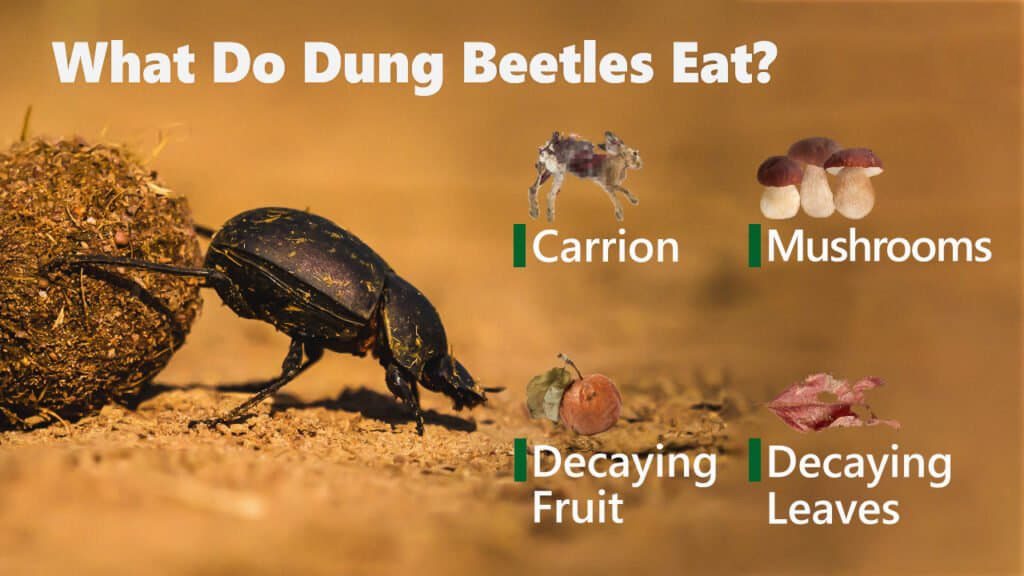
Beetles eat an enormous variety of foods. Some beetles feed on leaves, flowers, fruits, seeds, roots, or wood. Others eat fungi, dung, dead animals, stored grains, natural fibers, or other insects. A few beetles are highly specialized, while many are flexible feeders that use whatever suitable food is available in their habitat.
So, if you are asking “what do beetles eat?” the honest answer is: it depends on the beetle.
A Japanese beetle eating rose leaves, a carpet beetle larva feeding on wool lint, a lady beetle hunting aphids, and a dung beetle using animal manure are all beetles — but their diets are completely different. Beetles belong to one of the largest and most diverse insect groups on Earth, so their feeding habits reflect that diversity.
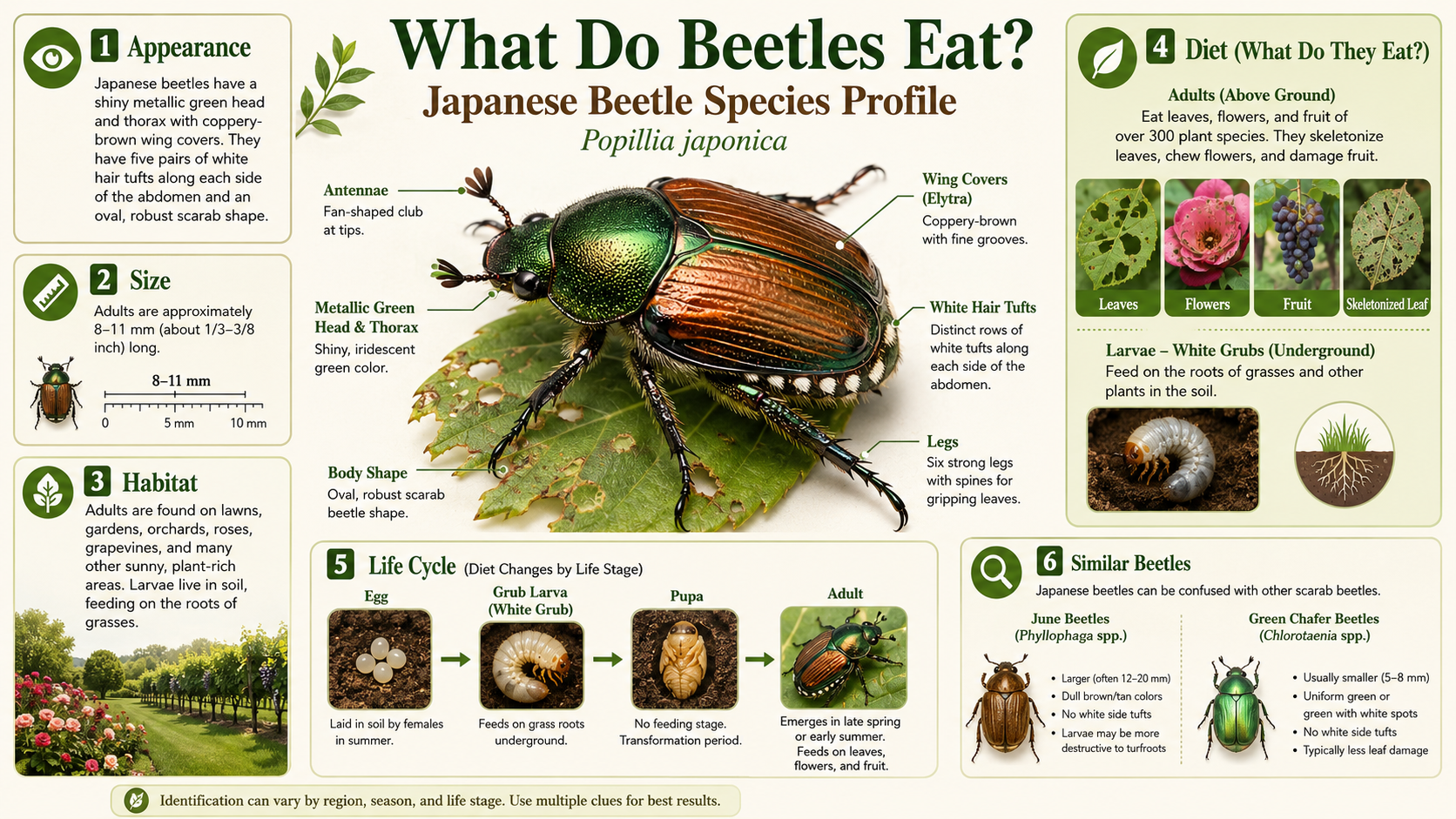
This guide explains beetle diets in a practical, beginner-friendly way. It will help homeowners, gardeners, students, teachers, and nature enthusiasts understand what beetles eat, how feeding clues can help with identification, and why beetle larvae often eat something different from adult beetles.
About This Guide
This guide is written for readers who want a clear overview of beetle diets without getting lost in technical language. Beetle identification can vary by region, life stage, season, and photo quality, so this article does not attempt to identify every beetle species from diet alone.
Instead, it explains useful patterns.
When trying to understand a beetle, observe several clues together:
- Size
- Color
- Body shape
- Antennae
- Wing covers
- Legs
- Location
- Season
- Host plant or food source
- Damage pattern
- Behavior
- Whether it is an adult beetle or a larva
Diet is one clue, not a guaranteed identification tool. For difficult identifications, compare your observations with university extension resources, museum references, government agriculture resources, natural history guides, and entomology references.
Quick Answer: What Do Beetles Eat?
Beetles may eat:
- Leaves
- Flowers
- Fruits
- Seeds
- Roots
- Wood
- Bark
- Fungi
- Nectar
- Pollen
- Stored grains
- Flour and dried pantry foods
- Wool, fur, feathers, hair, and other animal-based materials
- Dead insects
- Carrion
- Dung
- Snails
- Aphids
- Caterpillars
- Mites
- Other small insects and larvae
- Decaying plant and animal matter
Many beetles are plant feeders. Others are predators, scavengers, fungus feeders, wood borers, dung feeders, or stored-product feeders. Some are considered pests in gardens, homes, crops, forests, or pantries, while others are beneficial insects that help recycle nutrients or reduce populations of other insects.
Why Beetle Diets Are So Diverse
Beetles are not one simple “type” of insect. They are an entire order of insects called Coleoptera. This group includes lady beetles, ground beetles, scarab beetles, leaf beetles, weevils, click beetles, longhorn beetles, rove beetles, carpet beetles, pantry beetles, fireflies, diving beetles, and many more.
Because there are so many beetle families and species, beetles have adapted to many food sources.
Some live in soil.
Some live on leaves.
Some live under bark.
Some live in water.
Some live in flowers.
Some live in dung.
Some live in stored food.
Some live in the hidden edges of homes.
A beetle’s diet is closely connected to its habitat. A beetle found under a rotting log may eat fungi, decaying wood, or small insects. A beetle found on roses may be feeding on petals or leaves. A beetle larva found in a wool sweater may be feeding on animal-based fibers or debris. A fast-moving beetle on the ground may be hunting other small invertebrates.
This is why “what do beetles eat?” is best answered by looking at the beetle’s group, life stage, and location.
Adult Beetles vs. Beetle Larvae: Why Life Stage Matters
One of the most important things to know is that adult beetles and beetle larvae often eat different foods.
Beetles go through complete metamorphosis. That means their life cycle has four main stages:
- Egg
- Larva
- Pupa
- Adult
The larva is the immature feeding stage. In many beetles, the larva looks nothing like the adult. Beetle larvae may look like white grubs, wireworms, small worms, flattened larvae, hairy larvae, or dark predatory larvae.
The adult beetle is the stage most people notice because it has hard wing covers, legs, antennae, and a recognizable beetle shape.
Why larvae and adults may eat different foods
Larvae and adults often live in different places.
For example:
- Japanese beetle grubs feed underground on grass roots, while adult Japanese beetles feed on leaves, flowers, and fruit.
- Carpet beetle larvae feed on dried animal-based materials, lint, hair, dead insects, and sometimes stored products, while adult carpet beetles are often seen near windows or flowers.
- Lady beetle larvae and adults both eat small soft-bodied insects, but the larvae look very different from the familiar adult “ladybug.”
- Wood-boring beetle larvae may feed inside wood, while adults may live briefly, mate, and lay eggs.
This matters because the visible adult beetle may not be the stage causing the feeding damage.
Main Types of Beetle Diets
Beetles can be grouped by what they commonly eat. These categories are not perfect, because some beetles feed on more than one kind of material, but they are useful for beginners.
1. Plant-Eating Beetles
Many beetles feed on living plants. These are sometimes called herbivorous beetles or phytophagous beetles. “Phytophagous” simply means plant-eating.
Plant-eating beetles may feed on:
- Leaves
- Flower petals
- Buds
- Fruits
- Stems
- Seeds
- Roots
- Pollen
- Nectar
- Bark
- Sap
- Wood
Common examples include:
- Leaf beetles
- Weevils
- Japanese beetles
- Cucumber beetles
- Flea beetles
- Colorado potato beetles
- Some scarab beetles
- Some longhorn beetles
Signs of plant-feeding beetles
Look for:
- Holes in leaves
- Ragged leaf edges
- Skeletonized leaves
- Chewed flowers
- Damaged fruit skin
- Wilting seedlings
- Root damage
- Beetles clustered on a favorite plant
Some beetles are generalists and feed on many plant species. Others are specialists and prefer a narrow group of host plants.
2. Root-Feeding Beetle Larvae
Some beetle larvae live in soil and feed on roots. These larvae are often called grubs, especially when they are soft, pale, and C-shaped.
Root-feeding larvae may eat:
- Grass roots
- Vegetable roots
- Ornamental plant roots
- Fine feeder roots
- Decaying organic matter mixed with roots
White grubs are a familiar example. They are the larvae of scarab beetles such as Japanese beetles, June beetles, chafers, and related beetles.
Signs of root-feeding beetle larvae
Root feeding happens underground, so the beetle itself may not be visible at first.
Possible signs include:
- Brown patches in lawns
- Turf that lifts easily because roots are damaged
- Wilting plants despite watering
- Birds, skunks, raccoons, or other animals digging for grubs
- C-shaped larvae in soil
Not all grubs cause serious damage. A few grubs in healthy soil are normal. The level of concern depends on the plant, grub density, season, and local conditions.
3. Wood-Boring Beetles
Some beetles feed in wood, especially during the larval stage. These beetles are often called wood-boring beetles.
They may feed in:
- Dead branches
- Fallen logs
- Firewood
- Stressed trees
- Dying trees
- Structural wood
- Furniture
- Wooden beams
- Bark or cambium layers
Important wood-feeding groups include:
- Longhorn beetles
- Bark beetles
- Powderpost beetles
- Deathwatch beetles
- Some metallic wood-boring beetles
Do all wood-boring beetles damage homes?
No. Many wood-boring beetles are part of natural forest recycling. They help break down dead trees and return nutrients to the soil.
However, some species can be a concern when they infest structural wood, flooring, furniture, or lumber. If you see fresh exit holes, fine powdery frass, repeated adult emergence indoors, or softening wood, it may be worth seeking expert identification.
4. Fungus-Feeding Beetles
Many beetles feed on fungi, mold, or fungal growth associated with decaying plant material.
Fungus-feeding beetles may be found:
- Under bark
- In rotting logs
- In leaf litter
- In damp soil
- Around moldy stored products
- In compost
- In decaying mushrooms
- In moist indoor areas
Some fungus beetles are tiny and easy to overlook. Their presence may suggest damp conditions or decaying organic material nearby.
Why fungus-feeding beetles matter
In nature, fungus-feeding beetles help break down dead material. Indoors, however, they may indicate excess moisture, mold, or old organic debris. The beetles themselves may not be the main problem; the habitat that supports them may be the real clue.
5. Predatory Beetles
Some beetles are hunters. They feed on other insects, mites, snails, worms, larvae, eggs, and small invertebrates.
Predatory beetles include:
- Lady beetles
- Ground beetles
- Rove beetles
- Tiger beetles
- Some soldier beetle larvae
- Firefly larvae
- Diving beetles
- Many other aquatic and terrestrial beetles
What do predatory beetles eat?
Depending on the species, they may eat:
- Aphids
- Scale insects
- Mealybugs
- Mites
- Caterpillars
- Fly larvae
- Beetle larvae
- Insect eggs
- Slugs
- Snails
- Worms
- Small aquatic animals
Predatory beetles are often beneficial in gardens and natural habitats. They help regulate populations of other small animals.
Example: lady beetles
Lady beetles, often called ladybugs, are among the best-known predatory beetles. Many species feed on aphids, scales, mites, and other small soft-bodied insects. Both adults and larvae can be active predators.
The larvae look very different from adult lady beetles. They may be dark, elongated, and somewhat spiny. Beginners sometimes mistake lady beetle larvae for pests, even though they are often helpful garden predators.
Example: ground beetles
Ground beetles are usually fast-moving beetles found on soil, under stones, in leaf litter, or beneath logs. Many are nocturnal hunters. They may eat caterpillars, maggots, ants, aphids, slugs, other beetle larvae, and sometimes weed seeds.
Because many ground beetles help control pests, they are usually considered beneficial outdoors.
6. Scavenger Beetles
Scavenger beetles feed on dead or decaying organic matter. They are part of nature’s cleanup crew.
They may eat:
- Dead insects
- Dried animal remains
- Decaying plant matter
- Rotting organic debris
- Dead small animals
- Shed skins
- Nest material
- Hair and feathers
- Food crumbs mixed with organic debris
Scavenger beetles are important in ecosystems because they help recycle nutrients. In homes, some scavenger-like feeders may become noticeable when they find lint, hair, dead insects, old food, or stored natural materials.
7. Dung Beetles
Dung beetles feed on animal dung. Some species roll dung into balls. Others tunnel below dung piles or live directly inside the dung.
Dung beetles may use dung for:
- Adult feeding
- Larval food
- Nesting
- Egg-laying
- Nutrient recycling
Dung beetles are ecologically important because they help break down animal waste, return nutrients to soil, improve soil structure, and reduce the amount of dung left on the surface.
Most people do not find dung beetles inside homes. They are more commonly associated with pastures, grasslands, farms, wild animal areas, and natural habitats.
8. Carrion-Feeding Beetles
Carrion-feeding beetles feed on dead animals. Some eat the carrion directly, while others feed on fly larvae or other insects associated with carrion.
Examples include:
- Carrion beetles
- Burying beetles
- Some rove beetles
- Some hister beetles
- Dermestid beetles
Dermestid beetles are especially known for feeding on dried animal material. Museums may use carefully managed dermestid colonies to clean skeletons for scientific study.
In nature, carrion-feeding beetles are recyclers. They help break down dead animals and return nutrients to ecosystems.
9. Stored-Product Beetles
Some beetles feed on dry stored foods. These are often called pantry beetles or stored-product beetles.
They may feed on:
- Flour
- Rice
- Pasta
- Cereal
- Dried beans
- Dried peas
- Seeds
- Nuts
- Spices
- Dry pet food
- Birdseed
- Dried fruit
- Grain products
Common stored-product beetles include:
- Flour beetles
- Grain beetles
- Drugstore beetles
- Cigarette beetles
- Some weevils
- Some carpet beetles when they infest stored products
Signs of stored-product beetles
Look for:
- Small beetles in pantry shelves
- Beetles inside food packaging
- Larvae in dry goods
- Webbing or powdery residue in food
- Tiny holes in packaging
- Adults gathering near windows after emerging from stored products
The best response is usually to find the source, discard heavily infested food, clean cracks and shelves, and store dry goods in sealed containers.
10. Fabric and Natural-Fiber Feeders
Some beetle larvae feed on animal-based materials such as wool, fur, feathers, silk, hair, and dead insects. Carpet beetles are the best-known example.
Carpet beetle larvae may feed on:
- Wool clothing
- Wool carpets
- Felt
- Fur
- Feathers
- Hair
- Dead insects
- Pet hair
- Lint
- Taxidermy
- Natural fiber blends
- Organic debris under furniture
- Stored dry foods in some cases
Clean synthetic fabrics are usually not the preferred food. However, synthetic fabrics stained with sweat, food, urine, or other organic material may attract larvae.
Adult carpet beetles are often seen near windows or flowers, but the larvae are the stage that feeds on household materials.
What Do Beetles Eat in the Garden?
Garden beetles may eat plants, pests, pollen, nectar, roots, fungi, seeds, or decaying organic matter. Some are harmful to plants, some are harmless visitors, and some are beneficial predators.
Beetles that may feed on garden plants
Plant-feeding beetles may chew:
- Leaves
- Flowers
- Fruit
- Seedlings
- Stems
- Roots
Examples include:
- Japanese beetles
- Cucumber beetles
- Flea beetles
- Leaf beetles
- Weevils
- Colorado potato beetles
- Asparagus beetles
- Bean leaf beetles
Beetles that help the garden
Beneficial beetles may feed on:
- Aphids
- Mites
- Caterpillars
- Slugs
- Insect eggs
- Other larvae
- Weed seeds
Examples include:
- Lady beetles
- Ground beetles
- Rove beetles
- Soldier beetle larvae
How to tell if a garden beetle is feeding on plants
Look at the damage pattern:
- Small round holes may suggest flea beetles or small leaf feeders.
- Skeletonized leaves may suggest Japanese beetles or other leaf-feeding beetles.
- Chewed flowers may suggest adult scarab beetles or other flower feeders.
- Wilting seedlings may suggest root or stem feeding.
- Ragged edges may suggest larger chewing insects.
Do not assume every beetle on a plant is causing the damage. Some beetles are hunting the insects that are feeding on the plant.
What Do Beetles Eat in the House?
Beetles found indoors may eat stored food, natural fibers, dead insects, pet hair, lint, wood, or organic debris. Some do not feed indoors at all and are simply accidental visitors.
Common indoor beetle food sources
Indoor beetles may be associated with:
- Pantry foods
- Flour and grain products
- Dry pet food
- Birdseed
- Wool clothing
- Rugs
- Fur
- Feathers
- Dead insects in window tracks
- Pet hair under furniture
- Old lint
- Stored decorations made from natural materials
- Damp organic debris
- Firewood
- Structural wood
Indoor beetles that may not be feeding indoors
Some beetles wander indoors by accident. Ground beetles, click beetles, leaf beetles, and other outdoor beetles may enter through gaps, doors, windows, or firewood. Many of these do not reproduce indoors and do not feed on household materials.
If you find one or two beetles indoors, observe before assuming there is an infestation.
When indoor feeding is more likely
Indoor feeding is more likely when you see:
- Multiple beetles over time
- Larvae, not just adults
- Damage to wool, fur, or stored foods
- Beetles emerging from a specific cabinet, closet, or window area
- Shed larval skins
- Fine powder from wood
- Repeated activity in the same room
The source is often more important than the adult beetle itself.
What Do Beetles Eat in the Wild?
In wild habitats, beetles are part of many food webs. They feed on living plants, dead plants, fungi, dung, carrion, other insects, aquatic animals, and decaying material.
Forest beetles
Forest beetles may feed on:
- Dead wood
- Bark
- Fungi
- Leaf litter
- Tree sap
- Insect larvae
- Carrion
- Decaying plant matter
Wood-boring beetles and bark beetles are especially important in forest ecosystems. Some attack stressed or weakened trees, while many help break down dead wood.
Grassland beetles
Grassland beetles may feed on:
- Grass roots
- Seeds
- Dung
- Small insects
- Plant leaves
- Decaying organic matter
Dung beetles and ground beetles are common examples of grassland beetles with important ecological roles.
Aquatic beetles
Some beetles live in water. Aquatic beetles may feed on:
- Mosquito larvae
- Small aquatic insects
- Tadpoles
- Tiny fish
- Dead organisms
- Algae
- Plant material
Diving beetles are often predatory, while some water beetles are scavengers.
Diet Clues That Help with Beetle Identification
Diet can help narrow down beetle identification, but it should be used with other clues.
Ask these questions:
Where was the beetle found?
- On a flower?
- Under a log?
- In a pantry?
- In a closet?
- In soil?
- In a lawn?
- On a tree trunk?
- Near a window?
- In a damp basement?
- Around firewood?
Location is one of the strongest clues.
What was nearby?
Look for possible food sources:
- Chewed leaves
- Damaged flowers
- Stored grain
- Wool or fur
- Dead insects
- Pet hair
- Dung
- Fungi
- Wood dust
- Rotting logs
- Compost
- Soil roots
Was it an adult or larva?
Adults and larvae may eat different foods. If you only identify the adult, you may miss the damaging stage.
For example:
- Adult beetles may be seen near windows.
- Larvae may be hidden in closets, soil, wood, or pantry foods.
- Adults may feed lightly or not much at all.
- Larvae may do most of the feeding and growth.
What kind of damage is visible?
Damage patterns can help:
- Holes in leaves suggest chewing plant feeders.
- Skeletonized leaves suggest beetles feeding between leaf veins.
- Damaged roots suggest grubs or root feeders.
- Powdery wood dust suggests wood-boring insects.
- Irregular holes in wool suggest fabric-feeding larvae.
- Beetles in flour or grain suggest stored-product feeders.
- Missing aphids may suggest predatory beetles nearby.
Comparison: Common Beetle Groups and What They Eat
| Beetle Group | Common Foods | Where You May Find Them | Home/Garden Relevance |
|---|---|---|---|
| Lady beetles | Aphids, scales, mites, small insects, insect eggs | Gardens, plants, shrubs, trees | Usually beneficial predators |
| Ground beetles | Caterpillars, slugs, insects, larvae, sometimes weed seeds | Soil surface, under stones, leaf litter | Beneficial outdoors; accidental indoors |
| Japanese beetles | Adults eat leaves, flowers, fruit; grubs eat grass roots | Gardens, lawns, roses, grapes, fruit trees | Can damage ornamental plants and turf |
| Carpet beetles | Larvae eat wool, fur, feathers, hair, dead insects, lint, some stored products | Closets, rugs, baseboards, windows, stored items | Larvae may damage natural materials |
| Weevils | Seeds, grains, roots, leaves, fruits, nuts, stored foods | Plants, pantry, fields, gardens | Some are crop or pantry pests |
| Longhorn beetles | Larvae often feed in wood; adults may feed on plant material, pollen, sap, or little food | Trees, logs, firewood, woodlands | Mostly natural recyclers; some wood concerns |
| Dung beetles | Animal dung | Pastures, grasslands, farms, wildlife areas | Beneficial nutrient recyclers |
| Carrion beetles | Dead animals, fly larvae, decaying animal matter | Outdoors, forests, fields, carcasses | Important decomposers |
| Flour beetles | Flour, cereals, grain products, dry pantry foods | Kitchens, pantries, stored food areas | Stored-product pests |
| Bark beetles | Inner bark and tree tissues, often in stressed trees | Forests, trees, logs | Important in forest ecology; some tree pests |
Common Mistakes When Guessing What Beetles Eat
Mistake 1: Assuming all beetles eat plants
Many beetles do eat plants, but not all of them. Some are predators, scavengers, fungus feeders, dung feeders, carrion feeders, or stored-product feeders.
A beetle walking across a leaf may not be eating the leaf. It may be hunting aphids or resting.
Mistake 2: Blaming the adult beetle when larvae are responsible
In many beetles, larvae cause the most noticeable feeding damage.
Examples:
- Carpet beetle larvae damage fabrics, not the adults.
- Japanese beetle grubs damage grass roots, while adults damage leaves and flowers.
- Wood-boring beetle larvae feed inside wood.
- Pantry beetle larvae may develop inside stored foods before adults appear.
If you see adults, look for larvae and the source.
Mistake 3: Thinking one beetle means an infestation
A single beetle indoors may be an accidental visitor. Many outdoor beetles enter homes by mistake and cannot survive or reproduce indoors.
Repeated sightings, larvae, shed skins, damaged materials, or beetles emerging from one area are stronger signs of an indoor source.
Mistake 4: Ignoring season and region
Beetle activity changes by season. Some adults appear in spring or summer. Some larvae feed underground for months. Some household beetles are noticed when adults move toward windows.
Region also matters. A beetle common in one state or country may be rare or absent in another.
Mistake 5: Using color alone for identification
Color helps, but it is not enough. Many beetles are black, brown, metallic green, reddish, or patterned. Identification should include body shape, size, antennae, legs, wing covers, habitat, behavior, and food source.
Habitat and Behavior: Why Location Matters
A beetle’s location often tells you more than its color.
Beetles on flowers
Beetles on flowers may be eating:
- Pollen
- Nectar
- Petals
- Other insects
- Sap or plant fluids
Some flower-visiting beetles help with pollination. Others chew blossoms.
Beetles under logs
Beetles under logs may be eating:
- Fungi
- Decaying wood
- Other insects
- Mites
- Dead organic matter
- Slugs or small invertebrates
This is a normal place for many beneficial decomposers and predators.
Beetles in soil
Soil beetles or larvae may be eating:
- Roots
- Seeds
- Other larvae
- Organic matter
- Fungi
White grubs, wireworms, ground beetle larvae, and many other beetle larvae live in soil.
Beetles in pantries
Pantry beetles may be feeding on:
- Flour
- Grain
- Pasta
- Cereal
- Spices
- Seeds
- Nuts
- Dry pet food
Check the oldest, least-used packages first. Beetles often begin in forgotten food.
Beetles in closets
Closet beetles may be associated with:
- Wool
- Fur
- Feathers
- Hair
- Pet hair
- Lint
- Dead insects
- Stored natural materials
Carpet beetle larvae prefer hidden, undisturbed areas.
Beetles near windows
Adult beetles near windows may be trying to get outside. This is common with carpet beetles and some pantry beetles after adults emerge.
Window sightings can be a clue, but the food source may be elsewhere.
Beetle Diet and Life Cycle
Diet is closely tied to the beetle life cycle. The larval stage is often the main growth stage, so larvae usually feed heavily. Adults may feed to survive, reproduce, or disperse. In some species, adults feed very little.
Egg stage
The egg does not feed. Female beetles usually place eggs near a suitable food source for the larvae.
Examples:
- Carpet beetles may lay eggs near lint, wool, hair, or organic debris.
- Japanese beetles lay eggs in soil where grubs can feed on roots.
- Pantry beetles lay eggs near stored food.
- Wood-boring beetles lay eggs in cracks, bark, or wood surfaces.
Larval stage
The larva feeds and grows. This is often the stage that causes noticeable damage.
Larvae may feed in:
- Soil
- Wood
- Stored food
- Fabric
- Leaf tissue
- Roots
- Carrion
- Dung
- Fungi
- Other insects
Pupal stage
The pupa is the transformation stage. It usually does not feed. During this stage, the beetle changes from larva to adult.
Adult stage
Adults may feed, mate, disperse, and lay eggs. Their diet may be similar to or very different from the larval diet.
What Do Beetles Eat Around the Home?
Around the home, beetles may be found in gardens, lawns, pantries, closets, firewood, window frames, garages, basements, attics, and storage areas.
In lawns
Beetle larvae may feed on grass roots. White grubs are the most familiar example.
In gardens
Adult beetles may feed on leaves, flowers, fruit, pollen, nectar, or other insects.
In pantries
Stored-product beetles may feed on dry goods such as flour, cereal, pasta, rice, grains, seeds, spices, and pet food.
In closets and storage areas
Carpet beetle larvae may feed on wool, fur, feathers, hair, dead insects, lint, and other animal-based debris.
In firewood
Wood-boring beetles may emerge from firewood brought indoors. In many cases, these beetles developed in the wood before it was brought inside.
In attics or wall voids
Some beetles may be associated with old bird nests, rodent nests, dead insects, or stored organic material.
Are Beetles Harmful Because of What They Eat?
Some beetles can damage plants, stored food, fabrics, or wood. Others are beneficial. Many are neutral visitors that play a quiet role in nature.
A beetle’s impact depends on:
- Species
- Life stage
- Number of beetles
- Food source
- Location
- Season
- Plant health
- Whether they are indoors or outdoors
A few holes in leaves may be cosmetic. A small number of ground beetles outdoors may be helpful. A single beetle indoors may not matter. But repeated damage to stored food, natural fibers, turf, or structural wood deserves closer inspection.
When to Seek Professional Help
Most beetle sightings do not require professional help. However, expert assistance may be useful in some situations.
Consider contacting a local extension office, pest professional, museum, agricultural department, or entomology expert if:
- You find repeated beetle activity in the same indoor area.
- Stored food is repeatedly infested despite cleaning.
- Wool, fur, feathers, or natural materials show ongoing damage.
- You see fresh wood dust, exit holes, or suspected structural wood damage.
- A lawn has severe root loss and grubs are present in high numbers.
- A valuable tree shows signs of boring insects, bark damage, or decline.
- You need species-level identification for school, agriculture, collection care, or management.
- You cannot tell whether the beetle is beneficial or damaging.
For identification, provide clear photos from several angles and include location, size, date, habitat, and what the beetle was found on or near.
Educational Disclaimer
This guide is for general education and identification support. Beetle diets and identification details vary by region, season, species, and life stage. A photo or feeding clue alone may not be enough for confirmed species identification. For serious crop, structural, museum, pantry, or household damage, consult a qualified local expert or extension service.
FAQ
What do beetles eat?
Beetles eat many different foods, depending on the species. Some eat leaves, flowers, roots, fruits, seeds, or wood. Others eat fungi, dung, carrion, stored food, natural fibers, or other insects.
Do beetles eat plants?
Yes, many beetles eat plants. Plant-feeding beetles may chew leaves, flowers, fruit, stems, seeds, roots, or bark. However, not all beetles are plant feeders.
Do beetles eat wood?
Some beetles eat wood, especially during the larval stage. Wood-boring beetle larvae may feed inside dead wood, stressed trees, firewood, furniture, or structural wood, depending on the species.
Do beetles eat other insects?
Yes. Many beetles are predators. Lady beetles often eat aphids and scales, while ground beetles may eat caterpillars, slugs, larvae, and other small invertebrates.
What do beetle larvae eat?
Beetle larvae may eat roots, wood, leaves, stored food, natural fibers, fungi, dung, carrion, or other insects. Their diet depends on the beetle species and where the eggs were laid.
What do beetles eat in the house?
Indoor beetles may eat stored grains, flour, cereal, dry pet food, wool, fur, feathers, hair, dead insects, lint, or wood. Some beetles found indoors do not feed inside and are accidental visitors.
What do beetles eat in the garden?
Garden beetles may eat leaves, flowers, fruit, roots, pollen, nectar, aphids, mites, caterpillars, slugs, seeds, fungi, or decaying plant material. Some damage plants, while others are beneficial predators.
Do carpet beetles eat carpet?
Carpet beetle larvae can feed on wool carpets and other animal-based materials. They may also eat fur, feathers, hair, dead insects, lint, and organic debris. Adult carpet beetles are not usually the stage causing fabric damage.
Do lady beetles eat plants?
Most familiar lady beetles are predators that eat aphids, scales, mites, and other small insects. Some may also use pollen or nectar. A few lady beetle relatives, such as Mexican bean beetles, feed on plants.
Do ground beetles eat plants?
Many ground beetles are predators that eat insects, larvae, caterpillars, slugs, and other small animals. Some species also eat weed seeds. Most ground beetles found outdoors are considered beneficial.
Why are beetles eating my leaves?
Leaf damage may be caused by plant-feeding beetles such as Japanese beetles, flea beetles, cucumber beetles, leaf beetles, or weevils. Look at the damage pattern, plant type, season, and beetle shape to narrow down the likely cause.
Can beetle diet help identify the species?
Diet can help narrow identification, but it should not be used alone. For better identification, combine diet with size, color, body shape, antennae, wing covers, habitat, behavior, season, and location.
Conclusion
So, what do beetles eat? Beetles eat almost every kind of natural material imaginable. Some feed on leaves, roots, flowers, fruit, seeds, or wood. Others eat fungi, dung, carrion, stored pantry foods, wool, feathers, dead insects, or living prey.
The key is to avoid treating all beetles as the same. A beetle’s diet depends on its species, life stage, habitat, season, and location. Adult beetles and larvae may feed on completely different things, and the stage you see may not be the stage doing the most feeding.
For beginners, the best approach is to observe carefully. Look at where the beetle was found, what food sources are nearby, what kind of damage is visible, and whether you are seeing adults, larvae, or both. With those clues, you can better understand whether the beetle is a plant feeder, predator, scavenger, decomposer, pantry beetle, fabric feeder, wood borer, or harmless visitor.
Beetles are not just pests. Many are essential recyclers, pollinators, predators, and soil builders. Understanding what beetles eat is one of the simplest ways to understand their role in the natural world — and to make better decisions when you find them in your home, garden, or local habitat.
2 thoughts on “What Do Beetles Eat? A Complete Guide to Beetle Diets, Feeding Habits, and Home & Garden Clues”