

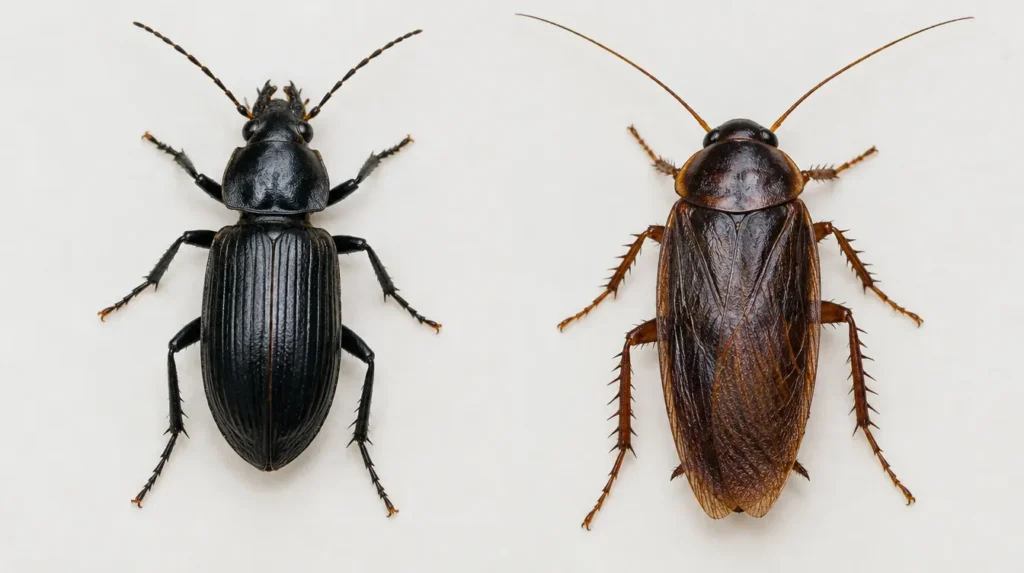
A dark insect runs across your kitchen floor, disappears beneath a cabinet, and leaves you wondering whether you’ve just seen a beetle or a cockroach. The confusion is understandable. Some ground beetles look remarkably similar to dark-colored cockroaches, especially when they’re moving quickly.
The most reliable way to tell a beetle from a cockroach is to examine its wings. Most adult beetles have two hardened wing covers, called elytra, that meet in a straight line down the back. Winged cockroaches have more flexible, leathery front wings that overlap rather than forming the same hard central seam.
If the insect has no visible wings, look for a flattened body, long threadlike antennae, a shield covering much of the head, and two small appendages at the rear. Together, these features may point toward a cockroach.
Here’s how to examine the differences without relying on color or speed alone.
Beetle vs Cockroach: Quick Identification Chart
| Feature | Beetle | Cockroach |
|---|---|---|
| Wing covers | Usually hard, meeting in a straight central seam | Leathery and overlapping when fully developed |
| Body shape | Highly variable; often oval or elongated | Commonly broad, oval, and flattened |
| Antennae | Short, long, clubbed, threadlike, or other forms | Usually long, slender, and threadlike |
| Head | Often visible from above | Usually partly concealed beneath the pronotum |
| Rear appendages | No typical cockroach-like cerci | Usually a pair of short cerci |
| Movement | Some walk slowly; ground beetles can run very quickly | Many species run quickly and seek shelter |
| Young stages | Larvae look different from adults | Nymphs resemble small, wingless adults |
| Indoor significance | Varies from accidental visitor to household pest | Varies from outdoor visitor to indoor pest |
No single feature works perfectly for every insect. Wing structure is particularly useful for typical adults, while wingless cockroaches require additional clues.
1. Look at the Wings First
Turn your attention to the insect’s back.
Beetles have hardened wing covers
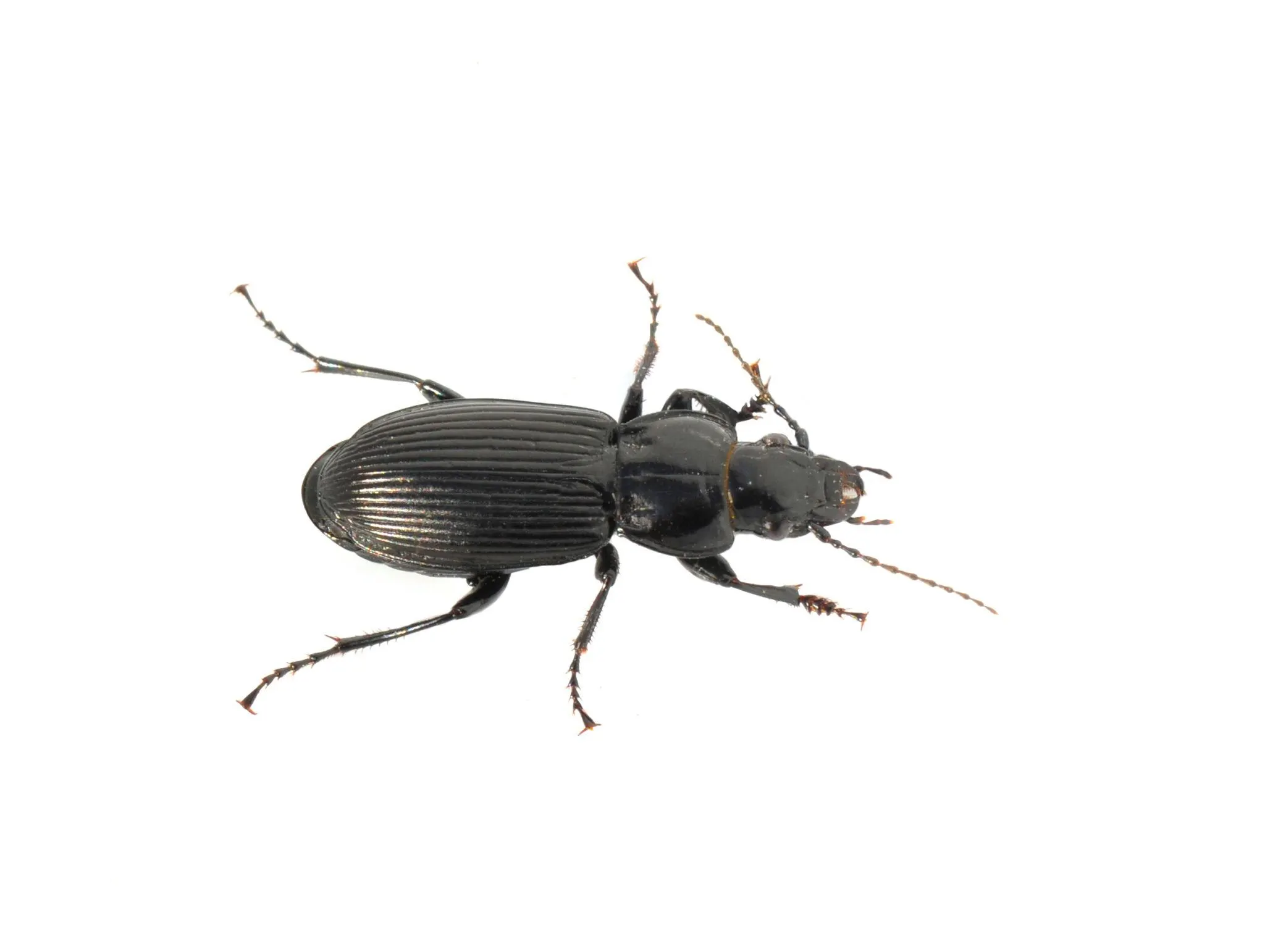
In most beetles, the front pair of wings has evolved into protective covers called elytra. When closed, the two covers usually meet along a distinct central line.
This line may look like a fine seam running from behind the thorax toward the end of the abdomen.
Ground beetles often show this feature clearly. Their dark wing covers may also have fine lengthwise grooves or ridges.
The wings used for flying, when present, are usually folded beneath these protective covers.
Cockroaches have overlapping wings
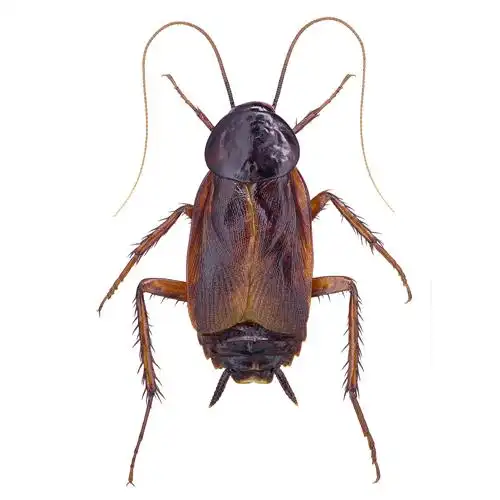
Many adult cockroaches have leathery front wings called tegmina.
Instead of forming two rigid halves that meet along a central seam, these wings generally overlap across the back. They may have visible veins and look flatter or more flexible than beetle wing covers.
However, not every cockroach has fully developed wings. Female oriental cockroaches, for example, have short wing structures, and young cockroaches lack developed wings altogether.
Identification tip: A clearly visible pair of hard wing covers meeting down the middle strongly suggests a beetle. If those structures are absent, examine the antennae, head, and rear of the abdomen before deciding.
2. Compare the Body Shape and Head
Cockroaches are usually flattened from top to bottom. Their broad bodies help them move into narrow cracks and concealed spaces.
One useful feature is the pronotum, the plate immediately behind the head. In cockroaches, this shield often extends forward enough to hide much of the head when viewed from above.
Many beetles have a more distinct-looking head, thorax, and wing-cover outline. Ground beetles frequently have visible heads and prominent jaws.
But body shape alone can be misleading.
Some beetles are naturally flattened, and certain cockroaches look relatively thick-bodied. Both groups include insects with glossy black or brown surfaces.
A beetle does not have to be rounded, and a cockroach does not have to be paper-thin.
3. Check the Antennae and Rear Appendages
Antennae are helpful, especially when the wings are difficult to see.
Cockroaches usually have long, thin, threadlike antennae. These may extend as far as or beyond the body.
Beetle antennae are more varied. Some have club-shaped tips, some are elbowed, and others are long and slender.
Ground beetles have threadlike antennae, so antenna shape alone will not always separate them from cockroaches. Longhorn beetles can have antennae considerably longer than their bodies.
A more useful additional feature is found at the rear.
Cockroaches typically have two short appendages called cerci at the tip of their abdomen. These are sensory structures that help detect disturbances.
Typical adult beetles lack these cockroach-like rear appendages.
On a clear photograph, the combination of a shielded head, long antennae, and visible cerci can be particularly useful when identifying a wingless cockroach.
4. Ground Beetle vs Cockroach: The Most Common Mix-Up
One of the easiest identification mistakes is confusing a ground beetle with a cockroach.
Ground beetles belong to the family Carabidae. Many are black or dark brown, have long running legs, and become active at night.
They can move remarkably quickly when disturbed.
A ground beetle crossing a basement floor may look like a cockroach for the few seconds before it disappears.
However, closer examination usually reveals several differences.
A ground beetle often has:
- Hard, clearly defined wing covers, sometimes with lengthwise grooves.
- A relatively visible head with developed chewing jaws.
- Threadlike antennae that are not necessarily short.
- No pair of cockroach-like cerci at the abdominal tip.
A cockroach typically has:
- A broad, flattened body.
- A prominent pronotum partly concealing its head.
- Long, slender antennae.
- Leathery overlapping wings, reduced wings, or no developed wings.
- A pair of cerci near the rear of the abdomen.
The oriental cockroach is an especially understandable source of confusion because it can be very dark and glossy.
For a closer look at the beetle side of this comparison, see our ground beetle identification guide.
5. Can You Identify Them by How They Move?
Movement can provide supporting evidence, but it should never be the deciding factor.
Cockroaches often run toward cover when disturbed. Many species are active at night and hide in narrow crevices during the day.
Ground beetles are also frequently nocturnal. They run quickly and may hide beneath stones, leaves, logs, or objects lying on the ground.
That means the familiar advice that cockroaches run fast while beetles move slowly is unreliable.
A fast-moving insect in the dark could belong to either group.
Flight is not a dependable shortcut, either. Some beetles are strong fliers, while others rarely fly or cannot fly. Cockroach flight ability also varies considerably by species and sex.
Look at the anatomy first. Use behavior as a secondary clue.
6. Baby Cockroach vs Beetle: What Is the Difference?
Young cockroaches can be particularly confusing because they don’t have the developed wings used to distinguish many adults.
A young cockroach is called a nymph. It generally resembles a smaller, wingless version of an adult cockroach.
Depending on its species and developmental stage, a nymph may be dark brown, reddish, or patterned.
Useful features include its flattened shape, long antennae, shield-like pronotum, and rear cerci.
Beetles develop differently.
Their life cycle includes an egg, larva, pupa, and adult. A beetle larva may look like a C-shaped grub, an elongated wireworm, or a hairy, segmented insect.
A beetle larva does not simply look like a tiny version of its adult parent.
This distinction is particularly helpful when comparing immature insects.
A small wingless insect shaped like an adult cockroach may be a cockroach nymph. A grub-like insect is more consistent with a beetle larva or another insect’s immature stage.
Size and color still matter, but they should be combined with visible anatomy.
7. Is It a Beetle or Cockroach in Your House?
Where you found the insect provides another useful clue.
Near an outside door or basement window
A ground beetle may have wandered indoors through a small opening.
Ground beetles normally live outdoors, often in soil, leaf litter, and other sheltered habitats. Many feed on smaller insects and other invertebrates.
University extension guidance indicates that ground beetles generally do not reproduce inside homes. Most indoor sightings involve accidental visitors.
Behind kitchen appliances or cabinets
Repeated sightings around food preparation areas, sinks, refrigerators, and hidden cracks deserve closer investigation.
Some cockroach species, including German cockroaches, can establish breeding populations indoors.
Look for additional evidence rather than assuming that one insect proves an infestation.
Potential signs include:
- Repeated sightings of cockroaches.
- Small cockroach nymphs appearing alongside adults.
- Egg cases in sheltered areas.
- Dark fecal spots or smears around hiding places.
- Multiple specimens collected in monitoring traps.
Near woodlands or outdoor vegetation
Not every cockroach that enters a house is a household pest.
Wood cockroaches, for example, normally inhabit outdoor environments. Some occasionally enter buildings but do not establish persistent indoor populations.
Similarly, finding a beetle indoors does not automatically mean it is harmless. Carpet beetles, pantry beetles, and some other beetle groups can become household pests under suitable conditions.
The insect’s identity matters more than the label “beetle” or “cockroach.”
For other possible indoor beetles, visit our Beetles Around the Home section.
8. What Should You Do If You’re Still Unsure?
The best next step is to collect a little more evidence rather than immediately applying insecticide.
If practical, photograph the insect from above. Try to capture the entire back, the antennae, and the tip of the abdomen.
A side-view photograph may also help reveal whether the body is flattened and how the head sits beneath the pronotum.
Note where it was found, its approximate size, and whether you have seen others.
If the insect appears to be an occasional ground beetle, you can usually capture it in a container and release it outside. Sealing entry gaps may help prevent future visitors.
If you repeatedly find insects resembling cockroaches indoors, particularly adults and nymphs near kitchen or bathroom hiding places, consider monitoring with sticky traps.
A local university extension office or qualified pest management professional may be able to confirm the identification from a suitable photograph or specimen.
For general beetle recognition, our Beetle Identification section explains how to combine body shape, antennae, markings, and habitat clues.
Frequently Asked Questions
Do beetles have long antennae like cockroaches?
Yes. Ground beetles and longhorn beetles are two examples with relatively long antennae. Some longhorn beetles have antennae longer than their bodies. Antenna length alone cannot reliably distinguish a beetle from a cockroach.
Can a cockroach have a hard-looking shell?
Yes. A cockroach’s exoskeleton can look glossy and rigid, especially in dark species. The distinction is not whether the insect looks hard, but whether it has the characteristic paired, hardened beetle wing covers.
Does finding one cockroach mean an infestation?
Not necessarily. Some outdoor cockroaches accidentally enter buildings. Repeated indoor sightings, nymphs, egg cases, and other evidence are more informative than a single encounter.
Are ground beetles harmful indoors?
Ground beetles are generally harmless accidental visitors. They do not normally breed indoors or damage stored food, clothing, or building materials. Some can pinch if handled, so capturing rather than touching them is preferable.
The next time a dark insect races across the floor, start with its back. A pair of hardened wing covers meeting along a central seam is a strong beetle clue. Overlapping wings, a concealed head, long antennae, and rear cerci point more toward a cockroach. If the wings aren’t visible, several clues together will give you a better answer than color or speed alone.