

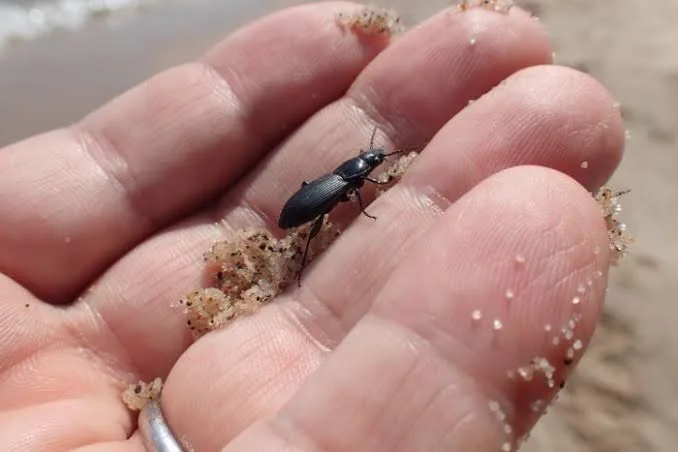
Ground beetles are fast-running, mostly nocturnal beetles in the family Carabidae, usually dark and shiny with lengthwise grooves on their wing covers, thread-like antennae, and long legs. Nearly all are harmless predators that eat slugs, caterpillars, and other pests.
If one turned up under a flowerpot, in a window well, or scuttling across a basement floor at night, you almost certainly found an insect that works in your favor outdoors. Carabids do not bite people in any meaningful way, do not damage houses, and do not feed on stored food, fabric, or wood. The beetle running away from your flashlight is the same animal that spent last night eating cutworms in the vegetable bed.
The confusing part is that “ground beetle” covers an enormous range of sizes and colors, and several unrelated beetles look similar at a glance. This guide works through the family characters that actually separate carabids from their look-alikes.
About This Guide
This page is a group profile rather than a single-species page. It explains what unites the roughly 40,000 described species in Carabidae, how to recognize the family in your yard, and what these beetles do ecologically.
Family-level identification is realistic for a careful observer. Species-level identification usually is not. Many carabid genera contain dozens of similar black species separated by details of the leg segments, punctures, or genitalia that require a specimen, a microscope, and a regional key. If you want a name for the exact beetle in your photo, the honest answer for most sightings is “a ground beetle, probably in the genus Pterostichus or Harpalus,” and that is a legitimate stopping point.
What Are Ground Beetles?
Ground beetles belong to the family Carabidae, in the beetle order Coleoptera and the suborder Adephaga. The family includes more than 40,000 described species worldwide, making it one of the most species-rich beetle families. Roughly 2,000 species occur in North America and about 2,700 in Europe, though North American counts vary by checklist, and some sources put the continental figure closer to 2,300 or higher. Treat any of these as approximations; new species are still being described. nihUrite
Carabids are microhabitat specialists as a group, occupying alpine meadows, tree canopies, mossy logs, leaf litter in deciduous forests, sandy riverbanks, and sparsely vegetated grasslands. That habitat range is why almost any garden, park, field edge, or woodlot in temperate regions has ground beetles in it, usually more than the owner realizes. nih
Most are predators. They have well-developed, often large mouthparts used for chewing prey and seeds, are primarily nocturnal hunters, and move very quickly, which helps them catch prey and escape other predators. SDSU Extension
How to Identify a Ground Beetle
No single feature identifies the family. Work through the combination below.
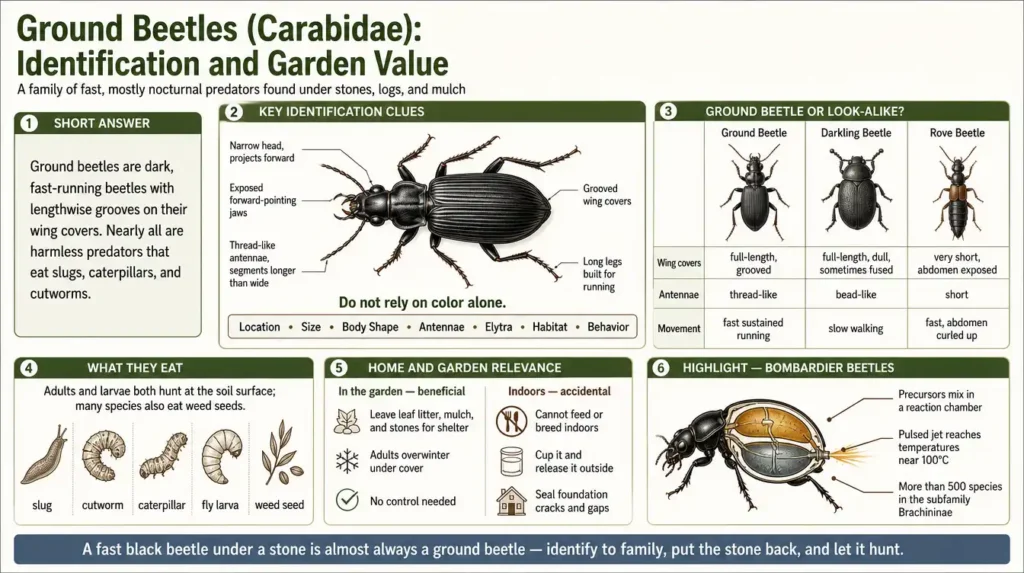
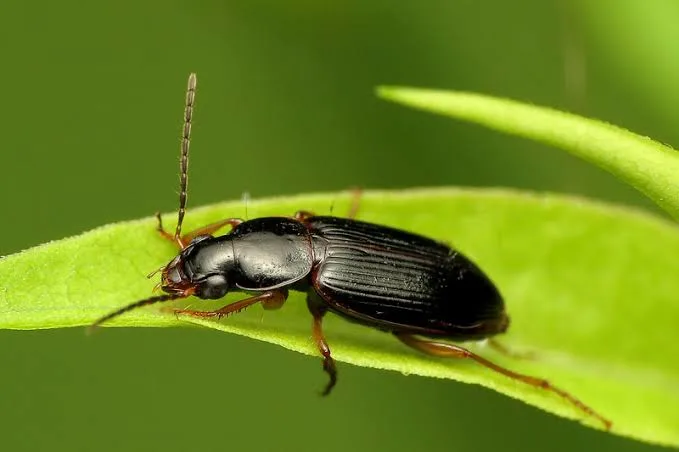
Body shape and posture. Adults are somewhat flattened, often elongate, with a narrow head that projects forward, long legs, large eyes, and strong sickle-shaped mandibles. The head being clearly narrower than the thorax is one of the most useful field characters — it gives carabids a slightly “shouldered” outline. Ohioline
Wing covers. The elytra are hard and typically show numerous fine parallel grooves or ridges running lengthwise, meeting in a straight line down the back. In some species the elytra are fused and the beetle has lost the ability to fly entirely.
Antennae. Ground beetles have long, thread-like antennae, large eyes, and a distinct bean-shaped segment (the trochanter) on each hind leg. In carabids the antennal segments are usually longer than wide, so the antenna looks like a near-continuous filament rather than a string of beads. If you want more practice with this feature across families, see our guide to reading beetle antennae. SDSU ExtensionBlogger
Jaws. Look at the front of the head: if the mandibles are exposed and directed forward, you likely have a ground beetle or another predatory beetle; if they are concealed beneath the clypeus, you are probably looking at a darkling beetle or another beetle that feeds on plants or detritus. Blogger
Size and color. Most are small to moderate — about 1/8 to 1/2 inch, with a few reaching an inch — generally black or brown and iridescent, though some species are brightly colored in blues, greens, and reds. Across all North American species the range runs from roughly 1/10 inch to about 1 3/4 inches. umnSDSU Extension
Behavior. Ground beetles are active at night, hide during the day under leaves, logs, stones, and loose bark, and when exposed they run quickly for shelter rather than flying. umn
Color alone is never enough. Thousands of unrelated beetles are black or dark brown, which is exactly the trap our black beetle identification guide is built around. Combine location, size, body shape, antennae, elytra, habitat, season, and behavior before you commit to an answer.
Ground Beetle Look-Alikes: A Comparison
| Feature | Ground beetle (Carabidae) | Darkling beetle (Tenebrionidae) | Rove beetle (Staphylinidae) | Cockroach (not a beetle) |
|---|---|---|---|---|
| Wing covers | Full-length, hard, usually finely grooved lengthwise | Full-length, often dull or matte, sometimes fused | Very short, leaving most of the abdomen exposed | No hardened elytra; leathery forewings overlap |
| Antennae | Thread-like, segments longer than wide | Often bead-like or slightly clubbed | Short, thread-like or slightly clubbed | Very long, thin, whip-like, constantly moving |
| Head and jaws | Narrower than thorax; jaws exposed and forward-pointing | Head often tucked under the front of the thorax; jaws hidden | Jaws exposed; body long and flexible | Head hidden beneath a shield-like pronotum |
| Gait | Fast, sustained running | Slow, deliberate walking; some raise the rear when disturbed | Fast, often curling the abdomen upward | Fast, erratic, freezes and darts |
| Surface | Usually glossy | Usually dull or matte | Variable, often somewhat glossy | Glossy, often reddish-brown to dark brown |
| Typical role | Predator of soil-surface pests | Scavenger of dead plant material | Mostly predator or scavenger | Scavenger; some species are indoor pests |
Darkling beetles are a very large family of mostly dull black or brown ground-crawling scavengers, and many species are flightless, some with the elytra fused together and no visible split down the back. If the beetle lumbers along slowly and only runs when prodded, a darkling beetle is likely; sustained fast running points to a carabid. Missouri Department of ConservationBlogger
The cockroach question comes up constantly for indoor sightings. The quickest test is the head: a cockroach’s head is hidden under a broad shield, and it has long whip-like antennae in constant motion. A ground beetle has a visible, forward-pointing head, shorter antennae, and rigid grooved wing covers.
What Ground Beetles Eat
This is where carabids earn their reputation. They are known early-season predators of aphids, slugs, and the immature stages of seedcorn maggots and other fly pests, hunting primarily along the soil surface, while some species known as caterpillar hunters climb into foliage to find food. Garden prey includes caterpillars, aphids, grubs, fly maggots, root maggots, cutworms, snails, spiders, slugs, mites, and other beetles. University of Maryland ExtensionFairfax Gardening
They can consume close to their own body weight in food daily, so the cumulative effect on pests and weeds is significant over time. University of Maine Cooperative Extension
Larvae are predators too. The burrowing larvae seek out and feed on pests in the soil, which means a healthy carabid population is working in two layers at once. If you want to see how carabid feeding compares with the rest of the order, our overview of what beetles eat puts it in context. eOrganic
Seed eating is the second half of the story. Many carabid species feed on weed seeds along the soil surface, helping reduce total weed emergence and biomass. In North American farm systems, Amara and Harpalus species are considered the most important seed predators, with both larvae and adults consuming seeds. Ground beetles do not generally feed on plant matter other than seeds, and they are rarely considered direct crop pests. Carabid Beetles – UMD Extension – University of Maryland +2
The practical takeaway for a home gardener: a beetle you find under mulch at night is far more likely to be eating your slugs than your seedlings.
Habitat, Life Cycle, and Overwintering
Ground beetles spend daylight hours in cover. Look for them under stones, boards, logs, loose bark, in leaf litter, under mulch, and in soil cracks. Moist, shaded microhabitats hold the most.
Adults are generally active from April through October, most species produce a single generation of adults per year, and females lay eggs in the soil after mating. The life cycle runs egg, larva, pupa, adult; larvae live in organic litter or topsoil and pass through four instars, and mature larvae form a cell in the soil to pupate. Development can take up to a year, and adults may live two years or more — long-lived by beetle standards, which our page on how long beetles live puts in perspective. University of Maine Cooperative Extension
For winter, most species simply stay put in cover. In South Dakota, for example, most ground beetle species have one generation per year and overwinter as adults in leaf litter or other sheltered areas. Overwintering carabids emerge and resume hunting in early spring. SDSU ExtensionUniversity of Maryland Extension
That has a direct gardening implication. Raking every leaf, removing all mulch, and clearing every log removes the overwintering habitat of the predators you want. Leaving a few unraked corners, a stone edging, a log pile, or an undisturbed mulched bed is one of the simplest ways to keep carabids on site. Reduced disturbance matters at larger scales too: informed decisions about tillage, pesticide use, and beneficial habitat can increase carabid abundance and diversity. Penn State
Bombardier Beetles: The Family’s Chemical Weapon
Some of the strangest chemistry in the animal kingdom belongs to a subfamily of ground beetles. The subfamily Brachininae, known as bombardier beetles, includes more than 500 species and represents the only animals known to sustain an explosion of hot chemicals inside their own bodies. nih
The mechanism is genuinely explosive. A reservoir chamber holds hydroquinones and hydrogen peroxide; when the beetle is provoked, surrounding muscles push these precursors through a one-way valve into a reaction chamber where catalase and peroxidase trigger an exothermic reaction, releasing p-benzoquinones, water, and oxygen at temperatures up to 100°C. The result is ejected as a pulsed jet toward the threat at speeds up to 10 meters per second and over distances up to 30 centimeters. PubMed Centralnih
The pulsing is what protects the beetle: pressure from each explosion expands a membrane that closes the valve, and when the pressure is released the membrane relaxes and the passage reopens for the next pulse. Bombardier beetles occur on every continent except Antarctica, and very few animals prey on them. Sci.NewsMIT News
For a person, this is a curiosity rather than a hazard. A bombardier beetle handled roughly can produce a hot, irritating discharge and a stain on the skin, so the sensible response is the same as for any wild insect: look, photograph, and let it walk away rather than picking it up.
Ground Beetle Groups You Are Likely to Meet
- Woodland ground beetles (Pterostichus, Poecilus). Glossy black or bronzy, medium-sized, with clearly striated elytra. Pterostichine species are among the most diverse feeders, taking slugs, aphids, moth larvae, and beetle larvae. These are the beetles most often found under garden stones. University of Maine Cooperative Extension
- Seed-eating carabids (Harpalus, Amara). Amara species are generally medium-sized, 3.9–14.3 mm, many with a metallic sheen and a distinctly pill-shaped body, and are strongly associated with weed-seed predation. eOrganic
- Caterpillar hunters (Calosoma). Larger, sometimes brilliantly metallic green or blue, and unusual among carabids in climbing vegetation to hunt.
- Big-headed burrowers (Scarites). Large beetles, roughly 14–30 mm, shiny black with big mandibles, often found under bricks, logs, mulch, or stones lining flower beds. nih
- Bombardier beetles (Brachinus). Often with a reddish-orange head and thorax contrasting with dark blue-black elytra.
For a wider tour of beetle families side by side, see our roundup of common beetle types with pictures.
Ground Beetles Indoors: Almost Always Accidental
Finding one in a basement in late summer is normal and does not indicate an infestation. Ground beetles found indoors are accidental invaders that do not feed or reproduce inside, and where possible they should be captured and returned outside; they are beneficial insects providing biological control in gardens and farms, and they do not require management. SDSU Extension
They usually enter in mid to late summer through cracks, spaces, and other small openings, and indoors they turn up in hidden, damp areas of the basement or under boxes. They are harmless: they do not attack people, pets, structures, or household contents, and special controls are usually unnecessary. umnIowa State University Extension
What actually works:
- Slide a piece of paper under the beetle, cup it, and release it in the garden.
- Vacuum or sweep up any that are already inside. Iowa State University Extension
- Reduce entry by caulking gaps and cracks in the foundation and siding, and check door sweeps and window screens. Iowa State University Extension
- Reduce the pull of outdoor lighting. Ground beetles are attracted to lights — moving or shielding fixtures near doors helps, a pattern explained further in our article on why beetles are drawn to light. umn
- Move heavy leaf litter and stacked wood a short distance away from the foundation, without stripping the garden of cover entirely.
Insecticides are the wrong tool here. You would be spraying a beneficial predator that cannot survive indoors anyway. If a persistent, high-volume entry problem develops, a licensed pest management professional or a local extension office can inspect the structure and advise on exclusion.
Common Mistakes in Ground Beetle Identification
- Judging by color. A metallic green carabid and a metallic green scarab are unrelated; so are a black carabid and a black darkling beetle. Our metallic green beetle guide shows how far color alone can mislead.
- Assuming a fast black beetle indoors is a pest species. Most stored-product and fabric pests are tiny, oval, and slow; carabids are larger, elongate, and fast.
- Estimating size from a photo with no scale. Put a coin, pen tip, or ruler in the frame.
- Ignoring the jaws. Exposed, forward-pointing mandibles are one of the strongest quick signals for Carabidae.
- Trying to name the species. Many species are difficult to distinguish, and a confident species label from a single blurry photo is usually wrong. Ohioline
When Professional Identification Matters
Get expert help when the identification has consequences: a suspected crop or stored-product pest, an insect associated with a bite or skin reaction, a specimen from a survey or school project, or anything that might be a non-native species. County extension offices, university entomology departments, natural history museums, and the BugGuide.net community all accept photo submissions. Include a scale object, the date, the location, and where exactly the beetle was found.
Frequently Asked Questions
Are ground beetles harmful to humans?
No. They do not sting, do not seek out people, and are not venomous. A large species handled roughly may pinch with its mandibles, and some release a defensive fluid that can irritate skin or stain briefly. Neither is a health concern for most people. Our broader page on whether beetles are good or bad covers this across families.
Do ground beetles bite?
Only if picked up and squeezed, and even then most people describe a brief pinch rather than an injury. Handle any unfamiliar insect with a container instead of your fingers.
Are ground beetles good for the garden?
Yes. Adults and larvae prey on slugs, cutworms, caterpillars, root maggots, and other soil-surface pests, and many species also eat weed seeds.
Why do I keep finding ground beetles in my basement?
They wander in through foundation cracks, gaps under doors, and window wells, usually in late summer, and are often drawn toward outdoor lights. They cannot breed indoors, so the numbers reflect entry points rather than a population living in the house.
Do ground beetles fly?
Some do, but most rely on running, and a number of species have fused wing covers and cannot fly at all. Compare with the genuinely airborne groups in our guide to flying beetles.
How do I tell a ground beetle from a cockroach?
A ground beetle has rigid, grooved wing covers and a visible forward-pointing head. A cockroach has a head hidden under a broad shield, very long whip-like antennae, and no hardened elytra.
What do ground beetle larvae look like?
Elongate, somewhat flattened, dark-headed grubs with six legs, prominent forward-facing jaws, and often two small tail appendages. They live in soil and leaf litter, not in the open.
Where do ground beetles go in winter?
Most overwinter as adults in leaf litter, under logs and stones, in mulch, and in soil cracks, emerging to hunt in early spring.
Should I kill ground beetles I find outside?
No. They are among the most useful predators in a garden. Leaving stones, mulch, and some leaf litter in place gives them daytime shelter and winter habitat.
Can ground beetles damage plants?
Very rarely. They eat seeds and occasionally sample soft fruit — ripening strawberries are the classic example — but they are not considered crop pests as a group.
Conclusion
Ground beetles are the working predators of the soil surface: a family of more than 40,000 species, recognizable by grooved wing covers, thread-like antennae, a narrow forward-pointing head with exposed jaws, long legs, and a fast nocturnal running gait. They eat slugs, cutworms, caterpillars, fly larvae, and weed seeds, they overwinter under the exact leaf litter and stones many gardeners are tempted to clear away, and when they turn up indoors they are lost rather than established.
Identify to family with confidence, leave species-level naming to a specimen and a specialist, and when you meet one in the garden, the best possible response is to put the stone back and let it get on with its night’s work. Explore more group profiles in our types of beetles section.
References and further reading
- University of Minnesota Extension — Ground Beetles
- Penn State Extension — Ground and Tiger Beetles (Coleoptera: Carabidae)
- SDSU Extension — Ground Beetles: Predators That Provide Benefits in Agricultural Landscapes
- Iowa State University Yard and Garden — Ground Beetle Invaders
- University of Maryland Extension — Carabid Beetles
- University of Maine Cooperative Extension — Carabidae (Ground Beetles) on Maine Farms
- Colorado State University — Ground Beetles
- MIT News — How Some Beetles Produce a Scalding Defensive Spray
1 thought on “Ground Beetles: Identification, Habits & Garden Value”