

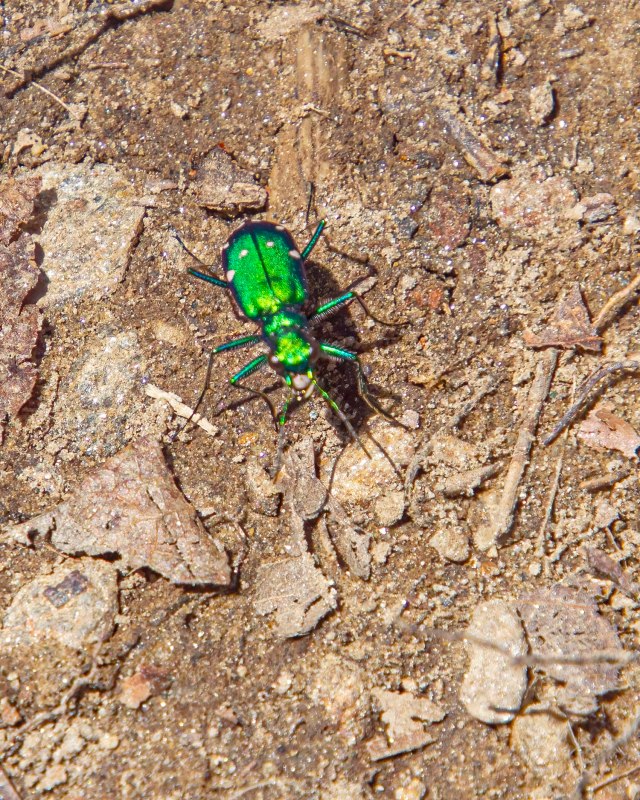
A metallic green beetle is most reliably identified by combining its size, body shape, wing-cover markings, antennae, behavior, host plant, habitat, season, and geographic location.
A small oval beetle with a metallic green head, copper-brown wing covers, and white hair patches may be a Japanese beetle. A large, heavy beetle flying noisily around lawns or ripe fruit may be a green June beetle or green fruit beetle. A narrow, bullet-shaped beetle found on an ash tree may require closer examination for emerald ash borer. A fast-running green beetle on a woodland trail is more likely to be a tiger beetle.
Color is useful, but it is rarely enough for a confident identification. Many unrelated beetle species appear emerald green, blue-green, bronze-green, coppery, or iridescent under sunlight.
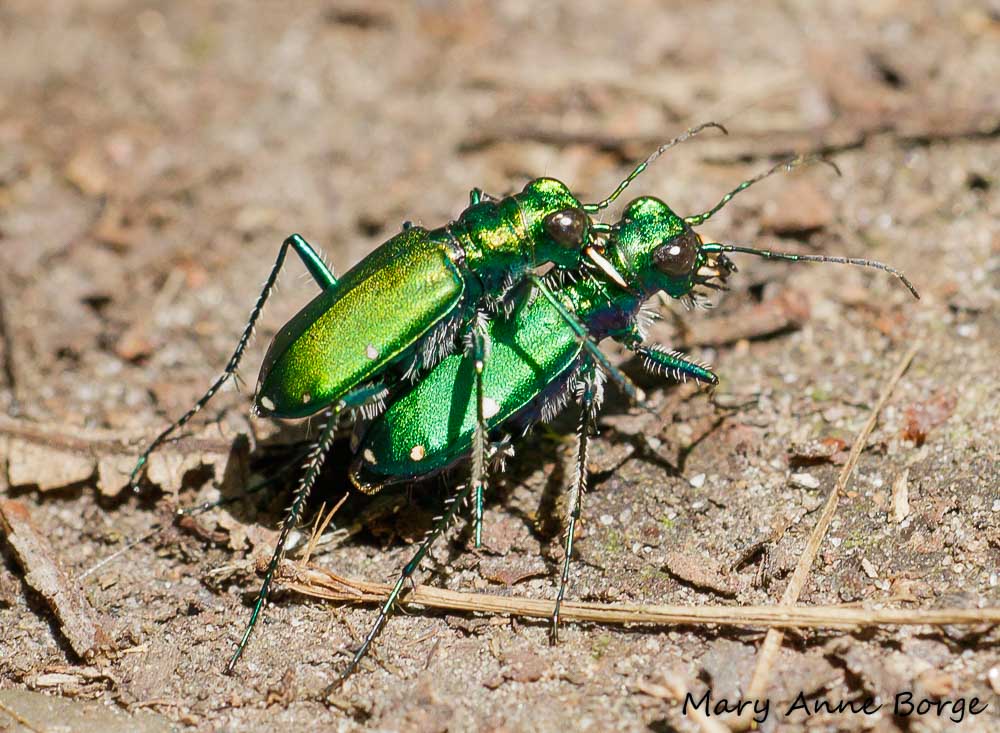
For broader comparisons of green, yellow-green, and spotted species, see this guide to green beetles. The focused process below is designed specifically for metallic green beetle identification.
About This Guide
This guide helps beginners narrow down the identity of a shiny green beetle without assuming that every metallic insect belongs to the same species.
Beetle appearance can vary with:
- Geographic region
- Life stage
- Sex
- Age
- Season
- Lighting conditions
- Viewing angle
- Body size
- Wear or damage to the wing covers
- Photo focus and color balance
Some metallic colors are especially difficult to photograph. A beetle that appears emerald green in sunlight may look blue, black, bronze, or copper in a shaded photograph.
Species-level identification may require examination of small anatomical details that cannot be seen in an ordinary phone image. When identification affects an ash tree, commercial crop, valuable garden plant, suspected infestation, pesticide decision, or scientific record, consult a local extension office, natural history museum, agriculture agency, or qualified insect specialist.
What Does Metallic Green Mean?
A metallic beetle has a reflective, polished, or jewel-like appearance. Its color may become brighter in direct light or shift between green, blue, violet, copper, bronze, and gold as the viewing angle changes.
This color-changing effect is called iridescence. In many animals, iridescence is produced by microscopic structures that affect how light is reflected. The visible color is therefore influenced by both the insect’s surface and the direction of the light.
This explains why color descriptions alone can be misleading. Two photographs of the same beetle may look noticeably different when they are taken:
- In direct sunlight
- Under a porch light
- With a camera flash
- In deep shade
- Through a window
- Against a brightly colored leaf
- From different angles
“Metallic green beetle” is therefore a visual description, not a scientific group. Metallic species occur in several beetle families, including scarab beetles, leaf beetles, tiger beetles, ground beetles, and metallic wood-boring beetles.
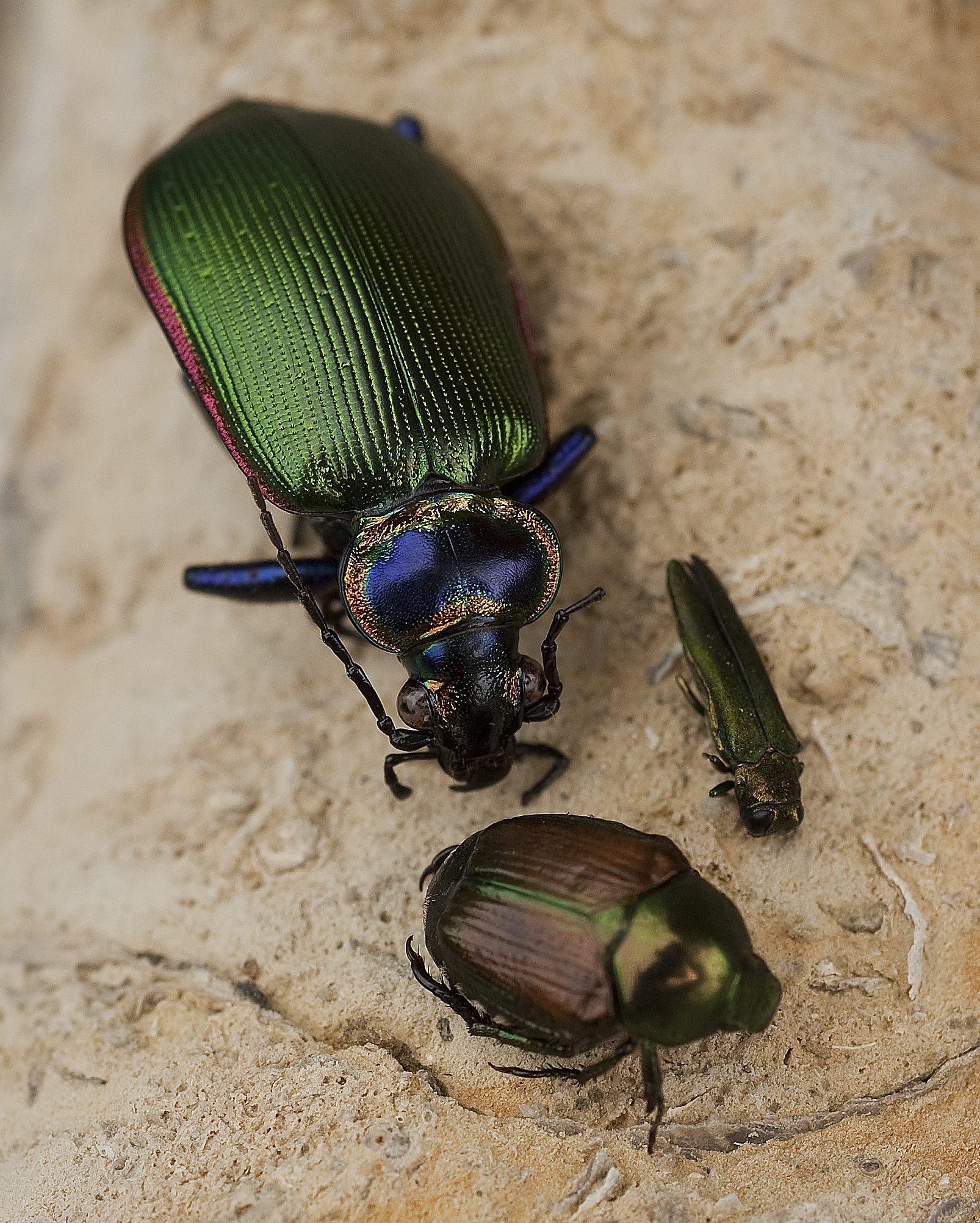
How to Confirm the Insect Is a Beetle
Before comparing species, check whether the insect has the basic structure of a beetle.
Adult beetles have hardened front wings called elytra. These wing covers usually meet in a straight line down the center of the back. They protect the softer flying wings folded underneath.
Look for:
- Six legs
- One pair of antennae
- A clearly defined head
- A thorax behind the head
- Two hardened wing covers
- A center seam running lengthwise down the back
- Chewing mouthparts rather than a long piercing beak
Not every shiny green insect is a beetle. Metallic green sweat bees, cuckoo wasps, flies, shield bugs, and other insects may be mistaken for beetles in photographs.
Bees and wasps usually have more visibly membranous wings and a different body outline. True bugs often have overlapping wings rather than two hard covers that meet in a straight center seam.
Readers unfamiliar with beetle anatomy can begin with this broader beetle identification guide.
Quick Metallic Green Beetle Identification
Use the following clues in order. Beginning with size and body shape is usually more reliable than beginning with color.
1. Estimate the Beetle’s Size
Place a ruler near the beetle without touching it, or photograph it beside a familiar object.
A rough size guide:
- Under 1/8 inch: possible flea beetle, pollen beetle, or another tiny leaf beetle
- About 1/4 inch: small leaf beetle, small jewel beetle, rosemary beetle, or metallic borer
- About 3/8 to 1/2 inch: Japanese beetle, dogbane beetle, tiger beetle, or emerald ash borer
- About 3/4 to 1 inch: green June beetle, green fruit beetle, or another large scarab
A beetle nearly one inch long is not an emerald ash borer. Size immediately eliminates many common misidentifications.
2. Examine the Body Shape
Metallic green beetles commonly fall into several recognizable shapes.
Broad and heavy: Often a scarab such as a green June beetle.
Small and oval: May be a Japanese beetle or leaf beetle.
Long and narrow: May be a metallic wood-boring beetle.
Long-legged with a large head: May be a tiger beetle.
Tiny with enlarged hind legs: May be a flea beetle.
Rounded with colored stripes: May be a rosemary beetle or another leaf beetle.
3. Look at the Wing Covers
The elytra often provide the most useful markings.
Check for:
- Copper-brown wing covers
- White spots near the outer edges
- Pale yellow margins
- Purple or blue longitudinal stripes
- Rows of pits or grooves
- A smooth, polished surface
- A tapered or squared rear end
- Whether the covers completely conceal the abdomen
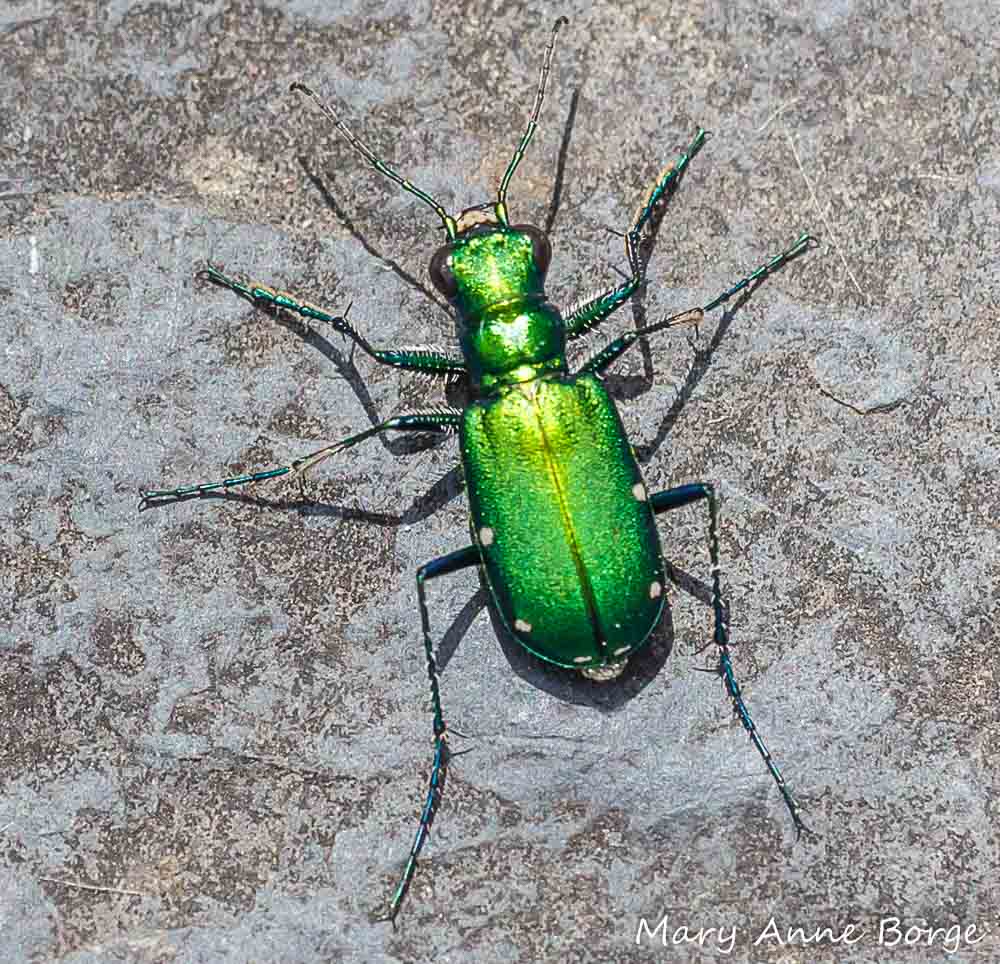
Japanese beetles, for example, have copper-brown wing covers and visible white hair patches along the sides of the abdomen. Six-spotted tiger beetles may have several pale spots along the outer edges of otherwise bright green wing covers. Emerald ash borers are much narrower and lack the Japanese beetle’s white side tufts.
4. Check the Antennae
Antennae help distinguish major beetle groups.
- Scarab beetles have clubbed antennae with leaflike terminal segments.
- Leaf beetles usually have relatively short, threadlike antennae.
- Longhorn beetles have conspicuously long antennae.
- Weevils often have elbowed antennae arising from a snout.
- Tiger beetles have slender antennae, long legs, large eyes, and prominent jaws.
A clear side photograph is often necessary to see antenna shape.
5. Record Where the Beetle Was Found
The beetle’s immediate surroundings may be more informative than its color.
Ask:
- Was it feeding on roses?
- Was it on ripe fruit?
- Was it sitting on an ash trunk?
- Was it running along a sunny woodland path?
- Was it on dogbane?
- Was it jumping from vegetable leaves?
- Was it inside a rosemary or lavender plant?
- Was it crawling around flowers?
- Was it found near firewood or recently cut branches?
A beetle on its usual host plant is easier to identify than a beetle found on a wall, car, window, or sidewalk.
6. Observe Its Behavior
Useful behaviors include:
- Flying heavily or clumsily
- Running quickly across bare ground
- Jumping when disturbed
- Feeding in groups
- Resting on flowers
- Boring into wood
- Skeletonizing leaves
- Feeding on fruit
- Remaining closely associated with one plant species
Behavior should support other clues rather than serve as the only identifying feature.
Common Metallic Green Beetles Compared
| Beetle | Typical adult size | Main colors and markings | Body shape | Common setting | Key identification clue | Usual significance |
|---|---|---|---|---|---|---|
| Japanese beetle | About 1/3–1/2 inch | Metallic green head and thorax, copper-brown wing covers, white hair tufts | Small, oval scarab | Roses, grapes, fruit, ornamentals | Five white hair patches along each side and two near the rear | Can damage many garden plants |
| Green June beetle | About 3/4–1 inch | Green to velvety green with yellow, bronze, or tan margins | Large, broad, heavy scarab | Lawns, compost-rich soil, ripe fruit | Large size and low, noisy daytime flight | Usually an outdoor species; may damage ripe fruit |
| Green fruit beetle | About 3/5–9/10 inch | Metallic green with tan or yellowish borders | Large scarab | Western gardens, compost, ripe fruit | Large western green scarab associated with fermenting or ripe fruit | May feed on soft fruit |
| Emerald ash borer | About 8.5–13.5 mm | Bright metallic green, sometimes brassy | Narrow, elongated, bullet-shaped | Ash trees and ash wood | Small narrow body combined with ash association and tree symptoms | Serious invasive ash pest |
| Six-spotted tiger beetle | About 1/2 inch | Bright metallic green with zero to eight pale spots | Long-legged, large-headed predator | Sunny forest paths and woodland edges | Runs rapidly; large eyes and jaws | Beneficial predator |
| Dogbane beetle | About 8–10 mm | Blue-green, green, copper, gold, or mixed iridescence | Small, rounded to oblong leaf beetle | Dogbane plants in fields and roadsides | Jewel-like beetle closely associated with dogbane | Usually harmless to cultivated plants |
| Rosemary beetle | About 6–7 mm | Metallic green and purple stripes | Rounded leaf beetle | Rosemary, lavender, sage, and related herbs | Distinct green-purple striping | May feed on herb foliage and flowers |
| Metallic flea beetle | Often 1/16–1/8 inch | Green, blue-green, bronze, black, or striped | Tiny leaf beetle with enlarged hind legs | Vegetable leaves and seedlings | Jumps suddenly when disturbed | Can produce small feeding holes |
| Pollen beetle | About 2–3 mm | Dark green, bronze, or black | Very small, compact beetle | Inside flowers | Tiny shiny beetle crawling among pollen | Usually part of normal garden wildlife |
Sizes and appearances can vary, and regional species may look similar. Use the table as a starting point rather than a final species determination.
Japanese Beetle
The Japanese beetle, Popillia japonica, is one of the most recognizable metallic green beetles in North American gardens.
Adults are approximately 1/3 to 1/2 inch long. The head and thorax are metallic green, while the wing covers are copper-brown. The sides of the abdomen have five white patches of hair on each side, with two additional patches near the rear.
Identification Clues
Look for this combination:
- Small, compact, oval body
- Metallic green head and thorax
- Copper or bronze wing covers
- White hair tufts along the abdomen
- Clubbed scarab antennae
- Several beetles feeding together
- Skeletonized leaves with tissue eaten between the veins
The white hair tufts are more reliable than color alone. Several beetles have metallic green and copper coloring, but they do not share the same arrangement of white abdominal patches.
A false Japanese beetle may have a dull green head and copper-brown wing covers, but it lacks the characteristic white tufts.
Habitat and Behavior
Adults may gather on roses, grapes, fruit trees, vegetables, and many ornamental plants. Their feeding can leave leaves with a lace-like appearance.
The immature stage is a white grub that develops in soil. The adult and larval stages therefore occupy different settings and may damage different plant parts.
What to Do
One beetle does not always justify treatment. Record the number present, the plant affected, and the amount of injury.
Where Japanese beetles are established and feeding is substantial, follow local extension guidance. Management recommendations differ according to the plant, season, beetle density, and region.
Green June Beetle
The green June beetle, Cotinis nitida, is much larger than a Japanese beetle or emerald ash borer.
Adults are metallic or velvety green and nearly one inch long. The edges of the body may be bronze, tan, or yellowish, and the wing covers may sometimes appear reddish brown.
Identification Clues
Look for:
- Broad, heavy scarab body
- Approximately 3/4 to 1 inch in length
- Green upper surface
- Yellow, tan, or bronze margins
- Strong buzzing flight
- Daytime activity
- Low flight over lawns or gardens
- Association with soft or ripe fruit
Adults may appear intimidating because of their size and noisy, somewhat clumsy flight. Their flight behavior can cause them to bump into people, walls, or other objects, but this is not an attack.
Larvae
Green June beetle larvae are large, cream-colored grubs. Unlike many other scarab grubs, they may travel across the soil surface on their backs.
The larvae are commonly associated with soil rich in decomposing organic material. In high numbers they may disturb the soil mechanically, while adults may feed on soft fruit.
Similar Species
In western North America, a large green scarab may instead be a green fruit beetle or figeater. Green June beetles and green fruit beetles can be difficult to separate visually in regions where their ranges approach one another.
Green Fruit Beetle or Figeater
The green fruit beetle, Cotinis mutabilis, is also called the figeater beetle or western green June beetle.
Adults are large, metallic green scarabs commonly associated with the western and southwestern United States. They may be seen around compost, lawns, gardens, orchards, and ripe fruit.
The green fruit beetle and eastern green June beetle can look extremely similar. The University of California notes that confident separation may require expert examination of anatomical details.
Identification Clues
Look for:
- Large scarab body
- Metallic green upper surface
- Yellowish, tan, or pale margins
- Strong daytime flight
- Presence around ripe or damaged fruit
- Western location
Garden Relevance
Adults may feed on fruit that is already soft, split, damaged, or overripe. Larvae often develop in decaying organic material, including compost or accumulations of decomposing plant matter.
Fruit sanitation, timely harvesting, and management of excessive rotting organic material may be more relevant than treating every adult beetle seen in flight.
Emerald Ash Borer
The emerald ash borer, Agrilus planipennis, is a small invasive metallic wood-boring beetle associated with ash trees.
Adults have a narrow, elongated body and are much smaller than green June beetles. USDA identification material describes adults as approximately 8.5 to 13.5 mm long, with a metallic green pronotum and darker emerald-green wing covers.
The damaging stage is the larva, which feeds beneath ash bark and disrupts the tree’s vascular tissues. Emerald ash borer has caused extensive ash decline and mortality in North America.
Identification Clues
Do not identify emerald ash borer from green color alone. Look for a combination of:
- Small size
- Narrow, bullet-shaped body
- Metallic emerald or brassy green coloring
- Association with a true ash tree
- Canopy thinning or branch dieback
- Bark splitting
- Woodpecker activity
- Serpentine larval galleries beneath the bark
- Distinctive D-shaped adult exit holes
A green beetle found near an ash tree is not automatically an emerald ash borer. Six-spotted tiger beetles, dogbane beetles, Japanese beetles, native metallic wood-borers, and other insects are regularly confused with it. Extension publications specifically present these beetles as common lookalikes.
What to Do
Suspected emerald ash borer findings should be documented rather than treated as an ordinary garden beetle.
Take clear photographs of:
- The top and underside of the beetle
- The beetle beside a ruler
- The tree’s leaves
- The bark
- Exit holes
- Galleries beneath loose bark
- Branch dieback or canopy symptoms
Report a credible suspected finding through the relevant state, provincial, or national agriculture or forestry authority. USDA specifically encourages photographs of both the insect and ash tree damage when reporting possible emerald ash borer activity.
Six-Spotted Tiger Beetle
The six-spotted tiger beetle is a bright metallic green predator commonly found in deciduous forests and nearby open areas.
Adults are about 1/2 inch long and may have from zero to eight white spots along the outer edges of the wing covers, despite the common name “six-spotted.”
Identification Clues
Look for:
- Brilliant green or blue-green color
- Long legs
- Large eyes
- Large curved jaws
- Relatively narrow waist between body sections
- Pale spots near the outer elytral margins
- Very rapid running
- Short bursts of flight when approached
Habitat and Behavior
Six-spotted tiger beetles are often seen on:
- Sunny woodland trails
- Dirt roads
- Forest clearings
- Edges of deciduous woods
- Bare or lightly vegetated ground
They actively hunt other small insects. A fast metallic green beetle running across a trail is more likely to be a tiger beetle than a plant-feeding scarab or emerald ash borer.
Tiger beetles are generally useful predators and do not require garden control.
Dogbane Beetle
The dogbane beetle, Chrysochus auratus, is a small North American leaf beetle known for its intense iridescent coloring.
Adults are approximately 8 to 10 mm long. Depending on the light, the same beetle may display metallic green, blue, copper, gold, violet, or red reflections.
Identification Clues
Look for:
- Small, rounded to oblong body
- Smooth, highly polished surface
- Mixed green, blue, copper, and gold reflections
- Lack of Japanese beetle-style white hair patches
- Presence on dogbane
- Roadsides, meadows, field edges, or unmanaged areas
Dogbane is a particularly important clue. Adults feed on dogbane foliage, while larvae develop around the roots of host plants.
Garden Relevance
Dogbane beetles are not considered significant pests of ordinary cultivated plants. Their presence on native dogbane is part of the plant’s natural ecological community.
They are sometimes mistaken for emerald ash borers because of their size and metallic color. The dogbane beetle is broader and more rounded, while the emerald ash borer is narrower and more bullet-shaped.
Rosemary Beetle
The rosemary beetle, Chrysolina americana, is a metallic leaf beetle associated with rosemary and related aromatic plants.
Adults are approximately 6 to 7 mm long and have distinctive metallic green and purple stripes extending along the thorax and wing covers.
Identification Clues
Look for:
- Rounded body
- Alternating metallic green and purple stripes
- Smooth, polished wing covers
- Presence on rosemary, lavender, sage, thyme, or related plants
- Greyish larvae with darker longitudinal markings
Garden Relevance
Both adults and larvae may feed on foliage and flowers. Light feeding may cause little lasting harm, while larger populations can reduce leaves to short stubs or produce visible discoloration.
The beetle is well established in parts of Europe, including Britain. Geographic location should therefore be considered before applying the name to a striped beetle found elsewhere.
Metallic Flea Beetles
Flea beetles are tiny leaf beetles named for their ability to jump suddenly when disturbed.
Many species are black, bronze, blue-green, or metallic green. Most are only about 1/16 to 1/8 inch long, although some species are larger. Their enlarged hind legs provide one of the most useful identification clues.
Identification Clues
Look for:
- Very small size
- Metallic green, blue, bronze, or black coloring
- Enlarged hind legs
- Sudden jumping
- Numerous small holes in leaves
- Presence on vegetable seedlings or brassicas
A tiny green beetle that vanishes by jumping is more likely to be a flea beetle than a small emerald ash borer.
Garden Relevance
Established plants often tolerate limited feeding. Seedlings can be more vulnerable because the same amount of feeding removes a greater proportion of their leaf area.
Identify the affected plant and estimate the level of damage before deciding whether management is necessary.
Pollen Beetles
Pollen beetles are very small, dark metallic beetles commonly found inside flowers.
Adults are usually about 2 to 3 mm long and may appear green, bronze, or black. They crawl among anthers and feed on pollen. In ordinary gardens they rarely cause meaningful damage and may contribute to normal flower visitation.
Identification Clues
Look for:
- Extremely small size
- Dark metallic surface
- Compact oval body
- Clubbed antennae
- Activity inside open flowers
- Several beetles in yellow or pollen-rich blooms
Their tiny size separates them from Japanese beetles, dogbane beetles, tiger beetles, and emerald ash borers.
Metallic Green Beetles in the House
A metallic green beetle found indoors is often an outdoor visitor rather than evidence of a household infestation.
It may have entered through:
- An open door
- A window or damaged screen
- Cut flowers
- Potted plants
- Firewood
- Fresh branches
- Clothing or outdoor equipment
- Attraction to indoor or porch lighting
The first question is not simply, “What color is it?” Ask where it appeared.
Near a Window
A single beetle near a bright window may be trying to return outdoors. Photograph it, capture it in a container, and release it if there is no reason to suspect an invasive regulated species.
Near Houseplants
Check leaves for feeding holes, larvae, eggs, and repeated adult sightings. Tiny jumping beetles may be associated with plants, while one large scarab is more likely to have flown indoors accidentally.
Near Firewood
A narrow metallic beetle emerging repeatedly near stored wood deserves closer attention. Determine the tree species, origin of the wood, and whether exit holes are present.
Do not transport potentially infested firewood to a new location.
Repeated Indoor Sightings
Repeated sightings from the same wall, wood item, plant, or stored material justify closer investigation. However, familiar household beetle problems involving carpets, fabrics, pantry foods, or animal materials are not usually diagnosed from metallic green color alone.
Use the location and affected material to compare likely beetles around the home.
Habitat and Behavior Clues
A useful identification combines the beetle with the place where it was active.
On Roses, Grapes, or Ornamentals
A small metallic green and copper beetle with white abdominal tufts strongly suggests Japanese beetle.
Around Ripe Fruit
A large green scarab may be a green June beetle or green fruit beetle. Check geographic region, body margins, size, and fruit condition.
On an Ash Tree
A small narrow beetle may require comparison with emerald ash borer and native wood-boring beetles. Examine the tree itself for symptoms.
Running on a Forest Trail
A long-legged beetle with large eyes and jaws is likely a tiger beetle.
On Dogbane
A small, jewel-like beetle displaying several shifting colors is likely a dogbane beetle.
Jumping from Vegetable Leaves
A tiny metallic beetle with enlarged hind legs is probably a flea beetle.
Inside Rosemary or Lavender
A rounded beetle with green and purple stripes may be a rosemary beetle, particularly in Europe.
Inside Flowers
A beetle only a few millimeters long may be a pollen beetle or another flower-associated species.
Diet and Life Cycle
Beetles undergo complete metamorphosis. Their life cycle includes four distinct stages:
- Egg
- Larva
- Pupa
- Adult
The larva may look nothing like the adult and may live in a completely different habitat.
This is particularly important when evaluating plant damage.
Japanese Beetles
Adults feed on leaves, flowers, and fruit. Larvae are white grubs that develop in soil and feed below ground.
Green June Beetles
Adults may feed on soft fruit. Larvae are large grubs commonly associated with soil containing substantial decaying organic material.
Emerald Ash Borers
Adults are seen on or around ash trees, but the larvae cause the most serious injury by feeding beneath the bark.
Tiger Beetles
Both adults and larvae are predators. Adults run across the ground in pursuit of prey, while larvae live in burrows and ambush passing insects.
Dogbane Beetles
Adults feed on dogbane foliage. Larvae develop around and feed on host plant roots.
Rosemary Beetles
Both adults and larvae feed on leaves and flowers of rosemary and related plants.
Flea Beetles
Adults make small feeding pits or holes in leaves. Larvae may feed on roots, stems, or leaves, depending on the species.
The range of diets found among shiny green beetles is one reason color cannot predict whether a beetle is beneficial, neutral, or damaging. More examples are covered in what beetles eat.
Common Metallic Green Beetle Identification Mistakes
Mistake 1: Relying Only on Color
Metallic green appears in unrelated beetle families. Use size, shape, antennae, host plant, and behavior alongside color.
Mistake 2: Assuming Every Small Green Beetle Is an Emerald Ash Borer
Dogbane beetles, tiger beetles, leaf beetles, native metallic wood-borers, and other insects may resemble emerald ash borer in photographs.
Ash association and tree symptoms are essential evidence.
Mistake 3: Ignoring Actual Size
A close-up photograph can make a 3 mm pollen beetle and a 25 mm scarab appear similarly large.
Include a ruler or another reliable scale reference.
Mistake 4: Trusting Camera Color
Automatic white balance, flash, shade, and image compression can shift green toward blue, black, yellow, or bronze.
Take photographs in natural light from more than one angle.
Mistake 5: Ignoring the Host Plant
A beetle on dogbane, ash, rosemary, ripe fruit, roses, or brassica seedlings provides a major ecological clue.
Photograph the entire plant as well as the insect.
Mistake 6: Assuming the Beetle Caused Nearby Damage
An insect resting on a damaged plant is not automatically responsible for the injury.
Look for active feeding, repeated presence, larvae, eggs, frass, galleries, exit holes, or damage patterns consistent with that beetle.
Mistake 7: Treating Before Identifying
Some metallic beetles are predators or harmless native plant feeders. Unnecessary pesticide use can affect other insects without addressing the actual cause of plant damage.
Accurate pest identification is the first step in responsible management.
Mistake 8: Expecting a Species Name from One Blurry Photo
Some beetles can be identified only to family or genus from ordinary photographs. Exact species identification may depend on microscopic structures, sex, geographic range, or examination of a physical specimen.
A careful family-level identification is more useful than an unsupported species-level guess.
How to Take Useful Identification Photos
Good photographs can substantially improve identification accuracy.
Take at least four images:
- A clear view from directly above
- A side view showing body depth and legs
- A close-up of the head and antennae
- A wider view showing the plant or habitat
Also photograph:
- The underside, when it can be done safely
- A ruler placed beside the beetle
- Leaf damage
- Bark symptoms
- Exit holes
- Frass or galleries
- Larvae or eggs
- Several individuals if their markings differ
University of Georgia guidance recommends combining close-up photographs with wider images showing the entire insect, surrounding conditions, top and underside views, distinctive markings, and any related damage.
Record these details:
- Country, state, province, or county
- Date
- Approximate length
- Plant species
- Indoor or outdoor location
- Number of beetles
- Whether it flew, ran, jumped, or fed
- Time of day
- Type of damage observed
Avoid crushing a specimen that may require professional examination. Antennae, legs, and other small structures may be important for identification.
When to Seek Professional Help
Professional or official identification is appropriate when:
- Emerald ash borer is suspected
- An ash tree shows decline or D-shaped exit holes
- A regulated invasive species may be involved
- Many beetles are emerging from firewood or structural wood
- A commercial crop is being damaged
- A valuable tree is declining
- A recurring indoor population is present
- Pesticide treatment is being considered
- A scientific record requires species-level accuracy
- The beetle cannot be separated from a close lookalike
Useful contacts include:
- County or regional extension offices
- State agriculture departments
- Provincial agriculture agencies
- Forestry departments
- Natural history museums
- University entomology departments
- Certified arborists
- Licensed pest-management professionals
Provide photographs, location, date, size, host plant, behavior, and damage symptoms. A physical specimen may be requested when photographs are insufficient.
Frequently Asked Questions
What is the most common metallic green beetle?
There is no single most common species everywhere. Japanese beetles are widely recognized in many North American gardens, while green June beetles, tiger beetles, dogbane beetles, flea beetles, and regional leaf beetles may be more common in other habitats.
What beetle is metallic green with copper wings?
A small beetle with a metallic green head and thorax, copper-brown wing covers, and white hair patches along the abdomen is likely a Japanese beetle. The white hair tufts are the strongest visual clue.
What is a large metallic green beetle flying around my yard?
A broad beetle approximately 3/4 to 1 inch long may be a green June beetle or green fruit beetle. These large scarabs often fly during the day and may be associated with lawns, compost-rich soil, or ripe fruit.
What is a small metallic green beetle on an ash tree?
Emerald ash borer is one possibility, but many native beetles and other insects look similar. Check the beetle’s size and shape and examine the ash tree for canopy decline, bark splitting, galleries, and D-shaped exit holes. Seek official confirmation before taking action.
How can I tell a tiger beetle from an emerald ash borer?
A tiger beetle has long legs, large eyes, prominent jaws, and fast ground-running behavior. Emerald ash borer is narrower, shorter-legged, and associated with ash trees and wood-boring symptoms.
Are metallic green beetles harmful?
Some can damage plants, while others are harmless or beneficial. Japanese beetles and certain leaf beetles feed on plants. Emerald ash borer damages ash trees. Tiger beetles are predators, and dogbane beetles usually remain on native dogbane plants.
Do metallic green beetles bite people?
Most metallic green beetles do not seek out or feed on people. A large-jawed beetle may pinch if trapped or handled roughly, but this is defensive rather than predatory behavior toward humans. Avoid handling unidentified insects unnecessarily.
Why did I find a metallic green beetle in my house?
It may have flown through an opening, followed light, arrived with flowers or plants, or entered with firewood. One adult indoors does not necessarily indicate an infestation. Repeated sightings from the same material deserve closer investigation.
What are the tiny metallic green beetles jumping from my plants?
They may be flea beetles. Flea beetles are very small leaf beetles with enlarged hind legs that allow them to jump. They often leave small pits or holes in leaves.
Why does a green beetle change color when I move it?
The beetle may have iridescent structural coloration. Microscopic layers or structures in the outer surface reflect different wavelengths of light at different angles, making the beetle appear green, blue, copper, purple, or gold.
Should I kill a metallic green beetle?
Do not kill it automatically. Photograph it and identify it first. The beetle may be a beneficial predator, a harmless outdoor visitor, a native plant feeder, or a species requiring official reporting rather than casual control.
Can a photo confirm the exact species?
Sometimes, but not always. A sharp photograph showing size, antennae, body shape, wing-cover markings, legs, underside, host plant, and location may support identification. Closely related species may require microscopic examination or a physical specimen.
Conclusion
Successful metallic green beetle identification depends on observing more than a shiny green surface.
Begin with actual size. Then examine the body shape, wing covers, antennae, legs, markings, host plant, habitat, behavior, season, and geographic location.
A small green-and-copper beetle with white hair patches may be a Japanese beetle. A large green scarab around ripe fruit may be a green June beetle or green fruit beetle. A narrow beetle associated with ash may require emerald ash borer evaluation. A long-legged beetle running across a forest trail is more likely to be a tiger beetle, while a multicolored jewel-like beetle on dogbane may be a dogbane beetle.
When the evidence does not support a confident species identification, record the beetle as accurately as possible and seek regional expertise. A careful, honest identification is more valuable than a precise-sounding guess.
Readers comparing a wider range of shapes, colors, habitats, and beetle families can continue with this overview of types of beetles.
1 thought on “Metallic Green Beetle identification”