

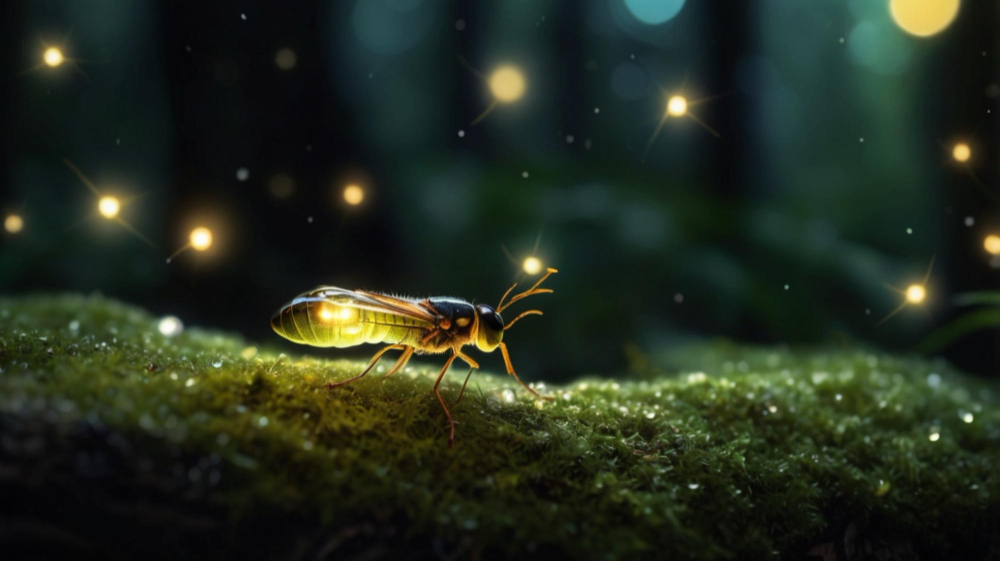
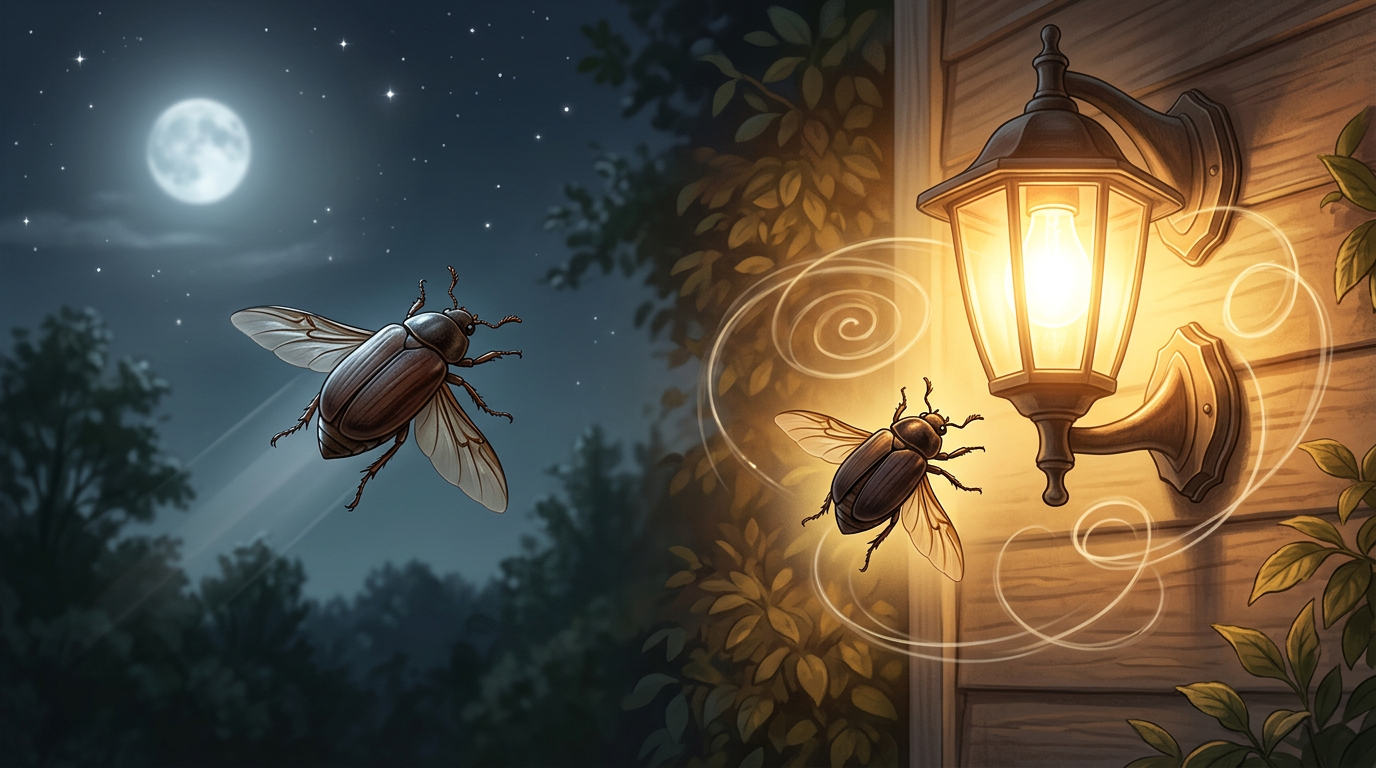
Beetles are often seen flying around porch lights, garage lights, streetlights, and bright windows at night. The simple answer is that many night-flying beetles use light and darkness as part of their orientation system, and artificial lights can confuse that system. A beetle near a bright bulb may circle, land on a wall, bump into a screen, or seem to “come toward” the light even though it may not be intentionally choosing the lamp as a destination.
The question “why are beetles attracted to light” is a little more complex than it sounds. Not every beetle responds to light in the same way. Some beetles are strong night fliers. Some are weak, clumsy fliers. Some are not very interested in lights at all. Many beetles found near lights are simply active at night and happen to pass through the bright area.
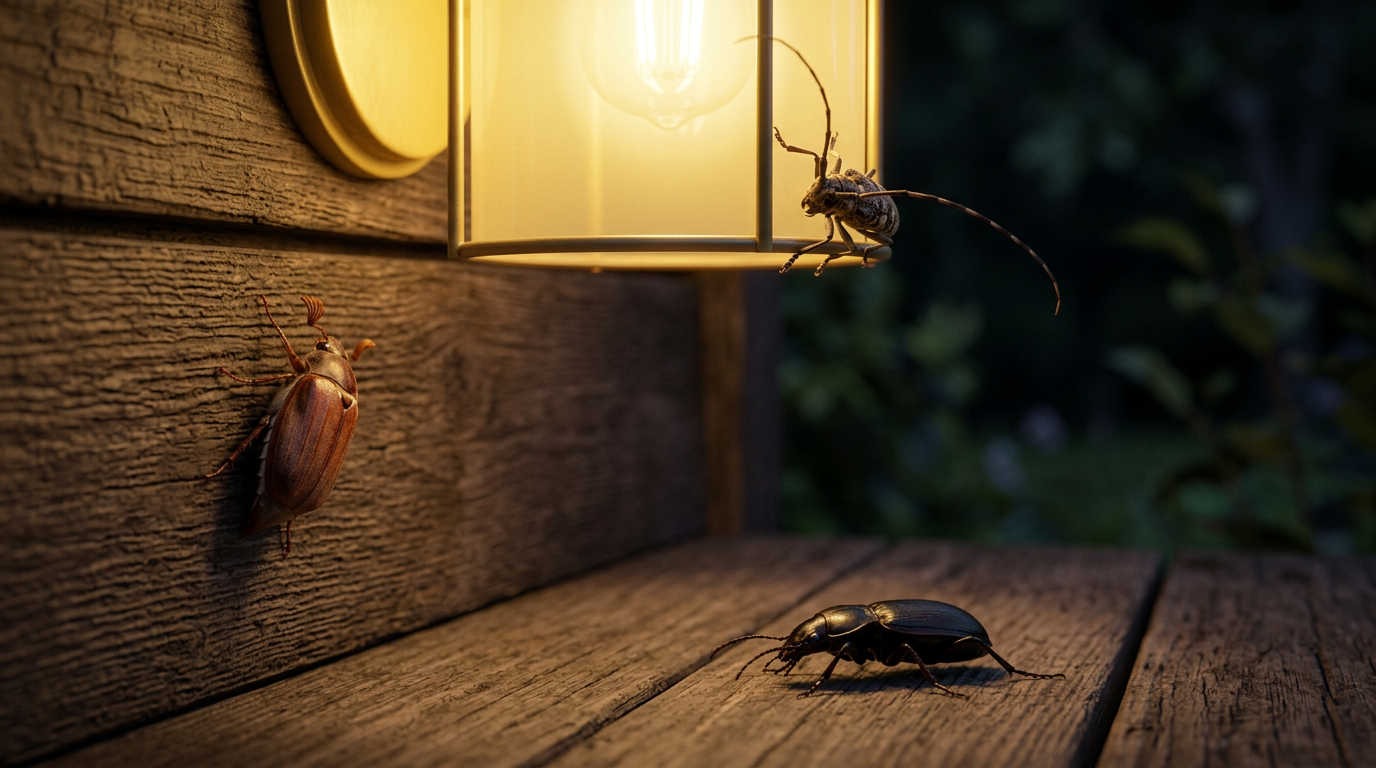
Recent research on flying insects suggests that artificial lights can disrupt a natural flight response. Insects often use the brightest part of the visual field as a clue for “up,” because in nature the sky is usually brighter than the ground. Near a lamp, that useful rule can become confusing, causing insects to tilt, orbit, stall, or crash instead of flying normally.
For beginners, the most useful approach is not just asking why the beetle came to the light. It is also asking what clues the beetle shows: body shape, size, antennae, color, wing covers, season, location, and behavior. If you are trying to identify a beetle you found at night, start with careful observation and compare it with a broader beetle identification guide.
About This Guide
This guide explains why beetles appear around lights, what kinds of beetles are most often noticed at night, and how to observe them without jumping to a species-level identification too quickly.
Beetle identification can vary by region, season, life stage, sex, size, color, markings, body shape, antennae, wing covers, habitat, behavior, and photo quality. Many beetles look similar, especially in poor lighting or blurry photos. A beetle seen on a porch wall may be easy to recognize as a broad type, such as a scarab beetle or longhorn beetle, but difficult to confirm to exact species without better details.
This article is educational. If identification matters because of crop damage, stored food contamination, possible wood-boring activity, turf damage, allergy concerns, or a serious household infestation, contact a local extension office, museum, pest management professional, or qualified insect expert.
Table of Contents
- Why Are Beetles Attracted to Light?
- The Science Behind Beetles and Artificial Light
- Why Beetles Gather Around Porch Lights
- Are All Beetles Attracted to Light?
- Common Beetles Seen Around Lights
- How to Identify a Beetle Found Near a Light
- Comparison Table: Beetles and Similar Night Visitors
- Common Mistakes When Identifying Beetles at Lights
- Habitat, Season, and Night Behavior
- Diet and Life Cycle Clues
- Beetles Around the Home and Garden
- How to Reduce Beetles Around Outdoor Lights
- When to Seek Professional Help
- FAQ
- Conclusion
- References and further reading
- Optional image suggestions
Why Are Beetles Attracted to Light?
Many beetles are attracted to light because they are active at night and artificial light interferes with how they orient themselves while flying. A porch light or streetlight creates an unusually bright point in the dark. For a flying insect, that bright point can confuse normal navigation and body-positioning cues.
This does not mean the beetle “wants” the light in the same way it wants food, a mate, shelter, or a host plant. In many cases, the beetle is not choosing the light as a goal. It may be reacting to the light as part of its flight control system.
This is why beetles around lights often behave strangely. They may:
- Circle the light repeatedly
- Hit a window or screen
- Land under the bulb
- Drop suddenly onto a porch
- Fly in short, uneven bursts
- Stay still near the light after landing
- Appear more active on warm, humid nights
Researchers studying flying insects around artificial lights found that insects did not simply fly straight toward the lamp. Instead, many turned the top side of their bodies toward the light. This response can help an insect keep the bright sky above it in natural conditions, but near an artificial lamp it can create confused flight paths.
For beetles, this helps explain why a porch light can become a gathering point. The light does not need to smell like food or look like a plant. It can affect movement and orientation by being an intense visual cue in the night environment.
The Science Behind Beetles and Artificial Light
Artificial light at night is very different from natural moonlight or starlight. It is closer, brighter, more directional, and often placed at the side of a building, under a porch roof, on a pole, or near reflective surfaces.
Many flying insects respond to the brightest part of their surroundings. In nature, the sky is usually the brightest area above them. Keeping the bright sky above the body can help an insect maintain stable flight. This kind of response is often called a dorsal light response, meaning the insect tends to orient its back toward the light.
A lamp changes that pattern. The brightest area is no longer above the insect in a broad, sky-like way. It may be to the side, below, behind, or very close. When an insect tries to orient to that light, its flight can become unstable.
This can lead to several behaviors people notice around outdoor lights:
- Orbiting: The beetle or insect circles the lamp.
- Stalling: It slows down or loses stable flight.
- Inverting: It may flip or tilt awkwardly.
- Crashing: It hits a wall, window, bulb cover, or screen.
- Landing nearby: It stops flying and rests close to the light.
The important point is that “attracted to light” is a convenient phrase, but it can oversimplify what is happening. In some beetles, the light may draw them into the area. In others, the light may trap or confuse them once they are already nearby.
Why Beetles Gather Around Porch Lights
Porch lights are especially good at making beetles visible. They are placed near doors, walls, windows, plants, lawns, gardens, and other places beetles may already use. A beetle flying through the yard at night may cross the bright zone around the porch and then become easier to see.
Several factors make porch lights common beetle gathering spots.
Porch lights are close to beetle habitat
Many beetles live in soil, leaf litter, lawns, shrubs, trees, mulch, wood, flowers, or garden beds. A porch light is often only a few feet from these habitats.
A beetle may not come from far away. It may already be living in the yard and become visible only when it flies near the light.
Warm nights increase beetle activity
Many beetles are more active on warm evenings. In late spring and summer, adult beetles may fly to search for mates, food, or new habitat. If warm weather overlaps with bright outdoor lighting, more beetles may appear near walls, screens, and lamps.
Lights make beetles easier for people to notice
A black, brown, or green beetle in a dark yard may go unseen. The same beetle on a pale porch wall under a bright bulb becomes obvious. This can make it seem as if the light created a beetle problem, when it may have simply revealed beetles that were already active nearby.
Building surfaces trap confused fliers
Porches create hard surfaces. A beetle circling a light may hit siding, glass, a screen door, or the underside of a roof. After impact, it may land and stay there. That is why people often find beetles on porch floors the next morning.
Are All Beetles Attracted to Light?
No. Not all beetles are attracted to light, and not all beetles found near a light arrived for the same reason.
Beetles are extremely diverse. Some fly often, some rarely fly, and some do not fly at all. Some are active during the day. Some are active at night. Some live underground, in wood, in stored food, under bark, in flowers, in water, or in leaf litter.
The beetles most likely to be noticed near lights are usually adult beetles that fly at night. Larvae, grubs, and beetles that spend most of their time hidden in soil, food products, carpets, wood, or plant material are much less likely to gather around porch lights.
A beetle near a light may be:
- A night-flying adult beetle
- A beetle searching for a mate
- A beetle moving from one habitat to another
- A beetle emerging seasonally from soil or wood
- A beetle disturbed from nearby vegetation
- A beetle accidentally trapped by the lighted area
- A non-beetle insect mistaken for a beetle
If you are comparing broad groups, a page about types of beetles can help you understand why some beetles behave very differently from others.
Common Beetles Seen Around Lights
The exact beetles you see depend on your region, season, nearby plants, soil, weather, and local habitat. Still, several broad beetle groups are commonly noticed around lights.
May Beetles and June Beetles
May beetles and June beetles are scarab beetles often noticed on warm nights. They may fly into porch lights, window screens, garage lights, and outdoor fixtures. Many are brownish, oval-bodied, and somewhat clumsy in flight.
People often notice them because they are large enough to make a sound when they hit a screen or wall. They may drop to the ground and remain still for a while.
These beetles are often associated with soil during their immature stage. Their larvae are grubs that live underground and feed in soil environments. Adult beetles are the stage most people see flying.
Japanese Beetles
Japanese beetles are metallic green and coppery beetles that are more often noticed feeding on plants during the day, but they are useful for understanding beetle life cycles and garden relevance. Adults feed on many kinds of leaves, flowers, and fruits, while the larvae are white grubs in soil that can damage turfgrass roots. University extension resources describe Japanese beetle adults as feeding on hundreds of plant species and the larvae as turf pests.
If you find a shiny green and copper beetle near plants, do not rely on color alone. Look at body shape, size, wing covers, white side tufts, season, and feeding damage before deciding.
Longhorn Beetles
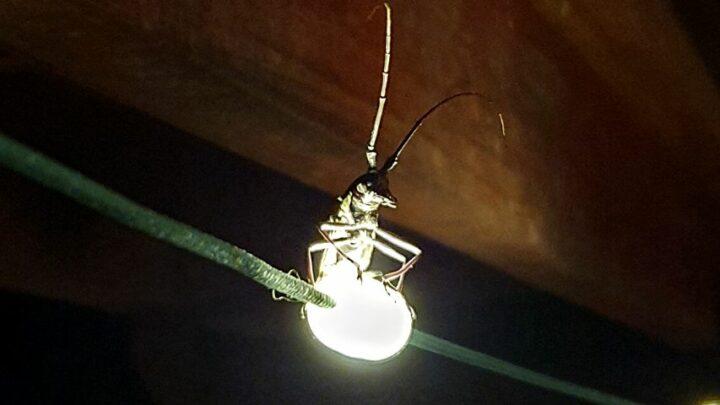
Longhorn beetles often have long antennae, sometimes as long as or longer than the body. Some species are active at night and may come to lights near wooded areas, firewood, or trees.
A longhorn beetle on a porch wall can look alarming because of its long antennae and sometimes large body. Many are simply outdoor beetles that wandered to the light. However, if you repeatedly find beetles emerging from indoor wood, furniture, firewood, or structural wood, identification becomes more important.
Ground Beetles
Ground beetles are often dark, flattened, and fast-running. Many are more likely to run across the ground than circle a lamp, but they may still appear under porch lights because lights attract other insects or because the beetles are active around foundations, gardens, and soil.
Many ground beetles are predators of small insects and other invertebrates. Finding one near a light does not automatically mean there is a household infestation.
Click Beetles
Click beetles are usually narrow and elongated. When placed on their backs, many can snap their bodies to flip upright, producing a clicking movement. Adults may appear near lights at night.
Their larvae, called wireworms, live in soil or decaying material depending on the species. If you find an adult click beetle at a light, it does not automatically tell you where the larvae are.
Fireflies
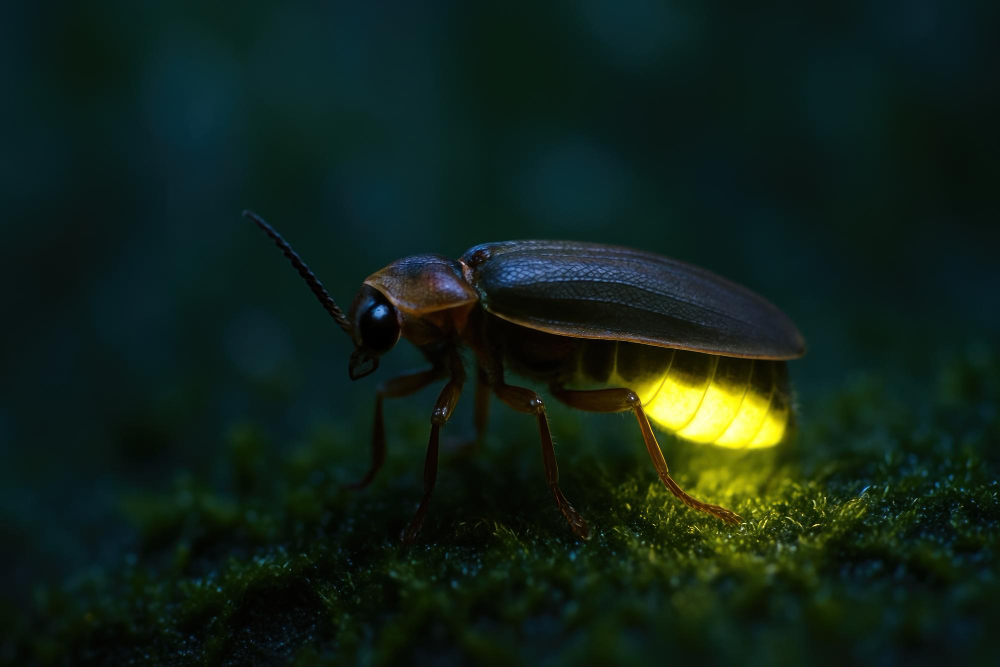
Fireflies are beetles, although many people do not think of them that way. They are famous for producing light through bioluminescence. Seeing fireflies in the same area as outdoor lights can be confusing because they are beetles associated with light, but their glow is a communication signal rather than a porch-light attraction behavior.
Bright outdoor lighting can make it harder to notice natural firefly flashes and may interfere with the nighttime environment used by many insects.
How to Identify a Beetle Found Near a Light
If a beetle lands near your porch light, do not identify it by color alone. Color can change under artificial light, camera flash, shadows, and phone settings. A brown beetle may look black. A metallic beetle may look dull. A patterned beetle may appear plain.
Use several clues together.
Look at the body shape
Beetle body shape is often more useful than color. Ask:
- Is the beetle oval, round, long, flattened, or cylindrical?
- Is the body hard and shiny?
- Are the wing covers smooth, ridged, spotted, or patterned?
- Is the head visible from above?
- Does the beetle look compact or narrow?
Most beetles have hardened front wings called wing covers. These wing covers meet in a straight line down the back. This is one of the most helpful features when separating beetles from many other insects.
Check the antennae
Antennae can give strong identification clues.
Common antenna shapes include:
- Long and threadlike
- Clubbed at the tip
- Saw-like
- Feathered or fan-like
- Short and bead-like
- Very long compared with the body
Longhorn beetles often have very long antennae. Scarab beetles may have clubbed or fan-like antennae. Some small household beetles have short antennae that are hard to see without a close photo.
Notice the size
Size helps, but it can be misleading in photos. If possible, compare the beetle with a coin, ruler, fingertip, or door frame detail.
A beetle that is half an inch long belongs in a very different comparison group than a beetle that is two inches long.
Record where it was found
Location matters. A beetle on a porch light near an oak tree suggests different possibilities than a beetle in a pantry, carpet edge, firewood pile, vegetable garden, or bathroom window.
For indoor situations, compare your observation with a calm guide to beetles around the home before assuming the beetle is harmful.
Note the season
Many beetles appear seasonally. Some adults emerge in late spring or summer. Others are noticed after rain, warm nights, or changes in stored food, plants, or firewood.
A beetle found one time in June may simply be a seasonal outdoor visitor. A beetle found repeatedly indoors for weeks may need closer investigation.
Take clear photos
A useful beetle photo should show:
- The top of the body
- The side view if possible
- Antennae
- Legs
- Size comparison
- Color in natural light if available
- Where the beetle was found
If the beetle is alive, avoid handling it roughly. Many beetles can be moved outside using a cup and stiff paper.
Comparison Table: Beetles and Similar Night Visitors
| Night visitor | Typical appearance | Why it may be near light | Often indoors? | Key identification clue | What readers should know |
|---|---|---|---|---|---|
| June beetles / May beetles | Brown, oval, sturdy scarab beetles | Night flight, seasonal adult activity, light confusion | Usually accidental indoors | Oval body, clumsy flight, often warm-season appearance | Often noticed because they hit screens or porch walls |
| Longhorn beetles | Elongated body, very long antennae | Some species fly at night and visit lights | Sometimes near firewood or open doors | Antennae may be as long as or longer than the body | Repeated indoor emergence from wood should be checked |
| Ground beetles | Dark, flattened, fast-running | Active at night near soil, foundations, or prey | Occasionally wander indoors | Long legs, fast running, often black or dark brown | Many are outdoor predators and not household pests |
| Click beetles | Narrow, elongated body | Adults may fly to lights | Occasionally | Can click or flip when on back | Larvae are wireworms, but adults near lights do not confirm a soil problem |
| Japanese beetles | Metallic green and coppery body | More commonly seen on plants, sometimes near lighted areas | Rarely an indoor issue | Metallic body, white side tufts, plant feeding | Garden relevance is usually about adult feeding and soil grubs |
| Fireflies | Soft-bodied beetles, often with glowing abdomen | Natural light signals, may be near dark lawns or gardens | Rarely | Flashing light produced by the beetle | They are beetles, but their glow is not the same as porch-light attraction |
| Moths | Scaly wings, soft body, not beetles | Strong light response in many species | Often near lights | Wings are broad and powdery-looking | Commonly mistaken for beetles when resting on walls |
| True bugs | Piercing mouthparts, different wing structure | Some fly to lights | Sometimes | Wings often overlap differently than beetle wing covers | Not all “bugs” near lights are beetles |
Common Mistakes When Identifying Beetles at Lights
Mistake 1: Calling every porch insect a beetle
Many insects gather near lights. Moths, flies, lacewings, true bugs, wasps, and caddisflies may all appear near the same bulb. A beetle usually has hardened wing covers that meet in a line down the back. If you cannot see that feature, be cautious.
Mistake 2: Relying only on color
Color is one of the least reliable clues under artificial light. Porch bulbs, phone flash, yellow lighting, shadows, and camera processing can all change how a beetle looks.
Use body shape, antennae, size, habitat, and behavior along with color.
Mistake 3: Assuming a beetle near the door means infestation
A beetle at a porch light is often an outdoor visitor. One or two beetles near a door do not prove there is an indoor infestation. Repeated indoor sightings, larvae, damaged stored food, plant damage, sawdust-like material, or insects emerging from wood are more meaningful clues.
Mistake 4: Assuming every large beetle is dangerous
Large beetles can look intimidating, especially at night. Many are harmless to people and simply trying to fly, feed, or find mates. Some may pinch if handled, and some can scratch with their legs, so gentle no-touch removal is still wise.
Mistake 5: Ignoring the surrounding habitat
A porch beside a lawn, garden, compost area, wooded edge, or firewood stack will attract different beetle visitors. Habitat is often one of the best identification clues.
For photo-based comparison, a visual guide to common types of beetles with pictures can be more useful than matching color alone.
Habitat, Season, and Night Behavior
Beetles near lights are often connected to the habitat around the light. A bright fixture does not exist in isolation. It sits inside a small ecosystem of plants, soil, walls, moisture, heat, and hiding places.
Lawns and soil
Scarab beetles, click beetles, and ground beetles may be associated with lawns or soil. Some beetle larvae live underground. Adults may emerge seasonally and fly at night.
Japanese beetle larvae, for example, are white grubs that feed on grass roots, while adults feed on foliage, flowers, and fruits. Extension sources describe the larval and adult stages as affecting different parts of the yard and garden.
Trees and wooded edges
Longhorn beetles, bark-associated beetles, and many other beetles may be more common near trees, dead branches, logs, or wooded edges. Outdoor lights near these areas may receive more beetle visitors.
Gardens and flowers
Some beetles feed on pollen, petals, leaves, or fruit. Others hunt small insects among plants. A light near a vegetable garden or flower bed may reveal beetles that are active in the planting area.
Moist areas
Some beetles are more active after rain or in humid weather. Moist soil, leaf litter, and plant debris can support many insects, including beetles and their prey.
Stored food and indoor sources
A beetle inside a pantry, closet, or storage area may have nothing to do with porch lights. Small stored-product beetles and carpet beetles have different clues, such as larvae, shed skins, damaged dry goods, or repeated indoor sightings.
Diet and Life Cycle Clues
Understanding what beetles eat can help explain why they are near a lighted area.
Adult beetles and beetle larvae may eat very different things. The adult flying to a light may not feed on the same material as its larvae.
Some beetle diets include:
- Leaves
- Flowers
- Pollen
- Fruit
- Fungi
- Wood
- Decaying plant material
- Stored grains or dry foods
- Other insects
- Roots or turfgrass in the larval stage
This is why one adult beetle near a light does not always reveal the full story. A June beetle at a porch light may have developed as a grub in soil. A longhorn beetle may be connected to wood or trees. A ground beetle may be hunting other small animals near the foundation.
For a broader food-based approach, compare the beetle with a guide to what beetles eat. Diet can narrow the possibilities when combined with body shape, habitat, and season.
Beetles Around the Home and Garden
Most beetles found at outdoor lights are not a reason to panic. They are often seasonal visitors.
However, the context matters.
When it is probably just an outdoor visitor
A beetle is more likely to be an accidental outdoor visitor if:
- It is found only once or twice
- It appears near a porch light, garage light, or open door
- It is active during warm months
- It is large and easy to see
- There are no larvae indoors
- There is no damage to food, fabrics, wood, or plants
- It disappears after being moved outside
When it deserves closer attention
A beetle deserves closer attention if:
- You find many indoors over several days or weeks
- You find larvae, shed skins, or repeated adult beetles inside
- Dry foods show signs of insect activity
- Wool, feathers, stored natural materials, or carpets show damage
- Plants show repeated feeding injury
- Turfgrass lifts easily because roots are damaged
- Beetles appear to emerge from wood, furniture, or firewood
- Someone in the home has allergic reactions possibly connected to insects or shed hairs
For yard and garden pests, avoid making decisions from one beetle on a porch. Plant damage, larval evidence, and expert confirmation matter. Extension guidance on Japanese beetles, for example, warns that traps can attract more beetles than they catch, which is an important reminder that quick fixes are not always helpful.
How to Reduce Beetles Around Outdoor Lights
If beetles gather around your lights and you want fewer of them near doors or windows, start with lighting changes rather than harsh action.
Turn off unnecessary lights
The simplest step is to turn off lights that are not needed. A dark porch attracts fewer night-flying insects than a bright one.
Use motion sensors
Motion-sensor lights reduce the amount of time a lamp stays on. Less lighting time means fewer opportunities for beetles and other insects to become disoriented.
Shield lights downward
A shielded fixture directs light toward the ground instead of outward into the yard or sky. Research on flying insects suggests that light direction matters, and light from below or from unnatural angles can be especially disruptive.
Choose warmer, less intense lighting
Many insects respond strongly to shorter-wavelength light, including ultraviolet and blue-rich light. Warmer, less intense lighting may reduce attraction for some insects compared with bright white or blue-rich lights. This does not eliminate beetles, but it can make outdoor lighting less disruptive.
Move lights away from doors
If possible, place exterior lighting away from the doorway. A light several feet from the entrance can draw insects away from the door instead of toward it.
Keep screens and door seals in good condition
Many beetles enter homes accidentally. Tight screens, door sweeps, and sealed gaps reduce accidental entry.
Avoid unnecessary pesticide use
A few beetles around lights usually do not require pesticides. If you believe there is a real pest issue, identify the beetle first and follow local guidance. For pesticide decisions around homes, gardens, pets, children, pollinators, or edible plants, consult a qualified local source and follow product labels carefully.
When to Seek Professional Help
Most porch-light beetles can be observed, photographed, and moved outside. Professional help is more appropriate when identification affects health, property, food, crops, or safety.
Consider contacting a local extension office, museum, pest professional, or qualified expert if:
- Beetles appear in large numbers indoors
- You find larvae in stored food
- You suspect carpet beetle larvae are damaging fabrics
- You see beetles emerging from wood
- Garden plants are being heavily defoliated
- Turfgrass shows grub damage
- You need species-level identification for school, research, agriculture, or pest management
- You are considering pesticide treatment and need local guidance
For beginners, the safest first step is documentation. Take clear photos, note the date and location, and record what the beetle was doing.
FAQ
Why are beetles attracted to light at night?
Many beetles seen at lights are night-flying adults whose flight orientation is affected by artificial light. The light may confuse their sense of direction, causing them to circle, land, or crash near the fixture.
Are beetles really attracted to light, or are they confused by it?
In many cases, “confused by light” is more accurate than “attracted to light.” Research on flying insects shows that artificial lights can disrupt normal body orientation rather than simply acting as a destination.
Why do beetles keep hitting my window at night?
A bright window can act like a light source in a dark environment. Beetles flying nearby may become disoriented, bump into the glass, and land on the window or screen.
What kind of beetles come to porch lights?
Common porch-light visitors may include June beetles, May beetles, longhorn beetles, click beetles, ground beetles, and other night-flying beetles. The exact type depends on your region, season, and nearby habitat.
Are beetles attracted to LED lights?
Some beetles and other insects may still appear near LED lights, especially if the lights are bright, blue-rich, white, or left on for long periods. Warmer, shielded, lower-intensity lighting may reduce insect activity around fixtures.
Are black beetles attracted to light?
Some dark-colored beetles may appear near lights, but color alone does not explain the behavior. Many black beetles near lights are simply nocturnal or active around soil, foundations, plants, or nearby hiding places.
Why do beetles show up more in summer?
Many adult beetles are more active in warm weather. Late spring and summer are common periods for adult emergence, mating flights, and nighttime movement.
Does one beetle near a porch light mean my house is infested?
Usually, no. One beetle near a porch light is often an outdoor visitor. Repeated indoor sightings, larvae, food damage, fabric damage, wood damage, or many beetles appearing inside are stronger reasons to investigate.
Are beetles around lights harmful?
Most beetles around outdoor lights are not harmful to people. Some may be garden pests, some may be beneficial predators, and many are neutral outdoor insects. Identification and context matter.
How can I keep beetles away from my porch light?
Turn off unnecessary lights, use motion sensors, choose warmer and less intense bulbs, shield lights downward, move lights away from doors, and keep screens and door seals in good condition.
Do beetle larvae come to lights?
Usually, no. Larvae and grubs generally live in soil, wood, stored food, plant material, or other protected places. Adult beetles are the stage most often seen flying to lights.
Should I kill beetles that come to my lights?
Usually, there is no need to kill a beetle just because it came to a light. If it is a harmless outdoor visitor, you can move it outside. If you suspect a pest issue, identify it first before taking action.
Conclusion
So, why are beetles attracted to light? Many night-flying beetles appear around lights because artificial lighting interferes with normal flight orientation. A porch light creates a bright, unnatural visual cue that can cause beetles to circle, land, crash, or remain near the fixture.
The best way to understand a beetle near a light is to look beyond the light itself. Observe body shape, antennae, wing covers, size, season, habitat, and behavior. Many beetles are harmless outdoor visitors, while others may deserve closer attention if they appear repeatedly indoors, damage plants, affect stored food, or emerge from wood.
For identification, avoid relying on color alone. Use multiple clues, take clear photos, and compare the beetle with reliable educational resources. When the situation affects safety, food, plants, wood, or pest management decisions, local expert guidance is the most responsible next step.
References and further reading
- Nature Communications — Why flying insects gather at artificial light
- University of Minnesota Extension — Japanese beetles in yards and gardens
- University of Florida IFAS Featured Creatures — Japanese beetle, Popillia japonica
- PubMed Central — The impact of artificial light at night on nocturnal insects: A review and synthesis
- Associated Press — Are insects drawn to light? New research shows it’s confusion, not fatal attraction
- The Guardian — Why are moths attracted to lights? Science may finally have an answer