

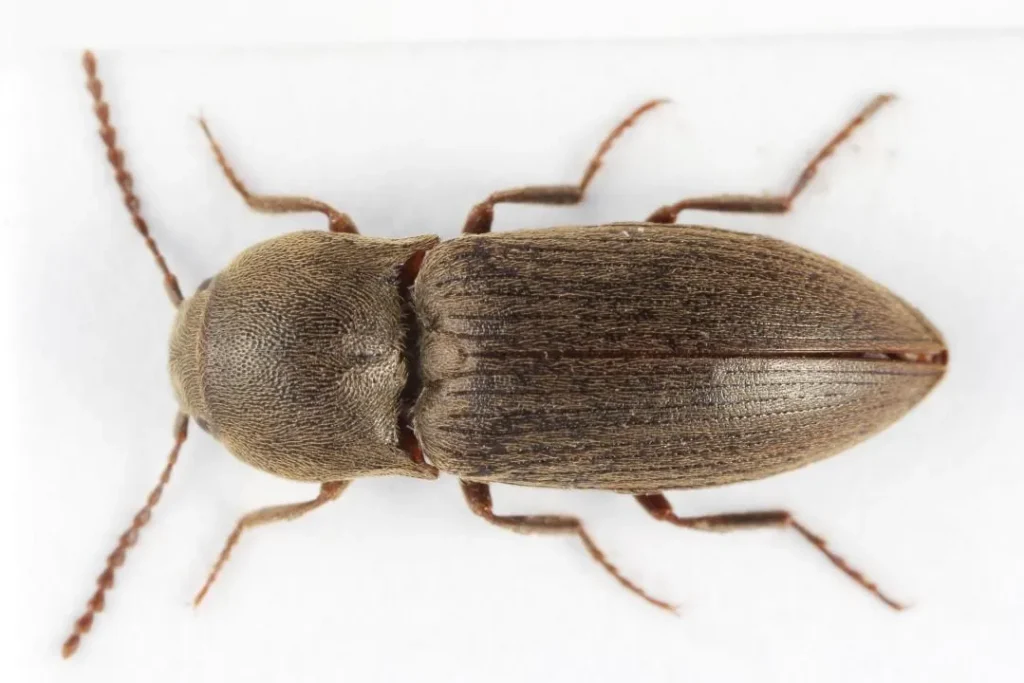
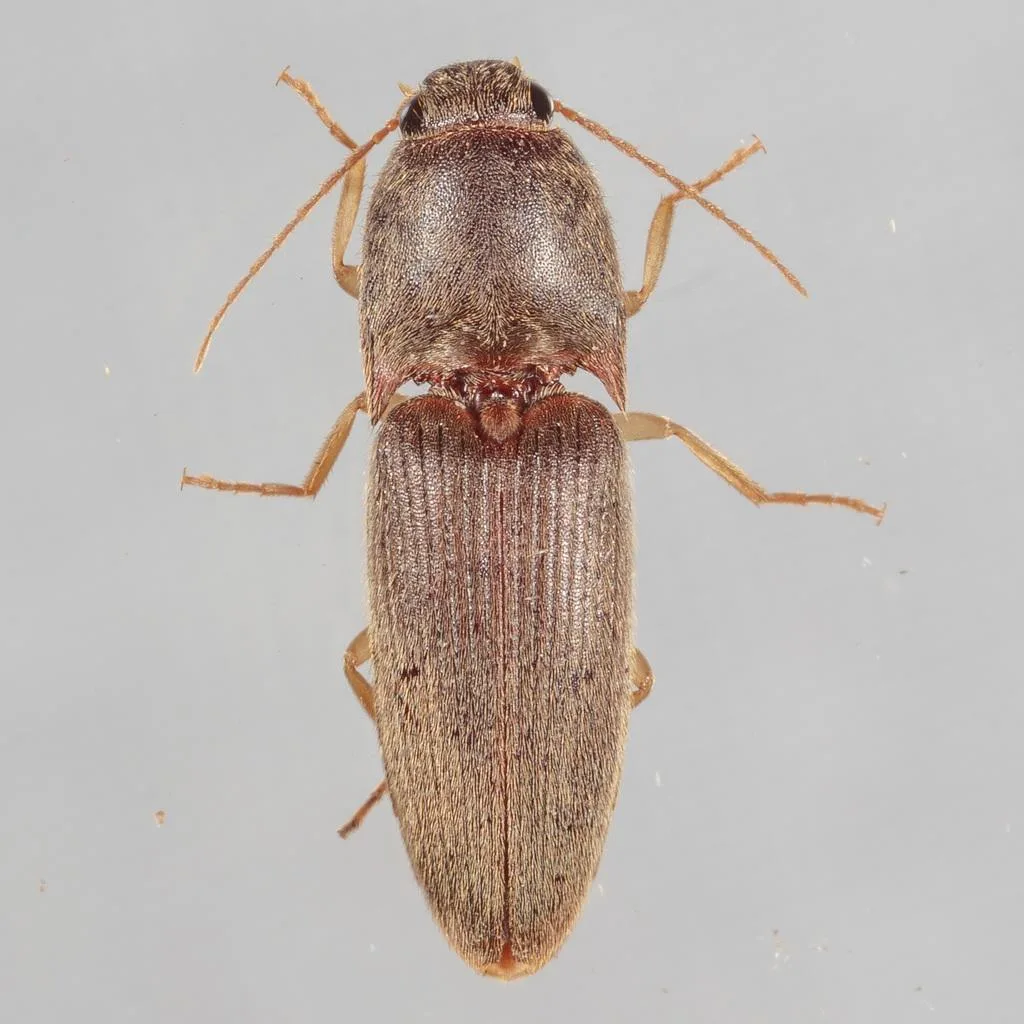
A slender brown or black beetle with pointed corners behind its head may be a click beetle. Members of the family Elateridae are best recognized by a combination of body shape, thorax structure, antennae, and—when it happens naturally—a sharp click that can launch the beetle into the air. The sound is useful, but you do not need to make the insect jump to identify it.
Quick Click Beetle Identification Checklist
- Shape: Long and fairly narrow, often with nearly parallel sides and a tapered rear end.
- Thorax: The hind corners of the pronotum—the shieldlike plate just behind the head—often project backward into points.
- Antennae: Frequently threadlike or sawtoothed, rather than ending in a distinct round club.
- Wing covers: Two hard covers (elytra) meet in a straight line down the back; some show lengthwise grooves.
- Behavior: Many adults make an audible snap and spring upward when they need to right themselves.
- Context: Adults may turn up on plants, bark, walls, or near porch lights.
No single item is conclusive. The combination of several features is much more useful than color or a click by itself.


What Does a Click Beetle Look Like?
1. A long, compact body
Most familiar click beetles look like a narrow capsule with a small head, a distinct pronotum, and relatively long wing covers. Many are brown, gray, or black, sometimes with fine hairs or mottled patterns. Common North American examples may measure roughly 6–20 mm (about 1/4–3/4 inch), but that is not a size limit for the family. Some distinctive species are much larger.
Do not identify a click beetle solely because it is small and dark. Ground beetles, darkling beetles, and several other families can match that description.
2. Pointed corners behind the head
Look at the pronotum, the hard plate between the head and the wing covers. In many click beetles, its two rear corners extend backward as sharp angles. From above, these can resemble tiny shoulders that point toward the tail.
This is one of the most useful visible clues in an ordinary photograph. It is not exclusive to click beetles, however, so check the rest of the body too.
3. Slender or sawtoothed antennae
Some species have simple, threadlike antennae. Others have serrated segments that give them a saw-edge appearance. Antennae vary considerably among species and sexes, so a missing sawtooth pattern does not automatically rule out Elateridae.
4. The distinctive clicking mechanism
A typical adult click beetle has a projecting structure beneath the front of its thorax, called the prosternal spine. It engages with a receiving cavity farther back on the underside. When the mechanism releases suddenly, the beetle can snap and jump, often to escape a threat or regain its footing.
If you see this happen on its own, it is a strong supporting clue. Avoid repeatedly turning a live beetle over to test it: closely related beetles can also have clicking mechanisms, and unnecessary handling adds little to a careful identification.
Common Click Beetle Appearances
Click beetles do not all have the same color or markings. These examples show why family-level identification is often more practical than naming a species from one photo.
| Appearance | Useful clue | Important caution |
|---|---|---|
| Small brown or black click beetle | Narrow outline, rear-pointing pronotal angles, variable serration of antennae | Many unrelated beetles look similar at first glance |
| Large beetle with two apparent eyespots | Some Alaus species have conspicuous dark circles on the pronotum | The spots are not true eyes; compare species and geographic location |
| Mottled or patterned click beetle | Patchy scaling or hairs over an elongated body | Markings vary even among close relatives |
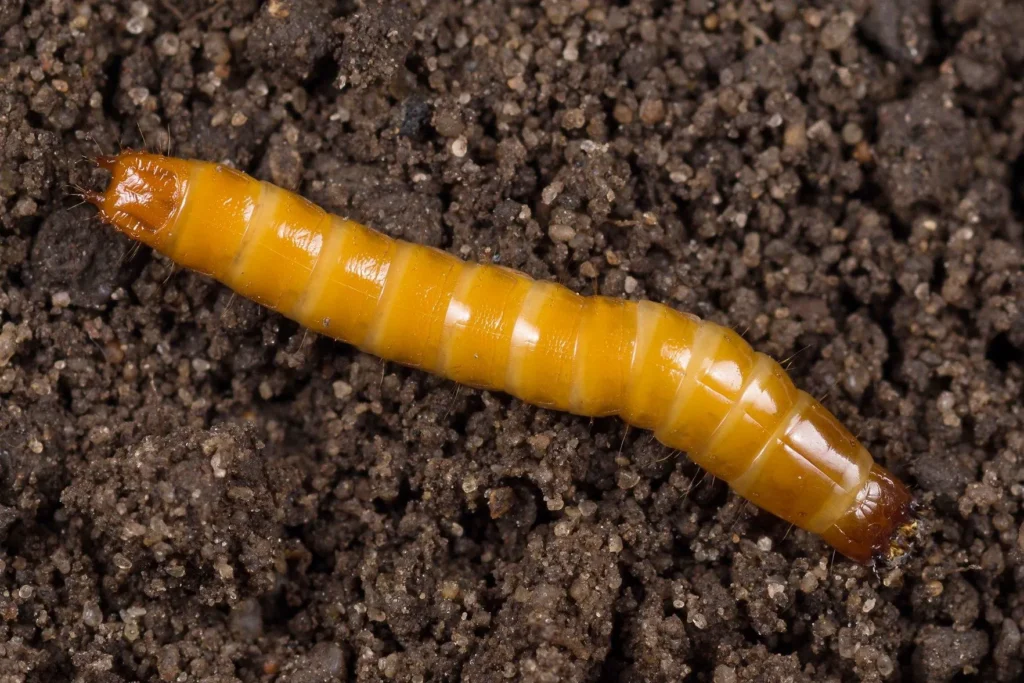
| Yellow-brown, hard-bodied larva | Wireworm shape and three pairs of small legs near the head | Several soil larvae, including mealworms, can look similar |
Eyed Click Beetles: The Most Recognizable Example
In parts of eastern North America, the eastern eyed click beetle, Alaus oculatus, stands out because of two large black, pale-ringed spots behind its head. Adults can reach about 25–45 mm (roughly 1–1 3/4 inches). The actual eyes are small and located on the head, ahead of the false eyespots.
Not every large click beetle with a patterned thorax is A. oculatus. Similar species occur, so range, detailed markings, and expert comparison may matter.


Click Beetles vs. Similar-Looking Beetles
The narrow body of a click beetle can make identification tricky, especially when the insect has been photographed from only one angle.
| Lookalike | What to compare | How certain is the clue? |
|---|---|---|
| Longhorn beetles (Cerambycidae) | Antennae are often much longer relative to the body, and the thorax has a different outline | Useful first comparison; some longhorns have shorter antennae |
| Jewel beetles (Buprestidae) | Often more wedge-shaped and rigid, sometimes metallic; compare pronotal edges | Color alone is unreliable |
| False click beetles (Eucnemidae) | Very similar overall shape; detailed antennal insertion and other structures may be needed | Difficult: some false click beetles can click too |
| Ground beetles (Carabidae) | Often have more obvious running legs and a differently shaped thorax | Good for narrowing possibilities, not guaranteed identification |
For long-antenned lookalikes, see our guide to beetles with long antennae.


How to Identify a Click Beetle Larva (Wireworm)
Young click beetles look nothing like the adults. Their larvae are commonly called wireworms because many have tough, cylindrical bodies that feel more rigid than ordinary soft-bodied grubs. They are usually yellowish, tan, or brown, with visible segments and three pairs of short legs close to the head.
Wireworms may live in soil or, depending on the species, in decaying wood. Some feed on seeds, roots, or young plant tissue and can be agricultural pests; others feed differently, including on decaying material or other invertebrates. Finding one wireworm does not establish that a garden has a serious pest problem.
Mealworm larvae can resemble wireworms. The body’s terminal segment, head structure, habitat, and other characters may be needed for a closer identification.


Why Did I Find a Click Beetle in My House?
An adult click beetle on an indoor wall, curtain, or windowsill is commonly an outdoor insect that wandered or flew inside. Many are attracted to lights after dark. One adult indoors is not evidence of a household infestation, and adult click beetles generally are not considered damaging household pests.
If the beetle is alive, guide it into a container and release it outside in a sheltered spot. Check window screens, gaps around doors, and bright lights near open windows if sightings are frequent. Do not assume that a clicking adult means wireworms are eating plants under the house.
For other indoor lookalikes, use our beetles around the home resource.
Are Click Beetles Harmful to People or Gardens?
Most encounters with adults are harmless. They are not known as routine household biting pests, and the snapping sound is a mechanical escape response, not a sting.
The garden question concerns the larval stage. Certain wireworms damage germinating seeds, roots, seedlings, or tubers underground. But many click beetle species are not agricultural pests. To investigate suspected crop injury, look for actual plant damage and larvae near affected roots rather than treating the presence of an adult as proof of a problem.
How to Photograph a Click Beetle for Identification
- Take a sharp top-down photograph showing the head, pronotum, antennae, and the entire length of both wing covers.
- Take a side view if possible, especially when the back looks unusually flat or arched.
- Include a familiar size reference without crowding or harming the insect.
- Record where it was found—country or region, habitat, and approximate date.
- Note whether you observed a natural clicking jump, but do not force the behavior.
A clear photograph is often enough to suggest the family Elateridae. Separating very similar genera or species may require a specialist to examine small structural details, and in some cases a specimen.
Frequently Asked Questions
Can click beetles fly?
Yes. Many adult click beetles fly, and some arrive at outdoor lights at night. Their flying behavior is different from the sudden jumping movement produced by the clicking mechanism.
Is a click beetle the same as a wireworm?
They are different life stages of the same beetle family: a click beetle is the adult, while a wireworm is its larva.
Does every click or jump prove it is a click beetle?
No. Related families, especially false click beetles, may also possess a clicking mechanism. Use the pronotum, antennae, body shape, and other features together.
Further Identification and Sources
Compare your observation with these specialist and institutional resources:
- Missouri Department of Conservation — Click Beetles (Elaterids)
- North Carolina State University — Family Elateridae
- Virginia Tech Extension — Click Beetles
- University of Florida IFAS — Alaus Click Beetles
- University of California IPM — Wireworms
- UK Beetle Recording — False Click Beetles
- GBIF / Catalogue of Life — Elateridae
Still unsure what you found? Start with our broader beetle identification hub and compare more than one visible feature before choosing a species name.