

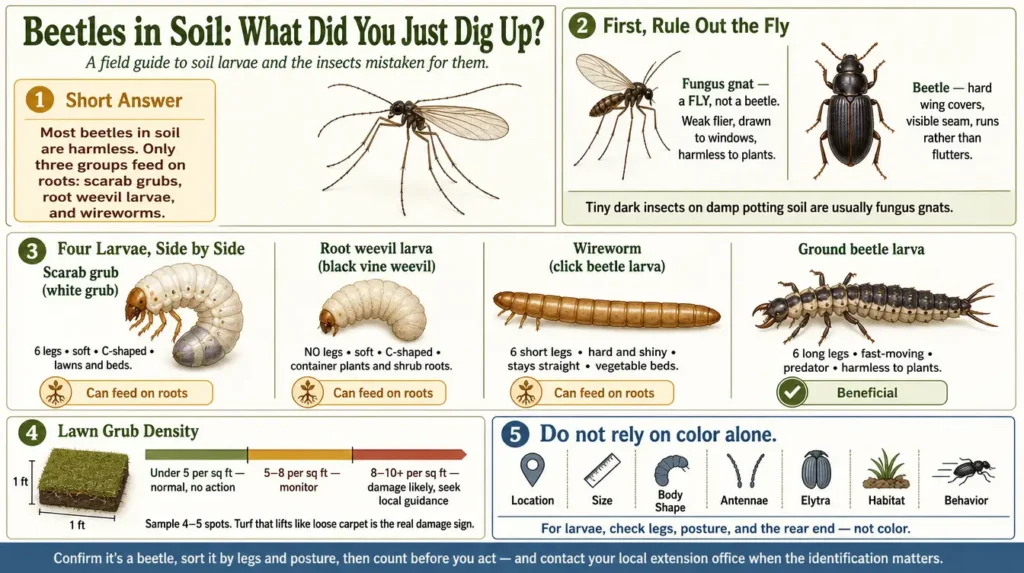
Most beetles in soil are harmless, and many of the small dark insects people find in potting soil are not beetles at all. Only three groups regularly cause plant problems: scarab grubs, root weevil larvae, and wireworms. Everything else is usually passing through.
That single fact resolves a large share of soil-insect worry. A shovelful of healthy garden soil contains an enormous number of organisms, and beetles are among the most common. Some eat roots. Many more eat other insects, break down decaying matter, or simply spend the daylight hours underground because it is dark and damp there.
The practical question is not “are there beetles in my soil?” — there almost certainly are, and that is normal. The question is which ones, how many, and whether the plants above them are showing any actual sign of trouble.
About This Guide
This guide is written for the moment right after you tipped a plant out of its pot, turned a spade in a vegetable bed, or peeled back a patch of lawn and found something wriggling. It covers the beetle groups that genuinely live in soil in North America, the non-beetle insects that get mistaken for them, and how to decide whether the situation calls for anything at all.
One caution up front. Soil insect larvae are difficult to identify to species from a photograph or a written description, and often difficult even in hand. Many white grubs look nearly identical to one another; separating them reliably can require magnification and careful examination of features on the underside of the abdomen. This guide will get you to the correct group with reasonable confidence, which is usually enough to make a decision. It will not always get you to a species name, and any guide that promises otherwise is overselling.
Start Here: Is It Even a Beetle?
Before working through beetle groups, rule out the most common false alarm.
Tiny dark insects on potting soil are almost always fungus gnats
If the moving things are small, dark, and either running across the surface of houseplant soil or drifting up in a loose cloud when you water, they are very likely fungus gnats — small flies in the order Diptera, not beetles at all. They are among the most common houseplant complaints in the country, and they are misidentified as beetles constantly.
How to tell the difference without a hand lens:
- Wings. Fungus gnats have a single visible pair of thin, clear wings and a delicate, mosquito-like build. Beetles have hardened wing covers (elytra) forming a firm shell over the back, usually with a visible seam down the middle.
- Legs and antennae. Fungus gnats look leggy and fragile, with long, thin legs and antennae longer than the head. Beetles look compact and armored.
- Behavior. Fungus gnats fly weakly and are drawn to windows and lamps. Tap the pot and a small number will lift off. Beetles that live in soil generally run or burrow rather than flutter.
- Where they concentrate. Fungus gnat larvae live in the top half inch or so of consistently damp potting mix. They are translucent white, legless, thread-like, and have a small shiny black head — very different from any beetle larva.
Adult fungus gnats do not bite people and do not damage plants. Their larvae feed mainly on fungi and decaying organic matter, though heavy populations can damage fine roots on seedlings and cuttings. The underlying cause is nearly always soil that stays wet. Letting the top inch or two of mix dry between waterings, watering from below, removing fallen leaves from the surface, and using yellow sticky cards to monitor adults will address the great majority of cases without touching a chemical.
Springtails are the second most common false alarm
If the specks are pale or grayish, very small, and jump when disturbed, they are probably springtails. They are not beetles either, and they are essentially harmless — they feed on fungi, algae, and decomposing matter, and their presence, like fungus gnats, mostly signals persistently damp conditions.
Quick sorting table
| What you’re looking at | Legs | Body | Where | Likely identity |
|---|---|---|---|---|
| Plump, white, curled into a C, brown head | 3 obvious pairs, near the head | Soft, wrinkled, often dark at the rear | Lawn, garden beds, compost | Scarab grub (white grub) |
| Plump, white, curled into a C, brown head | None visible | Soft, small, often with fine hairs | Container plants, shrub roots | Root weevil larva |
| Slender, stiff, tan to dark brown, glossy | 3 short pairs, near the head | Hard, cylindrical, clearly segmented | Vegetable beds, newly broken sod | Wireworm (click beetle larva) |
| Elongate, dark, flattened, fast-moving | 3 pairs, long and obvious | Tough plates along the back, often forked at the tail | Under stones, mulch, leaf litter | Ground or rove beetle larva |
| Tiny, translucent, thread-like, shiny black head | None | Soft, under 1/4 inch | Top half inch of wet potting mix | Fungus gnat larva (a fly) |
The Beetle Larvae You Are Most Likely to Dig Up
White grubs (scarab beetles)
These are the classic soil find: a plump, creamy-white larva that curls into a C when you expose it, with a distinct brown head capsule and three well-developed pairs of legs behind it. The rear end often looks darker or grayish because soil contents show through the body wall.
White grubs are the larvae of scarab beetles, a family that includes Japanese beetles, masked chafers, European chafers, May and June beetles, and green June beetles. They live in the root zone, feeding on grass roots, organic matter, or both depending on species. Adults of the group are covered in more detail in our Japanese beetle profile, which is the species most homeowners in the eastern half of the country encounter.
Size is a rough age indicator, not a species indicator. A grub found in early spring and the same species found in autumn will differ substantially in length.
Root weevil larvae, including black vine weevil
Root weevil larvae look superficially like small white grubs — same creamy color, same C-shaped curl, same brown head — with one decisive difference: they have no legs at all. A legless C-shaped grub in a container or around the roots of a shrub is almost certainly a weevil larva, not a scarab.
Black vine weevil is the best-known example. Mature larvae reach roughly half an inch, feed on fine roots first and larger roots and the root crown later, and are a particular problem in pots and containers where the entire root system is confined and the larvae cannot be diluted across a large soil volume. Yew, rhododendron, azalea, hemlock, euonymus, and a long list of herbaceous perennials are favored hosts.
The adult stage is a slate-gray to black, flightless weevil with a short snout and elbowed antennae, active at night and hidden under debris or pot rims during the day. Its signature is neat, crescent-shaped notches chewed into leaf margins. That notching is cosmetic. The damage that kills plants happens below the soil line, weeks or months earlier, and is usually noticed only when a container plant wilts, yellows, or fails to push new growth in spring despite adequate watering.
One detail explains why the problem builds quickly: black vine weevil populations are functionally all female and reproduce without mating, so every adult present can lay eggs — several hundred over a season. Houseplants summered outdoors near infested shrubs are a common route of entry into a home collection.
Wireworms (click beetle larvae)
Wireworms look nothing like grubs. They are slender, stiff, cylindrical, and glossy, ranging from straw-yellow to dark brown, with a hard segmented body that feels almost like a piece of wire — hence the name. Three short pairs of legs sit near the head. Size ranges from about a quarter inch to well over an inch depending on species and age.
They are the larvae of click beetles, the elongate beetles that snap themselves into the air with an audible click when placed on their backs. Wireworms feed on germinating seeds, roots, tubers, and underground stems, and they are the usual explanation for narrow tunnels bored into potatoes and carrots, or patchy failures where seed simply never came up.
Two features matter for gardeners. First, wireworms have unusually long life cycles — several years underground for many species — so a population does not disappear in a single season. Second, they are strongly associated with ground that was recently sod or heavy weed cover, because click beetles prefer to lay eggs in dense grassy vegetation. A brand-new vegetable bed cut out of lawn is the classic high-risk situation, and populations typically decline with a few years of regular cultivation.
Small numbers are tolerable. Damage worth worrying about generally shows up as poor stand establishment across a bed, not as one tunneled potato.
Ground beetles and rove beetles: in the soil, but not eating your plants
If what you uncovered is dark, elongate, flattened, and moves fast — running for cover the instant light hits it — you have almost certainly found a predator, either an adult or a larva.
Ground beetles (family Carabidae) shelter in soil, under stones, and beneath mulch during the day and hunt at night. Their larvae are soil dwellers too: elongate, segmented, dark on top and pale underneath, with obvious legs, prominent jaws, and often a pair of projections at the tail end. Both stages are generalist predators, taking caterpillars, cutworms, root maggots, aphids, and other beetle larvae — including wireworms. Some species also consume large quantities of weed seeds.
Rove beetles (family Staphylinidae) are the ones that look almost like earwigs without pincers: elongate, with short wing covers that leave most of the abdomen exposed, and a habit of curling the abdomen upward when disturbed. They are likewise predators, and several species specifically target fly larvae in soil and growing media — including fungus gnat larvae.
Neither group damages plants. Finding them is a sign that the soil food web is working. If one turns up indoors, it wandered in by accident; it will not feed or breed in the house, and the appropriate response is to put it back outside. Our beetle identification section covers the adult forms of both families in more detail.
Why Posture and the Rear End Beat Color
Color is the least reliable feature on a soil-dwelling larva, and it is the feature most people reach for first. Grubs are pale because they live in the dark, not because paleness identifies them. A grub’s apparent color also shifts with what it has eaten, how recently it molted, and how much soil is visible through the body wall.
Structure is far more dependable. Work through these instead:
- Legs, or the absence of them. Three pairs of jointed legs behind the head means scarab or wireworm. No legs at all, on an otherwise grub-like body, means weevil. This single check separates the two most confused groups.
- Resting posture. Scarab and weevil larvae hold a relaxed C shape when exposed and are sluggish. Wireworms stay straight and stiff. Predatory larvae are elongate and actively try to escape.
- Body texture. Soft and wrinkled points to scarabs and weevils. Hard, smooth, and shiny points to wireworms. Distinct plates along the back point to ground and rove beetle larvae.
- The rear end. Scarab grubs carry a species-specific arrangement of small spines and bristles on the underside of the last abdominal segment, called the raster pattern. It is the standard feature entomologists use to separate white grub species, it requires roughly 10× magnification to read, and it is genuinely diagnostic where color is not. If a precise species name matters to you, this is where the answer lives.
- Context. Habitat, season, region, and the condition of the plant above all narrow the possibilities. A legless white grub in a rhododendron container in autumn and a legged white grub under lawn in the same month point in completely different directions.
The same principle governs adult identification, which is why our beetle facts coverage repeatedly returns to combined features rather than single traits. For a broader treatment of immature stages across all habitats, see the beetle larva identification guide.
What It Means Where You Found It
In houseplants and containers
Container soil is the highest-stakes situation, because a confined root system has no reserve. Legless C-shaped grubs among the roots of a potted plant should be taken seriously — that is the black vine weevil picture, and repotting into fresh mix after washing the roots clean is the standard non-chemical response, along with checking any other pots that shared a shelf or a summer patio.
Legged white grubs in a houseplant pot are unusual and generally mean a scarab found its way into outdoor-stored potting mix. Fungus gnats, by contrast, are extremely common and rarely serious.
In vegetable beds
Wireworms and the occasional white grub are the expected finds. Turning soil in autumn exposes larvae to birds and cold; digging root crops promptly rather than storing them in the ground reduces feeding damage; and clearing dead vegetation removes the conditions female click beetles prefer for laying eggs. In beds newly converted from lawn, expect a few years of elevated wireworm pressure that declines with cultivation.
In lawns
This is where restraint matters most, because grub treatments are applied far more often than the numbers justify.
Extension turf programs across the country converge on a similar picture. Cut a one-foot-square flap of sod two to three inches deep, peel it back, and count the grubs in the root zone. Fewer than about five per square foot rarely produces visible damage in a healthy, well-rooted lawn — that is a normal population, and no action is warranted. Somewhere around eight to ten per square foot is where most programs consider damage likely and treatment potentially justified. Tolerance also varies by grass type; deep-rooted tall fescues sustain higher counts than Kentucky bluegrass before showing stress.
Two practical notes. Take four or five samples in different parts of the lawn, including both healthy and damaged areas, because grubs are distributed unevenly and a single count is misleading. And rule out lookalikes before blaming grubs — drought stress, disease, chinch bugs, and pet urine all produce brown patches. The distinguishing sign of real grub damage is turf that lifts away from the soil like loose carpet because the roots have been severed underneath.
Skunks, raccoons, and birds digging in a lawn indicate grubs are present, but not necessarily at damaging density. Animals will dig for a meal well below the level at which the grass itself is at risk.
Common Mistakes
- Assuming anything moving in soil is a pest. The majority of soil beetles are neutral or actively helpful. See are beetles good or bad coverage across our home section for the wider picture.
- Treating on sight rather than on count. A few grubs in a lawn is the baseline condition, not a problem.
- Using color as the identifying feature. It is the weakest signal available on a larva.
- Confusing adult presence with larval damage. Notched rhododendron leaves are unsightly; the root feeding that actually kills the plant happened underground.
- Diagnosing a wilting houseplant as an insect problem without checking the roots. Overwatering and root rot cause the same symptoms far more often, and the two frequently occur together.
When to Get an Expert Look
Reach out to your local Cooperative Extension office when:
- You have counted grubs above the local threshold and want species-level identification before deciding anything, since different scarab species differ in timing and in how much damage they cause.
- Plants are declining and you cannot connect the symptoms to what you found in the soil.
- You are seeing repeated crop failures in a vegetable bed across multiple seasons.
- You suspect an insect that may be new to your area or under regulatory monitoring.
Extension offices provide regionally specific advice at no or low cost, and most accept physical or photographed specimens. University entomology departments, natural history museums, and BugGuide.net are also good identification resources. For a treatment decision on a property, a licensed pest management professional can assess in person — but ask them for a count first.
This site does not recommend specific insecticide products, concentrations, or application methods. Those decisions depend on local regulations, the plant or turf involved, and the species confirmed present, and they belong with a regional authority rather than a general reference article.
Frequently Asked Questions
Are the tiny black bugs on my houseplant soil beetles?
Almost never. They are usually fungus gnats — small flies with a single pair of thin wings and long legs — or springtails, which jump. Beetles have a hard shell over the back and a visible seam down the middle.
What are the white C-shaped grubs in my soil?
Most often scarab beetle larvae, which have three pairs of legs behind the head. If the same grub has no legs, it is a root weevil larva instead.
Do beetles in soil damage plant roots?
Some do. Scarab grubs, root weevil larvae, and wireworms feed on roots. Ground beetle and rove beetle larvae are predators and do not.
How many grubs in a lawn are too many?
Fewer than about five per square foot rarely causes visible damage. Around eight to ten per square foot is where most extension programs consider treatment worth discussing. Sample several spots, not one.
How do I tell a wireworm from a grub?
Wireworms are slender, straight, stiff, and glossy tan to brown. Grubs are plump, soft, and curled into a C.
Is it bad to find beetles in my garden soil?
Usually not. Soil beetles are a normal part of a functioning garden, and many of them prey on insects that do damage plants.
What causes grubs in potting soil?
Most often, mix that was stored outdoors, a plant that spent the summer outside, or a nursery plant that arrived with larvae already present in its root ball.
Can I identify a grub to species from a photo?
Rarely. Reliable species identification usually requires magnified examination of the raster pattern on the underside of the last abdominal segment. Photos can normally get you to the correct group only.
Do adult beetles live in soil permanently?
Some shelter there by day and hunt at night; others only enter soil to lay eggs or overwinter. Ground beetles and rove beetles are the common daytime occupants.
Should I kill every grub I find?
No. Removing the few you encounter while digging is harmless, but soil-wide action is only warranted when counts and plant symptoms both point that way.
Conclusion
Finding beetles in soil is normal, expected, and usually not a problem. The decision comes down to three checks: confirm it is actually a beetle rather than a fungus gnat or springtail, sort it into a group using legs, posture, and body texture rather than color, and then judge whether the numbers and the condition of the plant above justify any response at all. Scarab grubs, root weevil larvae, and wireworms are the ones capable of real damage. Ground beetles and rove beetles are on your side. And when the identification matters enough to affect a decision, a local extension office will take a look at the specimen and tell you what you actually have.
References and further reading
- University of Maryland Extension — White Grubs in Lawn and Garden Soil
- University of Maine Cooperative Extension — White Grubs
- Purdue Extension — Managing White Grubs in Turfgrass
- Cornell Integrated Pest Management — Grubs
- Penn State Extension — Black Vine Weevil
- Ohioline, Ohio State University — Black Vine Weevil and Other Root Weevils
- UC IPM — Fungus Gnats