

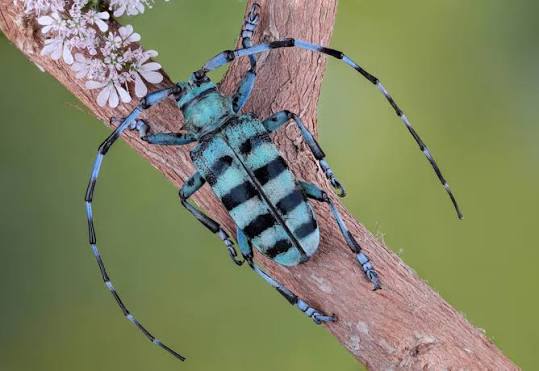
Longhorn beetle identification starts with the antennae, but antenna length alone is not enough. Longhorn beetles belong to the family Cerambycidae and usually have an elongated or cylindrical body, clearly developed hardened wing covers called elytra, prominent antennae, and a body form adapted to life on plants, bark, flowers, or wood.
Many longhorn beetles have antennae that approach or exceed the length of the body. Others have much shorter antennae. Color also varies enormously, from plain brown or black species to beetles marked with white, yellow, red, orange, metallic, or banded patterns.
For a reliable identification, combine location, size, body shape, antennae, elytra, markings, habitat, behavior, season, larvae, and geographic region. Do not rely on color alone.
About This Guide
Longhorn beetles are a large and diverse group containing thousands of species worldwide. Some are easy to recognize at the family level, while identifying an individual specimen to species can require close examination of small anatomical details.
This guide is designed to help you determine whether a beetle is likely to belong to the family Cerambycidae and narrow the possibilities using visible field characters.
If you are still unsure whether your insect is even a beetle, start with this broader beetle identification guide.
A photograph can often support a family- or genus-level identification, but it may not be sufficient for a confident species identification. Similar species may differ in subtle antennal, leg, thoracic, or surface features that are difficult to see in casual photographs.
Quick Longhorn Beetle Identification Checklist
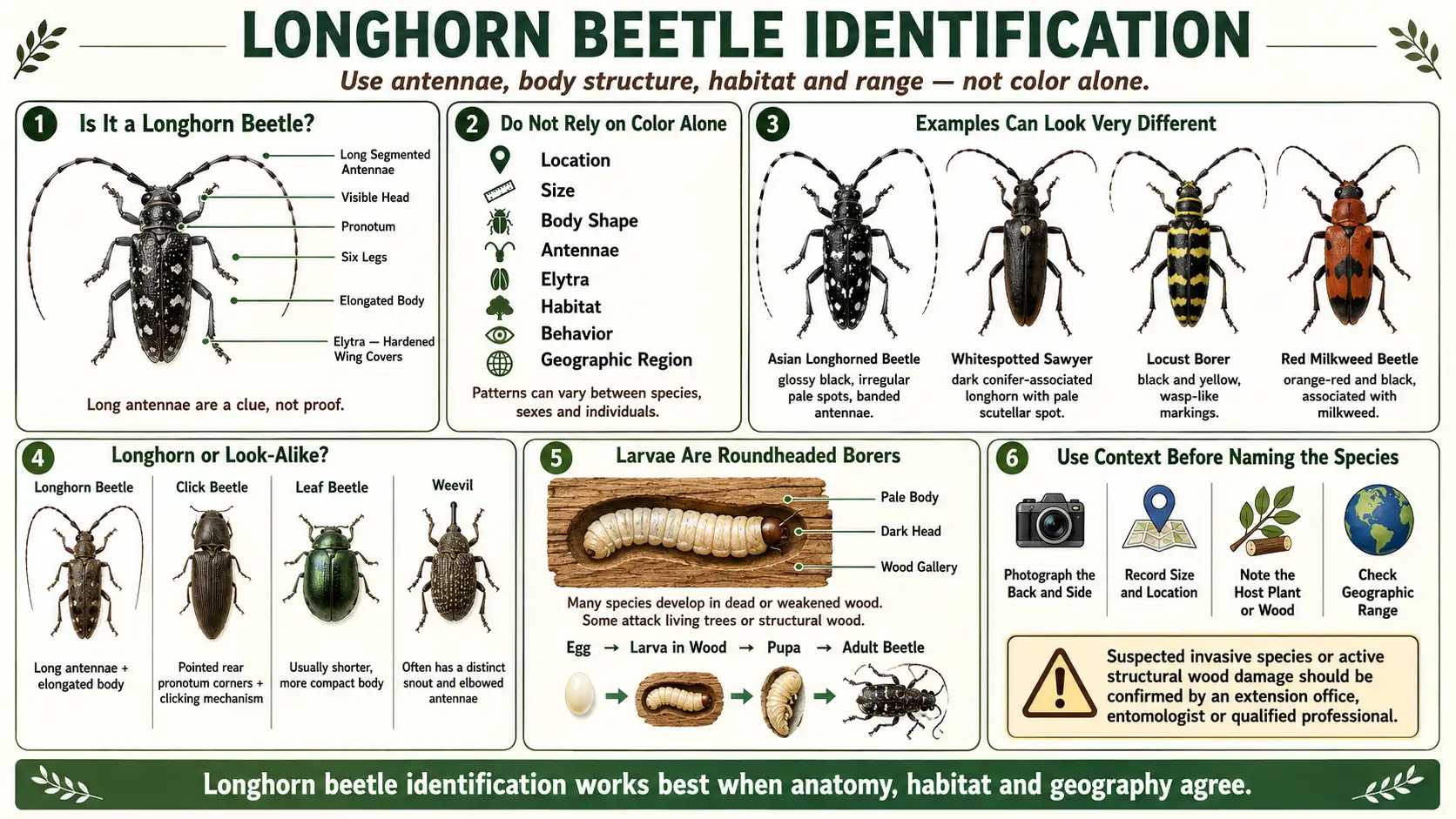
A beetle is more likely to be a longhorn beetle when several of the following clues occur together:
- Six legs
- Hardened elytra covering the abdomen
- Prominent antennae, frequently at least half the body length
- Elongated, cylindrical, or moderately flattened body
- Clearly visible head
- Pronotum narrower than or distinctly separated from the elytra
- Eyes sometimes curved or notched around the antenna bases
- Thorax sometimes equipped with lateral spines or bumps
- Adults found on trees, logs, flowers, cut wood, or vegetation
- Larvae developing inside wood, stems, roots, or other plant tissue
Key identification rule: Long antennae are an important clue, not a diagnosis. Check the entire beetle and its context.
The Most Important Longhorn Beetle Identification Features
1. Antennae
The long antennae responsible for the family’s common name are usually the first feature people notice.
In many species, the antennae are approximately as long as the body or much longer. Males of some species have especially long antennae. In other longhorns, however, the antennae are only moderately long.
Look for:
- where the antennae attach to the head;
- whether they are threadlike, segmented, banded, or somewhat thickened;
- their length relative to the body;
- whether males and females differ in antenna length.
A beetle should not automatically be identified as a longhorn simply because it has long antennae. Several other beetle families contain species with relatively long antennae.
2. Body Shape
Many longhorn beetles have an elongated body that looks approximately parallel-sided or gently tapered.
Common forms include:
- long and cylindrical;
- moderately flattened;
- broad-shouldered;
- narrow and wasp-like;
- robust and heavy-bodied.
The diversity is substantial. Some flower-visiting longhorns are slender, while large wood-associated species may be broad and powerful.
Compare an unknown specimen with other major types of beetles rather than using a single visual feature.
3. Elytra
Like other beetles, adult longhorns possess hardened forewings called elytra.
The elytra usually meet in a straight line down the back and cover most or all of the abdomen. Their surface may be:
- smooth;
- rough or punctured;
- hairy;
- ridged;
- spotted;
- striped;
- banded;
- uniformly colored.
The elytra can provide valuable clues, but patterns should always be interpreted with body structure and geographic range.
4. Head and Eyes
Longhorn beetles generally have a clearly visible head rather than one deeply hidden beneath the thorax.
In many Cerambycidae, the eyes partly surround or curve around the bases of the antennae. Some species show a pronounced indentation in the eye near the antennal attachment.
This feature can be useful when visible, although it is not equally obvious in every longhorn species.
5. Pronotum
The pronotum is the upper surface of the first major thoracic segment, immediately behind the head.
Depending on the species, it may be:
- cylindrical;
- rounded;
- strongly sculptured;
- narrower than the elytra;
- equipped with a spine on each side.
Large lateral spines can be highly noticeable in some longhorns, but many species have no dramatic thoracic spines.
6. Legs
Longhorn beetles commonly have well-developed legs that allow them to walk over bark, stems, foliage, and flowers.
Some species have noticeably enlarged hind femora, especially among slender flower-visiting forms.
Leg coloration and banding may support an identification, but they should not be treated as primary evidence by themselves.
Do Not Identify a Longhorn Beetle by Color Alone
Longhorn beetles occur in an exceptionally wide range of colors and patterns.
They may be:
- black;
- brown;
- gray;
- cream;
- yellow;
- orange;
- red;
- greenish;
- bluish;
- metallic;
- spotted or banded.
A black beetle with white spots, for example, could represent more than one species. A yellow-and-black longhorn can resemble a wasp, while an orange-and-black species may resemble other colorful beetles.
For this reason, black beetle identification should never depend on the word “black” alone.
Use color as one clue among many.
Longhorn Beetle vs Similar Beetles
Several unrelated or distantly related beetles are frequently mistaken for longhorns.
| Feature | Longhorn Beetles | Click Beetles | Leaf Beetles | Weevils |
|---|---|---|---|---|
| Antennae | Often long and conspicuous | Usually moderate, sometimes serrated | Usually shorter to moderate | Frequently elbowed |
| Body | Often elongated or cylindrical | Elongated and often flattened | Frequently compact or oval | Variable |
| Head | Usually visible | Often partly directed downward | Usually visible | Often has a rostrum or snout |
| Pronotum | Sometimes rounded or spined | Rear corners often sharply pointed | Usually less elongate | Variable |
| Special clue | Long antennae plus characteristic body form | Can often “click” and flip | Often associated with foliage | Snout common in many species |
Longhorn Beetle vs Click Beetle
Click beetles are often elongated like longhorns, creating confusion.
Many click beetles can be recognized by the sharply projecting rear corners of the pronotum. They also possess the famous clicking mechanism used to snap the body upward when overturned.
Most do not have the extremely long antennae seen in many longhorn beetles.
Longhorn Beetle vs Leaf Beetle
Leaf beetles in the family Chrysomelidae are relatives of longhorn beetles within the superfamily Chrysomeloidea.
Many leaf beetles are shorter, more rounded, and more compact, with shorter antennae. However, the distinction is not always obvious from body shape alone.
Longhorn Beetle vs Weevil
Many weevils can quickly be separated from longhorns by their rostrum, or snout.
Their antennae are also commonly elbowed and may attach along the rostrum rather than directly to a broad, exposed head.
Common Longhorn Beetles You May Encounter
The examples below demonstrate how different members of Cerambycidae can look. They should not be treated as a complete identification key.
Asian Longhorned Beetle
Scientific name: Anoplophora glabripennis
The Asian longhorned beetle is an invasive wood-boring species that has received significant attention from plant-health agencies in North America and Europe.
Adults are typically:
- glossy black;
- marked with irregular pale or white spots;
- equipped with long, distinctly banded antennae;
- relatively large and robust.
Because several native beetles can appear superficially similar, suspected Asian longhorned beetles should be identified using more than photographs of color patterns.
Where this species is regulated or under eradication, suspected specimens should be reported to the appropriate state, provincial, or federal plant-health authority.
Whitespotted Sawyer
Scientific name: Monochamus scutellatus
The whitespotted sawyer is a native North American longhorn associated primarily with conifers.
Adults are usually dark, and the conspicuous pale spot on the scutellum near the base of the elytra is an important clue. Females may appear more mottled than males.
Sawyer beetles are frequently confused with invasive longhorn species because of their dark coloration and long antennae.
Cottonwood Borer
Scientific name: Plectrodera scalator
The cottonwood borer is a large North American longhorn with striking pale and dark markings.
Its larvae develop in the roots and lower portions of trees such as cottonwoods and related poplars. The adult’s size, bold pattern, and long antennae make it one of the more distinctive longhorns where it occurs.
Locust Borer
Scientific name: Megacyllene robiniae
The locust borer is a black-and-yellow patterned longhorn associated with black locust.
Adults may visit flowers, particularly during late summer and fall. Their yellow markings can make them resemble wasps at a glance.
The presence of hardened elytra and beetle-shaped anatomy separates them from true wasps.
Red Milkweed Beetle
Scientific name: Tetraopes tetrophthalmus
This conspicuous orange-red and black longhorn is closely associated with milkweed.
Its antennae divide the compound eyes so dramatically that the genus name Tetraopes refers to an apparent “four-eyed” appearance.
Its distinctive color is helpful, but its association with milkweed, body shape, eye structure, and geographic range provide stronger evidence.
Banded Alder Borer
Scientific name: Rosalia funebris
The banded alder borer is a striking western North American longhorn with contrasting dark and pale bands.
Adults are often associated with hardwoods. Its dramatic pattern makes it memorable, but even boldly patterned species should be checked against regional look-alikes before assigning a species name.
For a broader look at diversity within the group, see the site’s overview of beetle species.
Where Are Longhorn Beetles Found?
Longhorn beetles occur in forests, grasslands, gardens, shrublands, orchards, urban landscapes, and many other habitats.
Adults may be found on:
- tree trunks;
- freshly cut logs;
- dead branches;
- flowers;
- shrubs;
- foliage;
- firewood;
- lumber;
- outdoor lights.
Many adults are strong fliers, so finding a longhorn at a porch light does not necessarily reveal where its larvae developed.
Readers interested in how and why beetles fly can also see flying beetles.
What Do Longhorn Beetle Larvae Look Like?
Longhorn beetle larvae are commonly called roundheaded borers.
A typical larva is:
- pale cream or whitish;
- elongated;
- soft-bodied;
- somewhat cylindrical;
- darker around the head;
- often broad near the thorax.
Legs may be very small or difficult to see.
Most longhorn larvae develop within plant material. Depending on species, they may feed in:
- dead wood;
- dying trees;
- living trees;
- branches;
- trunks;
- roots;
- stems.
Because the larvae remain hidden, the first evidence of their presence may be galleries, frass, sap flow, bark injury, or adult emergence holes.
Larval appearance alone is often insufficient for species identification.
Are Longhorn Beetles Wood-Damaging Pests?
Some are. Many are not.
A large number of longhorn species play normal ecological roles by developing in dead, dying, weakened, or decomposing wood. Their activity contributes to nutrient cycling and wood decomposition.
Other species use living trees, shrubs, roots, or stems. A comparatively small number become important forestry, agricultural, ornamental-tree, or structural pests.
Examples with significant economic relevance include certain invasive tree borers and the old house borer, Hylotrupes bajulus, which can infest seasoned softwood lumber.
The presence of one adult longhorn beetle in a home does not automatically mean that the building is infested.
Why Is There a Longhorn Beetle in My House?
Adult longhorn beetles sometimes appear indoors after emerging from:
- firewood;
- wooden decorative objects;
- recently installed wood;
- stored logs;
- lumber;
- furniture;
- outdoor material carried inside.
Others simply fly indoors through doors or windows.
If you find a single adult, examine where it appeared and whether any wood nearby shows fresh evidence of insect activity.
Potential signs worth investigating include:
- repeated emergence of similar beetles;
- fresh exit holes;
- fresh wood dust or frass;
- audible larval activity in some situations;
- galleries beneath bark or inside wood.
For more general help with indoor beetles, see beetles around the home.
Do not apply insecticides simply because an unidentified longhorn beetle entered the house. Correct identification and locating the source come first.
If structural wood appears to be actively infested, contact a qualified pest-management professional or local extension office for confirmation.
How to Use Habitat and Host Plants for Identification
Host information is especially valuable when identifying longhorn beetles.
Record the type of plant or wood where the beetle was found.
Useful questions include:
- Was it on a hardwood or conifer?
- Was the wood living, recently dead, or well-decayed?
- Was the beetle on a flower rather than wood?
- Did it emerge from firewood?
- Was it associated with milkweed, locust, cottonwood, willow, pine, fir, or another identifiable plant?
- Was it found beneath bark?
- Was the specimen attracted to an outdoor light?
Some longhorns have relatively narrow host associations, while others use many kinds of trees.
Host information can therefore eliminate many possibilities.
Geographic Region Matters
A species name should always make biological sense for the location where the beetle was found.
Two visually similar beetles may have completely different geographic distributions.
For identification, record at least:
- country;
- state, province, or region;
- approximate date;
- habitat;
- host plant if known.
This information is often more useful than a vague description such as “large black beetle with long antennae.”
Distribution is particularly important when distinguishing native longhorn beetles from invasive species.
Season and Behavior Can Help
Adult activity varies among species.
Some longhorns are active mainly in spring or early summer. Others become especially noticeable in late summer. Some visit flowers during daylight, while others are more active at dusk or night.
Behavioral clues can include:
- running rapidly over logs;
- resting on tree trunks;
- visiting flowers;
- flying to lights;
- mating on host plants;
- laying eggs in bark cracks or plant tissue.
Seasonal behavior should support an identification rather than determine it by itself.
How to Photograph a Longhorn Beetle for Identification
Good photographs greatly improve the chance of a useful identification.
Try to obtain:
- A clear dorsal photo showing the full back.
- A side view showing body shape and pronotum.
- A close view of the head and antennae.
- A photograph with a scale reference for size.
- A view of the underside, if safe and practical.
- A photograph of the host tree, plant, log, or wood.
- Any exit holes, frass, galleries, or plant damage.
Avoid handling an unknown insect unnecessarily. A container can make photography easier without injuring the beetle.
Common Longhorn Beetle Identification Mistakes
Mistake 1: “It has long antennae, so it must be a longhorn”
Long antennae are useful evidence, but not exclusive to Cerambycidae.
Confirm the body form, elytra, head, pronotum, and other characters.
Mistake 2: Using Color as the Main Identification Feature
Color is one of the easiest characteristics to observe and one of the easiest to overuse.
Lighting, wear, age, sex, and natural variation can change the way a specimen looks.
Do not rely on color alone.
Mistake 3: Assuming Every Longhorn Damages Healthy Trees
Many species develop mainly in dead or weakened wood and are important decomposers.
Their presence may reflect existing wood decay rather than the original cause of tree decline.
Mistake 4: Assuming a Beetle Indoors Is a Structural Pest
A longhorn may simply have emerged from firewood or flown indoors.
Repeated activity and evidence from structural lumber deserve more attention than one isolated beetle.
Mistake 5: Ignoring Geographic Range
A photograph that resembles a species online does not prove that species occurs where your beetle was found.
Distribution should always be checked.
Mistake 6: Identifying an Invasive Species from One Trait
This is especially important with the Asian longhorned beetle.
Native sawyers and other beetles may share dark coloration, spots, or long antennae. Suspected invasive insects should be evaluated using several diagnostic characters and geographic information.
When Does Professional Identification Matter?
Casual identification is often enough for ordinary nature observations. More formal identification becomes important when the beetle may involve:
- a regulated invasive species;
- damage to valuable trees;
- structural lumber;
- commercial timber;
- orchards or crops;
- repeated indoor emergence;
- nursery plants or transported wood.
In these situations, preserve the specimen if possible and take clear photographs.
A local university extension office, state agriculture department, natural-history museum, entomologist, or qualified pest professional may be able to provide a more reliable identification.
Frequently Asked Questions
How can I tell if a beetle is a longhorn beetle?
Look for a combination of prominent segmented antennae, an elongated or cylindrical body, hardened elytra, a visible head, and a characteristic longhorn body form. Habitat and geographic range should also match.
Do all longhorn beetles have antennae longer than their bodies?
No. Many do, but antenna length varies widely among Cerambycidae. Some species have antennae shorter than the body, particularly females or members of certain groups.
Are longhorn beetles dangerous to people?
Longhorn beetles are not generally a human health threat. They are not blood-feeding insects. Some large beetles may defend themselves mechanically if handled, so observation without unnecessary handling is preferable.
Do longhorn beetles bite?
Their mouthparts are designed primarily for feeding on plant material, bark, sap, flowers, or related resources. A large beetle may pinch defensively if restrained, but longhorn beetles do not seek people as hosts.
Are longhorn beetles harmful to trees?
Some species can damage living trees, but many develop in dead, dying, or weakened wood. The ecological and economic importance varies greatly by species.
What do longhorn beetle larvae look like?
They are typically pale, elongated, soft-bodied grubs with a darker head and a relatively enlarged front section. They are often called roundheaded borers.
Why did a longhorn beetle come out of my firewood?
The larva may have already been developing inside the wood before it was brought indoors. Indoor warmth can sometimes accelerate adult emergence.
Is a black beetle with white spots an Asian longhorned beetle?
Not necessarily. Several native beetles can have dark bodies and pale markings. Check antenna pattern, body shape, pronotum, markings, size, host tree, and geographic region before drawing a conclusion.
Are sawyer beetles longhorn beetles?
Yes. Sawyer beetles in the genus Monochamus belong to the family Cerambycidae. Their long antennae and association with conifers make them recognizable members of the longhorn group.
Should I kill a longhorn beetle I find outside?
Usually there is no reason to kill a native longhorn simply because it is present. Many species perform normal ecological functions. If you suspect a regulated invasive species, photograph or safely contain the specimen and contact the appropriate plant-health authority for instructions.
Conclusion
Reliable longhorn beetle identification depends on recognizing a combination of features rather than a single dramatic trait.
Start with the antennae, then examine the beetle’s body shape, head, pronotum, elytra, size, markings, habitat, host plant, season, behavior, and geographic region. If larvae or wood damage are present, those clues can further narrow the possibilities.
Above all, do not rely on color alone. Longhorn beetles are an extremely diverse family, and superficially similar species may have very different ecological roles.
When an identification involves a potentially invasive beetle, valuable trees, or structural wood, confirmation from an extension office, museum, entomologist, plant-health authority, or qualified pest professional is the safest approach.
References and Further Reading
USDA APHIS — Asian Longhorned Beetle
University of Minnesota Extension — Asian Longhorned Beetle
University of Florida Featured Creatures — Asian Longhorned Beetle
BugGuide, Iowa State University — Family Cerambycidae: Longhorned Beetles
Michigan State University Extension — Asian Longhorned Beetle