

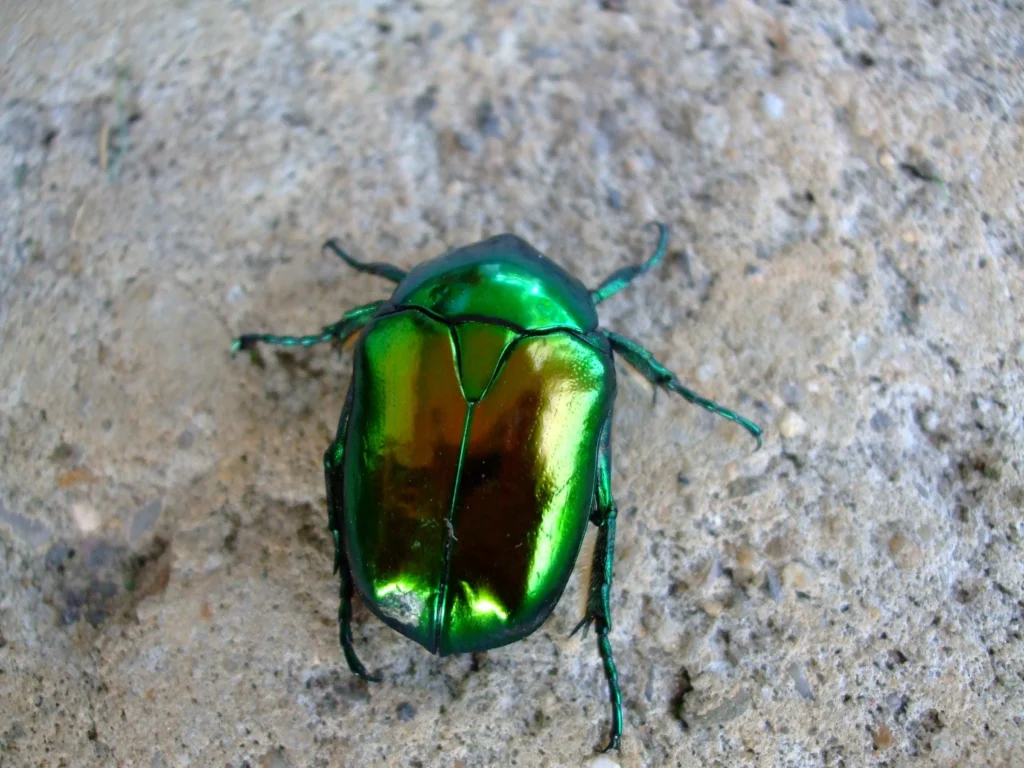
Water beetles are true beetles that live in ponds, ditches, streams, and slow water, and the three families you are most likely to meet are predaceous diving beetles (Dytiscidae), water scavenger beetles (Hydrophilidae), and whirligig beetles (Gyrinidae). All of them breathe air, and all of them can fly.
If a shiny dark beetle appeared in your swimming pool overnight, or a group of small black ovals is spinning on the surface of a pond, you are almost certainly looking at one of these three. None of them will infest a house, damage wood, or breed indoors. A few of the larger ones can pinch if you pick them up, which is the only real caution worth giving.
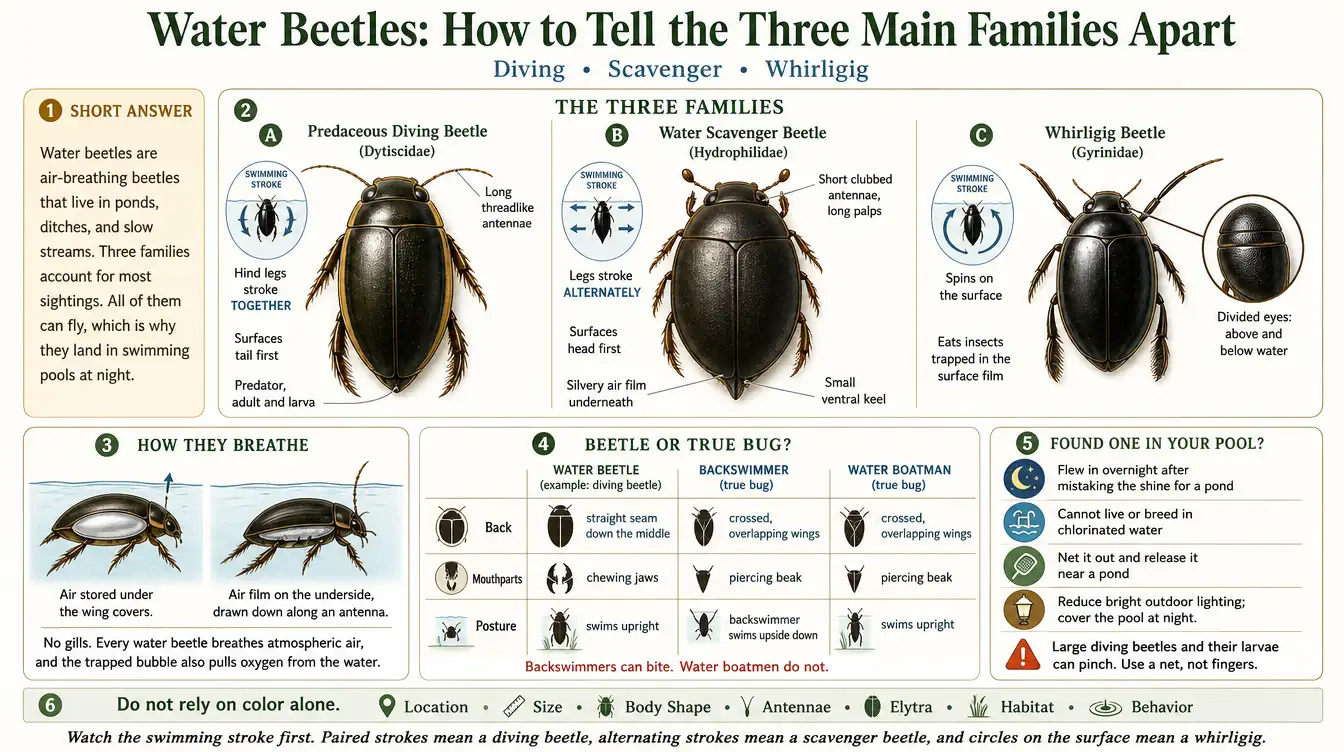
The families look similar from a distance. Told apart properly, they are not hard to separate: watch how the legs move, look at what is sticking out of the front of the head, and note whether the beetle stays on the surface or spends its time below it.
About This Guide
This guide works at the family level, because that is as far as a photograph or a description will usually take you. There are more than 5,000 diving beetle species and over 3,000 water scavenger beetles worldwide, and many of them are separated by microscopic details of the legs, mouthparts, or genitalia. A confident species name almost always requires a specimen and a specialist.
What you can do reliably at home is narrow a water beetle to its family, rule out the aquatic true bugs that get confused with beetles, and decide whether anything needs to be done about it. That is what the sections below cover.
What Makes a Beetle a Water Beetle
“Water beetle” is an ecological label, not a scientific group. It gathers together beetle families that independently moved into freshwater at different points in evolutionary history. They all share the standard beetle body plan: hardened forewings called elytra that meet in a straight seam down the back, chewing mouthparts, and a complete life cycle with egg, larva, pupa, and adult stages.
Two features separate aquatic beetles from their terrestrial relatives. The hind legs are usually flattened and fringed with stiff hairs that fold out into a paddle on the power stroke. And none of them has gills as adults, so every one of them has to solve the same problem: how to carry a supply of atmospheric air underwater.
Beyond the three main families, freshwater holds smaller groups that turn up in samples and school pond studies: crawling water beetles (Haliplidae), riffle beetles (Elmidae) that cling to rocks in fast streams, water pennies (Psephenidae) whose larvae look like flat copper discs stuck to stones, and marsh beetles (Scirtidae). These are worth knowing about, but they are rarely what someone finds in a pool.
Predaceous Diving Beetles (Dytiscidae)
These are the beetles most people mean when they say water beetle. They are smooth, streamlined ovals, widest near the middle and tapering slightly toward the head, in shiny black, dark brown, or olive, often with a pale or yellow margin around the body. North American species run from a few millimeters up to about 1.5 inches in the largest genera.
Three details identify them:
- Antennae are long and threadlike, held forward like fine hairs. Nothing else about the head stands out.
- The hind legs stroke together, both at once, like a rower pulling two oars. The motion is even and direct.
- They surface tail first, hanging head-down just under the film with the tip of the abdomen breaking through.
Adults and larvae are both predators. They take mosquito larvae, other aquatic insects, small crustaceans, tadpoles, and occasionally small fish. In fish-free ponds and temporary pools they are often the top predator present.
Males of many species carry adhesive pads or suction discs on the front feet, used to grip the female during mating. In some groups the females have grooved or ridged elytra that make that grip harder to maintain.
Water Scavenger Beetles (Hydrophilidae)
Water scavenger beetles overlap with diving beetles in size, habitat, and color, which is why they get mixed up constantly. Separating them is straightforward once you know where to look.
- Antennae are short and clubbed, and usually tucked out of sight. What appears to be a pair of long antennae on the head is actually the maxillary palps, sensory mouthparts that are often longer than the real antennae.
- The legs move alternately, left-right-left-right, giving a rocking, slightly clumsy stroke rather than the diving beetle’s clean push.
- They surface head first, breaking the film with one antenna to draw air down to the underside of the body.
- Many have a keel or spine running down the midline of the underside, past the hind legs. Diving beetles never have this.
The body is often more domed above and flatter below than a dytiscid. Underwater, the film of air trapped on the underside can flash bright silver, which is where the nickname “silver beetle” comes from.
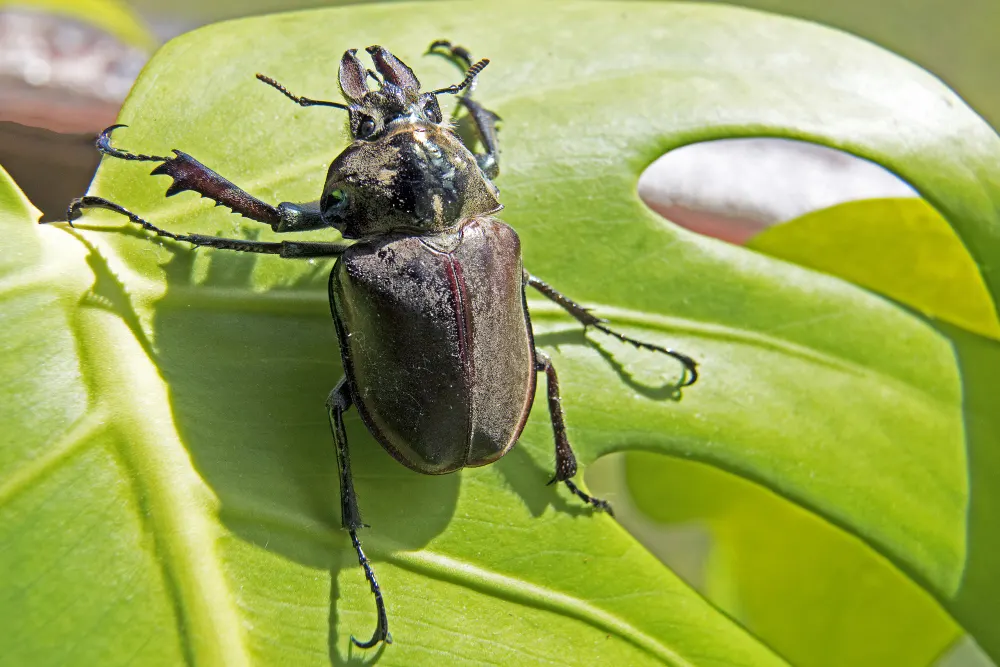
The family name is a little misleading. Adults feed largely on decaying plant material, algae, and detritus, but the larvae are active predators with strong jaws, and some specialize in aquatic snails.
Whirligig Beetles (Gyrinidae)
Whirligigs are unmistakable once you have seen them. Groups of small, flattened, shiny black ovals skate and spin across still water in fast, looping circles, especially in sheltered corners of ponds and slow streams. Most are between about an eighth and three-quarters of an inch long.
Their defining feature is the eyes. Each compound eye is divided into an upper and a lower half, so the beetle appears to have four eyes and can watch the air above and the water below at the same time. The forelegs are long and slender and are held forward to grab prey; the middle and hind legs are short, flat paddles that beat at very high frequency.
Whirligigs feed on insects trapped in the surface film, and they use the last segments of their antennae to detect the tiny ripples struggling prey makes. When disturbed, a group scatters and some individuals dive, carrying a bubble of air with them. Many species also release a defensive secretion; in some, the odor is often compared to ripe apples.
Telling the Three Families Apart
| Feature | Diving beetles (Dytiscidae) | Water scavenger beetles (Hydrophilidae) | Whirligig beetles (Gyrinidae) |
|---|---|---|---|
| Swimming stroke | Hind legs move together, in unison | Legs move alternately, rocking | Middle and hind legs beat rapidly; spinning surface paths |
| Antennae | Long, threadlike, obvious | Short, clubbed, usually hidden | Very short and stout |
| Conspicuous head appendage | The antennae themselves | The maxillary palps (longer than antennae) | Neither; the divided eyes stand out instead |
| Eyes | Normal, undivided | Normal, undivided | Divided into upper and lower halves |
| Where it spends its time | Below the surface | Below the surface, often crawling on plants | On the surface film |
| How it takes air | Tail first, air stored under the elytra | Head first, air drawn along an antenna to a ventral film | At the surface; bubble under elytra when diving |
| Underside | Smooth | Often keeled, with a midline spine | Smooth, flattened |
| Adult diet | Predatory | Mostly scavenging on plant matter and detritus | Insects caught in the surface film |
The stroke pattern is the most useful field character, because you can see it in a glass jar or a shallow tray without touching the beetle. Watch for five seconds: even and paired means dytiscid, uneven and alternating means hydrophilid.
How Water Beetles Breathe Underwater
No adult water beetle has gills. Every one of them carries atmospheric air down with it, and the two main families do it differently.
Diving beetles store air in the space beneath the elytra, above the abdomen, where the spiracles open. When the supply runs low, the beetle rises tail first, breaks the film with the abdomen tip, and refreshes the store. A visible bubble often sits at the rear of the body.
Water scavenger beetles hold their air as a thin silvery film across the hairy underside of the body. To recharge, the beetle comes up head first and pushes one antenna through the surface, creating a channel that lets air flow down to the film.
In both cases the trapped air works as more than a tank. Because oxygen diffuses inward from the surrounding water as the beetle consumes it, the bubble functions as a physical gill and stretches a dive well beyond what the initial volume would allow. Some small species with dense, water-repellent hair layers can stay submerged for very long periods, and a few need to surface only rarely.
Larvae solve the problem separately. Diving beetle larvae usually hang from the surface film and breathe through spiracles at the abdomen tip, though some have filamentous abdominal gills. Whirligig larvae have feathery gill filaments along the abdomen and stay on the bottom.
Water Beetles vs. Backswimmers and Water Boatmen
This is the single most common mix-up, and it is worth getting right because one of these bites and the beetles mostly do not.
Backswimmers (Notonectidae) and water boatmen (Corixidae) are true bugs in the order Hemiptera, not beetles. Three checks separate them from any water beetle:
- The back. A beetle has hard elytra meeting in a straight seam down the midline. A true bug’s wings overlap and cross, with no clean central seam.
- The mouthparts. True bugs have a beak for piercing and sucking. Beetles have visible chewing jaws.
- The posture. Backswimmers swim upside down, belly up, with a keeled, boat-shaped back that is usually pale. Water boatmen swim right side up, are flatter and darker, and often show fine crosslines across the back.
Backswimmers are predators and will bite in self-defense if trapped against skin. The bite is sharp and stings but is not medically serious for most people. Water boatmen feed on algae and detritus and do not bite. Both are strong fliers, and water boatmen in particular come readily to lights at night, which is why they end up in pools alongside the beetles.
If you are not sure whether you are looking at a beetle at all, the beetle identification basics on body structure will sort it out faster than color ever will.
Water Tigers: The Larvae You Should Not Handle
Diving beetle larvae are called water tigers, and they earn the name. They are long, tapered, and slightly flattened, with a large head, six legs clustered near the front, and a pair of curved, sickle-shaped jaws held open in front. The largest species produce larvae several inches long.
The jaws are hollow. The larva grips prey, injects digestive enzymes through channels in the mandibles, and draws out the liquefied tissue. They take mosquito larvae, other insect larvae, tadpoles, small fish, and each other.
A large water tiger can deliver a painful pinch if picked up, and so can a large adult diving beetle. It is a defensive response, it is not venomous in any medically meaningful sense, and it is not dangerous, but it hurts more than people expect from a pond insect. Move them with a net or a container rather than bare fingers, and keep that in mind during pond-dipping activities with children.
If you found a long, jawed aquatic larva and want to confirm what it is, compare it against the broader beetle larva identification characters before assuming it is a dytiscid. Dragonfly and damselfly nymphs are the usual look-alikes, and they have a hinged lower lip rather than external sickle jaws.
Why Water Beetles Show Up in Pools, Tanks, and Under Porch Lights
Almost every aquatic beetle keeps a functional pair of membranous hindwings folded under the elytra, and many are strong fliers. This is not a detail about how beetle flight works, which the guide to flying beetles already covers, but about timing and destination.
Water beetles disperse at night. A pond that is drying out, a crowded habitat, or simply the seasonal urge to find new breeding water sends adults into the air after dark. In flight they are searching for water, and they locate it by looking for large, flat, shiny reflective surfaces. A swimming pool is an excellent imitation of a pond from a hundred feet up. So is a dark car roof, a greenhouse pane, and a wet patio.
Once they land, a few things happen:
- In pools, the chlorinated water is not habitable long-term. Beetles that arrive usually die or leave within a day or two. There is nothing to treat; they are not breeding there.
- Under porch lights, they land on driveways and decks and then crawl awkwardly, because legs built as paddles are poor for walking. A large diving beetle scuttling across concrete after a rainy night is a common sight and often mistaken for a giant June beetle.
- In stock tanks, water features, and rain barrels, they may genuinely settle in, and in these settings they are usually doing useful work eating mosquito larvae.
The practical response in nearly every case is to scoop the beetle out with a net and release it near a pond or ditch, or simply leave it alone. Reducing bright white outdoor lighting during peak dispersal nights, switching to warmer or shielded fixtures, and keeping a pool cover on will cut the number of arrivals more effectively than anything applied to the water. Chemical treatment is not warranted for insects that are passing through, and pool water chemistry should be handled as a water quality issue, not a pest issue. Other seasonal visitors that turn up around the house are covered under beetles around the home.
What Water Beetles Do in a Healthy Pond
Aquatic beetles occupy several rungs of the freshwater food web at once. Diving beetles and their larvae are significant predators of mosquito larvae, midges, and other invertebrates, particularly in small ponds and temporary pools where fish are absent. Water scavenger beetle adults process decaying vegetation and help break down organic matter, while their larvae prey on snails and insect larvae. Whirligigs clean up insects trapped on the surface film. All of them are food for fish, frogs, birds, and larger invertebrates.
Aquatic beetles also feature in freshwater biomonitoring. Different families tolerate very different conditions, and that variation is what makes them useful. Riffle beetles (Elmidae) live in well-oxygenated, fast-flowing water and are considered sensitive to pollution and sedimentation, so their presence in a stream sample counts toward a good water quality score. Diving beetles and water scavenger beetles, by contrast, are air breathers and can persist in warm, low-oxygen, or temporarily stagnant water where sensitive groups have disappeared. A pond full of dytiscids is not by itself a sign of clean water; it is the overall mix of families in a standardized sample that tells the story. Volunteer stream monitoring programs run by state agencies and extension services use exactly this kind of family-level scoring.
Common Identification Mistakes
Relying on color. Nearly every common water beetle is black, dark brown, or olive. Dark color tells you almost nothing here. Do not rely on color alone; work from size, body shape, antennae, elytra, the swimming stroke, the habitat, the season, and your geographic region together.
Calling every water insect a beetle. Backswimmers, water boatmen, water striders, and water scorpions are all true bugs. Check for the straight elytral seam first.
Assuming a bubble means a diving beetle. Whirligigs and hydrophilids carry air too. The location of the air, under the wing covers versus across the underside, is the useful distinction.
Confusing size with species. Body length varies enormously within these families, and a small dytiscid and a large one may be unrelated genera. Size narrows the options; it does not name the beetle.
Treating them as household pests. Water beetles do not reproduce indoors, feed on stored food, damage fabric, or bore into wood. Broader context on which beetles matter and which do not is in the types of beetles overview.
When an Expert Opinion Is Worth Getting
Family-level identification from a clear photo is realistic. Species-level identification usually is not, and any source that offers one from a single blurry image is overreaching.
Get in touch with a specialist if you are documenting species for a survey or property record, if a pond is producing large numbers of an insect you cannot place, or if you need a legally or scientifically defensible identification. Your local cooperative extension office, a state department of natural resources, a university entomology department, or a natural history museum will usually identify a submitted specimen at no cost or a small fee. BugGuide.net is a good option for photo-based help from experienced volunteers.
Frequently Asked Questions
Do water beetles bite?
Large adult diving beetles and their larvae can pinch defensively if handled, and it hurts, but it is not venomous or medically significant. Water scavenger beetles and whirligigs rarely bite. Handle larger specimens with a net rather than bare hands.
What is the difference between a diving beetle and a water scavenger beetle?
Watch the legs. Diving beetles stroke both hind legs at the same time and have long threadlike antennae. Water scavenger beetles paddle alternately, have short clubbed antennae with long palps in front, and usually have a keel down the underside.
How do water beetles breathe underwater?
They carry air with them. Diving beetles store it under the elytra; water scavenger beetles hold it as a silvery film on the underside. The trapped air also absorbs oxygen from the surrounding water, extending the dive.
Can water beetles fly?
Yes. Most species fly well and disperse at night between water bodies, which is how they end up in swimming pools, birdbaths, and under porch lights.
Why are there beetles in my swimming pool?
They flew in overnight after mistaking the reflective surface for a pond. They cannot live or breed in chlorinated water. Net them out and, if it happens repeatedly, reduce bright outdoor lighting and cover the pool at night.
What is a water tiger?
It is the larva of a predaceous diving beetle: long, tapered, with sickle-shaped hollow jaws it uses to inject digestive enzymes into prey. Large ones can pinch and should not be picked up bare-handed.
Are water beetles good or bad for a pond?
Mostly beneficial. They eat mosquito larvae and other invertebrates, recycle decaying plant material, and feed fish and birds. Very large numbers of diving beetles can be a nuisance in fish hatcheries, but in a garden pond they are a good sign.
Why do whirligig beetles swim in circles?
The circling is part of how they hunt and how a group responds to disturbance. Their divided eyes watch above and below the water at once, and their antennae read ripples from insects struggling in the surface film.
Do water beetles indicate clean water?
Some do. Riffle beetles need well-oxygenated flowing water and count as sensitive indicators. Diving and scavenger beetles breathe air and can tolerate poor conditions, so their presence alone does not confirm clean water.
Can water beetles live in a home aquarium?
Diving beetles are sometimes kept, but they are predators and will attack fish, shrimp, and each other. They also fly, so any tank holding them needs a secure lid.
Conclusion
Water beetles are a group defined by where they live rather than by shared ancestry, and for most readers the useful question is which of three families is in front of them. Diving beetles push both hind legs together, show long threadlike antennae, and store air under their wing covers. Water scavenger beetles paddle alternately, hide clubbed antennae behind long palps, and carry a silver film of air on the underside. Whirligig beetles spin on the surface and have eyes split for two worlds at once.
None of them threatens a home, and most of them are quietly useful, eating mosquito larvae and cleaning up organic debris. If one turns up in a pool or on a driveway after a warm night, it is a traveler that misread a shiny surface for water. Scoop it out, look at how it swims, and let it go.
References and further reading
- Missouri Department of Conservation — Predaceous Diving Beetles (Water Tigers)
- Missouri Department of Conservation — Water Scavenger Beetles
- Missouri Department of Conservation — Whirligig Beetles
- Missouri Department of Conservation — Backswimmers
- Texas A&M AgriLife — Diving Beetle, Field Guide to Common Texas Insects
- NC State University, ENT 425 General Entomology — Family Hydrophilidae
- University of Wisconsin–Milwaukee Field Station — Whirligig Beetle
- LSU AgCenter — Pool Pests