

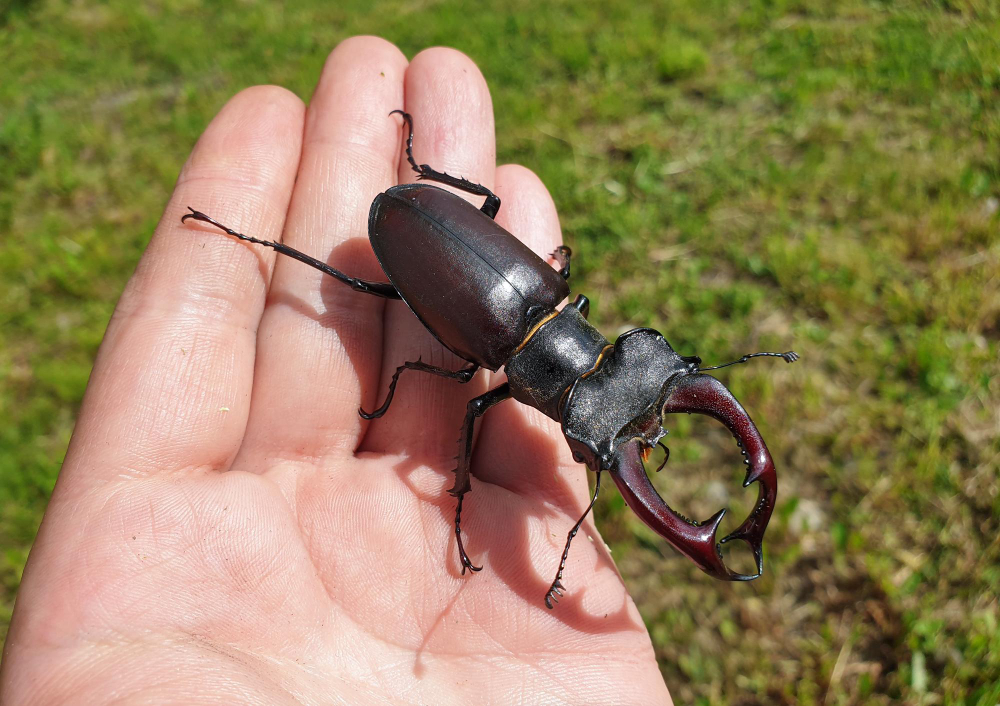
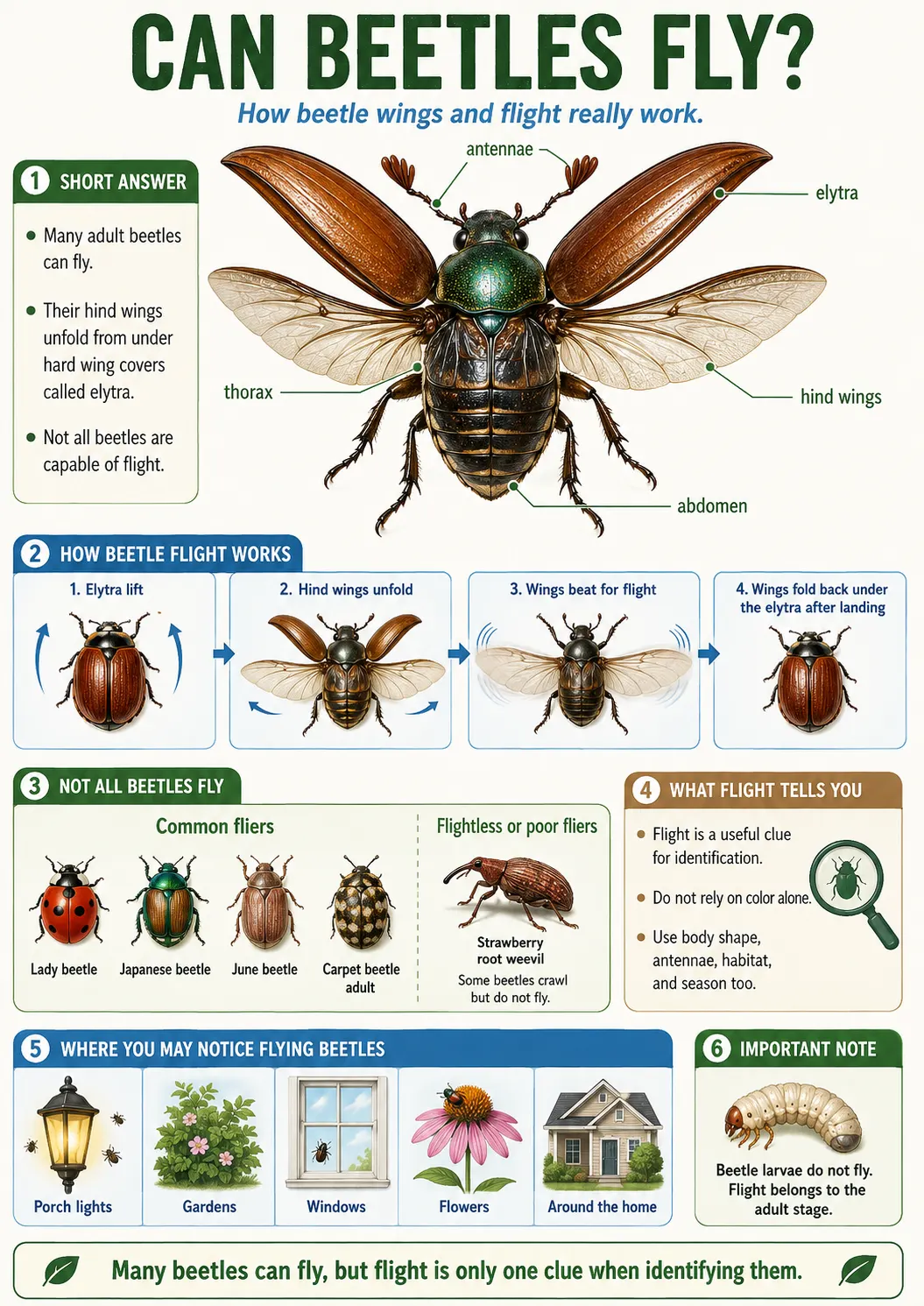
Can beetles fly? Yes. Many adult beetles can fly, although not every beetle species is capable of flight. In a typical flying beetle, the hard structures that look like a shell on its back are not the main flight wings. They are modified forewings called elytra. The softer flight wings are folded underneath them when the beetle is resting.
That unusual arrangement explains one of the most surprising things about beetles. A beetle can look compact, hard-shelled, and built mainly for crawling, then suddenly open its wing covers, unfold a much larger pair of wings, and take off.
The answer becomes more complicated when you ask whether all beetles fly. They do not. Flight ability varies greatly among beetle families, species, sexes, life stages, and even populations. Some are highly mobile fliers. Others fly only occasionally, and some species have reduced or nonfunctional flight wings and remain on the ground.
If you are trying to identify a beetle that flew past you, landed on a window, or appeared around a porch light, flight behavior is useful—but it should be treated as one clue among several.
How This Guide Helps
This guide explains beetle flight for beginners and shows how flight behavior can support beetle identification without being mistaken for a guaranteed species-level clue.
Beetle identification can change with:
- geographic region
- season
- life stage
- sex
- size
- body shape
- antennae
- wing-cover shape
- color and markings
- habitat
- activity time
- behavior
- photo angle and image quality
Many unrelated beetles can be brown, black, metallic, oval, or elongated. Likewise, both closely related and completely unrelated beetles may differ in their ability to fly.
For that reason, use flight together with several visible features. If you are starting with an unknown specimen, this beetle identification guide provides a broader identification framework.
Table of Contents
- Can Beetles Fly?
- How Do Beetle Wings Work?
- What Are Elytra?
- Can All Beetles Fly?
- Why Are Some Beetles Flightless?
- Common Beetles That Fly
- Flying vs. Flightless Beetles
- Why Beetles Fly
- When Beetles Fly
- Can Beetle Larvae Fly?
- How to Identify a Flying Beetle
- Beetles Around Lights
- Flying Beetles in the House
- Flying Beetles in the Garden
- Common Identification Mistakes
- When to Seek Expert Help
- FAQ
How Do Beetle Wings Work?
The basic beetle wing arrangement is different from what you see in butterflies, moths, flies, or dragonflies.
Adult beetles belong to the insect order Coleoptera. One of the defining features of this order is that the front pair of wings has been modified into hardened wing covers called elytra. In flying species, a second, more delicate pair of wings lies folded underneath.
These two structures have different jobs.
The elytra mainly protect the upper abdomen and the more fragile hind wings.
The hind wings provide most of the aerodynamic surface used during flight.
This is why a resting beetle may appear to have no usable wings at all. Its true flight wings are hidden.
What Are Elytra?
Elytra are the hard or leathery structures forming the visible upper surface of most beetles.
They meet along the center of the back, often creating a clear straight line from the thorax toward the tip of the abdomen. Their texture, grooves, color, spots, hairs, scales, and shape are frequently useful for identification.
The Smithsonian National Museum of Natural History describes elytra as a beetle-specific adaptation derived from wings. They protect the softer structures underneath and have contributed to beetles being able to occupy an extraordinary range of habitats.
Elytra should therefore not be thought of simply as a “shell.” They are modified wings.
What Happens When a Beetle Flies?
In many flying beetles, the sequence looks roughly like this:
- The beetle raises or separates its elytra.
- The folded hind wings underneath are released.
- The hind wings expand into a much larger flight surface.
- Wing movement creates lift and propulsion.
- The elytra remain raised or positioned around the working flight wings.
- After landing, the hind wings are folded back beneath the elytra.
A good real-world clue is that the functional wings may be almost invisible when the animal is walking. University of Minnesota Extension notes this clearly for foreign grain beetles: their wings fold under the wing covers while at rest, which can make them difficult to see.
This explains why someone can watch a small hard-backed insect crawling across a wall and be surprised when it suddenly flies.
Can All Beetles Fly?
No. Not all beetles can fly.
The order Coleoptera is extremely diverse, so there is no single rule that applies to the flight ability of every species.
Some beetles have fully functional hind wings and fly regularly. Others possess wings but rarely use them. In some evolutionary lineages, the flight wings have become reduced or lost. Research on beetle groups also documents flightless species with reductions in both elytra and flight-wing structures.
Even within beetles that look broadly similar, flight ability can differ.
A useful household example is the strawberry root weevil. University of Minnesota Extension specifically notes that adult strawberry root weevils do not fly, even though they may wander indoors during summer.
By contrast, foreign grain beetles are described by the same extension service as strong fliers.
So the presence of elytra does not automatically mean a particular beetle can take flight.
Why Are Some Beetles Flightless?
Flight provides major advantages, but maintaining structures used for flight also requires energy and specialized anatomy.
Over evolutionary time, flight can become less important in beetles that live in environments where walking, burrowing, hiding, or remaining close to a stable food source is more useful.
Some flightless beetles have reduced hind wings. In other groups, changes in the elytra or thorax accompany the loss of flight. Entomological research has documented multiple beetle lineages in which flight-related structures have been reduced.
Flightlessness is therefore not a defect. It can be a normal characteristic of a species.
It is also important not to conclude that a beetle is flightless simply because you have never seen it fly. Some perfectly capable species spend much of their time walking and use flight only under particular conditions.
Common Beetles That Can Fly
Thousands of beetle species are capable of flight. For identification purposes, however, it is more useful to focus on groups people regularly encounter.
For a more species-focused treatment, see the site’s dedicated guide to flying beetles.
Lady Beetles
Adult lady beetles are capable fliers.
University of Minnesota Extension notes that adults may fly considerable distances while searching for food and describes lady beetles as highly mobile because of their ability to fly.
Their flight ability also helps explain why releasing purchased lady beetles does not guarantee that they will remain in a particular garden.
The multicolored Asian lady beetle provides an especially familiar example. Adults may fly toward buildings in fall while seeking protected overwintering sites.
Japanese Beetles
Adult Japanese beetles are mobile above-ground insects that move among lawns, gardens, flowers, fruit plants, and other vegetation during their adult season.
They should not be confused with their larval stage, commonly called a white grub, which lives in the soil. The ability to fly belongs to the adult stage rather than the grub. University of Minnesota resources describe the dramatic difference between subterranean scarab larvae and winged adults.
May and June Beetles
May beetles and June beetles are classic examples of the large, noisy beetles people notice flying at night.
University of Missouri Extension describes adult May/June beetles as especially active at night and attracted to lights.
University of Minnesota Extension also notes that a low buzzing sound on spring evenings may reveal a May beetle taking wing nearby.
Their relatively heavy bodies can make their flight look less graceful than that of a butterfly or fly, but they are genuine flying insects.
Carpet Beetles
Carpet beetles illustrate why life stage matters so much.
The small adult beetles can fly. UC Integrated Pest Management notes that adult carpet beetles are pollen feeders found on flowers and can enter homes by flying through open doors or windows.
The hairy carpet beetle larvae, however, do not fly.
This distinction matters indoors because the larvae are generally the stage associated with damage to susceptible animal-based materials, while adults may be seen around windows or flowers.
Asparagus Beetles
Adult asparagus beetles can fly into gardens.
University of Minnesota Extension specifically advises gardeners that new adults may fly into an asparagus patch even after existing beetles have been removed.
That is a useful reminder that removing individual adult beetles does not necessarily isolate a plant from insects in the surrounding landscape.
Colorado Potato Beetles
Adult Colorado potato beetles can also fly into gardens.
University of Minnesota Extension recommends continued monitoring because new adults may move into potato plantings after earlier individuals have been removed.
Foreign Grain Beetles
These tiny reddish-brown beetles are surprisingly capable fliers.
University of Minnesota Extension describes them as strong fliers that may even be confused with small flies or gnats. Their true wings remain folded beneath the wing covers when they are not flying.
This is an excellent example of why body size is a poor predictor of flight ability.
Beetles That Are Flightless or Do Not Fly Readily
There is no simple list covering all flightless beetles worldwide because flight loss has evolved in many different beetle groups.
Some species retain obvious beetle wing covers but lack functional flight wings.
Others can technically fly but rely far more heavily on running or climbing.
The strawberry root weevil is a practical example for homeowners. It is a small, dark beetle that may wander indoors, especially in summer, but University of Minnesota Extension states that it does not fly.
This means that finding a dark beetle near a sink or bathtub does not automatically mean it flew through a window.
Flying Beetles Compared
| Beetle type | Can adults fly? | Where often noticed | Useful clue | What to know |
|---|---|---|---|---|
| Lady beetles | Yes | Plants, gardens, buildings | Rounded body; many species have spots | Adults are highly mobile and may move between feeding or overwintering sites. |
| May/June beetles | Yes | Lawns, trees, outdoor lights | Heavy oval body; often brown | Adults are commonly active at night and may come to lights. |
| Carpet beetles | Most common household species have flying adults | Flowers, windows, homes | Adults tiny and oval; larvae bristly | Adults may fly indoors; larvae are the stage normally associated with material damage. |
| Asparagus beetles | Yes | Asparagus plants | Small patterned leaf beetles | New adults can fly into gardens. |
| Colorado potato beetles | Yes | Potato and related crops | Yellow-orange wing covers with dark stripes | Adult movement means gardens can be recolonized. |
| Foreign grain beetles | Yes; strong fliers | Damp buildings, windows, mold-associated areas | Tiny reddish-brown body | Wings are hidden under the elytra when resting. |
| Strawberry root weevils | No | Foundations, basements, sinks, tubs | Dark weevil with snout | Adults crawl rather than fly. |
| Ground-dwelling beetles | Varies by species | Soil, leaf litter, under rocks and logs | Often dark with running legs | Do not assume flight ability from general body shape alone. |
The table is useful for narrowing possibilities, but behavior should always be combined with body form, antennae, markings, location, and season.
Why Do Beetles Fly?
A beetle does not fly simply because it has wings. Flight usually serves a practical purpose.
Depending on the species, adults may fly to:
- locate food
- reach host plants
- find mates
- disperse to new habitat
- move between feeding sites
- seek overwintering shelter
- escape unsuitable conditions
- enter or leave buildings
- reach flowering plants
- locate places suitable for egg laying
Lady beetles, for example, may fly while searching for concentrations of aphids and other prey. Multicolored Asian lady beetles also fly toward buildings when searching for overwintering locations.
Carpet beetle adults may move between flowers outdoors and suitable locations indoors, sometimes entering through open windows and doors.
The reason for flight therefore depends heavily on the beetle’s ecology.
When Are Beetles Most Likely to Fly?
There is no universal beetle flight season.
Different species become active at different times of year, and temperature, daylight, humidity, food availability, reproductive cycles, and local climate can all influence activity.
May and June beetles are often noticed during warm evenings around the season suggested by their common names, while multicolored Asian lady beetles may make conspicuous flights toward buildings in fall.
Carpet beetle adults are often associated with outdoor flowers and may enter buildings during the warmer portion of the year.
For identification, always record where and when you saw the beetle.
“Brown beetle” is a weak description.
“Large reddish-brown beetle flying around a porch light at night in June” is far more informative.
Can Beetle Larvae Fly?
No. Beetle larvae do not fly.
Beetles undergo complete metamorphosis: egg, larva, pupa, and adult. The body form changes substantially during development, and functional adult wings are associated with the adult stage. Smithsonian educational material describes this complete metamorphosis in beetles.
Beetle larvae may look nothing like the adults.
Depending on the group, they may appear as:
- white C-shaped grubs
- elongated wireworm-like larvae
- hairy carpet beetle larvae
- flattened predatory larvae
- wood-boring grubs
- mealworm-like larvae
A larva found in soil, food, wood, or fabric should therefore be identified using larval features rather than adult flight characteristics.
How Can You Tell Whether a Beetle Can Fly?
You often cannot determine flight capability with certainty from a quick photograph.
However, several observations can help.
1. Did You Actually See It Take Off?
This is the strongest behavioral evidence.
A beetle opening its wing covers, unfolding transparent or brownish hind wings, and becoming airborne is clearly capable of powered flight.
2. Look for the Elytra
Most beetles have a pair of hardened wing covers meeting down the center of the back.
Seeing elytra tells you that the insect is likely a beetle, but it does not prove that the hidden hind wings are functional. The Smithsonian describes elytra as protective structures covering the wings beneath in typical winged beetles.
3. Watch What Happens When the Beetle Is Disturbed
Some species respond by:
- flying away
- dropping from the plant
- running
- freezing
- pulling in their legs
- hiding beneath bark or debris
These behaviors can provide useful identification clues, but none should be used alone.
4. Record Where You Found It
Habitat is often more useful than flight itself.
Was the beetle:
- on a flower?
- under a log?
- inside flour?
- near a wool rug?
- on potato leaves?
- on asparagus?
- around lawn grass?
- at a porch light?
- on a windowsill?
- beneath tree bark?
Once habitat is combined with body shape and behavior, the possible beetle groups become much easier to narrow down.
Why Do Beetles Fly Around Lights?
Many nocturnally active beetles are commonly noticed around artificial lights.
May and June beetles are well-known examples. University of Missouri Extension notes that adults are active at night and attracted to lights.
Your own location matters, however. The beetle fauna around a porch light in Florida may be very different from that in Minnesota, Arizona, California, Europe, or Australia.
A light-attracted beetle might belong to several groups, including scarabs, click beetles, longhorn beetles, ground beetles, or other nocturnal species.
If you regularly find unfamiliar insects around lamps or windows, compare their body form with this guide to common types of beetles with pictures.
Do not identify a beetle solely because it flew to light.
Why Is a Flying Beetle in My House?
A flying beetle indoors does not automatically mean you have an infestation.
There are several possibilities.
It Flew in From Outdoors
An adult may enter through:
- an open door
- an open window
- damaged screening
- a small gap around a frame
- another exterior opening
UC IPM specifically notes that adult carpet beetles can enter through open windows and doors.
It Was Attracted to the Building
Some species seek buildings as shelter.
Multicolored Asian lady beetles are a familiar example because adults may fly toward structures in fall and enter through small gaps while searching for protected overwintering sites.
It Developed Indoors
Other beetles may be associated with a food or material source inside the building.
If you repeatedly find beetles in one room, investigate the location rather than focusing only on the flying adults.
Check:
- dry stored foods
- animal-based fabrics
- pet food
- dried flowers
- dead insects
- accumulated lint
- damp or moldy material
- wood with unexplained holes or powder
The site’s guide to beetles around the home can help narrow indoor possibilities.
It Is Simply a Lost Outdoor Beetle
A single beetle at a window may be no more significant than a moth or fly that accidentally entered.
Avoid assuming that one insect means a structural, food-storage, or fabric infestation.
What Should You Do if Flying Beetles Keep Appearing Indoors?
First identify the insect as accurately as possible.
Then look for a pattern.
Ask:
- Are you seeing one beetle or dozens?
- Are they always in the same room?
- Are they concentrated around windows?
- Are they coming from a pantry?
- Are larvae present?
- Is there damaged fabric?
- Is there moisture or mold?
- Are there holes or powder in wood?
- Is activity seasonal?
- Are they appearing only after doors or windows are opened?
The correct response depends on the species and source.
For example, larder beetles can be associated with dead insects or animal material in hidden areas of buildings, while carpet beetles have different food sources and life histories.
Avoid broad insecticide use before identification. If beetles are damaging stored food, fabrics, wood, valuable collections, or crops, a local extension service or qualified pest professional can help confirm the source.
Flying Beetles in the Garden
Seeing beetles fly through a garden does not tell you whether they are beneficial, harmful, or neutral.
Beetles occupy many ecological roles.
Some are predators.
Some feed on living plants.
Some feed on fungi.
Some consume dead organic material.
Some assist decomposition.
Some visit flowers.
Smithsonian educational resources note that beetles can be important decomposers and predators, with lady beetles being a familiar example of beetles that prey on aphids.
That means the first question should not be “How do I kill the beetle?”
It should be “What beetle is this, and what is it doing?”
A lady beetle hunting aphids has a very different role from a Japanese beetle feeding heavily on leaves.
Does a Beetle Flying Away Mean It Is a Pest?
No.
Flight tells you almost nothing about whether a beetle is harmful.
Many beneficial or ecologically important beetles fly.
Lady beetles are mobile predators of soft-bodied insects.
Other beetles contribute to decomposition, food webs, or flower visitation. Smithsonian sources emphasize the wide variety of ecological roles performed by beetles.
Conversely, some species that matter to homeowners or gardeners also fly.
The behavior must be interpreted together with species identity and context.
Common Mistakes When Identifying Flying Beetles
Mistake 1: Assuming Every Hard-Shelled Insect Is a Beetle
Other insects can also have firm-looking bodies.
Look for the typical beetle arrangement of hardened wing covers meeting along the back, six legs, antennae, and chewing mouthparts.
Mistake 2: Assuming Every Beetle Can Fly
Many can, but some cannot.
The strawberry root weevil is one documented flightless household visitor.
Mistake 3: Assuming a Beetle Without Visible Wings Cannot Fly
The true flight wings may be completely folded underneath the elytra.
Foreign grain beetles demonstrate this clearly: the wings can be difficult to see until the beetle flies.
Mistake 4: Identifying by Color Alone
Black, brown, red, yellow, green, and metallic coloration occur in many unrelated beetle groups.
Use multiple clues:
- size
- shape
- antennae
- markings
- leg structure
- elytra
- habitat
- season
- behavior
- location
For dark specimens in particular, compare the beetle with the site’s black beetle identification guide rather than treating “black beetle” as an identification.
Mistake 5: Assuming Every Flying Beetle Indoors Is Breeding Indoors
Outdoor beetles regularly enter buildings accidentally.
Before assuming an infestation, look for larvae, feeding damage, concentrated activity, or an identifiable food source.
When Does Beetle Identification Matter?
Casual identification is often enough when you simply want to know more about an insect found outdoors.
More confident identification becomes important when beetles are associated with:
- repeated indoor activity
- damaged stored food
- fabric or wool damage
- suspected wood damage
- crop injury
- valuable museum or natural-history collections
- commercial food storage
- unusual allergic symptoms
- quarantine or invasive-species concerns
Carpet beetle material, for example, can be relevant to people experiencing skin reactions, while some beetles are important agricultural or stored-product pests.
When the consequences of a wrong identification are significant, contact a university extension office, natural history museum, agricultural service, or qualified pest-management professional.
A clear photograph from above, a side photograph, approximate body length, location, date, and information about where the beetle was found can make identification much easier.
FAQ
Can beetles fly?
Yes. Many adult beetles can fly. Their hard outer wing covers, called elytra, open to allow softer hind wings underneath to unfold and function as the main flight wings. However, some beetle species are flightless.
Can all beetles fly?
No. Flight ability varies among beetle species. Some are strong fliers, some fly only occasionally, and others have reduced or nonfunctional flight wings. The strawberry root weevil, for example, is a beetle that does not fly.
Where are a beetle’s wings?
In a typical flying beetle, the visible hard covers on the back are the elytra. The functional hind wings are folded beneath them while the beetle is at rest.
Why do beetles have hard wing covers?
The hardened forewings help protect the more delicate wings and upper abdomen. These structures are called elytra and are one of the characteristic adaptations of beetles.
Can beetles fly into houses?
Yes. Some adult beetles can enter through open doors, windows, or other openings. Adult carpet beetles, for example, may fly indoors from outside.
Why are beetles flying around my porch light?
Many nocturnal beetles are attracted to artificial light. May and June beetles are common examples of beetles frequently noticed around lights at night.
Can carpet beetles fly?
Adult carpet beetles can fly. They are often associated with flowers outdoors and may enter buildings through windows or doors. Carpet beetle larvae do not fly.
Can ladybugs fly?
Yes. Ladybugs, more accurately called lady beetles, are capable fliers. Adults may move considerable distances while looking for food or suitable habitat.
Can beetle larvae fly?
No. Beetles undergo complete metamorphosis, and larvae are wingless immature stages. Functional flight wings occur in winged adults.
Does seeing one flying beetle mean my house is infested?
No. A single beetle may simply have entered from outdoors. Repeated beetles, larvae, food contamination, fabric damage, wood damage, or insects consistently emerging from one location provide stronger evidence that an indoor source should be investigated.
Conclusion
So, can beetles fly? Many can—but not all of them.
A typical flying beetle hides its functional hind wings beneath hardened forewings called elytra. When it takes off, those protective covers open and the folded wings underneath expand for flight. This compact wing system is one of the defining features of beetles.
Flight ability still varies enormously across Coleoptera. Lady beetles, May and June beetles, carpet beetle adults, asparagus beetles, and many other groups can fly. Other beetles have reduced flight structures or are completely flightless.
When identifying an unknown beetle, treat flight as evidence rather than an answer. Combine it with body shape, size, antennae, markings, wing covers, habitat, season, and behavior.
That approach will usually take you much further than asking whether a beetle is simply “black,” “brown,” “small,” or “flying.”
References and further reading
- Smithsonian National Museum of Natural History — What Is an Insect? — Overview of insect anatomy, including beetle elytra and the wings beneath them.
- Smithsonian National Museum of Natural History — The Beetle’s Special Adaptation for Survival: Elytra — Educational resource explaining the protective and evolutionary role of beetle elytra.
- Smithsonian National Museum of Natural History — Beetle Adaptations for Survival — Educational overview of beetle diversity, anatomy, and complete metamorphosis.
- University of Wisconsin–Madison Extension — Beetles (Coleoptera) — General educational introduction to beetle diversity and biology.
- University of Minnesota Extension — Lady Beetles — Biology and mobility of adult lady beetles.
- University of California Integrated Pest Management — Carpet Beetles — Information on adult carpet beetle flight, flowers, indoor entry, and household relevance.
- University of Minnesota Extension — Home-Invading Weevils — Includes identification and flight information for strawberry root weevils.
- University of Minnesota Extension — Foreign Grain Beetles — Useful example of a tiny but strong-flying beetle with wings hidden beneath the wing covers.
- University of Missouri Extension — Turfgrass Insects — Includes May and June beetle adult activity and attraction to lights.