

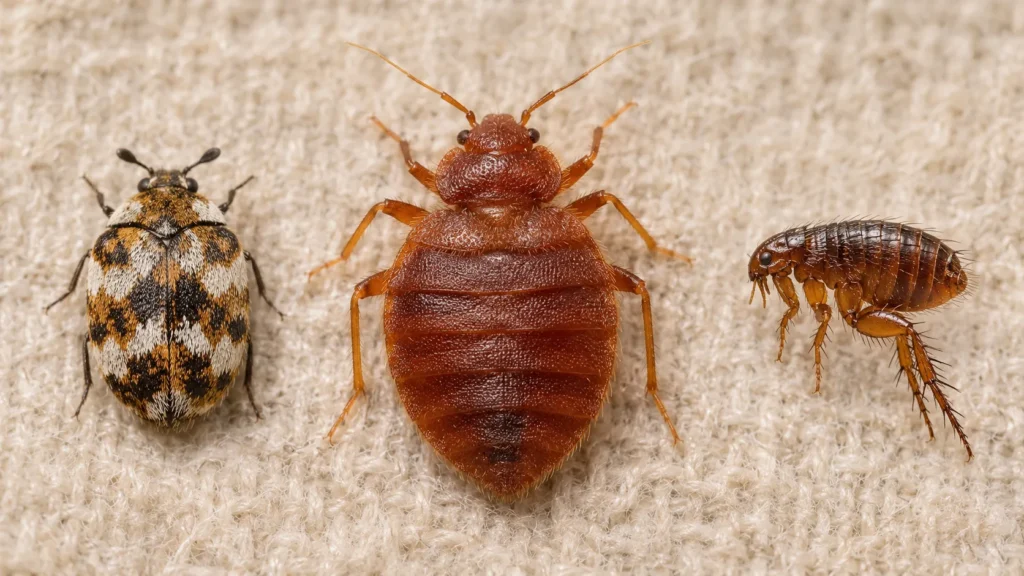
A tiny brown insect crawling across your bedsheet might be a bed bug, but it could also be a carpet beetle. A small dark insect discovered in a rug or near a pet’s sleeping area might raise a different question: is it a carpet beetle or a flea?
Although these three insects can occupy some of the same places indoors, their body structures, feeding habits, and life cycles are remarkably different. Knowing which features to examine can save you from treating the wrong household pest.
The quickest way to tell them apart:
- Carpet beetles: Small, rounded or oval insects with hard wing covers. Their larvae are usually hairy or bristly.
- Bed bugs: Broad, flattened, reddish-brown insects with visible abdominal segments that feed on blood.
- Fleas: Tiny, laterally flattened insects with powerful hind legs adapted for jumping.
Carpet beetles do not bite people. Bed bugs and adult fleas feed on blood, although carpet beetle larval hairs can cause skin irritation in sensitive individuals.
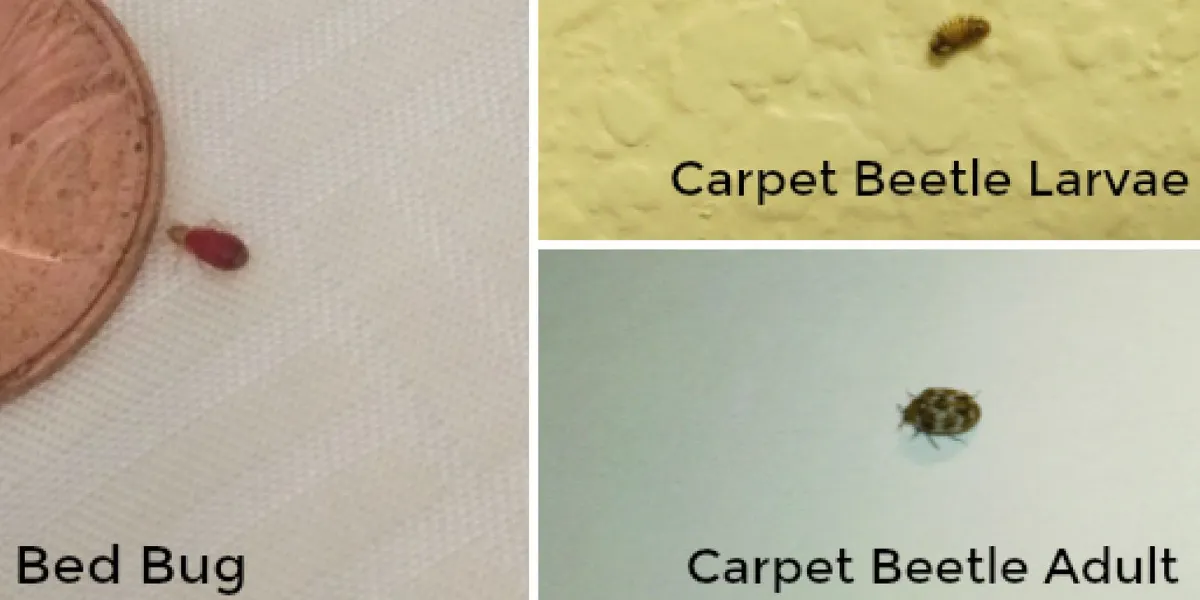
Carpet Beetle vs Bed Bug vs Flea: Quick Comparison
Size and color can help narrow down an identification, but neither is reliable on its own. A dark carpet beetle may be similar in length to a flea, while a small bed bug nymph can overlap in size with an adult carpet beetle.
Look at several physical and behavioral characteristics together.
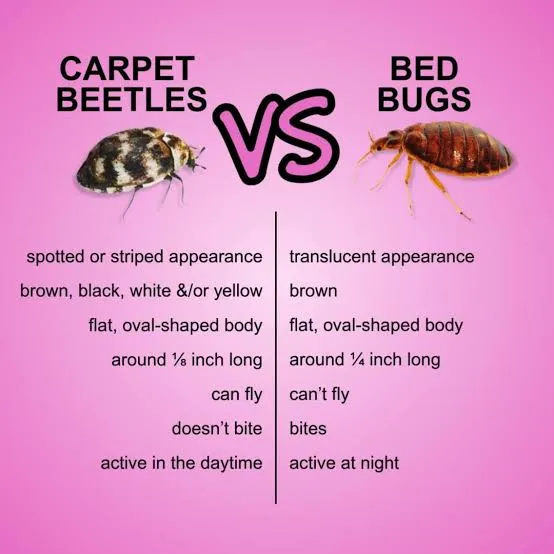
| Feature | Carpet Beetle | Bed Bug | Flea |
|---|---|---|---|
| Typical adult size | About 2–5 mm | About 5–7 mm | About 1–3 mm |
| Body shape | Rounded or oval, usually convex | Broad and flattened when unfed | Narrow, flattened from side to side |
| Color | Black, brown, or mottled | Brown to reddish-brown | Dark brown to reddish-brown |
| Hard wing covers | Present | Absent | Absent |
| Can fly? | Yes, as adults | No | No |
| Can jump? | Not typically | No | Yes |
| Feeds on blood? | No | Yes | Adults do |
| Immature stage | Hairy or bristly larva | Small, adult-like nymph | Slender, wormlike larva |
| Fabric damage | Possible from larvae | No feeding damage | No feeding damage |
| Typical indoor locations | Windows, closets, rugs, baseboards | Mattress seams, bed frames, nearby furniture | Pets, pet bedding, carpets, upholstery |
| Skin effects | Possible irritation from larval hairs | Bite reactions | Bite reactions |
These measurements describe common household forms rather than every species or life stage. Recently fed bed bugs, for example, become more swollen and elongated than unfed individuals.
Carpet Beetle vs Bed Bug: Differences in Appearance
Carpet beetles and bed bugs are sometimes confused because both can be small, brown, oval-shaped insects found around beds and furniture. A closer examination of their backs usually reveals the difference.
Carpet beetles have hard wing covers
Carpet beetles belong to the beetle family Dermestidae. Like other beetles, adults possess elytra, the hardened front wings that protect the flight wings underneath.
When viewed from above, the two wing covers usually meet along a straight central seam. Their bodies often have a rounded, slightly domed appearance rather than lying completely flat.
Common household carpet beetles include:
- Varied carpet beetles: Small, rounded beetles with irregular patches of white, brown, black, and yellowish scales.
- Furniture carpet beetles: Rounded beetles that often have contrasting light and dark markings.
- Black carpet beetles: More elongated beetles with dark brown or black bodies.
The patterned scales on some carpet beetles can wear away as the insects age. An older individual may therefore look much darker and less distinctive than a freshly emerged adult.
Bed bugs have exposed abdominal segments
A bed bug does not have the hard protective wing covers of a beetle. Instead, multiple transverse abdominal segments are clearly visible across its back.
Unfed adults are broad and flattened from top to bottom. This body shape allows them to shelter in narrow spaces around furniture, mattress seams, and bed frames.
After feeding, a bed bug’s abdomen becomes swollen and can appear darker or more reddish. Young bed bugs are smaller and often paler, which makes color-based identification particularly unreliable.
If the insect has a clearly defined seam dividing two hard wing covers, it is much more likely to be a beetle than a bed bug.
Carpet Beetle vs Flea: Shape, Legs, and Movement
The distinction between a carpet beetle and a flea is often easiest to recognize when the insect moves. Their bodies are adapted to very different ways of life.
Fleas are flattened from side to side
A flea’s body is compressed laterally, meaning it is narrow when viewed from above but noticeably deeper when viewed from the side. This structure helps the insect move through animal fur.
A carpet beetle has a broader, more rounded body protected by wing covers. Unlike a flea, it is not specialized for moving through the fur of a living animal to obtain blood.
Fleas have powerful hind legs
Adult fleas have enlarged hind legs that allow them to jump rapidly. Carpet beetles generally walk or fly instead of making the sudden jumps characteristic of fleas.
If a tiny insect repeatedly jumps from carpeting or from the area around a pet, a flea becomes a more plausible candidate than a carpet beetle.
However, jumping alone does not prove that an insect is a flea. Flea beetles, springtails, and other small arthropods can also jump.
Carpet beetles can fly
Adult carpet beetles have functional flight wings and can enter buildings through open windows and doors. They are often encountered near windows because they are attracted to light.
Fleas and bed bugs cannot fly. If you clearly observe the insect opening its wing covers and taking flight, neither a flea nor a bed bug is a likely identification.
Carpet Beetle Larvae vs Bed Bug Nymphs vs Flea Larvae
Comparing adults alone can be misleading. Much of the evidence associated with carpet beetles and fleas actually comes from their immature stages.
Carpet beetle larvae
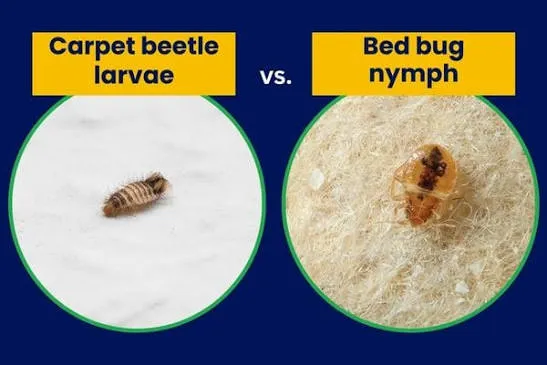
Carpet beetle larvae are usually brownish, segmented, and covered with noticeable hairs or bristles. Some are short and broad, while others have an elongated body that narrows toward the rear.
Several common species have conspicuous tufts of hairs near the end of the abdomen. As they grow, the larvae shed their outer skins, leaving behind hollow, bristly remains that can accumulate around feeding sites.
These larvae may feed on wool, feathers, animal hair, dead insects, and other suitable organic materials. They are responsible for the characteristic damage associated with carpet beetles in homes.
Bed bug nymphs
Bed bugs develop through a series of nymphal stages rather than a wormlike larval stage.
A newly hatched bed bug resembles a miniature version of the adult. It has six legs, an oval body, and recognizable abdominal segments. Young nymphs may appear nearly translucent before feeding.
Bed bugs do not produce the densely hairy, caterpillar-like larvae associated with carpet beetles.
Flea larvae
Flea larvae are elongated, usually pale, and wormlike. They have no legs and live away from the animal host, often within carpet fibers, pet bedding, or protected spaces beneath furniture.
Although flea larvae can have fine hairs, they lack the conspicuous brown bristly appearance typical of many carpet beetle larvae. Their food includes organic debris and blood-containing feces deposited by adult fleas.
The presence or absence of legs is another useful distinction: carpet beetle larvae have three pairs of small thoracic legs, whereas flea larvae are legless.
Carpet Beetle Rash vs Bed Bug Bites vs Flea Bites
Finding itchy red marks on the skin often leads people to suspect bed bugs or fleas. Carpet beetles can complicate this situation because exposure to their larval hairs may also cause a skin reaction.
Do carpet beetles bite humans?
No. Household carpet beetles are not blood-feeding insects, and neither their adults nor their larvae normally bite people.
However, contact with certain carpet beetle larval hairs can trigger irritation or an allergic skin reaction in sensitive individuals. This condition is sometimes called carpet beetle dermatitis.
Larval hairs may remain in dust, shed skins, or infested materials even when living larvae are difficult to locate.
Bed bugs and fleas feed on blood
Bed bugs pierce the skin to obtain blood meals. They commonly feed while a host is resting, although they are not restricted to nighttime activity.
Adult fleas also feed on blood. Many household flea problems involve cats, dogs, or other animal hosts, but fleas can also bite people.
Flea bites are frequently noticed around the lower legs and ankles, while bed bug bites may occur on exposed skin. These patterns are not sufficiently reliable to identify the insect responsible.
The appearance, arrangement, or timing of a rash cannot reliably distinguish carpet beetle dermatitis from bed bug bites, flea bites, or other skin conditions. Look for actual insects and physical evidence. Persistent or severe skin reactions should be evaluated by a healthcare professional.
For more information about defensive biting, irritation, and the different ways beetles interact with human skin, see our guide to whether beetles bite people.
Where You Find the Insect Can Help Identify It
Carpet beetles, bed bugs, and fleas can all occur around upholstered furniture, carpets, and sleeping areas. Their preferred food sources, however, lead them toward different parts of a room.
Common carpet beetle locations
- Windowsills and curtains where adults gather.
- Closets containing wool clothing or other animal-derived materials.
- Carpet edges and undisturbed spaces beneath furniture.
- Accumulations of lint, pet hair, and dead insects.
- Feather-filled furnishings and stored natural textiles.
A single adult carpet beetle near a window may have entered from outdoors. Repeated discoveries of larvae, shed skins, or feeding damage provide stronger evidence of an established indoor population.
Common bed bug locations
- Mattress seams, folds, and labels.
- Joints and cracks in bed frames.
- Behind headboards.
- Crevices in nearby furniture.
- Seams of upholstered chairs and sofas.
Bed bugs usually shelter where they have access to a resting host. Their distribution within a room is therefore more closely associated with sleeping and resting locations than with particular fabric types.
Common flea locations
- The fur of cats, dogs, or other animal hosts.
- Pet blankets and sleeping areas.
- Carpets and rugs used by pets.
- Upholstered furniture.
- Protected floor-level spaces containing organic debris.
Adult fleas may remain on an animal, while eggs, larvae, and pupae develop within its surroundings. This explains why finding fleas in carpeting does not necessarily mean that the carpet itself is their food source.
Signs of Carpet Beetles, Bed Bugs, and Fleas
| Evidence | What It May Indicate |
|---|---|
| Hairy brown larvae around wool or lint | Carpet beetles |
| Hollow, bristly larval skins | Carpet beetles |
| Irregular feeding damage on wool garments | Possible carpet beetles or other fabric pests |
| Dark fecal spots around mattress seams | Possible bed bugs |
| Flat, segmented insects hiding in bed frame joints | Possible bed bugs |
| Repeatedly jumping insects near pet bedding | Possible fleas |
| Dark, pepper-like particles in animal fur | Possible flea dirt |
| Small, pale, legless larvae in pet resting areas | Possible flea larvae |
No single stain, hole, or piece of debris confirms an identification. Whenever possible, collect or photograph the insect itself and compare its physical characteristics with the surrounding evidence.
Can Carpet Beetles Live in Your Bed?
Carpet beetles can be found on beds, mattresses, blankets, and upholstered furniture, particularly where suitable larval food is present.
Animal hair, feather filling, wool blankets, and accumulated organic debris may provide food for their larvae. Adult carpet beetles may also simply wander or fly onto a bed.
Unlike bed bugs, carpet beetles are not attracted to a sleeping person as a source of blood. Their presence in a bedroom does not automatically indicate a bed bug problem.
If you repeatedly discover small, dark beetles indoors, our guide to tiny black beetles in the house explains several other possible identifications.
What to Do After Finding One of These Insects
Before using a pest treatment, try to determine which insect is present. The appropriate response depends on its biology and the source of the problem.
If you find carpet beetles
Inspect stored natural textiles, carpet edges, closets, and spaces where pet hair or dead insects accumulate. Thorough vacuuming, cleaning, and appropriate laundering or dry cleaning can help remove food sources and affected insects.
Store clean, pest-free wool and other vulnerable materials in sealed containers. Check window screens and other potential entry points.
For a more detailed explanation of their development, identification, and household significance, see our complete carpet beetle identification and control guide.
If you find bed bugs
Examine mattress seams, bed frames, headboards, and nearby furniture. Avoid moving potentially infested belongings into unaffected rooms, as this may spread the insects.
Obtain a reliable identification and consider contacting a qualified pest management professional, particularly when multiple insects or other signs are present.
If you find fleas
Inspect pets and their resting areas. Vacuum carpets and upholstery, wash suitable bedding, and consult a veterinarian about appropriate flea management for your animals.
Addressing the animal host and its environment together is important because immature fleas can develop away from the host.
Frequently Asked Questions
Do carpet beetles jump like fleas?
Carpet beetles are not specialized jumping insects. Adults usually crawl or fly. Repeated, sudden jumping is much more characteristic of fleas, although other small arthropods can jump as well.
Are carpet beetles smaller than bed bugs?
Common adult carpet beetles are generally smaller than adult bed bugs. Carpet beetles often measure approximately 2–5 mm, compared with around 5–7 mm for typical adult bed bugs. Their sizes can overlap when immature bed bugs are included.
Can carpet beetles and bed bugs occur in the same house?
Yes. These insects have different food requirements, so finding carpet beetles does not rule out bed bugs. Each suspected insect should be identified independently.
Can fleas live in a home without pets?
Yes. Fleas may be associated with visiting animals, rodents, previous animal occupants, or other sources. Immature stages can also remain in protected indoor environments after an animal host has departed.
Do carpet beetles leave blood stains on sheets?
Carpet beetles do not feed on blood and do not normally produce the blood-related stains associated with bed bugs. However, stains alone cannot confirm a bed bug infestation.
Does finding a carpet beetle mean my house is dirty?
No. Adult carpet beetles can enter well-maintained homes from outdoors. Clean houses may still contain suitable larval food, such as wool, feathers, animal hair, or inaccessible organic debris.
What is the easiest way to identify these three insects?
Examine the insect’s back and body profile. A rounded insect with hard wing covers suggests a beetle. A broad, flattened insect with exposed abdominal segments may be a bed bug. A narrow, side-flattened insect with enlarged hind legs and strong jumping ability is consistent with a flea.
References
- University of California Statewide Integrated Pest Management Program. Carpet Beetles. Pest Notes, Publication 7436.
- University of California Statewide Integrated Pest Management Program. Fleas. Pest Notes, Publication 7419.
- United States Environmental Protection Agency. Bed Bugs Appearance and Life Cycle.
- United States Environmental Protection Agency. How to Find Bed Bugs.
- Penn State Extension. Carpet Beetle Dermatitis.
- University of Minnesota Extension. Fleas.
- University of Maryland Extension. Carpet Beetles.