

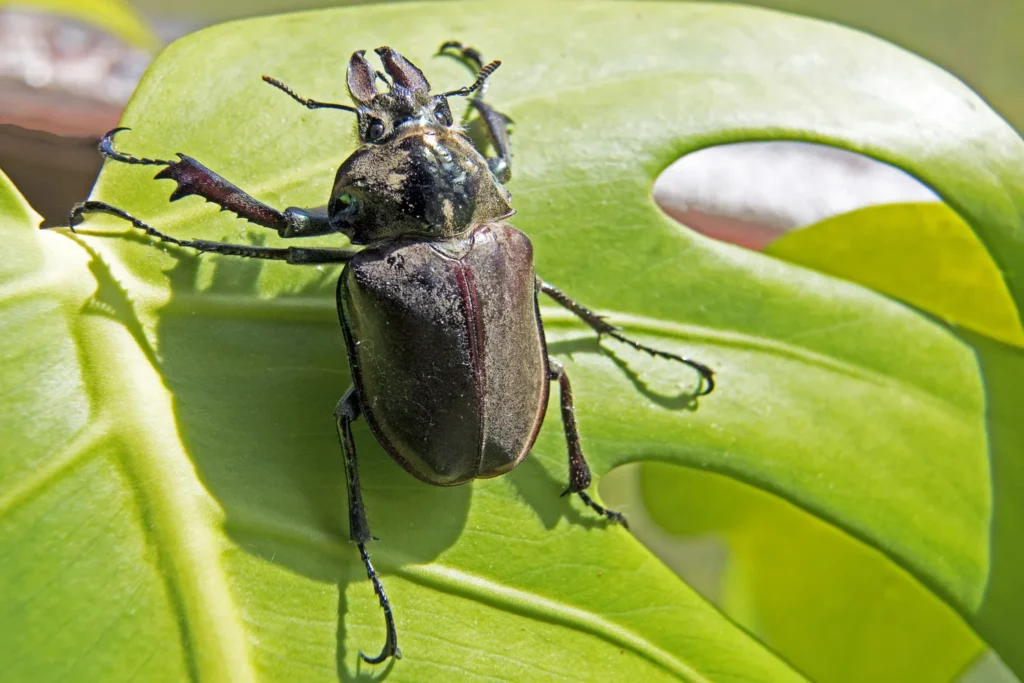
Do beetles bite? Almost never. Out of roughly 400,000 described beetle species, only a small handful can break or pinch human skin, and they do it when they are being held, squeezed, or trapped against a body. No beetle has a stinger, none seeks out people, and none feeds on blood.
That last point matters more than it sounds. Beetles are not parasites. Nothing in their biology rewards approaching a sleeping human. When a beetle’s jaws close on a finger, it is a trapped animal trying to get loose, not a predator taking a meal. This is why the marks people find on their skin in the morning almost never come from beetles at all.
About This Guide
This page answers one narrow question: can a beetle bite you, and what happens if one does. It stays out of the wider territory covered elsewhere on the site. If you want the broader picture of risk and harm, see whether beetles are harmful to humans and the fuller discussion of whether beetles are dangerous.
One caution up front. A skin reaction cannot be traced back to a species by looking at it. Photographs of marks do not identify insects, and neither do descriptions of how something felt. What follows explains mechanisms so you can reason about your own situation, not so you can diagnose it.
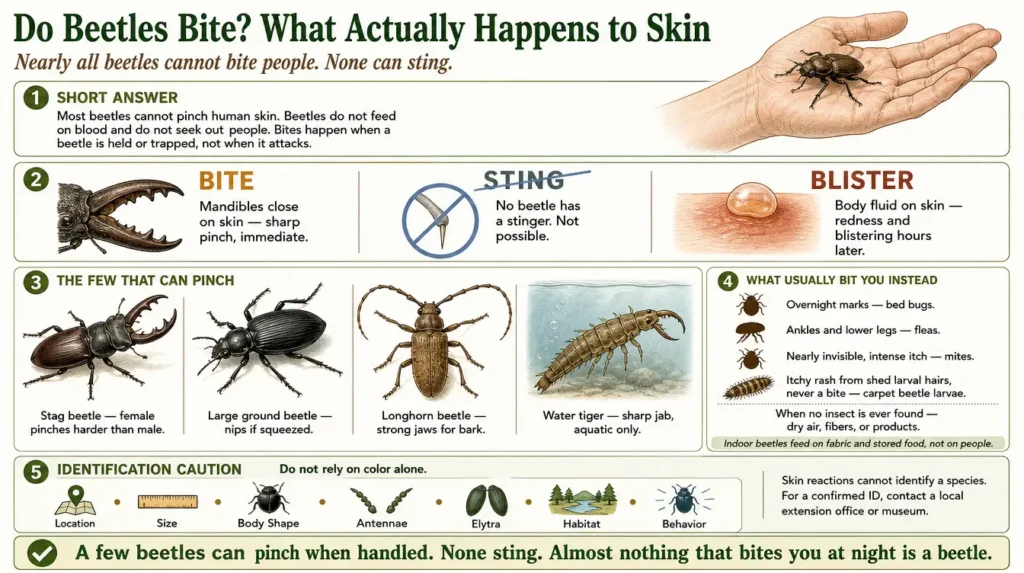
The Short Answer
Every adult beetle has mandibles. Chewing mouthparts are part of what defines the order Coleoptera, so in the strict anatomical sense nearly all of them are equipped to bite something. The practical question is different: are the jaws strong enough, and long enough, to close on human skin and be felt?
For the overwhelming majority, the answer is no. A ladybug’s mandibles are built for aphid tissue. A weevil’s snout is built for boring into seeds. A June beetle’s mouthparts handle leaves. Pressed against a fingertip, none of these can do anything at all.
The beetles that can be felt fall into two groups: predators with jaws evolved to hold struggling prey, and males with oversized mandibles evolved for wrestling rivals. Both are rare in the average household.
Beetles That Can Actually Bite or Pinch
Stag beetles
The famous one. Male stag beetles carry enormous antler-like mandibles, and they look far more threatening than they are. Those jaws evolved for grappling other males over mating sites, and the leverage that makes them impressive also makes them weak at the tip. A male can manage a mild pinch at most, and usually only if you provoke him.
The counterintuitive part is that females, whose jaws are short and unspectacular, close harder. Their mandibles are built for cutting into decaying wood, which is a shorter lever and a stronger bite. A female’s pinch can genuinely smart. It does not carry venom, does not transmit disease, and does not need treatment beyond washing the spot. Stag beetles are declining across much of their range and are worth moving gently rather than killing. The full species profile is in the stag beetle guide.
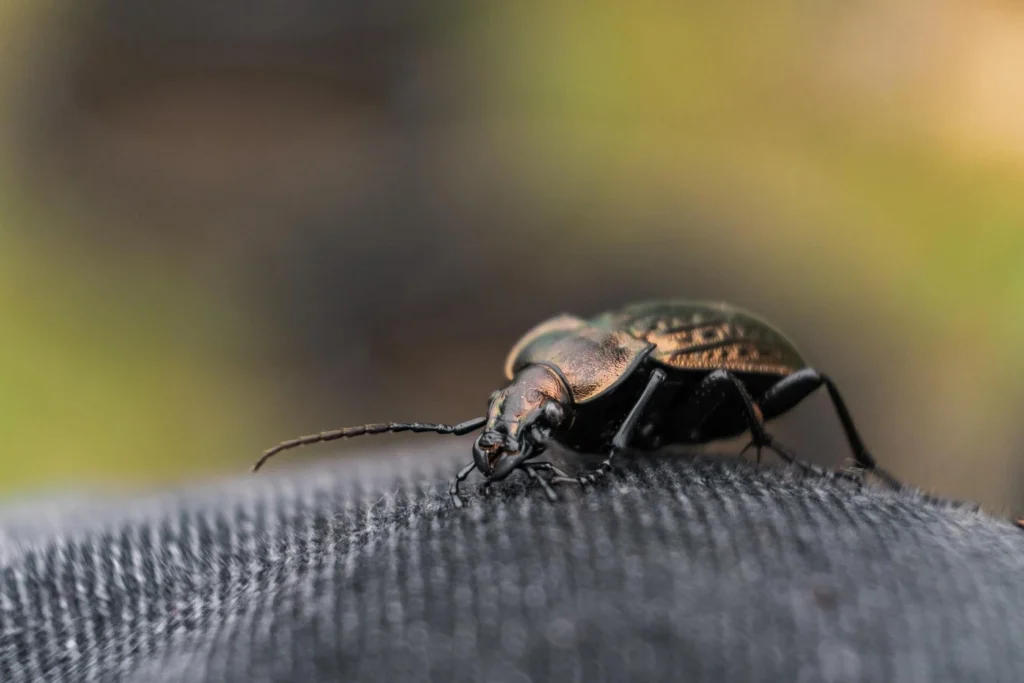
Large ground beetles
Ground beetles are nocturnal predators that hunt caterpillars, slugs, and fly larvae, and the bigger species carry visibly serrated jaws to match. A large carabid squeezed in a closed hand may nip. It stings briefly and fades.
The more common complaint with ground beetles is not the jaws at all. Many species discharge a defensive fluid from glands at the tip of the abdomen when handled, and in bombardier beetles that discharge is hot and audible. On skin it can burn slightly or stain; in the eyes it is genuinely irritating. Wash with soap and water and avoid touching your face afterward. This is a chemical reaction, not a bite, which is a distinction the next section develops.
Longhorn beetles
Adult longhorn beetles have strong jaws for chewing bark, and the larger species can pinch hard enough to be memorable, occasionally hard enough to break skin. Encounters usually happen when someone picks one up off firewood or a screen door. Once again, the beetle is not attacking. It is being held.
Diving beetle larvae
The one aquatic case worth knowing. Predaceous diving beetle larvae, nicknamed water tigers, have long sickle-shaped mandibles with channels running through them, used to inject digestive fluid into prey and draw the contents back out. Handled or trapped against skin, they can deliver a sharp, disproportionate jab.
Adults can nip too. Neither is medically significant, but both are painful enough that they deserve respect in a pond net. These larvae look nothing like the grubs people find in soil, and comparing shapes is easier with the beetle larva identification guide.
Bite Is Not Sting, and Neither Is Blister
Three different mechanisms get collapsed into the phrase “it bit me.” Separating them is the most useful thing on this page.
| Mechanism | Beetles involved | What you feel | |
|---|---|---|---|
| Bite | Mandibles close on skin | Stag, ground, longhorn beetles; diving beetle larvae | Sharp pinch at the moment of contact, then fading |
| Sting | Venom injected through a stinger | None | Not possible in beetles |
| Blister | Body fluid contacts skin | Blister beetles, some rove beetles | Nothing at first; redness and blistering hours later |
Beetles have no stinger. Not a weak one, not a hidden one. The abdominal apparatus that bees, wasps, and ants use to inject venom is a modified egg-laying structure that beetles never evolved. Anything described as a beetle sting is either a bite, a chemical reaction, or a different insect entirely.
Blister beetles leak, they do not bite
Blister beetles produce cantharidin, a compound stored in their body fluids. Crush one against your skin, or slap one that has landed on your arm, and the fluid transfers. Hours later the site reddens and a blister forms, often in a streak that traces where the beetle was smeared rather than a single point.
There is no bite involved. Nothing pierced the skin. The delay is the clearest tell: bites hurt immediately, cantharidin damage announces itself later. The practical advice is simple and worth remembering before it applies to you. Do not slap a beetle that lands on you. Blow it off or flick it away with a piece of paper, then wash the area. Getting cantharidin into an eye is far worse than getting it on an arm, so avoid rubbing your face after handling any unfamiliar beetle.
The Bites People Blame on Beetles
This is where most searches for this question actually come from. Someone finds itchy marks, finds a beetle in the house, and connects the two. The connection is almost always wrong, because the beetles that live indoors are stored-food and fabric feeders with no interest in and no equipment for biting people.
Bed bugs. The single most common real answer when marks appear overnight on skin that was exposed while sleeping. They hide in seams, frames, and headboards rather than in the open.
Fleas. Typically clustered low on the legs and ankles. Fleas are more likely where there are pets or where an animal has recently been in the crawlspace or attic.
Mites. Bird and rodent mites move into living space after the host animal dies or a nest is abandoned, and they are close to invisible. Straw itch mites arrive with hay, straw, or stored grain. Both produce intense itching from something almost nobody manages to see.
Carpet beetle larvae. The one case where a beetle really is involved, but not by biting. Carpet beetle larvae are covered in barbed hairs that break off easily and drift through the air. In people who have been exposed over long periods, these hairs can trigger an itchy rash that mimics bites closely enough to fool experienced clinicians. The larvae do not touch skin and cannot bite. Adults eat pollen. If this sounds familiar, look for shed larval skins that resemble empty bristly husks, and for grazed patches on wool, felt, or stored clothing. Other indoor beetles are covered under beetles around the home.
Nothing biological at all. Extension entomologists field these cases constantly, and a large share resolve to dry indoor air, fiberglass insulation, paper and cardboard fibers, new laundry products, or a medication side effect. Marks that keep appearing while nobody ever finds an insect are a strong hint to look at the environment rather than at pests.
A useful rule: if you have been bitten but you never see the culprit, beetles are near the bottom of the list. Beetles are slow, conspicuous, and armored. They do not manage stealth.
When a Bite Warrants Medical Attention
Nearly all beetle bites need soap, water, and nothing else. Reasons to have a clinician look at it:
- Signs of infection developing at the site over the following days
- Blistering that spreads well beyond the point of contact
- Any cantharidin exposure to the eye
- Symptoms that go beyond the skin, including swelling elsewhere, trouble breathing, or feeling faint
- Anything you already know you react strongly to
That is deliberately short. This site does not evaluate symptoms, and a page cannot tell you what is on your arm. If a rash is spreading, recurring, or worrying you, that is a question for a doctor.
How to Avoid the Bite in the First Place
Since nearly all beetle bites happen during handling, the fix is a handling technique.
- Coax the beetle onto a leaf, a card, or a container rather than pinching it between fingers
- Let a large beetle walk across an open palm instead of closing your hand
- Never slap a beetle off your skin
- Wear gloves in leaf litter, woodpiles, and compost
- Use a net rather than fingers around ponds
- Wash your hands afterward, before touching your eyes
Handled this way, even a female stag beetle or a large carabid poses no real problem. More on behavior and biology across the order is collected under beetle facts.
FAQ
Do beetles bite humans while they sleep?
No. Beetles do not feed on people and have no reason to approach a sleeping human. Marks that appear overnight point toward bed bugs, fleas, or mites.
Can beetles sting?
No beetle can sting. Beetles have no stinger and no venom-injecting apparatus. What gets called a sting is a bite, a chemical reaction, or a different insect.
Are beetle bites poisonous?
No. No beetle injects venom when it bites. Blister beetles are chemically dangerous, but through body fluid on the skin, not through a bite.
Do carpet beetles bite?
No, at any life stage. Rashes attributed to them come from the barbed hairs shed by larvae, which cause an allergic skin reaction in sensitized people.
Do ladybugs bite?
They can nip lightly, most often when they land on skin and probe it. Multicolored Asian lady beetles do this more often than native species. It is a brief pinch with no aftereffects.
Which beetle bites hardest?
Among species people commonly encounter, female stag beetles and large longhorn beetles produce the sharpest pinch. Diving beetle larvae deliver the most painful jab relative to their size.
Does a beetle bite leave a mark?
Usually little or nothing. Most produce brief pain with slight redness that fades within hours. Bites that break skin may leave a small puncture.
Do beetle bites need treatment?
Washing with soap and water is normally enough. Watch the site over the following days and see a clinician if signs of infection appear.
Do beetle larvae bite?
Most do not. The clear exceptions are aquatic predators like water tigers. Grubs found in soil and potting mix feed on roots or decaying matter and cannot bite people.
Why does my skin itch when no insect is ever found?
Common causes include dry indoor air, fiberglass or paper fibers, laundry and skincare products, and medication reactions. When repeated searching turns up no arthropod, the cause is often environmental.
Conclusion
So, do beetles bite? A few can, most cannot, and none want to. The species capable of it are large predators and oversized males whose jaws evolved for prey and for rivals, and they use them on people only when a hand closes around them. There is no beetle sting anywhere in the order. There is no beetle that feeds on human blood.
If you are trying to work out what left marks on your skin, beetles are a poor suspect and other explanations deserve attention first. If you are simply holding an impressive beetle and wondering whether to be nervous: coax it onto a leaf instead of gripping it, and there is nothing to worry about.
References and further reading
- Natural History Museum — Stag beetle facts
- Oxford University Museum of Natural History — Stag Beetle
- Missouri Department of Conservation — Stag Beetles (Lucanids)
- Missouri Department of Conservation — Predaceous Diving Beetles (Water Tigers)
- Penn State Extension — Carpet Beetle Dermatitis
- University of Kentucky Entomology — Mystery Bites: Insect and Non-Insect Causes
- Cornell University Integrated Pest Management — Mystery Bites
- National Capital Poison Center — Blister Beetles: Do Not Touch