

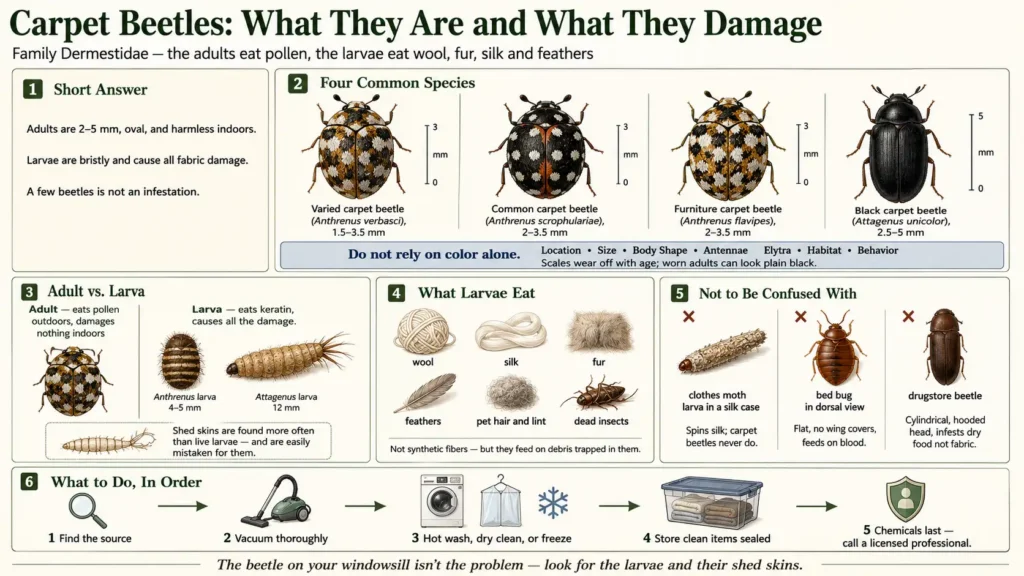
Carpet beetles are small, oval beetles in the family Dermestidae. Adults feed on pollen outdoors and damage nothing indoors. Their bristly larvae are the ones that feed on wool, silk, fur, and feathers — and finding a few beetles is not an infestation.
That distinction between the adult and the larva explains almost everything people find confusing about these insects. The beetle you see is usually on a windowsill, trying to get back outside toward flowers. The animal doing damage is somewhere darker and quieter: under the edge of a rug, at the back of a closet, in the lint behind a heavy dresser, inside a box of stored woolens. The two stages rarely turn up in the same place, which is why a homeowner can find beetles for weeks without ever spotting a hole in anything.
Carpet beetles are also genuinely common. Extension entomologists have long pointed out that most houses contain a few at any given time, especially in spring and early summer. In the vast majority of homes they remain a background presence rather than a problem, and the useful question is not “how do I eliminate every one” but “is anything of mine actually being eaten.”
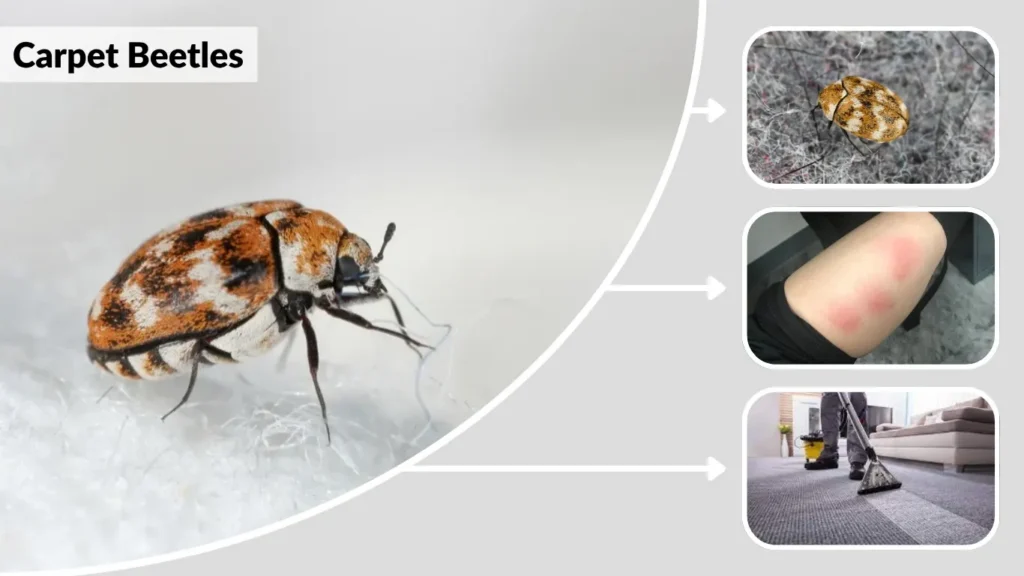
About This Guide
This guide covers the four dermestid species that turn up most often in North American homes, how to tell adults from larvae, what the larvae eat, and what a measured, non-chemical response looks like. It is written for people who have just found an insect and want an honest answer about it.
One caveat worth stating up front: carpet beetles are 2–5 mm long, and several species look alike to the naked eye. Scale patterns wear off with age, so an older adult can lose the markings that would have identified it. A photograph or a written description is often enough to say “this is a carpet beetle” but not enough to say “this is Anthrenus flavipes.” Where certainty matters — insurance claims, museum or heirloom collections, repeated damage that isn’t stopping — a specimen in a small vial, taken to a county extension office or a natural history museum, will settle it in minutes.
What Carpet Beetles Are
Carpet beetles belong to Dermestidae, a family of roughly 500 to 700 described species worldwide whose ecological job is recycling dried animal remains. In nature, dermestids clean up carcasses, feathers in bird nests, shed hair, and the dead insects that accumulate in sheltered places. Museums use one genus deliberately to clean skeletal specimens.
Everything a carpet beetle larva does indoors is a version of that same behavior. Wool is sheep hair. Felt, fur, silk, feathers, leather, and hair-stuffed antique furniture are all animal products. A wool rug is, to a dermestid larva, a large flat carcass that never decays. Synthetic carpet is not food, though larvae will chew through blends and will feed on the soil, skin flakes, and pet hair caught in synthetic pile.
The name is misleading in one respect: modern homes with synthetic broadloom rarely have beetle-damaged carpet. The problems that do occur are usually in stored clothing, wool area rugs, upholstery, taxidermy, and forgotten natural-fiber items.
The Four Species You’re Most Likely to Find
Four species account for most household records in the United States. Two genera are involved, and the genus is the easier call: Anthrenus species are nearly round and patterned with colored scales; Attagenus is a longer oval and plain dark.
| Species | Adult appearance | Adult size | Larva | Where it usually turns up |
|---|---|---|---|---|
| Varied carpet beetle (Anthrenus verbasci) | Nearly round; mottled calico of white, brown, and yellow scales over black, with irregular dark crossbands; looks gray at a glance | 1.5–3.5 mm | About 4–5 mm, brown with alternating light and dark bands, dense brown hairs, distinctly broader at the rear than the head end | The most widespread species. Lint under furniture, along baseboards, in closets, in insect and museum collections |
| Black carpet beetle (Attagenus unicolor) | Elongated oval; solid shiny black to dark brown; brownish legs; no color pattern | 2.5–5 mm | Up to about 12 mm — far longer than the others. Carrot-shaped, smooth and shiny, golden to chocolate brown, with a long tuft of curled hairs at the tail | Considered the most damaging dermestid in much of the US. Stored woolens, and also stored grain and dry pet food |
| Furniture carpet beetle (Anthrenus flavipes) | Round and slightly larger than the varied; mottled with black spots among white and yellow-orange scales; white underside; often appears solid black once scales wear | 2–3.5 mm | About 4–5 mm, rounded, thickly covered in brownish bristles; white when newly hatched, darkening to dark red or chestnut | Upholstered furniture, especially older hair- or feather-stuffed pieces. More frequent in warmer regions |
| Common carpet beetle (Anthrenus scrophulariae) | Round; black with white scales and, in many individuals, a band of orange to brick-red scales down the middle of the back | 2–3.5 mm | About 4–5 mm, elongate-oval, reddish-brown, covered in brownish-black hairs; noticeably fast-moving | Wool carpets and woolens; more often reported from cooler northern regions and older housing stock |
Two practical notes on using this table. First, scales rub off. A worn Anthrenus adult can look like a plain dark beetle and be mistaken for a black carpet beetle, so shape matters more than pattern: Anthrenus is close to circular in outline, Attagenus is clearly longer than wide. Second, color alone is never sufficient for identification in any beetle group. Combine size, body outline, antennae, elytra texture and pattern, the larva if you have one, the season, and where in the house you found it. This is the same principle that applies to black beetle identification generally.
Adults Do Not Eat Your Sweaters
This is the single most useful fact in the article. Adult carpet beetles feed on pollen and nectar. They are outdoor flower visitors, and indoors they eat nothing at all — they live two to six weeks on stored reserves, mate, and try to reach flowers again.
The larvae do all of the feeding. They hatch from eggs laid near a food source, then spend anywhere from two months to well over a year eating and molting, depending on species, temperature, and how good the food is. Larvae avoid light and burrow into what they’re eating, which is why they’re so rarely seen even when present. In an unheated attic or a cold closet, a single larval stage can drag on for a year or more; in a warm, food-rich spot, development is much faster.
Two consequences follow. Killing adult beetles on a windowsill accomplishes essentially nothing for fabric protection. And an absence of visible adults does not mean an absence of larvae — the destructive stage can be active for months before any adult emerges.
For a broader look at how beetle larvae differ across families, see the beetle larva identification guide.
Shed Skins: The Most Useful Sign in the House
Carpet beetle larvae molt five to eleven times, and each molt leaves behind a hollow, hair-covered cast skin that looks almost exactly like a living larva. These shells are dry, light, and easily blown into corners, so they accumulate where the larvae have been feeding.
In practice, cast skins are found more often than the larvae themselves, and they are the most reliable evidence that dermestids are breeding somewhere in the house rather than simply wandering in from outdoors. Look for them along carpet edges, in the seams and folds of stored clothing, at the back of closet shelves, inside drawers, and in the dust behind furniture that never gets moved.
They also mislead people in a specific way that’s worth knowing: because the shells persist for months or years, a small population can leave an alarming quantity of debris. Extension entomologists specifically warn that old cast skins are commonly mistaken for live larvae and make an infestation look far larger than it is. Before concluding anything, check whether the shells are empty husks or whether you can find animals that actually move.
What the Larvae Eat
Carpet beetle larvae specialize in keratin and other dried animal proteins. Their realistic indoor menu is:
- Wool — carpets, rugs, sweaters, blankets, felt (including piano felts)
- Silk, fur, leather, and feathers, including down pillows and feather trim
- Hair and bristles — old upholstery stuffing, natural-bristle brushes
- Pet hair and human hair accumulated in lint under furniture and along baseboards
- Dead insects in window frames, light fixtures, attics, and wall voids
- Taxidermy mounts, tanned hides, and pinned insect collections
- Dried pet food, and for Attagenus, stored grain products
- Accumulated dust and lint, which contains skin flakes and hair
The last few items matter more than they sound. Two of the most persistent hidden sources in houses are abandoned bird, rodent, or wasp nests in attics, chimneys, and eaves, and drifts of dead insects in light fixtures and window channels. Both can sustain a population indefinitely while a homeowner cleans the closets over and over with no result. Carpet beetles are one of the clearer examples of how varied beetle diets are across the order — the wider picture is covered in what do beetles eat.
Clean fabric is much less attractive than soiled fabric. Perspiration, body oils, and food residues make wool substantially more appealing, which is why the sweater that was worn once and put away unwashed is the one with holes in it.
Why Adults End Up on Windowsills and Near Lights
Adults are strongly drawn toward light and windows, and this is a feeding behavior rather than random confusion: they are trying to get outside to flowers. Windowsills, light fixtures, and the tops of curtains are where they collect, particularly in May and June when adults are most active and flying.
They arrive from outdoors through open windows, unscreened vents, and gaps around doors, and they are notoriously easy to carry in on cut flowers from the garden. Secondhand furniture, rugs, and thrifted wool clothing are the other common entry routes. The general phototactic behavior is discussed further in why beetles are attracted to light.
A handful of adults at the windows in early summer, with no larvae and no damage anywhere, is the most common carpet beetle situation there is. It usually means beetles are coming in from the yard, not that anything is breeding in the house.
Telling Carpet Beetles from Look-Alikes
Clothes moths. Both damage the same materials, and both peak at similar times of year. The differences: clothes moth larvae spin silk — webbing, tubes, or portable cases — and carpet beetle larvae never do. Carpet beetle larvae are bristly and beetle-like; moth larvae are smooth pale caterpillars. Damage patterns differ too, with carpet beetles tending to surface-graze large patches or produce ragged holes concentrated in one area, often under heavy furniture or along carpet edges, while moth damage is more often scattered. Pheromone traps sold for clothes moths do not catch carpet beetles, which is a frequent and expensive mistake.
Bed bugs. Superficially similar in size and color to a dark carpet beetle, but structurally very different: bed bugs are flat, wingless, and lack hard wing covers, and they feed on blood. Carpet beetles have rounded bodies with rigid elytra, six legs, clubbed antennae, and never bite. Bed bugs concentrate around mattress seams and bed frames; carpet beetle larvae concentrate in stored textiles and undisturbed lint.
Drugstore beetle (Stegobium paniceum) and its relatives. Small brown beetles found in pantries, but cylindrical rather than round or oval, with the head tucked under a hood-like pronotum and fine lengthwise striations on the elytra. They infest flour, spices, dried herbs, and pet food, not wool or fur. If small beetles are coming out of packaged dry goods rather than fabric, dermestids are usually not the answer.
If you are still working through a shortlist of possibilities, the general triage in tiny black beetles in the house covers the other candidates.
A Few Beetles Is Not an Infestation
University of Minnesota Extension puts it plainly: finding a single carpet beetle or a small number of them does not automatically indicate a problem. Adults are not pests indoors. A management response is warranted when larvae are found developing in fabrics, when cast skins are accumulating in a specific location, or when damage is appearing.
That threshold is worth holding onto, because searching for these insects online quickly produces language calibrated to sell treatments. Most households with carpet beetles have a low-level, self-limiting presence and need nothing more than ordinary vacuuming and sensible storage.
Responding in the Right Order
When there is real evidence — live larvae, fresh damage, growing piles of shed skins — the sequence below is the one recommended by extension programs, and the order matters more than any single step.
1. Find the source. This is the step people skip, and skipping it is why problems recur. Move heavy furniture and lift carpet edges. Empty closets and check the folds and seams of stored wool. Inspect taxidermy, hides, feather items, wool rugs in storage, and natural-bristle brushes. Check attics and eaves for old bird, rodent, or wasp nests. Clean out window channels and light fixtures where dead insects collect. Look at air return vents and ductwork edges where lint gathers. The infested item is often one thing, and dealing with it resolves the whole situation.
2. Vacuum thoroughly and repeatedly. Vacuuming physically removes eggs, larvae, cast skins, and the lint that feeds them. Concentrate on carpet edges and beneath the pile at the perimeter, under and behind furniture, closet floors and shelf corners, baseboards, and upholstery seams and crevices. Empty the canister or dispose of the bag outdoors immediately afterward so anything collected doesn’t simply crawl back out.
3. Apply heat or cold to infested items. Laundering in hot water and drying on high heat kills all life stages, as does dry cleaning. For items that can’t be washed — heirloom textiles, taxidermy, feather objects, delicate wool — freezing works, but only at genuine freezer temperatures held long enough. University guidance calls for around 0 °F for at least a week, or 72 hours if the freezer reaches roughly −20 °F. Seal items in plastic bags with the air pressed out before freezing, and let them return to room temperature inside the sealed bag afterward so condensation doesn’t form on the object.
4. Store clean items in sealed containers. Clean everything before long-term storage, since residues attract larvae, then pack into tight-fitting plastic containers or sealed garment bags. Cedar chests and cedar blocks are not reliable protection; the volatile oils dissipate and the wood offers no ongoing effect. Inspect stored woolens and furs once a year rather than leaving them undisturbed for a decade.
5. Chemical treatment last, and not by you. Insecticides are the final option and the least important one, because they do not reach larvae buried inside stored textiles or nesting material in a wall void. If cleaning, heat treatment, and source removal have not resolved a persistent problem, contact a licensed pest management professional who can inspect the structure and select and apply a product legally and appropriately. Never spray clothing, bedding, or fabrics directly. For questions about specific products, the National Pesticide Information Center answers public inquiries at no charge.
A Brief Note on Skin Irritation
Some people develop skin irritation after prolonged exposure to carpet beetle larval hairs, a reaction sometimes called carpet beetle dermatitis; it is generally understood to be a sensitivity reaction rather than a bite, since these beetles do not bite. If you have an unexplained persistent rash, that is a question for a physician, not an insect guide.
Common Mistakes
- Treating adults on the windowsill and assuming the problem is handled
- Counting cast skins as live larvae and concluding the situation is severe
- Using clothes moth pheromone traps against carpet beetles
- Washing only in cool water, which is unreliable against eggs and larvae
- Storing wool without cleaning it first
- Relying on cedar or scented sachets as the primary protection
- Never checking attics, chimneys, or eaves for old nests that quietly sustain the population
When Professional Identification Is Worth It
Take a specimen to a county extension office or a natural history museum when damage keeps appearing after two or three rounds of cleaning, when valuable textiles, taxidermy, or research collections are involved, or when you cannot tell whether you are dealing with dermestids or clothes moths. Put the beetle or larva in a small vial with rubbing alcohol, note where and when you found it, and bring the whole thing in. Species-level identification changes very little about the treatment, but confirming the family changes a great deal — moths and beetles require different approaches.
More household-insect coverage is collected in beetles around the home.
Frequently Asked Questions
Are carpet beetles harmful to humans?
They don’t bite, sting, or transmit disease. The only recognized health issue is skin or respiratory irritation in some people after long-term exposure to larval hairs, which is a sensitivity reaction and a matter for a physician.
Do carpet beetles bite?
No. Adults have mouthparts adapted for pollen, and larvae feed on fibers and dried animal material. Marks attributed to carpet beetle “bites” are usually irritation from contact with larval hairs.
How do I know if I have carpet beetle larvae or just stray adults?
Look for shed skins and live larvae in dark, undisturbed places: carpet edges, closet corners, drawer seams, under heavy furniture. Adults on windowsills with no larvae or debris anywhere generally means beetles are flying in from outside.
What do carpet beetle larvae look like?
Small bristly larvae, roughly 4–5 mm in most species, brown or reddish-brown with banding and dense hairs. The exception is the black carpet beetle larva, which reaches about 12 mm, is smooth and carrot-shaped, and has a long tuft of hairs at the tail.
Where do carpet beetles come from?
Adults fly in from outdoors, especially in late spring, often through open windows or on cut flowers. They also arrive in secondhand furniture, rugs, and clothing, and can breed in bird or rodent nests in attics and chimneys.
Will carpet beetles eat synthetic carpet?
Not the synthetic fibers themselves. They will feed on wool blends and on the hair, lint, and food residue trapped in synthetic pile, so synthetic carpet can still support larvae if it is never cleaned underneath furniture.
How long do carpet beetles live?
Adults live roughly two to six weeks. The larval stage lasts from about two months to more than a year depending on species, temperature, and food. General beetle lifespans across families are covered in how long beetles live.
Can I get rid of carpet beetles without pesticides?
In most household situations, yes. Finding and removing the source, thorough repeated vacuuming, hot laundering or dry cleaning, freezing for delicate items, and sealed storage handle the great majority of cases.
Are carpet beetles a sign of a dirty house?
No. They fly in from outdoors and are found in meticulously kept homes and museums alike. Undisturbed lint and long-stored wool are what sustain larvae, and both accumulate in perfectly clean houses.
What kills carpet beetles in clothes?
Hot-water laundering with a high-heat dryer cycle, or dry cleaning, kills all life stages. For items that can’t take either, sealed freezing at around 0 °F for a week or so is the standard non-chemical alternative.
Conclusion
Carpet beetles are small dermestid beetles whose adults are harmless flower visitors and whose larvae quietly recycle keratin — sometimes including wool, fur, feathers, and silk that people would rather keep. The four species most often found in homes are separable with a hand lens once you know that Anthrenus is round and patterned while Attagenus is a longer plain-dark oval, but the more important skill is reading the evidence: live larvae and fresh shed skins in a specific location mean something is being eaten, while a few beetles at the window in June usually mean nothing at all.
If you do find a source, the response is unglamorous and effective. Locate it, vacuum thoroughly, apply heat or cold to the infested items, store clean fabrics sealed, and leave chemicals as a last resort in professional hands. And when the identification genuinely matters, a specimen in a vial and a trip to an extension office beats any amount of squinting at photographs.
References and further reading
- UC IPM — Carpet Beetles
- Penn State Extension — Carpet Beetle Dermatitis
- Rutgers NJAES — Carpet Beetles (FS1181)
- Ohio State University Extension — Carpet Beetles
- Virginia Cooperative Extension — Carpet Beetles
- University of Maryland Extension — Carpet Beetles
- Natural History Museum, London — Carpet Beetles Identification Guide
- National Pesticide Information Center — Carpet Beetles