

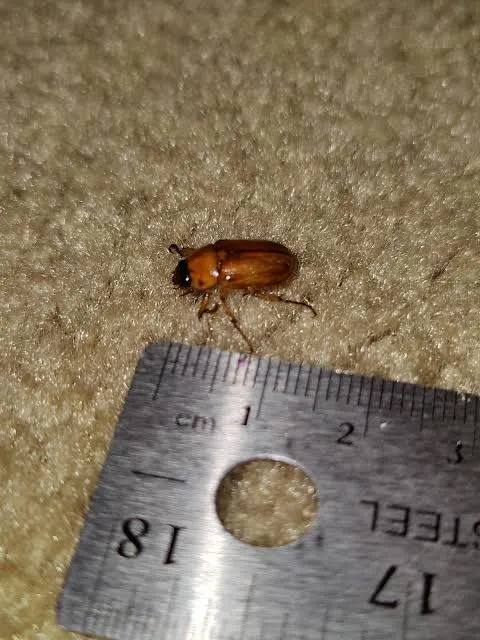
Tiny brown beetle identification is most reliable when you combine size, body shape, antennae, wing-cover details, and—most importantly—where the beetle was found. A tiny reddish-brown beetle emerging from spices is more likely to be a stored-product species, while a small rounded beetle beside a window may be a carpet beetle or an adult pantry beetle moving toward light.
Do not rely on brown color alone. Drugstore beetles, cigarette beetles, flour beetles, sawtoothed grain beetles, carpet beetles, and several harmless indoor visitors can all appear brown when viewed without magnification. Some of the most useful distinctions are only a few millimeters wide. Texas A&M AgriLife Extension, for example, distinguishes drugstore and cigarette beetles by the grooves on their elytra and the shape of their antennae.
Quick answer: If you found a tiny brown beetle, first record its approximate length and location. Check dry food if it is in a pantry, fabrics and lint if it is near closets or windows, wood if you see fresh holes or powder, and moisture if large numbers are appearing in a newer or damp building. Then compare body shape, antennae, and elytra before attempting a species identification.
About This Guide
“Tiny” is not a scientific size category. Here it refers broadly to beetles only a few millimeters long—the insects that can look like moving brown dots until viewed closely.
This guide focuses specifically on small brown beetles that are easily confused indoors. That makes it narrower than a general brown beetle identification with pictures guide, which also needs to cover larger scarabs, ground beetles, click beetles, and outdoor species.
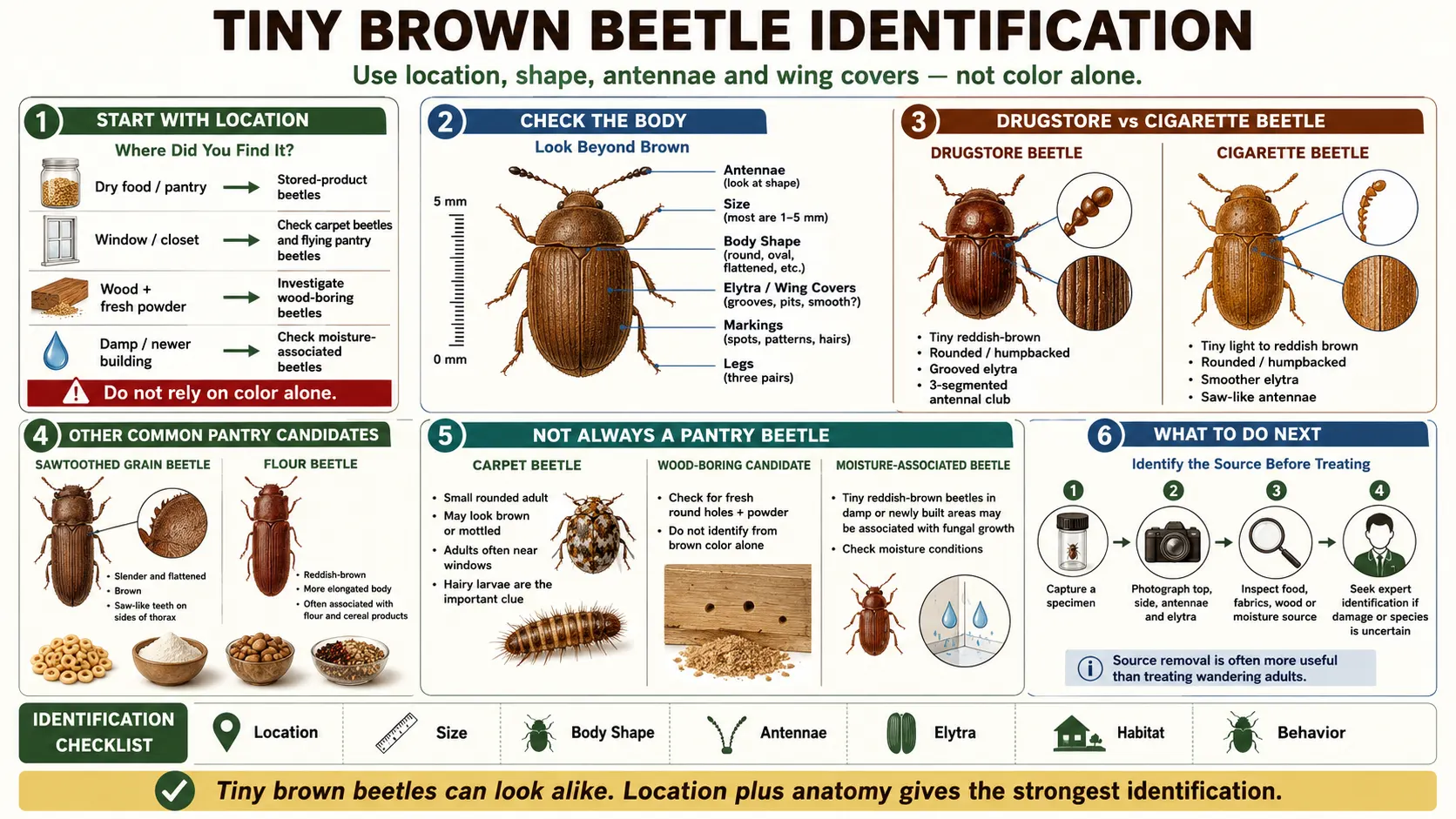
A photograph may narrow an insect to a family, genus, or likely household species, but not every specimen can be identified confidently to species from color and shape alone. Geographic region, season, larvae, food source, and microscopic characters can matter. For a broader introduction to anatomical clues, see the site’s beetle identification resources.
Start With Where You Found the Beetle
For a tiny household beetle, location often eliminates more possibilities than color.
| Where you found it | Good candidates to investigate | Clues to check next |
|---|---|---|
| Flour, cereal, spices, nuts, pet food | Drugstore, cigarette, flour, sawtoothed grain beetles | Food source, body shape, antennae, elytra |
| Pantry wall or nearby window | Drugstore or cigarette beetle; other pantry beetles | Inspect nearby dry foods |
| Windowsill or curtain | Carpet beetle; flying stored-product beetle | Rounded/mottled body, nearby fabrics or food |
| Wool, feathers, fur, pet-hair buildup | Carpet beetle larvae/adults | Hairy larvae, shed skins |
| Hardwood furniture, flooring, trim | Wood-boring beetle | Exit holes and fresh powder |
| Newly constructed or persistently damp area | Foreign grain beetle or other moisture-associated insects | Mold/moisture source |
| Basement floor, doorway, under objects | Outdoor beetle that wandered inside | Longer legs, fast running, lack of food/fabric association |
Stored-food beetles are especially important when insects are concentrated around dry products. University of Minnesota Extension lists sawtoothed grain beetles and flour beetles among the small reddish-brown species associated with stored foods.
Finding a beetle in a room does not necessarily mean that room contains its breeding source. Adult drugstore beetles can fly and may move toward light after emerging from infested material, so specimens may turn up well away from a pantry.
Tiny Brown Beetle Identification by Body Features
Once you know where the beetle appeared, examine the insect itself. A hand lens, macro phone camera, or inexpensive clip-on macro lens can reveal characters invisible to the unaided eye.
Measure the Body
Estimate the length from the front of the head or pronotum to the end of the abdomen. Do not include the antennae.
Many common household candidates fall into a remarkably small range. Drugstore and cigarette beetles are roughly 1/16–1/8 inch long, while sawtoothed grain beetles are about 1/10 inch long.
Do not estimate size entirely from a photograph. Place a ruler beside the specimen whenever possible.
Look at Body Shape
Shape can immediately divide the possibilities.
A rounded or humpbacked oval body suggests drugstore or cigarette beetles.
A slender, flattened body fits sawtoothed grain beetles better.
A more elongated reddish-brown form can suggest a flour beetle.
A very small rounded or oval beetle with mottled scales may be a carpet beetle.
A beetle with a conspicuous snout belongs to one of the weevil groups rather than the beetles discussed above.
Check the Antennae
Antennae are particularly useful when separating two otherwise similar brown beetles.
The drugstore beetle (Stegobium paniceum) has antennae ending in a club formed by three enlarged segments. The cigarette beetle (Lasioderma serricorne) instead has serrate, or saw-like, antennae.
These differences are usually too small to see clearly without magnification.
Examine the Elytra
The hardened front wings of adult beetles are called elytra. In most beetles they meet along a straight seam down the back.
Look for:
- Longitudinal grooves
- A smooth surface
- Fine hairs or scales
- Mottled markings
- Pits
- Shortened wing covers
- Strong ridges
Drugstore beetles have distinct longitudinal striae or grooves on their elytra, whereas cigarette beetle wing covers are comparatively smooth.
This is far more diagnostic than deciding whether the insect looks “light brown,” “reddish brown,” or “dark brown.”
Common Tiny Brown Beetles Compared
| Beetle | Approximate adult appearance | Common location | Strong identification clue |
| Drugstore beetle | Tiny, reddish-brown, oval, humpbacked | Pantry, spices, pet food, windows | Grooved elytra + 3-segmented antennal club |
| Cigarette beetle | Tiny, light to reddish brown, rounded/humpbacked | Dried plant products, spices, tobacco, pantry | Smooth elytra + saw-like antennae |
| Sawtoothed grain beetle | Tiny, narrow, flattened, brown | Cereals, nuts, dried fruit, stored foods | Tooth-like projections along thorax |
| Flour beetle | Small, reddish-brown, elongated | Flour, bran, cereal products | Long, relatively flat body |
| Carpet beetle | Tiny, rounded or oval; brown, dark, or mottled | Windows, closets, carpets, stored fabrics | Scales on adults; hairy larvae |
| Foreign grain beetle | Minute, flattened, reddish-brown | Damp or recently constructed buildings | Moisture/fungal association |
| Wood-boring beetle | Varies; many are brown or dark | Furniture, flooring, structural wood | Beetle plus fresh holes or powder |
Use the table as a narrowing tool rather than a species-level key. Even trained identifiers may need high-magnification characters, locality data, or a physical specimen to separate similar beetles.
Drugstore Beetle: One of the Most Likely Tiny Brown Pantry Beetles
The drugstore beetle is one of the first species worth checking when numerous tiny reddish-brown beetles suddenly appear indoors. Alabama Cooperative Extension describes adults as about 2–4 mm long, with fine grooves along the wing covers and an antenna ending in a three-segmented club.
The head is tucked downward beneath the front of the thorax, producing a rounded, humpbacked profile.
Possible food sources include:
- Flour and baking products
- Cereals and grain products
- Crackers
- Nuts
- Dried fruits
- Spices
- Pet food
- Dried plant material
Texas A&M notes that drugstore and cigarette beetles can exploit many stored plant and animal materials and that larvae can enter extremely small openings in food packaging.
If you find adults beside a window rather than directly inside food, do not rule out a pantry source. Adults can fly.
Drugstore Beetle vs. Cigarette Beetle
This is one of the most common identification problems involving tiny brown beetles.
From normal viewing distance, both are small, brown, oval, and humpbacked. Their heads can appear hidden from above. They also overlap considerably in the types of dried materials they infest.
Under magnification, however:
Drugstore beetle
- Elytra have clear longitudinal grooves
- Antennae end in a three-segmented club
Cigarette beetle
- Elytra look relatively smooth
- Antennae are serrate or saw-like
Do not identify either species only from the product in which it was found. Physical characters provide stronger evidence.
Both species are stored-product beetles rather than biting insects. Texas A&M specifically notes that neither bites people.
Sawtoothed Grain Beetle: Tiny, Flat, and Narrow
If the beetle looks much flatter and narrower than a drugstore beetle, inspect the sides of the thorax.
The sawtoothed grain beetle (Oryzaephilus surinamensis) is around 1/10 inch long, slender, flattened, and brownish-red to nearly black. The distinctive feature is a series of tooth-like projections along each side of the thorax.
It may occur in:
- Cereals
- Nuts
- Dried fruit
- Seeds
- Pasta
- Other dried foods
Because the diagnostic “teeth” are extremely small, a macro photograph is more useful than a distant image.
Flour Beetles: More Elongated and Reddish Brown
Red flour beetles and confused flour beetles belong to the genus Tribolium. Adults are elongated, reddish-brown beetles commonly associated with milled grain products.
University of Minnesota Extension describes them as elongate oval beetles associated with flour, bran, cereal products, dried fruits, nuts, and chocolate.
When comparing a flour beetle with a drugstore beetle, look at the profile. Flour beetles appear longer and less strongly humpbacked, and the head is much more apparent.
If the beetles are concentrated in flour or another milled product, inspect the package and neighboring foods before assuming the problem is spreading from somewhere else in the building.
For more background on how feeding habits help with identification, see what do beetles eat.
Could It Be a Carpet Beetle?
Yes—especially if the beetle is tiny, rounded, and found near a sunny window rather than directly in food.
Adult carpet beetles are typically around 1/10–1/8 inch long. Depending on species and condition, they may appear black, brown, yellowish, white-speckled, or mottled. UC IPM notes that adults are pollen feeders and often appear at windows when indoors.
The larvae, not the adults, are the stage associated with damage to vulnerable animal-derived materials. Larval carpet beetles are elongated and visibly hairy or bristly. They may be associated with wool, fur, feathers, hair, leather, dead insects, or similar material in dark and undisturbed locations.
Useful evidence includes:
- Hairy brown larvae
- Empty bristly larval skins
- Damage to susceptible stored materials
- Adults repeatedly appearing on windowsills
- Larvae beneath furniture or along baseboards
- Accumulations of lint, pet hair, feathers, or dead insects
An older varied carpet beetle can also be misleading because the colored scales on its body can wear away, making the adult look plainer, darker, or browner than a fresh specimen.
If your main concern is insects appearing throughout rooms rather than inside one product, the broader beetles around the home guide can help separate indoor breeders from outdoor beetles that entered accidentally.
Tiny Brown Beetles Around Windows
A windowsill is a useful clue, but not a final identification.
Carpet beetle adults commonly move toward windows and sunlight. Drugstore and cigarette beetles can also fly, so stored-product adults may leave their food source and appear elsewhere in the building.
If beetles repeatedly collect at a window:
- Capture several specimens.
- Inspect their body shape under magnification.
- Check nearby dry foods.
- Check wool, feathers, stored fabrics, lint, pet hair, and dead insects.
- Look in adjacent rooms rather than assuming the window itself is the source.
Readers dealing specifically with winged specimens can also compare the site’s flying beetles guide.
What If the Beetles Are Coming From Wood?
A brown beetle sitting on wood does not prove that it is a wood-boring species.
Look for evidence that the insect actually developed in the wood:
- New round exit holes
- Fresh powder or frass beneath the holes
- Repeated adult emergence from the same wood
- Damage concentrated in furniture, flooring, trim, or structural material
Wood-boring beetles include several biologically different groups, and appearance alone is often insufficient for deciding whether wood is actively infested. UC IPM recommends distinguishing the type of wood borer and the circumstances of the damage before deciding on management.
If fresh holes and powder repeatedly appear in structural timber, hardwood floors, valuable furniture, or other important wood, preserve specimens and contact a qualified pest professional, local extension office, or entomology specialist.
Avoid assuming that every tiny brown insect found on a wooden surface is a “powderpost beetle.”
Tiny Reddish-Brown Beetles in a Damp or New Building
A less obvious possibility is the foreign grain beetle.
University of Minnesota Extension describes foreign grain beetles as tiny, flattened, reddish-brown insects about 1/12 inch long. They are particularly associated with damp conditions, fungal growth, and sometimes newly constructed buildings where materials are still drying.
Despite the name, household occurrences are often not caused by dry pantry food. They can emerge in numbers from wall voids where moisture supports fungal growth.
This distinction matters because attacking the visible adult beetles does not correct the underlying moisture condition. UMN notes that these beetles are generally nuisance insects indoors and that moisture reduction is central to resolving the conditions that support them.
Not Every Tiny Brown Bug Is a Beetle
Before identifying species, first confirm that the animal is actually a beetle.
Adult beetles have:
- Six legs
- One pair of antennae
- A head, thorax, and abdomen
- Hardened front wings, or elytra, in typical adult forms
Several unrelated household arthropods may be described as “tiny brown beetles.”
Bed Bugs
Bed bugs are not beetles. Adults are flattened, oval, brown insects without beetle-like hardened wing covers. University of Minnesota Extension describes adult bed bugs as wingless and strongly flattened.
If the insect was found around a mattress or sleeping area, obtain a specific bed bug identification rather than comparing it only with pantry beetles.
Cockroach Nymphs
Young cockroaches can be brown, small, flattened, and fast-moving. They lack the hard paired elytra of an adult beetle and often have very long antennae.
Ticks and Mites
Adult ticks and mites have eight legs, whereas adult beetles have six. Count visible legs when the specimen is intact.
How to Photograph a Tiny Beetle for Identification
Good photographs can turn an uncertain “brown bug” into a useful identification.
Try to obtain:
- A straight top view
- A side view
- A close-up of the antennae
- A sharp view of the elytra
- A ruler or millimeter scale
- A photo of the location where it was found
- Images of larvae, shed skins, holes, frass, or damaged material
A side view is particularly valuable for drugstore and cigarette beetles because it reveals their rounded, humpbacked profile.
Do not crush the insect before photographing it. Antennae, legs, scales, and wing-cover characters may be lost.
What to Do After You Narrow Down the Identification
Treatment should follow identification, not precede it.
If the Beetles Are Associated With Stored Food
Search systematically for the source rather than spraying the adults you see.
Check:
- Flour and grain products
- Breakfast cereals
- Pasta
- Nuts
- Spices
- Dried fruit
- Pet food
- Birdseed
- Dried flowers and botanical material
- Old forgotten dry goods
Texas A&M recommends locating and removing infested materials and emphasizes sanitation and source detection for drugstore and cigarette beetles; insecticides alone are rarely effective.
Discard food confirmed to be infested, vacuum shelf cracks and crevices, and transfer susceptible replacement foods to tightly sealed containers.
If Carpet Beetles Are Suspected
Inspect the places larvae prefer rather than concentrating only on adults at windows.
UC IPM recommends removing lint, hair, dead insects, and infested material, along with regular cleaning and vacuuming of vulnerable areas.
If Wood Damage Is Suspected
Preserve several adult specimens and photograph the holes and material below them. Structural wood or expensive furniture may justify professional identification before treatment.
If You Cannot Identify the Beetle
Place one or more intact specimens in a small sealed container and record:
- City, state, province, or country
- Date
- Exact room or outdoor habitat
- Approximate body length
- Number seen
- Food, fabric, plant, or wood association
- Whether it flies
- Any larvae or damage
A local extension office, university entomology department, natural history museum, or qualified pest professional can often make a much stronger identification from a physical specimen than from a blurry photograph.
Common Tiny Brown Beetle Identification Mistakes
Mistake 1: Identifying by Brown Color Alone
Many unrelated beetles are reddish-brown, tan, chestnut, or dark brown. Lighting and camera exposure also alter color.
Use location + size + body shape + antennae + elytra + behavior.
Mistake 2: Assuming a Beetle at the Window Came From Outside
Carpet beetles may enter from outdoors, but stored-product beetles can also emerge inside and fly toward light.
Mistake 3: Calling Every Pantry Beetle a Weevil
True weevils typically have a recognizable snout or rostrum. Drugstore, cigarette, flour, and sawtoothed grain beetles are not weevils.
Mistake 4: Treating Before Finding the Source
Killing wandering adults does little if larvae remain inside food, fabric-associated debris, or another breeding material.
Mistake 5: Assuming One Beetle Means an Infestation
A single insect can enter accidentally. Repeated sightings, larvae, infested products, fresh wood powder, shed skins, or concentrated activity provide much stronger evidence of an indoor source.
FAQ
What is the most common tiny brown beetle in a house?
There is no single answer for every home or geographic region. Drugstore beetles are a common small brown stored-product beetle, but cigarette beetles, flour beetles, sawtoothed grain beetles, carpet beetles, and accidental outdoor visitors can look similar. Alabama Extension specifically identifies drugstore beetles as a common source of small brown beetle sightings indoors.
What are the tiny brown beetles in my kitchen?
If they are associated with dry foods, investigate drugstore beetles, cigarette beetles, sawtoothed grain beetles, flour beetles, and other stored-product insects. Inspect the actual food packages before choosing a species.
What is a tiny brown beetle that looks humpbacked?
Drugstore and cigarette beetles both have a rounded, humpbacked appearance because the head is partly concealed from above. Drugstore beetles have grooved elytra and clubbed antennae; cigarette beetles have smoother elytra and serrate antennae.
What tiny brown beetles are found near windows?
Adult carpet beetles commonly appear near windows, but flying pantry beetles such as drugstore and cigarette beetles can also move toward light. Check both fabric-associated materials and stored foods.
Are tiny brown beetles bed bugs?
Not necessarily, and bed bugs are not beetles. Adult bed bugs are flattened, wingless insects rather than hard-shelled beetles with paired elytra.
Do tiny brown beetles bite people?
The common drugstore and cigarette beetles discussed here do not bite. Other brown insects may have different biology, so identify the actual specimen rather than using the presence or absence of a suspected bite as the main clue.
What are tiny brown beetles in flour?
Flour beetles are one possibility, but several stored-product beetles can occur around flour and grain-based foods. Body shape, antennae, wing covers, and the exact product should all be checked.
Are tiny brown beetles harmful?
It depends on the species. Some contaminate stored food, some carpet beetle larvae can damage susceptible animal-derived materials, some wood-boring beetles can affect wood, and many others are simply nuisance visitors.
Should I spray insecticide when I find tiny brown beetles?
Not automatically. For pantry beetles, finding and removing the infested source is usually more important than spraying wandering adults. For carpet beetles, cleaning and source removal are also central management steps. Always follow product labels and local regulations if any pesticide is considered.
Can a photo identify the exact beetle species?
Sometimes, but not always. A sharp macro photograph showing antennae, body shape, elytra, size, and location may narrow the possibilities substantially. Very similar species may require magnification, a physical specimen, geographic information, or examination by an entomologist.
Conclusion
Reliable tiny brown beetle identification begins with context, not color. First determine where the beetle occurs and measure its size. Then compare body shape, antennae, elytra, larvae, habitat, season, behavior, and geographic region.
A humpbacked pantry beetle with grooved wing covers and clubbed antennae points toward a drugstore beetle. Smooth elytra and serrate antennae suggest a cigarette beetle. A narrow, flattened pantry insect with saw-like thoracic projections suggests a sawtoothed grain beetle. A rounded adult near windows accompanied by hairy larvae suggests a carpet beetle. Fresh holes and powder in wood require an entirely different investigation.
When the available evidence does not support species-level identification, leave the identification at the most defensible level. A local extension office, natural history museum, university entomology department, or qualified pest professional can examine difficult specimens when accurate identification matters.
References and Further Reading
Texas A&M AgriLife Extension — Cigarette and Drugstore Beetles — Identification characters, food sources, biology, and management of two similar stored-product beetles.
Alabama Cooperative Extension System — What Are the Small Brown Beetles in My Home? Drugstore Beetles — Identification and household occurrence of drugstore beetles.
University of Minnesota Extension — Pantry Pests: Insects Found in Stored Food — Comparison of flour beetles, sawtoothed grain beetles, and other stored-food insects.
UC Statewide IPM Program — Carpet Beetles — Carpet beetle identification, biology, household damage, and management.
UC Statewide IPM Program — Wood-Boring Beetles in Homes — Identification and interpretation of beetles associated with household wood.
University of Minnesota Extension — Foreign Grain Beetle — Identification of tiny reddish-brown beetles associated with moisture and fungal growth in buildings.