

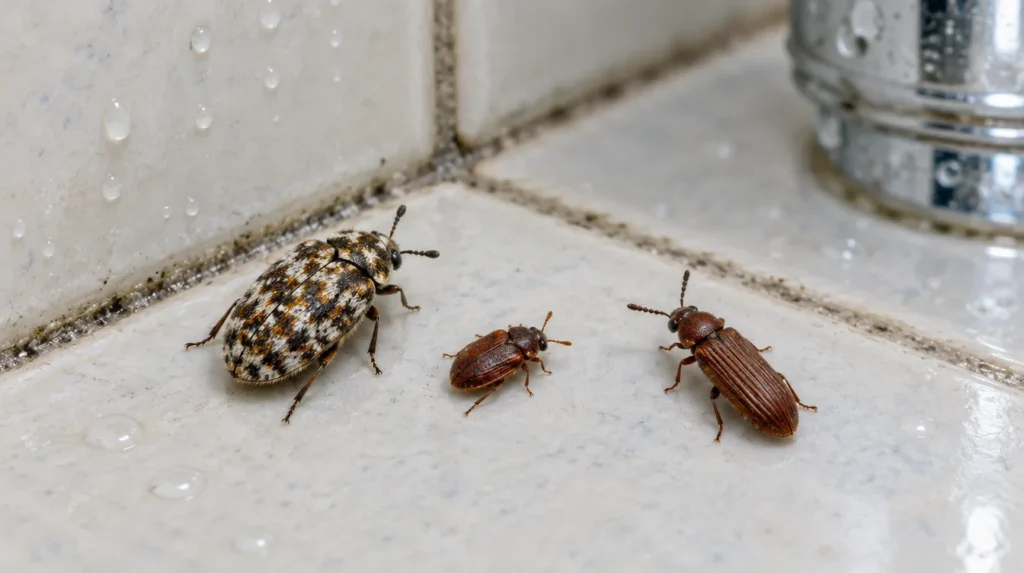
Most beetles found in a bathroom fall into one of three situations. Some are tiny beetles that feed on mold and mildew, and they show up because something in the room is staying damp. Some are household beetles, such as carpet beetles, that have wandered in from nearby rooms or are living on hair and lint that collects in corners and vents. And some are simply outdoor beetles that got inside by accident and ended up trapped in a tub or sink.
Telling these situations apart matters more than putting an exact name on the insect. The beetle’s size, shape, and color help, but where you found it, how many you are seeing, and whether the room has a moisture problem usually tell you more.
A single beetle in the bathtub is rarely a sign of an infestation. A steady trickle of tiny brown beetles around the same damp corner, week after week, is a different story.
Quick Identification Checklist
Before deciding what kind of beetle you have, confirm that it is a beetle at all. Many of the small creatures people find in bathrooms are not beetles.
A true beetle usually has:
- Six legs and a pair of antennae.
- Hardened wing covers (elytra), the stiff front wings that fold over the back and usually meet in a straight line down the middle.
- A firm body that does not squash easily.
- No tail filaments and no jumping ability.
Then note the details that help narrow it down:
- Size: Is it smaller than a sesame seed (about 1–3 mm), or closer to the size of a fingernail?
- Shape: Round and oval, long and narrow, or flattened?
- Surface: Shiny, dull, hairy, or covered in tiny colored scales?
- Location: Floor, windowsill, tub, sink, near the exhaust fan, inside a cabinet?
- Numbers and timing: One beetle once, or several every day?
- Room conditions: Lingering condensation, peeling paint, soft drywall, a musty smell, or a slow leak under the sink?
If you can, catch one in a clear container or on a strip of clear tape and take a sharp photo from above and from the side. A close look at the antennae and the outline of the body helps a great deal.
Why Beetles Show Up in Bathrooms
Bathrooms combine three things that matter to small insects: moisture, hidden debris, and easy entry points.
Moisture and mildew. Showers and baths add humidity, and poorly ventilated bathrooms can stay damp long after the water is off. Over time, mildew can grow on grout, caulk, drywall, ceiling paint, and inside wall voids. Several tiny beetles feed on that fungal growth rather than on anything in your home directly. Texas A&M AgriLife entomologists note that these mildew-feeding beetles are sometimes found in bathrooms and other humid rooms, and that their presence can point to a leak or other moisture problem.
Hair, lint, and dust. Bathrooms collect shed hair, lint from towels, and dust in corners, behind toilets, under cabinets, and in exhaust fan housings. That material is food for carpet beetle larvae.
Light and openings. Bathroom windows, gaps around pipes, and vents give outdoor insects a way in. Some beetles are drawn to lights at night and slip through small gaps or screens, then wander until they end up in a sink or tub.
Stored products. Medicine cabinets and bathroom shelves sometimes hold dried plant materials such as potpourri, dried flowers, or herbal products. A few stored-product beetles can live in items like these.
Most Likely Beetles in a Bathroom
The beetles below are common candidates, not a complete list. Exact species-level identification often needs magnification and, sometimes, a specialist.
Carpet Beetles (Family Dermestidae)
Carpet beetles are among the beetles people most often find indoors, and bathrooms are no exception.
Adults are small and rounded. Varied and furniture carpet beetles are about 3 mm long, oval, and patterned with tiny white, brown, and yellowish scales that can look mottled. Older adults may lose scales and look plain brown or black. The black carpet beetle is a little larger, roughly 3–6 mm (about 1/8–1/4 inch), oblong, and black with brownish legs.
Larvae look quite different. They are small, hairy, and carrot-shaped, often banded light and dark brown. Black carpet beetle larvae are longer and narrower, with a tuft of long bristles at the rear.
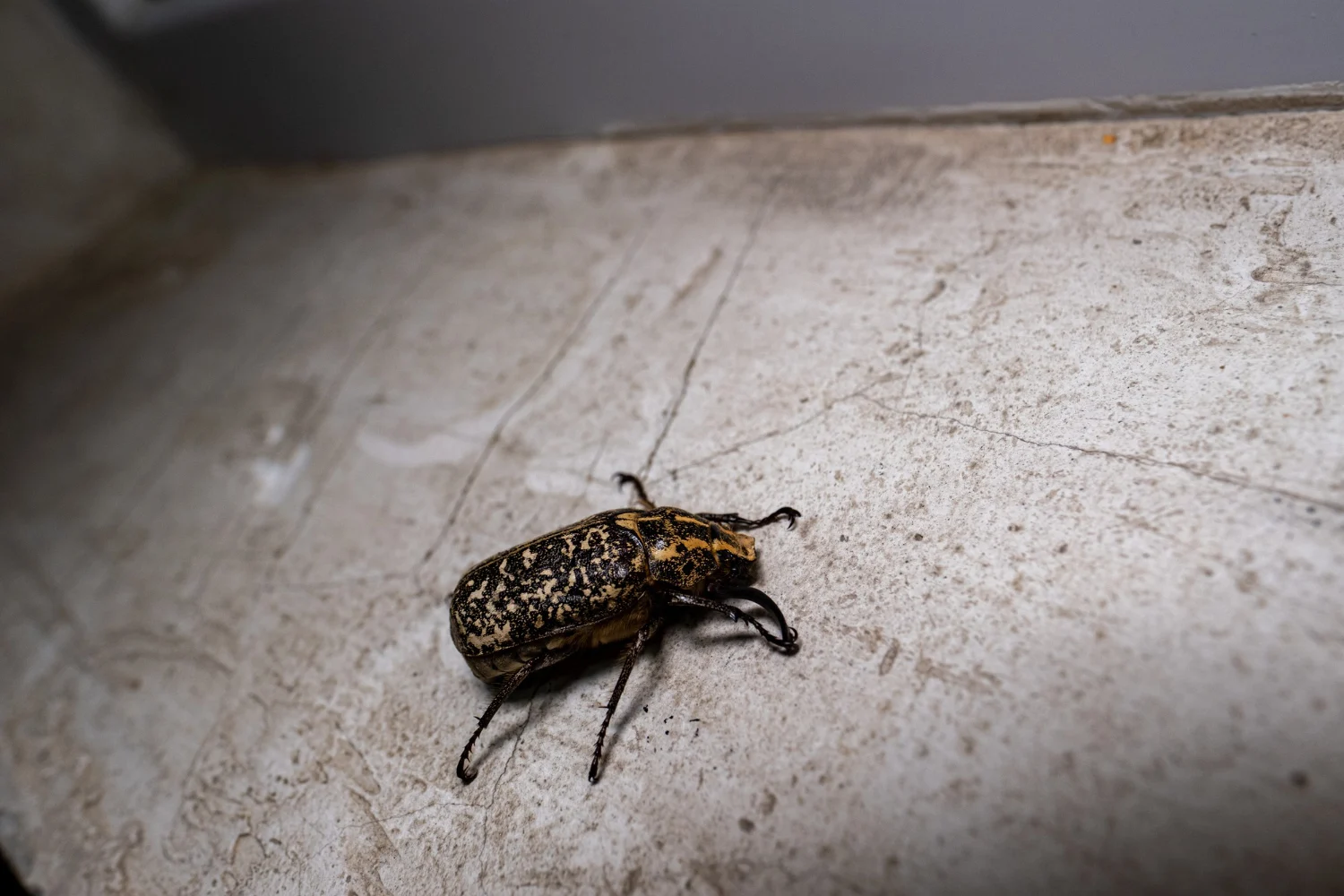
In a bathroom, the clues are usually:
- adults on a windowsill or near a light, since adults are attracted to light and often feed on pollen outdoors;
- larvae or their shed skins in corners, under the sink cabinet, or around vents where hair and lint build up.
The adult stage is not what damages household items. It is the larvae that feed on animal-based materials such as wool, hair, feathers, and lint. In a bathroom, that usually means accumulated hair and dust rather than anything valuable. Finding larvae there can still be a hint that an adjacent closet, bedroom, or duct also has a food source.
For a broader guide to this group, see our page on carpet beetles.
Mold- and Mildew-Feeding Beetles
These are the tiny beetles most closely linked to damp bathrooms. They are easy to overlook because many are only about 2–3 mm long.
Foreign grain beetle (Ahasverus advena, family Silvanidae). A tiny reddish-brown beetle, roughly 2–3 mm long, with a slightly flattened body. Under magnification, it has a small rounded bump on each front corner of the pronotum, the shield-like plate just behind the head, and antennae that end in a three-segmented club. Despite the name, indoors it is usually associated with mold rather than grain. It is well known for appearing in newly built homes, where damp lumber or drywall supports mildew growth, and it is also drawn to lights at night.
Minute brown scavenger beetles (family Latridiidae). Very small, about 1–3 mm, brown, and often with a sculptured or pitted look under a hand lens. They feed on mold and mildew and are sometimes called plaster beetles because of their association with damp plaster and new construction.
Silken fungus beetles (family Cryptophagidae) and a few related groups can turn up in the same conditions. They are hard to separate without magnification. For most homeowners the exact name matters less than the shared message: something nearby is staying moist.
The good news is that these beetles do not bite, do not damage the structure, and generally fade away once the moisture problem is solved and the mildew can no longer grow. In new homes, entomologists note that this can take several weeks of drying out.
If you are trying to sort out several kinds of tiny brown beetles, our guide to tiny brown beetle identification goes into more detail.
Drugstore and Cigarette Beetles (Family Ptinidae)
These two stored-product beetles are mostly kitchen and pantry insects, but they can appear in bathrooms when dry plant-based items are stored there.
Both are about 2.5 mm (roughly 1/10 inch) long and reddish brown.
- Drugstore beetle (Stegobium paniceum): more elongate, with faint lengthwise grooves on the wing covers and antennae ending in three enlarged segments. It earned its name by feeding on dried pharmaceutical materials. It also infests dried flowers, spices, and many other dry goods.
- Cigarette beetle (Lasioderma serricorne): rounder, with the head bent sharply down so the body looks humpbacked from the side. The wing covers are smooth and the antennae are evenly saw-toothed.
If these beetles are showing up near a medicine cabinet or bathroom shelf, check older, rarely used dry items such as potpourri, dried flower arrangements, herbal products, or boxed supplies. Their larvae are small, C-shaped grubs that live inside the food source, so the adults you see are usually emerging from something nearby.
Spider Beetles (Subfamily Ptininae)
Spider beetles are small, round-bodied beetles with long legs and a humped, shiny or hairy back that makes them look a bit like a tiny spider or tick. Many species are only a few millimeters long. They scavenge on dry organic debris and are often associated with old, neglected food or debris in undisturbed spaces. Because they need regular access to water, they may wander into damp areas such as bathrooms. Count the legs: spiders and ticks have eight, while spider beetles have six.
Accidental Outdoor Visitors
Sometimes the beetle in your bathroom has nothing to do with the bathroom at all.
Ground beetles are a good example. Most are dark, shiny, somewhat flattened, and fast-moving, ranging from a few millimeters to more than 2.5 cm (1 inch) long. They hunt other insects outdoors and occasionally wander inside, especially in fall and especially into ground-floor or basement bathrooms. They cannot survive and breed indoors, so one or two that show up are simply lost.
Other outdoor beetles can arrive through open windows or slip in after being drawn to a lit window at night.
Beetles found in a tub or sink are often these accidental visitors. Smooth porcelain and acrylic surfaces are hard for many small insects to climb, so a beetle that wandered in at night may still be there in the morning.
Comparison Table: Bathroom Beetles at a Glance
| Beetle | Approx. size | Shape and look | Where you may see it | What it usually signals |
|---|---|---|---|---|
| Carpet beetle (adult) | about 3 mm (black carpet beetle 3–6 mm) | Round to oval; mottled scales, or plain black | Windowsill, near lights | Adults wandering; check nearby rooms for larvae |
| Carpet beetle (larva) | about 5 mm or longer | Hairy, carrot-shaped, banded | Corners, under cabinets, around vents | Hair, lint, or animal-based material nearby |
| Foreign grain beetle | about 2–3 mm | Tiny, reddish brown, slightly flat | Damp walls, around lights, new homes | Moisture and mildew |
| Minute brown scavenger beetles | about 1–3 mm | Tiny, brown, sculptured surface | Damp plaster, grout, ceilings | Moisture and mildew |
| Drugstore / cigarette beetle | about 2.5 mm | Reddish brown; elongate or humpbacked | Medicine cabinet, shelves | A dry, plant-based product infested nearby |
| Spider beetle | a few mm | Round, long-legged, spider-like | Undisturbed areas, damp spots | Old debris or neglected stored items |
| Ground beetle | a few mm to over 2.5 cm | Dark, shiny, fast, flattened | Floor, tub, basement bathroom | Accidental visitor from outdoors |
Common Bathroom Lookalikes That Are Not Beetles
Many “beetles” reported in bathrooms turn out to be other small creatures that also like moisture.
Springtails. Very small, about 1.5–3 mm (1/16–1/8 inch), often gray, brown, or black, and soft-bodied. The giveaway is behavior: they jump using a forked structure under the abdomen. They gather around leaks, condensation, and overwatered houseplants. They are harmless and disappear when moisture drops.
Silverfish and firebrats. Wingless, slender, tapered insects covered in scales, with long antennae and three long tail filaments at the rear. They are usually longer than the beetles discussed here and move with a quick, wriggling motion.
Drain flies (moth flies). Small, fuzzy flies, about 1.5–6 mm (1/16–1/4 inch), that hold their hairy wings over the body like a little roof. Their larvae develop in the slimy film inside drains, so flies resting on walls near a sink or shower drain are a strong clue.
Booklice (psocids). Tiny (1–2 mm), pale, soft-bodied insects that feed on mildew in humid rooms. They are not true lice and do not bite.
Young cockroaches. Cockroach nymphs are wingless and can look beetle-like at a glance. They have long, thin antennae, a flattened body, and no hard wing covers meeting down the back.
If what you found has wings that look like a fuzzy roof, a tail of three filaments, or springs into the air when touched, it is not a beetle.
Accidental Visitor or Ongoing Problem?
Use the pattern of sightings, not a single insect, to decide what is going on.
Usually nothing to worry about:
- one or two beetles over several weeks;
- a large, dark beetle in the tub after a cool night;
- a beetle on the window during spring or summer when windows are open.
Worth a closer look:
- tiny brown beetles appearing daily in the same spot;
- hairy, carrot-shaped larvae or their shed skins;
- beetles near the medicine cabinet or a shelf of dry products;
- a musty smell, bubbling paint, soft drywall, or loose tiles alongside the beetles.
Signals that the real issue is moisture:
- beetles clustered near the ceiling over the shower, around a window with heavy condensation, or near the base of the tub or toilet;
- mildew on grout, caulk, or paint that keeps coming back;
- a bathroom exhaust fan that is missing, weak, or rarely used.
In these cases, the beetles are better treated as a symptom than as the problem itself.
What to Do Next
These are basic, non-chemical steps. Most bathroom beetle situations do not require insecticides. For mildew-feeding beetles, extension specialists note that pesticides generally do little unless the moisture problem is fixed.
- Remove what you can see. A vacuum with a crevice tool works well for adults, larvae, shed skins, hair, and lint. Empty or seal the bag or canister afterward.
- Dry the room out. Run the exhaust fan during and after showers, leave the door open when possible, and wipe down condensation. A dehumidifier can help in a bathroom without good ventilation.
- Look for the moisture source. Check under the sink, around the toilet base, along tub and shower caulk, and around windows. Persistent dampness inside a wall or ceiling may need a plumber or contractor.
- Clean the debris traps. Vacuum behind the toilet, under cabinets, and along baseboards. Remove lint and dust from exhaust fan covers and vent grilles.
- Check stored dry items. If beetles are near a medicine cabinet or shelf, look at older potpourri, dried flowers, herbal products, and similar items. Discard anything clearly infested in a sealed bag.
- Check adjacent rooms. If you find carpet beetle larvae, look in nearby closets and rooms for wool, feathers, pet hair, or stored natural fibers.
- Reduce entry points. Repair window screens and seal obvious gaps around pipes where they enter walls.
If you are seeing small beetles in several rooms, not only the bathroom, our broader guide to small beetles in the house may be a better starting point.
When Species-Level Identification Is Difficult
Many bathroom beetles are only 1–3 mm long. At that size, the features that separate one family from another are hard to see without a hand lens or microscope. These include the shape of the pronotum, the number of antenna segments, and the texture of the wing covers. A phone photo may be enough to say “a tiny mildew-feeding beetle” but not enough to name the species, and that is usually fine. For a moisture-related beetle, the useful action is the same either way.
If you need a confident identification, a local cooperative extension office, university entomology department, or natural history museum can often help. It is easier if you can provide a specimen in a sealed container or a sharp, magnified photo.
When to Contact a Professional
Consider getting outside help if:
- beetles keep appearing in large numbers after you have dried the room and cleaned thoroughly;
- you suspect hidden water damage, a leak inside a wall, or mold growth you cannot see or safely clean (a plumber, contractor, or mold-remediation specialist is the right call here);
- carpet beetle larvae keep turning up and you cannot find their food source;
- you or someone in your home develops an itchy rash or other symptoms you think may be connected to insects.
On that last point, beetles found in bathrooms are generally not biting insects. However, Penn State Extension describes an allergic skin reaction in some people with long-term exposure to carpet beetle larvae, caused by the larvae’s hairs rather than a bite. Any persistent rash or breathing symptoms should be checked by a healthcare provider. For more on this question, see Do beetles bite?
For more guides to beetles found in specific parts of the house and yard, visit Beetles Around the Home.
Frequently Asked Questions
Why do I keep finding beetles in my bathtub?
Often because they wandered in and could not climb back out. Smooth tub surfaces are difficult for many small insects to grip. A single beetle in the tub, especially a larger dark one, is usually an accidental visitor from outdoors.
Are tiny beetles in the bathroom a sign of mold?
They can be. Several very small brown beetles, including the foreign grain beetle and minute brown scavenger beetles, feed on mold and mildew. Repeated sightings near damp spots suggest that something in the room is staying wet long enough for mildew to grow.
Do beetles come up through the drain?
Beetles do not breed in drains. Small flying insects with fuzzy wings resting near a drain are more likely drain flies, which do develop in the film inside drains and traps.
Can beetles live in bathroom pipes or walls?
Mildew-feeding beetles can develop inside damp wall voids, especially in new construction or where there is a slow leak. They are using the moisture and mildew, not the pipes themselves.
Do bathroom beetles bite?
The beetles commonly found in bathrooms are not considered biting insects. Carpet beetle larvae can cause an allergic skin reaction in some people through contact with their hairs, which is different from a bite.
Is one beetle a sign of an infestation?
No. A single beetle is usually just a visitor. What matters is a pattern: many beetles over days or weeks, larvae, shed skins, or beetles concentrated in one damp or debris-filled area.
Will a dehumidifier or exhaust fan help?
For moisture-loving beetles, reducing humidity is one of the most effective steps. Running the exhaust fan during and after showers and fixing leaks helps remove the conditions mildew feeders need.
Why are there beetles near my medicine cabinet?
Drugstore and cigarette beetles feed on a wide range of dry plant and animal products, including some dried pharmaceutical and herbal materials, dried flowers, and spices. Check older dry items stored in or near the cabinet.
Who can identify a beetle from my bathroom?
A local cooperative extension office, a university entomology department, or a natural history museum can often help. A specimen in a sealed container or a sharp, close-up photo makes identification easier.
References
- University of Florida IFAS Extension — Carpet Beetles (IG089)
- Penn State Extension — Carpet Beetle Dermatitis
- Texas A&M AgriLife Extension, Insects in the City — Mildew-feeding insects in the home
- University of Arkansas, Arthropod Museum — Foreign grain beetle
- Oklahoma State University Extension — Drugstore Beetle (Stegobium paniceum) & Cigarette Beetle (Lasioderma serricorne)
- University of Missouri Extension — Household-Invading Beetles (G7368)
- University of Minnesota Extension — Springtails
- University of Maryland Extension — About Drain Flies