

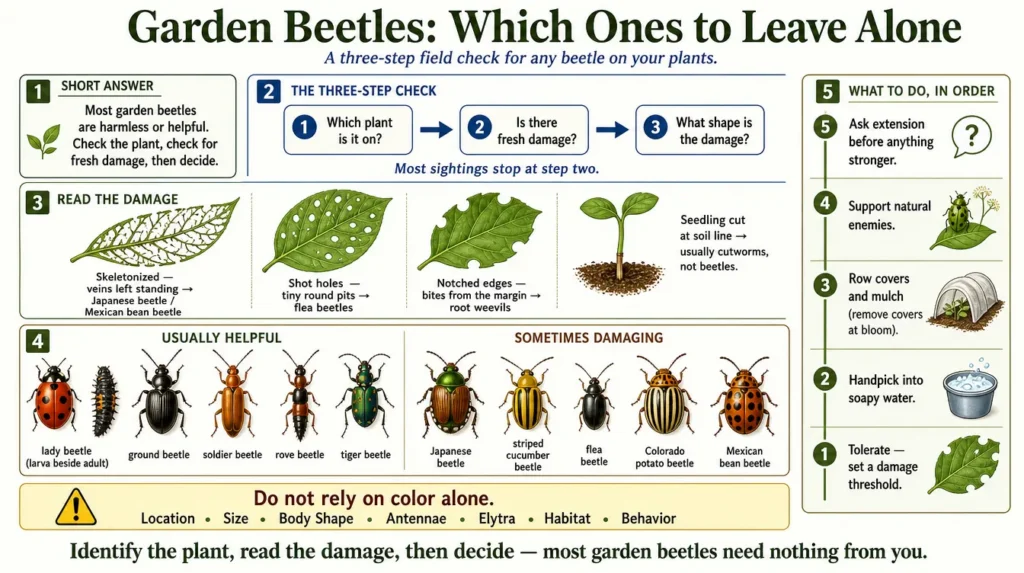
Most garden beetles are harmless or actively helpful. Before you do anything, check three things: which plant the beetle is sitting on, whether there is real damage, and what shape that damage takes. Only a small handful of species justify action.
That order matters. Gardeners who start with the beetle’s appearance tend to guess wrong, because dozens of unrelated beetles are shiny, black, spotted, or metallic green. Gardeners who start with the plant and the damage almost always land in the right neighborhood, even when the exact species stays uncertain.
A yellow beetle with black spots on a bean leaf and a yellow beetle with black spots on an aphid-covered rose are very different news. Same colors, opposite conclusions.
About This Guide
This is a decision guide, not a kill list. It gives you a repeatable sequence for evaluating any beetle you find outdoors, a set of damage patterns you can work backward from, profiles of the beetles most often responsible in home gardens across North America, and a graduated response that starts with doing nothing.
One honest caveat up front: photographs and written descriptions have limits. There are roughly 25,000 beetle species in North America alone, and many differ only in features you would need a hand lens and a technical key to see. This guide will reliably get you to a group and a decision. It will not always get you to a species name, and any source that promises otherwise is overselling. When the identification genuinely matters, the last section explains where to send your photos.
Start Here: Three Questions Before You Act
Work through these in order. Most beetle sightings resolve at question two.
1. What plant is it on, and what is it doing?
Note the plant first, then watch the beetle for thirty seconds. Is it chewing, sitting on a flower, running across bare soil, or hiding under mulch when you lift it?
Location is the single most useful clue you have. Beetles that damage gardens are picky. Colorado potato beetles want potatoes, eggplant, and tomatoes. Cucumber beetles want cucumbers, squash, and melons. Mexican bean beetles want beans. A beetle on a plant outside its host range is almost certainly passing through, hunting something else, or feeding on pollen.
Behavior narrows it further. A beetle that sprints across open ground and dives under a board is a predator, not a leaf eater. A beetle that sits still on a flower head is usually there for pollen and nectar. A beetle clustered with others on chewed foliage in full sun is the one worth a second look.
2. Is there actual damage — and is it fresh?
Look at the plant, not the insect. Old damage has healed, browned, or callused edges. Fresh chewing is pale green, wet-looking, and clean-edged.
Plenty of gardeners find a beetle next to a hole and convict the wrong suspect. Slugs, caterpillars, earwigs, sawfly larvae, hail, and several leaf diseases all produce holes, and the insect standing nearby is often an innocent bystander or a predator that came to eat whatever made the hole. Soldier beetles in particular get blamed constantly for damage they never cause.
If you find no fresh damage, you are done. Leave it.
3. What shape is the damage?
If there is fresh damage, the pattern tells you more than the beetle’s color does. That is the next section.
Only after those three answers do you decide whether to intervene, and the answer is usually still no.
Read the Damage Backward
Chewing insects leave signatures. These are the four patterns that come up most often in home gardens.
Skeletonized leaves — lace-like tissue with the veins left standing. Two common causes. On roses, grapes, beans, raspberries, lindens, and hundreds of other plants, in midsummer, with beetles feeding openly on upper leaf surfaces in groups: Japanese beetle. On bean leaves specifically, with the damage worked from the underside and yellowish spiny larvae present: Mexican bean beetle.
Shot holes — many small round pits and perforations, as if the leaf were hit with fine buckshot. This is flea beetle feeding, most severe on seedlings of eggplant, radish, arugula, mustard greens, potatoes, and other brassicas in spring and early summer. Confirm by tapping a leaf: flea beetles jump instantly and disappear.
Notched leaf edges — scalloped bites taken out of the margin. This is the calling card of adult root weevils, including black vine weevil, which feed at night and hide by day. The notches look alarming and are rarely a real problem for established plants. Bean leaf beetles produce a different pattern: round holes punched through the leaf blade.
Seedlings cut off at the soil line. This one is usually not a beetle. Cutworms, which are moth caterpillars, are the typical cause, and you can often find one curled in the soil an inch from the stump. Beetle larvae such as wireworms and white grubs do attack roots and can cause seedlings to wilt and pull up easily, but a cleanly severed stem points to caterpillars first. Ground beetles found in the same soil are predators that eat cutworms.
A worthwhile habit: photograph the damage as well as the insect. Extension diagnosticians often identify the culprit from the plant alone.
Garden Beetles That Help
These are the ones to protect. Broad-spectrum sprays kill them faster than they kill pests, because predators are mobile, exposed, and slower to rebound.
Lady beetles (Coccinellidae). Rounded, domed, usually red or orange with black spots, though plenty are black with red marks or unspotted. Adults and larvae both eat aphids, mites, and soft-bodied insects. Learn the larva: a tapered, alligator-shaped, spiny black creature with orange markings, about a quarter inch long. It looks like nothing you would want on a plant, and it is one of the most valuable insects in the garden. Two members of this family break the rule and feed on plants — the Mexican bean beetle and the squash beetle — which is exactly why spot counts alone will mislead you.
Ground beetles (Carabidae). Flat, fast, usually black or dark brown with grooved wing covers, most active at night. They run rather than fly when uncovered. Adults and larvae hunt cutworms, slugs, snails, root maggots, and caterpillars at ground level, and some species also eat weed seeds. If you lift a board or a stone and something black bolts for cover, that is almost always a ground beetle, and it belongs there. A broader look at what different beetles feed on is covered in what beetles eat.
Soldier beetles (Cantharidae). Elongated, soft-bodied, often orange-tan with dark markings, frequently seen in numbers on goldenrod, milkweed, and umbel-shaped flowers in late summer. Adults feed on pollen, nectar, and small soft-bodied insects; larvae are predators in soil and leaf litter. They do not damage plants and need no control at all. Gardeners report them constantly because they show up on flowers in large, conspicuous groups.
Rove beetles (Staphylinidae). Long, narrow beetles with very short wing covers that leave most of the flexible abdomen exposed, so they look half-finished. Some curl the abdomen upward when disturbed, which reads as threatening and is not. They hunt in compost, mulch, and moist soil, and many species prey on fly larvae and other small soil insects.
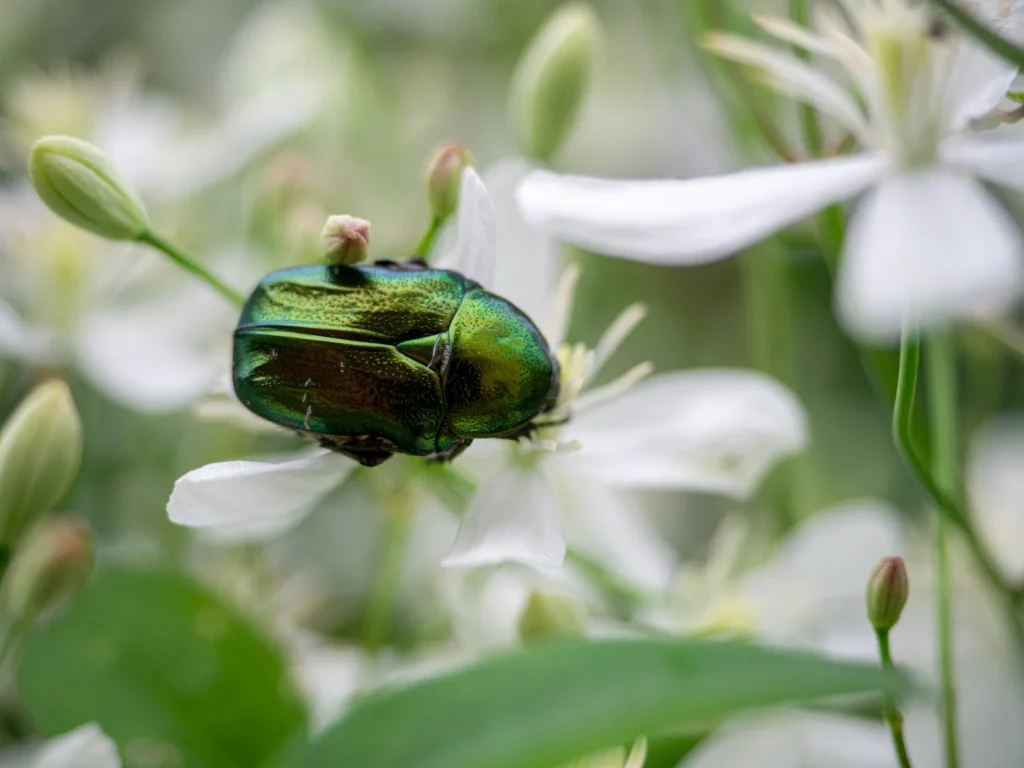
Tiger beetles (Cicindelinae). Long-legged, large-eyed, often brilliantly iridescent beetles that sprint across bare sunny paths and stop abruptly. Their oversized sickle-shaped mandibles are for catching prey. They are voracious predators as both adults and larvae. Because many are metallic green, they get confused with pest scarabs — a mix-up covered further in the guide to green beetles.
Garden Beetles That Sometimes Cause Real Damage
“Sometimes” is doing real work in that heading. Even these species are often present at levels that cause no meaningful harm.
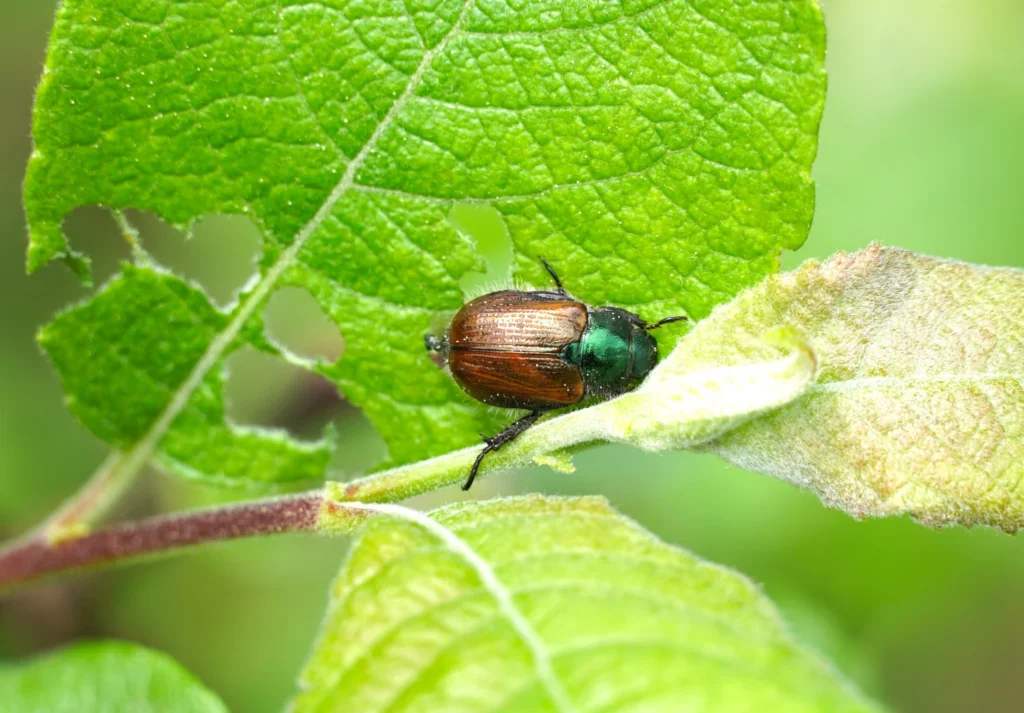
Japanese beetle (Popillia japonica). About half an inch long, metallic green thorax, coppery-bronze wing covers, and — the reliable feature — small white tufts of hair along each side of the abdomen and two at the tip. Adults feed in groups on upper leaf surfaces, skeletonizing foliage on more than 300 plant species from roughly late June through August in much of the eastern and midwestern United States. Damaged leaves release volatiles that attract more beetles, so early removal genuinely helps. Full life cycle details are in the Japanese beetle profile.
Cucumber beetles (striped and spotted). Striped: about a quarter inch, yellow with three black stripes down the wing covers and a black head. Spotted: yellow-green with twelve black spots. Both feed on cucurbits, but the serious problem is not the chewing — they transmit bacterial wilt and cucumber mosaic virus. A single infected beetle can carry wilt into a plant. If a cucumber or melon vine wilts suddenly while the soil is moist, cut a wilted stem, press the cut ends together, and pull them slowly apart; stringy strands of ooze indicate bacterial wilt. The spotted cucumber beetle is regularly mistaken for a lady beetle, which is one more reason to check body shape and host plant rather than spots.
Flea beetles. Tiny — often under an eighth of an inch — shiny, with enlarged hind legs that let them jump like fleas. They produce the shot-hole pattern described above. Seedlings and new transplants are genuinely vulnerable and can be stunted or killed under heavy pressure. Established plants tolerate a surprising amount of this damage without any yield loss, and pressure usually drops as the season advances.
Colorado potato beetle (Leptinotarsa decemlineata). Roughly three-eighths of an inch, oval and domed, with ten alternating yellow and black stripes running lengthwise. Larvae are the more destructive stage: humpbacked, brick red to pink, with black heads and two rows of dark spots along each side. Yellow-orange egg clusters appear on leaf undersides. Larvae feed in groups and can strip potato, eggplant, and tomato foliage quickly. A near-identical look-alike, the false potato beetle, is far less damaging, and this species has developed resistance to a long list of insecticides, which makes early hand removal more valuable than it sounds.
Mexican bean beetle (Epilachna varivestis). Copper to yellow-tan, rounded, with sixteen black spots — a lady beetle relative that eats plants. Larvae are yellow, oval, and covered in branched spines. Both stages feed from the undersides of bean leaves, leaving lacy, skeletonized tissue with patchy brown areas showing through on top. This is the single most consequential lady-beetle look-alike in vegetable gardens.
Quick comparison
| What you see | Likely group | Typical location | Action usually needed |
|---|---|---|---|
| Fast black beetle under mulch or a board | Ground beetle | Soil surface, at night | None — predator |
| Orange-tan soft beetle on late-summer flowers | Soldier beetle | Goldenrod, umbels | None — pollinator and predator |
| Spiny black-and-orange “alligator” larva | Lady beetle larva | Aphid-covered stems | None — protect it |
| Skeletonized upper leaf surfaces, beetles in groups | Japanese beetle | Roses, grapes, beans, lindens | Handpicking if heavy |
| Shot holes in seedling leaves, insects jump | Flea beetles | Brassicas, eggplant, potato | Protect seedlings only |
| Striped or spotted beetle on cucumber vines | Cucumber beetles | Cucurbits | Watch for wilt |
| Striped adult plus humpbacked red larvae | Colorado potato beetle | Potato, eggplant | Remove larvae and eggs |
| Spotted beetle plus spiny yellow larvae, bean undersides | Mexican bean beetle | Beans | Remove by hand |
The Response Ladder
Climb only as far as the situation requires. Most gardeners never leave the first rung.
1. Set a tolerance threshold before you look. Decide in advance how much damage matters on that particular plant. An established squash plant, a mature shrub, or a row of radishes shrugs off a lot of chewed leaf area. A newly transplanted eggplant or a first-year perennial does not. Cosmetic damage on a plant you are not eating is not a problem to be solved. Zero damage is not the goal and is not achievable in a living garden.
2. Handpick. For beetles large enough to grab, this is effective and immediate at home-garden scale. Go out early morning or evening when beetles are cool and sluggish, hold a container of soapy water underneath, and tap or knock them in. Check leaf undersides for egg masses and crush or remove those too — one destroyed egg cluster prevents dozens of larvae. Repeat every few days during peak activity rather than once.
3. Use barriers, mulch, and timing. Floating row covers over young plants exclude flea beetles and cucumber beetles during the vulnerable seedling window. Two rules make them work: seal the edges to the ground, and remove the cover once flowering begins on anything that needs insect pollination, such as squash, cucumbers, and melons. For leafy greens that do not need pollinators, covers can stay on until harvest. Fine netting can protect ornamentals from Japanese beetles. Mulch and thick organic matter interfere with soil stages of some pests while giving ground beetles and rove beetles the shelter they want. Adjusting planting dates so seedlings emerge outside a pest’s peak also helps.
4. Support natural enemies. A garden with a long, overlapping bloom sequence — especially plants in the aster, carrot, and milkweed families — feeds adult soldier beetles, lady beetles, and parasitic wasps. Leaving some leaf litter, flat stones, and undisturbed edges gives ground beetles and rove beetles daytime cover. Diversity of planting does more here than any single tactic, and skipping broad-spectrum sprays is itself a form of support.
5. Everything else, last. If a pest population is genuinely threatening a crop after the steps above, contact your county or state extension office. They will tell you what is registered and appropriate for your state and your specific crop, at the correct timing, which is the part that determines whether anything works at all. Skip this article’s opinion on products entirely — regional registrations differ, resistance patterns differ, and label directions are legally binding. It is also worth asking about traps before buying them: standard lure-baited Japanese beetle traps draw more beetles into a yard than they capture, and extension entomologists generally advise against hanging one in a home garden.
Common Mistakes
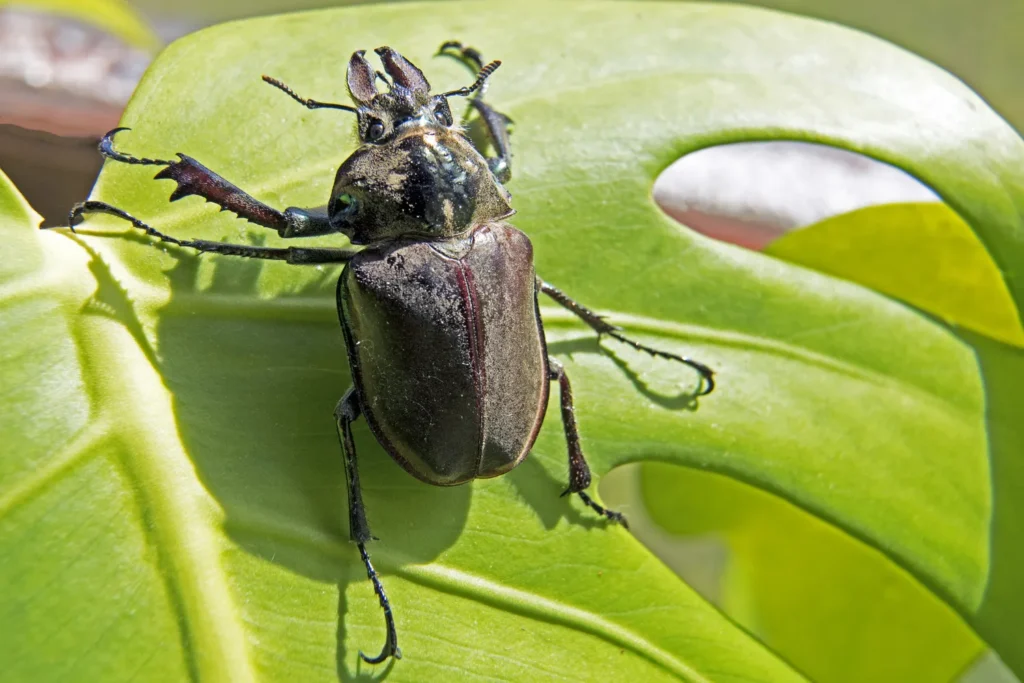
Judging by color. Metallic green describes tiger beetles, Japanese beetles, dogbane beetles, and several harmless flower scarabs. Black describes hundreds of ground beetles and a few pests. Color is one data point among many. Combine it with size, body shape, antennae, wing-cover texture and markings, larvae if present, habitat, season, behavior, and your geographic region. This principle sits at the center of every page in our beetle identification section.
Killing the larvae of beneficial species. Lady beetle larvae are the most-destroyed helpful insect in home gardens, purely because they look strange.
Treating a single sighting as an infestation. One beetle is one beetle. Come back tomorrow and look again before you conclude anything.
Spraying preventively. This removes predators first and often leads to worse outbreaks of aphids and mites later.
Assuming a beetle near damage caused it. Predators congregate exactly where prey is feeding, which puts them at the scene of the crime.
When Professional Identification Is Worth It
Get expert eyes on it when a crop is failing and you cannot name the cause, when a vine wilts suddenly, when you suspect a regulated or invasive species, or when you are about to spend money on treatment. County extension offices, university plant diagnostic clinics, natural history museums, and BugGuide.net all accept photo submissions, and they are free or inexpensive. Send clear images of the beetle from above and from the side, any larvae, and the damaged plant, along with your location and the plant’s name. The broader question of beetle value in a landscape is discussed in are beetles good or bad.
FAQ
Are garden beetles good or bad?
Overwhelmingly good or neutral. Predatory and pollinating beetles far outnumber the roughly five to ten species that regularly damage home gardens in a given region.
How do I tell a lady beetle from a Mexican bean beetle?
Check the host plant first. A spotted beetle chewing bean leaves from the underside, especially alongside spiny yellow larvae, is a Mexican bean beetle. Lady beetles are found near aphid colonies and do not chew foliage.
What beetle skeletonizes leaves?
Japanese beetles on a wide range of ornamentals and fruit, feeding openly on upper surfaces in groups. On beans, Mexican bean beetles produce similar lacy damage from the underside.
What makes tiny round holes in leaves?
Flea beetles. The pattern is called shot-hole damage, and the beetles jump away instantly when disturbed.
Should I use a Japanese beetle trap?
Extension entomologists generally advise against it in home gardens. The lures pull in more beetles from surrounding properties than the trap catches, and the extras feed on your plants.
Are the black beetles running around my soil harmful?
Almost certainly not. Fast-moving black beetles that hide under boards and mulch are usually ground beetles, which eat cutworms, slugs, and root maggots.
Do beetles damage roots?
Some larvae do. White grubs and wireworms feed on roots, and heavy populations can cause wilting or patchy lawn damage. Most grubs found while digging are harmless decomposers.
Can I identify a beetle from color alone?
No. Color varies within species and repeats across unrelated families. You need body shape, size, antennae, wing covers, habitat, season, and behavior together.
How much leaf damage should I tolerate?
More than instinct suggests. Established plants routinely handle significant defoliation without yield loss. Seedlings, new transplants, and plants grown for their leaves are the exceptions.
Do beetles bite people?
A few large predatory species can pinch if handled roughly, and it is startling rather than dangerous. Garden beetles do not seek out people.
Conclusion
Garden beetles are mostly allies, occasionally neutral, and only sometimes a problem. The reliable way to tell which you are looking at is not the beetle’s color but the sequence: identify the plant, confirm fresh damage, read the pattern of that damage, and only then decide. Run those steps and you will leave the ground beetles, soldier beetles, rove beetles, tiger beetles, and lady beetle larvae to do work you would otherwise pay for, while catching the small number of Japanese beetles, cucumber beetles, flea beetles, Colorado potato beetles, and Mexican bean beetles that genuinely warrant a response — usually with your hands, a bucket of soapy water, and a row cover rather than anything stronger.
References and Further Reading
- University of Minnesota Extension — Japanese Beetles in Yards and Gardens
- University of Minnesota Extension — Soldier Beetles
- University of Maryland Extension — Predatory Beetles
- University of Maryland Extension — Cucumber Beetles on Vegetables
- Colorado State University Extension — Flea Beetles
- Iowa State University Extension — Colorado Potato Beetle Identification, Biology and Management
- NC State Extension — Mexican Bean Beetle
- University of New Hampshire Extension — Beneficial Insects in New Hampshire Farms and Gardens