

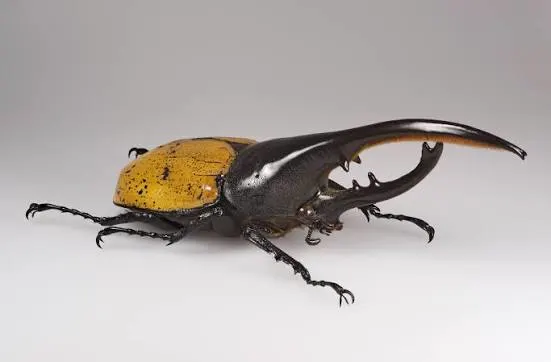
The Hercules beetle (Dynastes hercules) is a rhinoceros beetle from the rainforests of Central and South America and the Lesser Antilles, and a large male is the longest beetle on record once its horns are included. The biggest verified specimens reach about 17 cm (roughly 6¾ inches), and more than half of that length is horn. Females have no horns at all and are shorter, darker, and much easier to overlook.
If you live in the United States, the Hercules beetle you are most likely to see is a smaller relative: the eastern Hercules beetle (Dynastes tityus) in the East or the western Hercules beetle (Dynastes grantii) in the Southwest. This guide covers the tropical species first, then explains how to recognize the two North American ones.
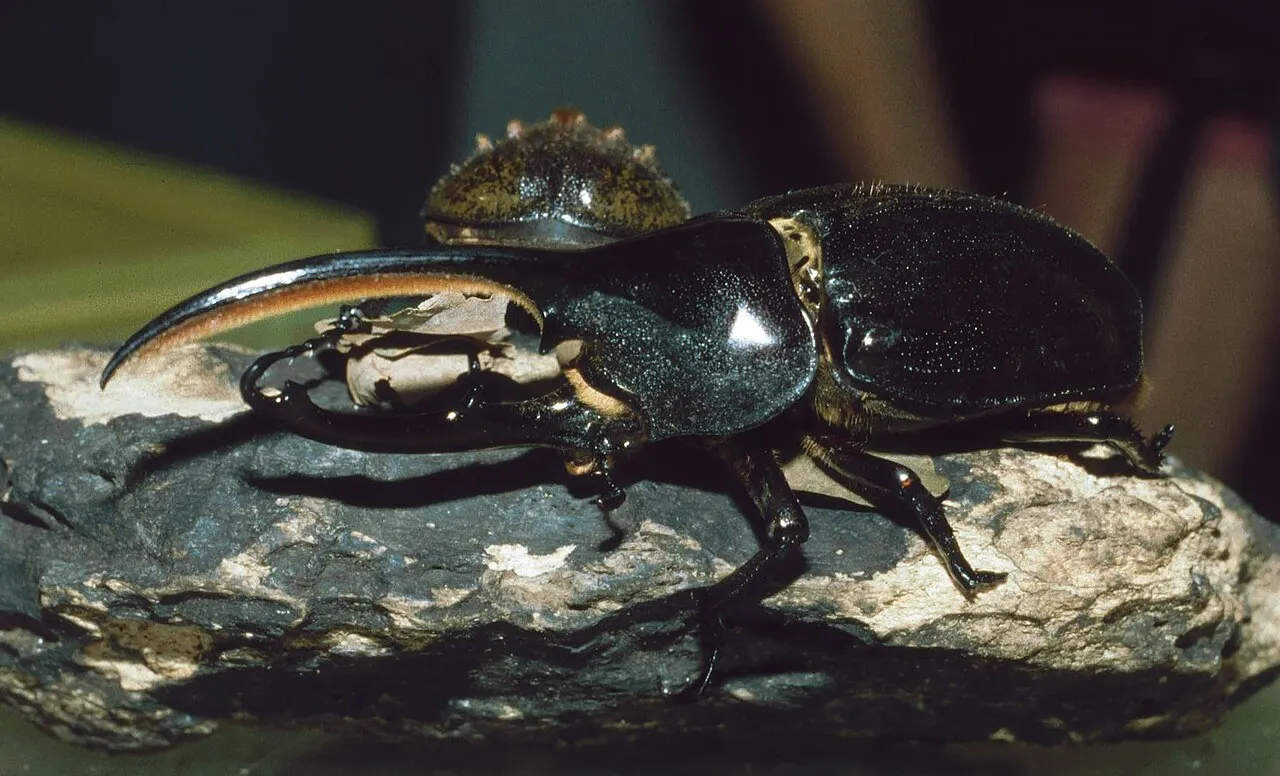
Quick Identification
- Group: a rhinoceros beetle (subfamily Dynastinae) in the scarab family, Scarabaeidae
- Males: two horns. A long horn grows forward from the pronotum (the hard shield behind the head), and a shorter horn curves upward from the head beneath it. Together they close like a pair of pliers.
- Females: no horns; a stout, mostly black beetle with rough, pitted wing covers
- Wing covers (males): olive-green to yellowish with scattered black spots in dry air, turning black when the air is humid
- Total length: about 4.4–17.2 cm (1.7–6.8 inches), depending on sex, horn size, and population
- Antennae: short, ending in a small club of flat, layered plates, the typical scarab antenna
- Where: rainforest from southern Mexico to Bolivia, plus several Caribbean islands
- When: active mainly at night and around dawn; adults feed on rotting fallen fruit
No single clue settles an identification on its own. A dark, hornless beetle can be a female Hercules beetle or one of many other scarabs, so location, body shape, and size need to be read together.
Scientific Classification
- Order: Coleoptera (beetles)
- Family: Scarabaeidae (scarab beetles)
- Subfamily: Dynastinae (rhinoceros beetles)
- Genus: Dynastes
- Species: Dynastes hercules (Linnaeus, 1758)
Below the species level, the classification is unsettled. Some references list about 13 subspecies. A University of Florida species profile recognizes three with confidence: D. h. hercules on Guadeloupe and Dominica, D. h. reidi on Martinique and St. Lucia, and D. h. septentrionalis in Mesoamerica. It treats the South American forms as uncertain. A 2015 genetic study of the genus found that the labels “species” and “subspecies” in Dynastes do not consistently track how distinct populations really are, so some forms may eventually be treated as separate species.
For a beginner, this matters mostly when reading size records and dealer listings, which often name a subspecies. For field identification, “Hercules beetle” plus the region where it was found is usually as precise as a photo allows.
The Hercules beetle belongs to the same broad group covered in our guide to rhinoceros beetles, which in turn sits within the much larger scarab beetle family.
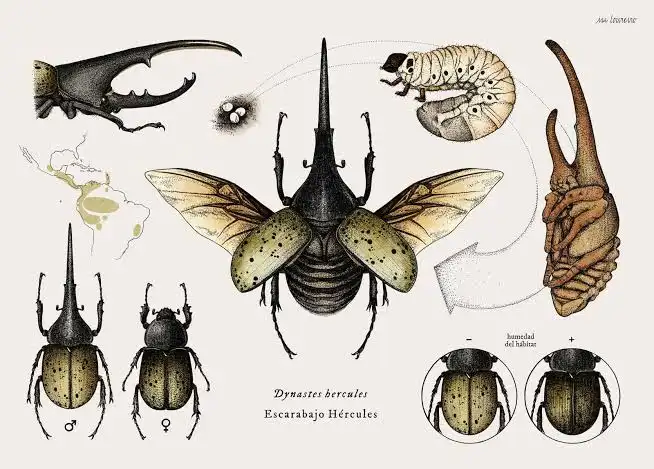
How Big Is a Hercules Beetle?
The answer depends on what is being measured. Guinness World Records lists the species at 44–172 mm (about 1.7–6.8 inches) in total length across its subspecies, horns included. The longest verified individual measured 172 mm (6.77 inches) and belonged to the subspecies from Guadeloupe and Dominica. Figures of 18–19 cm circulate widely, and London’s Natural History Museum gives a maximum of 19 cm, but Guinness treats reports above 172 mm as unconfirmed.
Horns account for much of that length. The Natural History Museum notes that more than half of a large male’s total length is horn. Measured by body alone, other beetles such as the titan beetle are longer, and several heavy-bodied species outweigh it. The Hercules beetle’s title is “longest overall,” not “biggest” in every sense.
Typical adults are far smaller than the record holders. The University of Michigan’s Animal Diversity Web reports that males average roughly 7.8 cm (about 3 inches) and females about 6.2 cm (about 2.4 inches). Males also vary enormously among themselves. A small male can carry stubby horns only a fraction of the length of a large male’s, which is why size alone is a weak way to judge sex or identity.
The Horns: Structure and Purpose
Only males have horns, and the two horns are built differently.
The thoracic horn is the long, forward-reaching one. It grows from the pronotum, the plate behind the head, and arches out over the head, extending well past it in large males.
The head horn (cephalic horn) is shorter. It rises from the head itself and curves upward toward the thoracic horn, so the gap between them works like jaws.
Males use this pincer to fight other males for access to females. Researchers studying these contests describe a pliers-like method: one male squeezes his rival between the two horns, lifts him, and throws him to the ground. A bout usually ends when one beetle lands on its back, is injured, or retreats. Horn size does not appear to influence which males females accept, so the horns are best understood as weapons for male-versus-male contests rather than as decorations aimed at females.
The horns are not used for digging, and they pose no meaningful threat to people. A Hercules beetle has no sting and no venom. Handled beetles can grip firmly with their legs, which is a good reason to let one walk onto your hand rather than prying it off a surface.
You will often see claims that Hercules beetles can lift hundreds of times their body weight. These figures are not well supported by published measurements on this species, so treat them as trivia rather than established fact.
Male vs Female Hercules Beetles
| Feature | Male | Female |
|---|---|---|
| Horns | Long thoracic horn plus shorter upturned head horn | None |
| Wing covers | Olive-green to yellowish with black spots (black when humid) | Usually all black; sometimes the rear part is colored like a male’s |
| Wing-cover texture | Relatively smooth | Coarsely pitted |
| Head and pronotum | Black | Black |
| Typical total length | Highly variable, roughly 4.4–17 cm | About 5–8 cm |
Because females lack horns, they are the sex most often misidentified. A female’s broad, heavy, domed body and lamellate antennae (the layered antennal club) point to a large scarab. Separating her from other big rhinoceros beetles usually needs location information or a specialist.
Why Hercules Beetles Change Color
The male’s olive or yellowish wing covers turn black as humidity rises and lighten again as they dry. This change was documented in the 1970s and has since been studied in detail.
The color does not come from pigment alone. The outer layer of the wing cover contains a fine, porous structure that scatters light to produce the pale color. When moisture fills those spaces, the structure stops scattering light the same way, and the darker layer beneath shows through.
For identification, this is a practical warning: a black-winged male is still a Hercules beetle. A beetle photographed on a humid night can look completely different from the same beetle photographed the next afternoon. The eastern Hercules beetle in North America shows a similar humidity-related darkening.
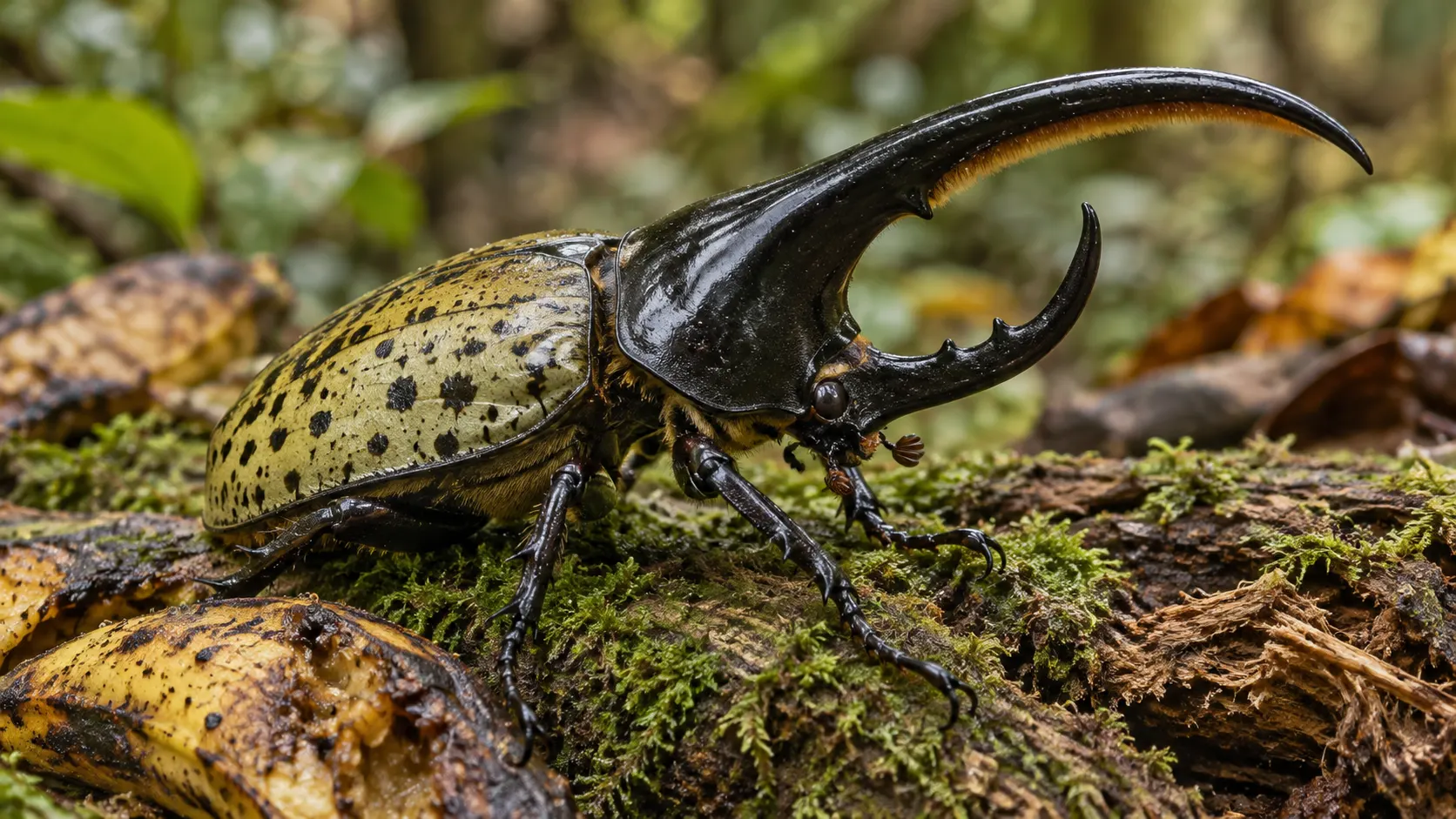
Habitat and Range
Dynastes hercules lives in montane and lowland rainforest from southern Mexico through Central America and into South America as far as west-central Bolivia, including the Amazon basin of Brazil, Ecuador, Colombia, and Peru. It also occurs on several islands in the Lesser Antilles. The range is patchy rather than continuous, following pockets of suitable forest.
Adults are mostly found in the forest understory and on the forest floor, in moist areas where fallen fruit and decaying wood accumulate. Larvae live inside rotting logs and decaying tree trunks.
This species is not native to the United States or Canada. A large horned beetle found in a backyard in the eastern or southwestern U.S. is almost certainly one of the native Dynastes species described below, not the tropical Hercules beetle.
What Hercules Beetles Eat
Adults and larvae eat different things, which is common among beetles.
- Larvae feed on dead, decaying wood inside rotten logs and trunks. Feeding on decaying wood is called saproxylophagy. By breaking wood down, the larvae help return nutrients to the forest soil.
- Adults feed mainly on rotting fruit that has fallen to the forest floor. Captive adults readily take soft fruit such as bananas and mangoes.
Neither stage is known as a crop pest. The larvae need wood that is already dead and soft, not living trees.
Hercules Beetle Life Cycle
Like all beetles, the Hercules beetle goes through complete metamorphosis: egg, larva, pupa, and adult. Our beetle life cycle guide explains these stages in general. What stands out in this species is how long the larval stage lasts.
The most detailed timings come from laboratory rearing at about 25 °C (77 °F), summarized by the University of Florida:
| Stage | Approximate duration (lab) |
|---|---|
| Egg | About 4 weeks |
| First larval instar | About 50 days |
| Second larval instar | About 56 days |
| Third larval instar | About 450 days |
| Pupa | About 32 days |
| Adult (in captivity) | About 3–6 months |
From egg to adult, development took about 19–21 months, and a complete life can approach two years. Other captive records give somewhat different stage lengths, including longer adult lives. Temperature and food quality change the timing, and wild timelines are less well documented than lab ones.
The larva is a classic scarab grub: soft, whitish, and curled into a C-shape, with a hard brown head and three pairs of legs near the front. Late-stage larvae can grow longer than 15 cm (6 inches) and, in some captive records, weigh more than 100 grams. If you are trying to tell grubs apart, our beetle larva identification guide covers the body features that separate scarab grubs from other larvae.
The pupa forms inside a chamber in the rotting wood or surrounding soil. The adult emerges with soft wing covers that harden over the following days.
Behavior
Hercules beetles are active mainly at night and around dawn, with activity peaking shortly before daybreak. Specimens collected at light traps have most often arrived in the early morning hours, roughly between 3 and 5 a.m.
Adults can fly, but they are heavy and fly clumsily. On the ground they move slowly. When disturbed, they can make a huffing sound by rubbing the abdomen against the underside of the wing covers. This behavior is called stridulation, and it may help deter predators.
Females release chemical signals (pheromones) that attract males. Where several males find the same female, horn fights follow.
Hercules Beetles in the United States
Two native Dynastes species share the Hercules name in North America. Both are much smaller than the tropical species, but they are still among the heaviest beetles most Americans will ever encounter.
Eastern Hercules Beetle (Dynastes tityus)
- Size: up to about 6 cm (about 2⅓ inches) long, with large males nearly 2½ inches including horns
- Color: greenish-gray to tan wing covers with irregular black spots. Each beetle’s spot pattern is unique, and some individuals are almost entirely dark brown or black. The wing covers darken in humid conditions.
- Horns: males have a long thoracic horn and a shorter head horn; females have none
- Range: eastern United States, north to New York and west to central Texas
- Habitat: deciduous forests with plenty of decaying wood; adults are often found around lights on summer nights
- Diet: larvae feed on rotting heartwood of hardwood logs and stumps; adults feed on tree sap and rotting fruit
- Life cycle: females can lay up to about 100 eggs near the bases of dead or dying trees. Development takes one to two years, and new adults may spend the winter in their pupal cells before becoming active the following summer.
Eastern Hercules beetles are harmless to people, though they can release an unpleasant odor when handled. The Missouri Department of Conservation notes that decaying ash trees are favored larval sites, so ash losses from the invasive emerald ash borer could affect this beetle in the long run.
Western Hercules Beetle (Dynastes grantii)
- Range: Arizona, New Mexico, and Utah, south into northern Mexico
- Color: bluish-gray to pale olive wing covers with black spots
- Habitat: stands of ash trees, especially along streams and other riparian areas
- Season: adults appear in late summer and early fall, roughly late July to October
- Behavior: adults strip bark from velvet ash to feed on the sap, and they are often collected at lights. When threatened, they may squirt a brown liquid from the abdomen.
- Larvae: develop in rotting wood; larvae have been recorded from rotten sycamore
The eastern and western species can interbreed, and their hybrids are fertile.
Comparing the Three Hercules Beetles
| Feature | Hercules beetle | Eastern Hercules beetle | Western Hercules beetle |
|---|---|---|---|
| Scientific name | Dynastes hercules | Dynastes tityus | Dynastes grantii |
| Region | Southern Mexico to Bolivia; Lesser Antilles | Eastern United States | Southwestern U.S.; northern Mexico |
| Habitat | Tropical rainforest | Deciduous forest with decaying wood | Ash stands, riparian areas |
| Total length | About 4.4–17.2 cm (1.7–6.8 in) | Up to about 6 cm (about 2½ in) | About 5–7.5 cm (2–3 in) |
| Wing covers | Olive to yellowish with black spots; black when humid | Greenish-gray to tan with black spots | Bluish-gray to pale olive with black spots |
| Adult food | Rotting fallen fruit | Tree sap, rotting fruit | Ash sap |
Beetles That Look Similar
Other rhinoceros beetles. Several large tropical rhinoceros beetles also have big horns. Elephant beetles (Megasoma), for example, share parts of the Hercules beetle’s range. They differ in horn arrangement and lack the spotted olive wing covers of a male Hercules beetle. In the United States, ox beetles (Strategus) are glossy dark brown to black. Male ox beetles carry several horns on the pronotum rather than one long forward-arching horn paired with a head horn.
Stag beetles. Stag beetles have enlarged jaws (mandibles), not horns. Look at where the “weapon” attaches: a stag beetle’s pincers project from the front of the mouth, while a Hercules beetle’s horns grow from the head and pronotum. Stag beetles also have elbowed antennae with a comb-like club. Our stag beetle guide covers them in detail.
Grapevine beetles and other large scarabs. The grapevine beetle, a common eastern scarab, has a few round black spots on tan wing covers. It is hornless and only about half the length of an eastern Hercules beetle. A female eastern Hercules beetle is also hornless, so judge by size and bulk: she is a much larger, heavier beetle.
Are Hercules Beetles Dangerous or Pests?
No. Hercules beetles have no sting or venom, do not attack people, and are not crop pests. Their larvae are decomposers that help break down dead wood in forests.
For the tropical species, the Animal Diversity Web lists no special conservation status on the IUCN Red List or under CITES. It identifies deforestation and climate change as the main threats. Hercules beetles are also popular in the hobby trade, where large captive-reared individuals can sell for substantial sums.
If you are considering keeping one, check the rules first. In the United States, importing or moving live non-native insects can require a permit from USDA APHIS, and other countries have their own regulations.
When Identification Needs an Expert
Most Hercules beetle sightings are easy to place by region. A big horned, spotted beetle at a porch light in Kentucky is almost certainly an eastern Hercules beetle, not a rainforest species. Expert help is worth seeking when:
- a large horned beetle turns up well outside the known range of the native species;
- you suspect an escaped or released non-native beetle;
- you have a hornless female or a large grub and need a confident species name.
A local extension office, natural history museum, or university entomology department can help. Photograph the beetle from above and from the side so the horns and wing covers are visible, include a coin or ruler for scale, and record the date and location. For other large species in the group, browse our Beetle Species section.
Frequently Asked Questions
How big can a Hercules beetle get?
The longest verified Hercules beetle measured 172 mm (6.77 inches) including horns, according to Guinness World Records. Reports of 18–19 cm appear in some sources but are not consistently verified. More than half of a large male’s length is horn.
Is the Hercules beetle the biggest beetle in the world?
It is the longest when horns are counted. Other beetles have longer bodies or weigh more, so the answer depends on whether you measure total length, body length, or weight.
Do female Hercules beetles have horns?
No. Females are hornless, usually black, and have rough, pitted wing covers. They are also generally shorter than males.
Can a Hercules beetle hurt you?
Not in any meaningful way. Hercules beetles have no sting or venom and do not attack people. They can grip firmly with their legs, and the eastern species may release an unpleasant smell when handled.
Why did a Hercules beetle’s wing covers turn black?
Humidity. The male’s wing covers have a porous outer structure that looks olive or yellowish when dry. When moisture fills those spaces, the wing covers look black. They lighten again as they dry.
How long do Hercules beetles live?
In laboratory rearing, development from egg to adult took about 19–21 months, and adults lived about 3–6 months in captivity, for a total of up to about two years. Most of that time is spent as a larva inside rotting wood.
Where do Hercules beetles live?
Dynastes hercules lives in rainforests from southern Mexico to Bolivia and on several Lesser Antilles islands. Larvae develop in rotting logs, and adults stay mostly in the understory and on the forest floor.
Are there Hercules beetles in the United States?
The tropical species is not native to the U.S., but two relatives are. The eastern Hercules beetle lives in the eastern states, and the western Hercules beetle lives in Arizona, New Mexico, and Utah.
Can Hercules beetles fly?
Yes. Despite their size, adults can fly, although they fly heavily and clumsily. Native U.S. species are often found after flying to lights at night.
References
- Keller, O., & Cave, R. D. Hercules Beetle, Dynastes hercules (Linnaeus) (Insecta: Coleoptera: Scarabaeidae). University of Florida IFAS Extension, EENY659. https://ask.ifas.ufl.edu/publication/IN1142
- Animal Diversity Web, University of Michigan Museum of Zoology. Dynastes hercules. https://animaldiversity.org/accounts/Dynastes_hercules
- GBIF Secretariat. Dynastes hercules (Linnaeus, 1758), taxon record based on the Catalogue of Life. https://gbif.org/species/1074504
- Natural History Museum, London. What is the biggest beetle in the world? https://www.nhm.ac.uk/discover/what-is-the-biggest-beetle-in-the-world.html
- Guinness World Records. Longest beetle (species). https://www.guinnessworldrecords.com/world-records/445498-longest-beetle-species
- LSU AgCenter. Dynastes tityus, Eastern Hercules Beetle (Coleoptera: Scarabaeidae). https://www.lsuagcenter.com/articles/page1777488631569
- Missouri Department of Conservation. Eastern Hercules Beetle. https://mdc.mo.gov/discover-nature/field-guide/eastern-hercules-beetle
- University of Nebraska State Museum. Generic Guide to New World Scarab Beetles: Dynastes grantii. https://unsm-ento.unl.edu/Guide/Scarabaeoidea/Scarabaeidae/Dynastinae/Dynastinae-Tribes/Dynastini/Dynastes/D-granti/D_granti.html