

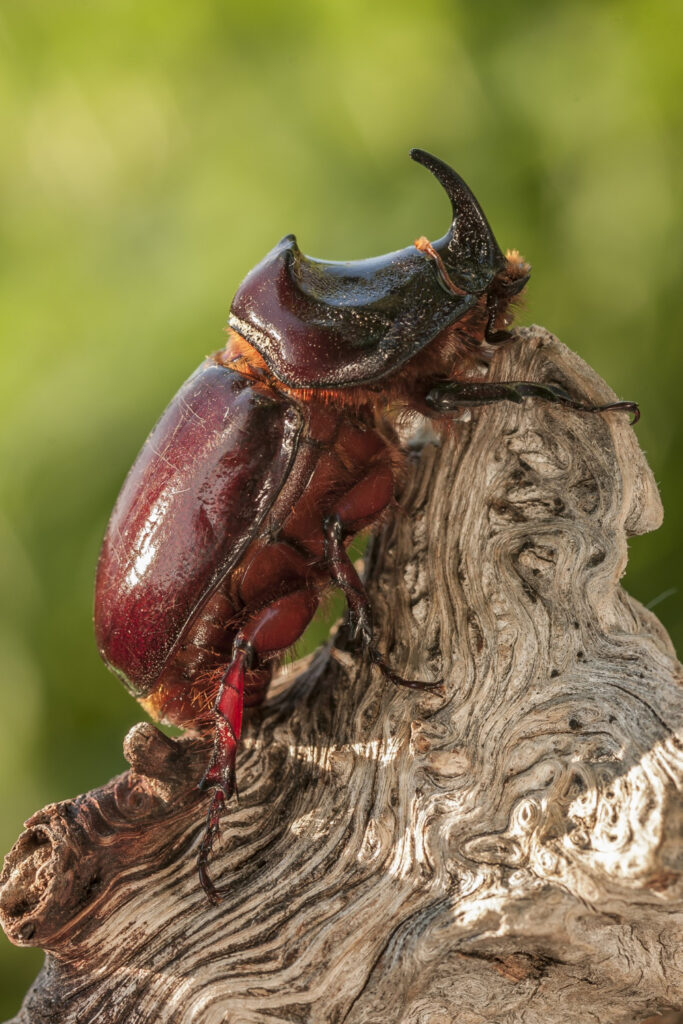
Scarab beetles are members of the family Scarabaeidae, a group of more than 30,000 species worldwide recognized by one shared feature: antennae that end in flattened plates the beetle can fan open like the pages of a book. Most are stout, oval, and heavy-bodied, with front legs built for digging.
That single antenna trait links insects that otherwise seem to have nothing in common — the metallic green Japanese beetle chewing your roses, the clumsy brown June bug thumping against a porch screen, the horned rhinoceros beetle, and the dung beetle rolling a ball across a pasture. All of them are scarabs.
The family also produces the most familiar larva in North American soil: the fat, white, C-shaped grub that turns up whenever you dig a garden bed or lift a patch of dying turf.
About This Guide
This page is a family-level overview. It explains what makes a beetle a scarab, walks through the major subgroups, shows how to recognize scarab larvae, and separates the genuinely damaging species from the many that are harmless or actively beneficial.
One honest limitation up front: family is usually identifiable from a good look at a live beetle, but species often is not. Scarabaeidae contains thousands of look-alikes, and several important groups can only be separated by examining fine details under magnification. Any guide that promises a species-level ID from a phone photo is overselling. Where certainty matters — a crop, a large lawn, or a suspected regulated pest — a physical specimen and a trained eye are the only reliable route.
What Makes a Beetle a Scarab?
The lamellate antenna is the single best clue
If you learn one thing about scarab beetles, learn their antennae.
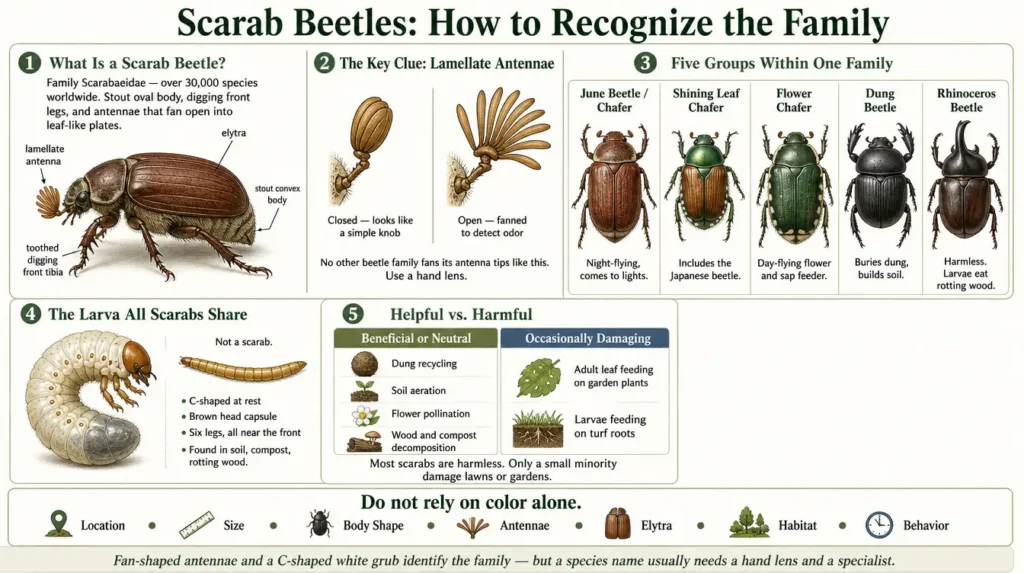
The last three to seven antennal segments are flattened sideways into thin plates called lamellae. At rest, these plates press together into a tight, knob-like club, so the antenna looks simply clubbed. When the beetle picks up a scent — flowers, sap, fresh dung, a mate — it spreads the plates apart like fingers or the leaves of a book, dramatically increasing the surface area available for detecting odor.
No other beetle family does exactly this. Click beetles have straight, saw-toothed antennae. Longhorn beetles have long, thread-like ones. Stag beetles come closest, with an elbowed antenna ending in a comb-like club, but those teeth are fixed and cannot close into a smooth ball.
Because the plates are usually shut, you often need a hand lens and a cooperative beetle. It is worth the effort: this trait is far more reliable than color, size, or shape. If you want to see how this fits into the wider picture, our guide to telling beetle families apart by their antennae compares all the major antenna types side by side.
A stout, oval, heavy body
Adult scarabs are compact and solidly built — convex on top, broadly oval or short-oblong in outline, with hard elytra (wing covers) that often have a glossy or enameled look. Most North American species run from about a quarter inch to an inch and a half. The largest tropical species, including the Goliath and Hercules beetles, reach several inches and are among the heaviest insects alive.
Color is wildly variable and, on its own, tells you almost nothing. Nocturnal groups tend toward brown, chestnut, and black. Day-active groups are often brilliant metallic green, bronze, copper, or gold. Both patterns occur within the same family, sometimes within the same subfamily.
Front legs built for digging
Turn a scarab over and look at the front legs. The outer edge of each front tibia is typically toothed or scalloped, like a small rake or shovel blade. These are fossorial legs — adapted for burrowing into soil, sand, compost, or dung.
The trait makes sense once you know the life history: nearly every scarab spends its larval stage underground or buried in organic matter, and most adult females dig to lay eggs. Some dung-rolling species have additionally modified hind legs that curve around a dung ball to grip and push it.
Other useful details include five segments on each tarsus (the “foot”), a stout head with strong chewing mouthparts, and, in many groups, horns on the head or thorax of males.
The Major Groups of Scarab Beetles
Scarabaeidae is divided into more than two dozen subfamilies, and the classification is still being revised — several groups once placed inside it have been raised to full family rank. For practical purposes, five clusters cover almost everything a North American reader will encounter.
June beetles and chafers (Melolonthinae)
The classic “June bug.” Adults are reddish-brown to chestnut, dull and slightly velvety rather than metallic, oval, and roughly half an inch to an inch long. They fly at night in early summer, bumble into lighted windows, and are clumsy on their feet.
The subfamily includes Phyllophaga May and June beetles, masked chafers, European chafers, and the Asiatic garden beetle. Adult behavior varies: some feed on tree foliage, while masked and European chafer adults do not feed at all. Their larvae are the white grubs most often blamed for lawn damage.
Shining leaf chafers (Rutelinae)
Smaller, glossier, and frequently metallic. This is where the Japanese beetle sits — metallic green head and thorax, coppery wing covers, and five small tufts of white hair along each side of the abdomen. Those hair tufts are the most reliable field mark for the species, since metallic green alone matches dozens of unrelated beetles. Our full Japanese beetle profile covers its host plants, damage pattern, and seasonal timing in detail.
Flower chafers (Cetoniinae)
Roughly 4,000 species, many of them day-flying and brightly colored. Adults visit flowers for pollen and nectar, browse on petals, and feed at sap flows and soft ripe fruit. Green June beetles, bee-mimic beetles, and the spectacular African Goliath beetles all belong here.
These are the scarabs most likely to be doing pollination work, and most likely to be mistaken for something dangerous because of their loud, low, hovering flight. They do not sting and cannot harm a person.
Dung beetles (Scarabaeinae and Aphodiinae)
The recyclers. Adults and larvae feed on mammal dung, which they roll away, tunnel beneath, or nest directly inside. In doing so they bury nutrient-rich material, aerate soil, and remove the breeding medium for pest flies and livestock parasites.
The economic value is substantial. A widely cited 2006 analysis estimated the dung-burial services these beetles provide to the U.S. cattle industry at roughly $380 million per year in avoided fertilizer, forage, parasite, and fly costs. Our dung beetle guide covers the rollers, tunnelers, and dwellers and how their nesting behavior differs.
Rhinoceros beetles (Dynastinae)
The heavyweights. Males of many species carry prominent horns on the head and thorax, used in shoving contests with rival males over feeding or mating sites. Despite their armored look, they have no sting, no venom, and mouthparts built for soft plant material and sap. Larvae develop in rotting wood, compost, and leaf litter.
This subfamily also contains the masked chafers, whose modest brown adults look nothing like their horned relatives — a good reminder that subfamily membership is about structure, not appearance. See our rhinoceros beetle profile for the species-level details.
Quick comparison
| Group | Typical look | Active when | Larvae develop in | Usual role |
|---|---|---|---|---|
| June beetles & chafers | Dull brown, stout, ½–1″ | Night, early summer | Turf and soil, on roots | Sometimes a lawn pest |
| Shining leaf chafers | Small, glossy, metallic | Day | Turf and soil | Includes garden pests |
| Flower chafers | Bright, often velvety green | Day | Compost, rich soil, rotting wood | Pollinator, decomposer |
| Dung beetles | Black or metallic, rounded | Day or night | Buried dung | Decomposer, soil builder |
| Rhinoceros beetles | Large, horned males | Night | Rotting wood, compost | Harmless decomposer |
White Grubs: The Larva Every Scarab Shares
Nearly all scarab larvae look alike, and the resemblance is strong enough to be diagnostic at family level.
A scarab grub is:
- C-shaped at rest, straightening only when crawling
- Dirty white to gray, soft, and plump, with a translucent darkened rear end
- Equipped with an orange-brown to black head capsule and hardened jaws
- Fitted with three pairs of legs clustered near the front, and none along the rest of the body
- Anywhere from a quarter inch to two inches long, depending on species and age
Full-grown Japanese beetle and masked chafer grubs average a little over an inch. May and June beetle grubs get considerably larger and may spend two or three years underground before pupating.
Telling scarab grubs from other larvae
- Wireworms (click beetle larvae) are slender, hard, shiny, and yellow-brown — nothing like a soft white grub.
- Fly maggots have no legs and no hard head capsule.
- Caterpillars have fleshy prolegs along the abdomen in addition to three pairs of true legs.
- Green June beetle grubs are the odd scarab out: their legs are small and weak, and they crawl on their backs, undulating across the soil surface, sometimes in plain view at night.
Separating scarab grubs to species is a different matter. Entomologists rely on the raster — a species-specific arrangement of hairs and spines on the underside of the last abdominal segment. Japanese beetle grubs show a V-shaped raster; masked chafer grubs show a random scatter; May and June beetle grubs show two parallel rows; European chafer grubs show parallel rows plus a Y-shaped anal slit. Reading these patterns requires a hand lens or microscope and a clean specimen. For a wider comparison of beetle larvae across families, see our beetle larva identification guide.
Helpful, Harmful, or Neither?
The most useful thing to understand about scarab beetles is that the family splits sharply by ecological role, and membership tells you very little about impact.
Decomposers. Dung beetles, many flower chafers, and rhinoceros beetle larvae process manure, leaf litter, compost, and rotting wood. This work returns nutrients to soil and is unambiguously beneficial.
Pollinators. Day-flying flower chafers carry pollen between blossoms as they feed. Certain rhinoceros beetles in the tribe Cyclocephalini are the primary — sometimes exclusive — pollinators of water lilies, custard apples, aroids, and some palms, which trap the beetles overnight in warmed flower chambers.
Turf and garden pests. A minority of species cause real trouble. Japanese beetle adults skeletonize foliage on hundreds of plant species. The larvae of Japanese beetles, masked chafers, European chafers, and several relatives sever grass roots, producing patches that yellow, wilt, and can be rolled back like carpet. Skunk, raccoon, and mole digging in a lawn is often the first sign.
Even here, restraint is warranted. Extension entomologists consistently note that a healthy lawn tolerates a modest grub population without visible injury, and that lawns do not need annual treatment in the absence of damage. If you suspect grubs, confirm before acting: lift a square-foot flap of turf, sift the top few inches of soil and thatch, and count what you find. Mowing higher, watering deeply but infrequently, and keeping turf vigorous all raise the damage threshold. Reducing bright outdoor lighting through midsummer can lower the number of night-flying adults settling nearby to lay eggs.
If numbers look high or damage is spreading, your county or state extension office can identify the species, tell you which life stage is present, and advise on locally appropriate options. Species and timing determine what works, which is exactly why a general web page is the wrong place to get a treatment recipe.
The Sacred Scarab of Ancient Egypt
The family name traces back to Scarabaeus sacer, a Mediterranean dung beetle that ancient Egyptians watched roll a ball of dung across the sand, bury it, and later produce apparently self-created young.
They read the daily ball-rolling as an image of the sun’s passage across the sky, and identified the beetle with Khepri, the god of the rising sun — a name built on the root kheper, “to come into being.” Khepri appears in the Pyramid Texts as early as the Fifth Dynasty. Carved scarabs went on to serve as seals, personal amulets, and heart scarabs placed in mummy wrappings and inscribed with a spell from the Book of the Dead.
It is a striking case of accurate observation feeding mythology: the behavior the Egyptians described is real dung beetle biology, and the beetle they revered still lives in North African pastures.
Common Identification Mistakes
- Relying on color alone. Metallic green appears in scarabs, leaf beetles, tiger beetles, and jewel beetles. Brown and black appear everywhere. Color narrows nothing on its own.
- Assuming horns mean rhinoceros beetle. Horned males occur in several scarab subfamilies, and stag beetles — a separate family — carry enlarged jaws that are often mistaken for horns.
- Calling any white grub a Japanese beetle grub. At least eight scarab species produce indistinguishable-looking grubs in North American lawns, and management timing differs among them.
- Treating all scarabs as pests. Most species in the family never touch a garden plant. Some of the ones you are most likely to see are pollinators or decomposers.
- Confusing the family with the superfamily. Stag beetles, bess beetles, hide beetles, and earth-boring dung beetles are all in Scarabaeoidea but are not in Scarabaeidae.
A trustworthy identification combines location, size, body shape, antennae, elytra texture and markings, larval form, habitat, season, and behavior. Any one of those alone will mislead you. Our broader beetle group comparisons can help you place an unfamiliar beetle in the right family before you attempt a species.
When Professional Identification Matters
Contact a local extension office, university entomology department, natural history museum, or licensed pest professional when:
- Grub damage covers a large lawn, sports field, or pasture and you need species-specific timing
- Beetles are damaging a commercial crop or nursery stock
- You are in a region where regulated pests such as the Japanese beetle are under active quarantine or survey
- You want a definitive species name for a collection, class project, or record
Bring a physical specimen where possible. A beetle in a small vial of alcohol, or a grub preserved the same way, is worth far more to an identifier than a dozen photographs.
Frequently Asked Questions
What is a scarab beetle?
Any beetle in the family Scarabaeidae — a group of over 30,000 species defined by antennae ending in flattened plates that fan open, stout oval bodies, and digging front legs.
Are scarab beetles dangerous to humans?
No. Scarab beetles have no sting and no venom, and they do not transmit disease. Even the large horned species are harmless to handle.
Do scarab beetles bite?
Not in any meaningful sense. Their jaws are built for leaves, sap, fruit, or dung. A large beetle gripping your skin with its clawed feet may feel like a pinch, but it is not a bite.
What is the easiest way to identify a scarab beetle?
Look at the antenna tip with a hand lens. If the last few segments are thin plates that can spread apart like a fan, you have a scarab.
Are all white grubs scarab beetles?
The classic white grub — C-shaped, pale, brown-headed, six legs near the front — is a scarab larva. Other beetle larvae in soil, such as wireworms, look completely different.
Is a Japanese beetle a scarab beetle?
Yes. It belongs to the shining leaf chafer subfamily, Rutelinae, within Scarabaeidae.
Is a stag beetle a scarab beetle?
No. Stag beetles are in the family Lucanidae. They are related — both sit in the superfamily Scarabaeoidea — but their antennal club has fixed teeth that cannot close into a smooth ball.
Why do scarab beetles fly into lights at night?
Many June beetles, chafers, and rhinoceros beetles are nocturnal and are strongly drawn to artificial light. This is why they appear at porch lights and windows on warm early-summer evenings.
What do scarab beetles eat?
It depends entirely on the group: dung, decaying plant matter, rotting wood, fungi, sap, nectar and pollen, ripe fruit, living leaves, or grass roots. Some adults, including masked chafers, do not feed at all.
Are scarab beetles good or bad for a garden?
Mostly good or neutral. Dung beetles and flower chafers improve soil and pollinate. A small number of species, chiefly Japanese beetles and a handful of turf-feeding chafers, cause real damage — but they are the exception within the family.
Conclusion
Scarab beetles are far easier to recognize as a group than most people expect. The fan-like lamellate antenna, the stout oval body, the toothed digging legs, and the C-shaped white grub together make Scarabaeidae one of the most identifiable beetle families in the world. What those shared traits do not tell you is what any given species does — the family runs from pasture-cleaning dung beetles and flower-visiting pollinators to a small handful of genuine turf and garden pests.
So when a heavy brown beetle hits your window screen or a pale grub curls up on your trowel, you can place it confidently in the scarab family. Going further, to a species and a decision about what to do next, usually calls for a hand lens, a look at the raster, and — when it matters — a conversation with your local extension office.
References and further reading
- Missouri Department of Conservation — Scarab Beetles (Scarabaeids)
- NC State University, ENT 425 General Entomology — Family Scarabaeidae
- Penn State Extension — White Grubs in Home Lawns
- University of Maryland Extension — White Grubs in Lawn and Garden Soil
- University of Georgia Extension — White Grub Pests of Turfgrass
- Texas A&M AgriLife, El Paso IPM — Family Scarabaeidae
- BugGuide.Net — Family Scarabaeidae
- McClung Museum of Natural History & Culture — The Sacred Scarab
1 thought on “Scarab Beetles: Identification, Types & Key Traits”