

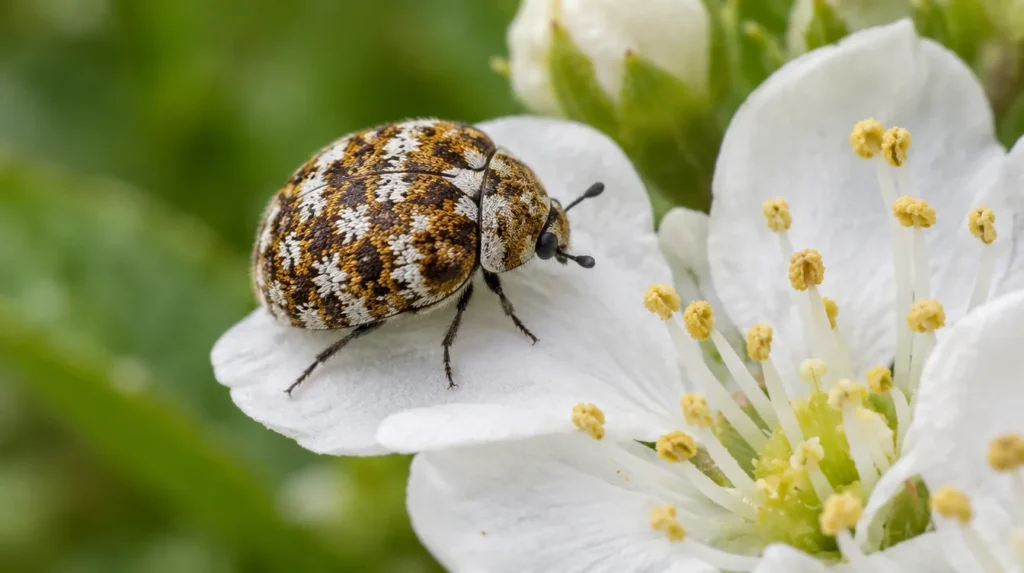
The varied carpet beetle (Anthrenus verbasci) is a tiny, rounded beetle in the skin beetle family (Dermestidae) recognized by the mottled white, tan, brown, and yellow-gold scales covering its dark back. Adults measure only about 1.5–3.5 mm (roughly 1/16–1/8 inch) and feed outdoors on flower pollen, while their bristly, banded larvae feed on dried animal proteins such as wool, feathers, fur, dead insects, and household lint.
Because it is widespread in both outdoor nests and indoor dust pockets, A. verbasci is one of the most frequently photographed tiny beetles on windowsills in spring. At the same time, its fragile surface scales rub off easily as the insect ages, which is why older adults are often mistaken for plain brown or black beetles.
Quick Facts: Varied Carpet Beetle (Anthrenus verbasci)
- Adult length: About 1.5–3.5 mm (1/16–1/8 inch)
- Mature larva length: About 4–5 mm (roughly 3/16 inch)
- Family: Dermestidae (skin and carpet beetles)
- Adult diet: Flower pollen and nectar outdoors; adults do not eat fabric
- Larval diet: Keratin and dried animal matter (wool, silk, fur, feathers, hair, dead insects, museum specimens)
- Typical indoor sighting: Sunny windowsills in spring (adults) or dark lint seams along baseboards and closets (larvae and cast skins)
Quick Identification Checklist
Color pattern alone is never enough to confirm a beetle species, especially in Dermestidae where scales wear away. A sighting is consistent with an adult varied carpet beetle when several of these clues line up together:
- Size: Very small—roughly the width of a sesame seed, about 1.5–3.5 mm long.
- Body shape: Broadly oval to nearly round, convex on top, and compact when viewed from above.
- Wing covers (elytra): The hardened front wings meet in a straight line down the back and carry irregular wavy bands of white, brown, and yellowish-tan scales over a dark cuticle.
- Underside: Coated with pale grayish-yellow to whitish scales rather than stark bright white.
- Antennae: Short and distinctly clubbed (thickened at the tips), often tucked tight against the body when the beetle is disturbed.
- Behavior: Pulls its legs and antennae inward and plays dead briefly if touched, and often walks or flies toward bright windows indoors.
Scientific Classification
Entomologists place the varied carpet beetle within the family Dermestidae—a group of more than 1,800 described scavenger beetles—and the subfamily Megatominae. Its species name, verbasci, refers to mullein (Verbascum), one of the flowering plants where adults were historically collected.
| Taxonomic Rank | Classification |
|---|---|
| Order | Coleoptera (beetles) |
| Suborder | Polyphaga |
| Superfamily | Bostrichoidea |
| Family | Dermestidae |
| Subfamily | Megatominae |
| Tribe | Anthrenini |
| Genus | Anthrenus |
| Species | Anthrenus verbasci (Linnaeus, 1767) |
To see how A. verbasci fits alongside other well-known taxa, browse the beetle species profiles or review general identification methods in our beetle identification hub.
Adult Appearance and Why Older Individuals Look Different
A freshly emerged adult varied carpet beetle has a crisp, mosaic-like pattern. Its elytra (the hardened forewings that form the beetle’s protective shell) and pronotum (the shield-like plate behind the head) are covered in microscopic flattened scales rather than painted pigment. Those scales create three irregular whitish-to-cream crossbands bordered by brown and yellowish-tan patches over a dark brown or black background.
Because those scales are physically attached to the surface like fine dust on a moth wing, everyday friction wears them off. Older adults—especially ones that have crawled through dusty crevices or spent weeks visiting flowers—may lose most of their pale scales and look dull dark brown or nearly solid black. When that happens, body outline, short clubbed antennae, and tiny size become far more useful clues than color. If you found a plain dark speck indoors without visible patterning, our tiny brown beetle identification guide can help you separate worn dermestids from pantry and wood-associated beetles.
Adult vs. Larva: Two Very Different Life Stages
People often assume they have two unrelated insects in the same room because varied carpet beetle adults and larvae look nothing alike. In practice, recognizing the larval stage matters most, because larvae are the only stage that chews natural fibers.
| Feature | Adult Anthrenus verbasci | Larva Anthrenus verbasci |
|---|---|---|
| Length | 1.5–3.5 mm (1/16–1/8 inch) | Up to 4–5 mm (about 3/16 inch) when mature |
| Body shape | Rounded-oval, domed, compact | Plump, teardrop-shaped—distinctly broader near the rear than at the head |
| Surface texture | Covered in tiny flat white, brown, and yellow scales | Alternating light and dark brown bands with dense tufts of dark bristles |
| Wings & mobility | Functional flight wings beneath elytra; crawls and flies | Wingless; crawls slowly in dark crevices |
| Food source | Pollen and nectar outdoors | Keratin-rich animal materials, dead insects, lint, and dry organic debris |
Diagnostic Larval Clues: Shape, Bristles, and Cast Skins
A helpful field clue for separating varied carpet beetle larvae from other common carpet beetle larvae is body taper: A. verbasci larvae are noticeably broader toward the hind end and narrower toward the head. By contrast, furniture carpet beetle larvae (Anthrenus flavipes) are broader toward the front, and black carpet beetle larvae (Attagenus unicolor) are longer, smoother, and carrot-shaped with a single trailing tuft of tail hairs.
Along the rear segments of an A. verbasci larva sit dense tufts of specialized, spear-tipped hairs called hastisetae. When disturbed, the larva flares these tufts upright into a defensive fan that can entangle small predatory ants or spiders. As larvae grow, they shed their outer skins (exuviae) multiple times. Those hollow, bristly shed skins remain behind long after a larva moves on and are often the first physical clue people notice inside a drawer seam or along a carpet edge. For broader help comparing grubs and bristly larvae, see our beetle larva identification guide.
Geographic Range and Habitat
Anthrenus verbasci is thought to have originated in the Palearctic region (Europe and parts of Asia), but centuries of global trade in wool, hides, grain, and household goods have carried it across much of the temperate world. Today it is widely established across North America (where historical records suggest arrival by the mid-1800s), Europe, Australia, New Zealand, and parts of Asia.
Outdoor Habitats
Outdoors, females lay eggs in dry, sheltered spots rich in dead insects or feathers—especially old bird nests (such as sparrow and swallow nests under eaves), abandoned wasp or bee nests, bat roosts, and sheltered spider webs. Adults congregate on open, pollen-rich flowers in spring and early summer.
Indoor Microhabitats
Indoors, larvae favor quiet, dark areas where pet hair, human hair, wool fibers, or dead insects accumulate: beneath heavy rugs and sofas, along baseboards, inside air ducts, behind radiators, in closets with unwashed woolens, and inside natural-history collections.
Diet and Ecological Role
Like many members of order Coleoptera, the varied carpet beetle fills two different ecological niches across its life stages (see what beetles eat for how widely beetle diets vary between adults and larvae).
- Adults as minor pollinators: Adult A. verbasci visit bright, open blossoms—especially white and pale-colored flowers such as spirea (Spiraea), yarrow, Queen Anne’s lace, and ornamental shrubs—where they eat pollen and nectar and mate in warm sunlight.
- Larvae as keratin decomposers: In nature, dermestid larvae perform essential cleanup work by breaking down tough animal proteins (keratin and chitin) left behind in carcasses, nests, and spider webs.
- Indoor food sources: Inside buildings, that same keratin-digesting ability lets larvae feed on wool rugs, cashmere, felt (including piano felts), silk, fur, feathers, leather bookbindings, taxidermy mounts, and pinned insect collections. They generally ignore clean synthetic fabrics such as polyester or nylon, though stains from food, sweat, or body oils can attract feeding on blended textiles.
Behavior and Life Cycle
The varied carpet beetle undergoes complete metamorphosis—egg, larva, pupa, and adult—following the four-stage pattern outlined in our beetle life cycle guide. What makes A. verbasci unusually interesting to entomologists is how flexible its larval clock is.
- Egg stage: A mated female typically lays around 40 eggs (occasionally more under favorable conditions) tucked into lint, fabric folds, or nest debris. Eggs hatch in roughly 10–20 days depending on temperature.
- Larval stage: Larvae avoid light and feed slowly, molting several times. According to university extension data (including UC IPM and UF/IFAS), larval development commonly spans about 220 to 350 days—and can stretch past 600 days (up to two or even three years) when temperatures are cool or food is scarce. Research on A. verbasci has shown that larval diapause (a developmental pause) is regulated by an internal circannual rhythm cued by seasonal changes in day length.
- Pupal stage: The mature larva pupates inside its final split larval skin, remaining as a pupa for roughly 10–13 days.
- Adult stage: Adults emerge primarily in spring and early summer outdoors (though heated buildings can produce stray adults over a broader window). Adult males typically live about 2–4 weeks and females about 2–6 weeks. Because adults are strongly attracted to daylight, indoor adults routinely gather on windowsills trying to get outside to flowers.
Pest Relevance and Calm Perspective
Seeing one or two varied carpet beetles on a windowsill in April or May does not automatically mean you have a fabric infestation. Adults are strong fliers that enter through open windows, loose screens, or cut garden flowers, and they may also emerge from an old bird nest in a soffit or attic vent.
Concern is more justified when you find multiple live larvae, clusters of bristly cast skins, or irregular holes in stored wool, silk, fur, or feathers. In museums and personal collections, A. verbasci is a well-documented specimen pest capable of hollowing out dried insects and bird skins if cabinets are unsealed. For everyday homes, thorough vacuuming of baseboards and under furniture, laundering or freezing susceptible woolens, and storing clean natural fibers in airtight containers resolve most minor issues. If damage is widespread across valuable textiles, antique upholstery, or a collection, consult a licensed pest management professional, local university extension office, or museum conservator.
Similar Species and Common Lookalikes
Several other dermestid beetles share the same indoor habitats as the varied carpet beetle. Comparing body outline, dorsal scale pattern, and larval shape helps narrow down the likely species:
| Species | Adult Size & Shape | Key Adult Pattern | How the Larva Differs |
|---|---|---|---|
| Varied carpet beetle Anthrenus verbasci | 1.5–3.5 mm; nearly round | Mottled white, brown, and yellow-tan scales in irregular bands; pale grayish-yellow underside | 4–5 mm; banded brown; broader at the rear than the front |
| Furniture carpet beetle Anthrenus flavipes | 2–3.5 mm; slightly rounder | Bolder white, yellow-orange, and black mottling; stark white underside | 4–5 mm; white turning dark chestnut; broader at the front than the rear |
| Common carpet beetle Anthrenus scrophulariae | 2–3.5 mm; broadly oval | Black with white speckles and a distinct orange-to-brick-red stripe down the center seam | 4–5 mm; elongate-oval, reddish-brown, fast-moving, covered in dark hairs |
| Black carpet beetle Attagenus unicolor | 2.5–5 mm; elongated oval | Solid shiny black to dark brown with brownish legs; no multicolored scales | Up to 10–12 mm; smooth, carrot-shaped, golden-brown with a long trailing tail tuft |
Outside Dermestidae, people sometimes confuse worn dark adults with drugstore beetles (Stegobium paniceum) or cigarette beetles (Lasioderma serricorne), which are more cylindrical, reddish-brown, and tied to dry pantry goods rather than wool or lint. Tiny round lady beetles can look superficially similar at a glance, but lady beetles have smooth, glossy wing covers without dust-like scales.
Identification Limitations
Even with a sharp smartphone photo, species-level confirmation within the genus Anthrenus is not always possible. Two practical hurdles come up repeatedly:
- Abraded scales: Once an adult loses its surface scales, A. verbasci, A. flavipes, and A. scrophulariae can all look like plain dark brown or black ovals.
- Close relatives in the same genus: More than 250 species of Anthrenus exist worldwide, including the museum beetle (A. museorum) and regional outdoor flower-visiting species. Confirming an unusual or worn specimen to exact species typically requires magnification to inspect antennal segment count, eye margins, scale shape, or underside coloration—a job best suited to an entomologist or local extension diagnostic lab.
Frequently Asked Questions
Do adult varied carpet beetles eat carpets or clothes?
No. Adult varied carpet beetles feed on flower pollen and nectar outdoors and do not chew fabric indoors. Only the bristly larval stage feeds on wool, silk, fur, feathers, and other dried animal proteins.
Why do I keep finding varied carpet beetles on my windowsill?
Adults are strongly attracted to daylight. Beetles that emerged indoors from a hidden lint pocket or attic nest fly toward sunny windows trying to reach outdoor flowers, while outdoor adults can also wander in through gaps around window screens.
Are varied carpet beetles dangerous to people or pets?
They do not bite, sting, or transmit human diseases. The main health nuisance is localized skin irritation in people who touch larval hairs (hastisetae) or shed skins directly, which can be minimized by vacuuming affected areas and washing stored textiles.