

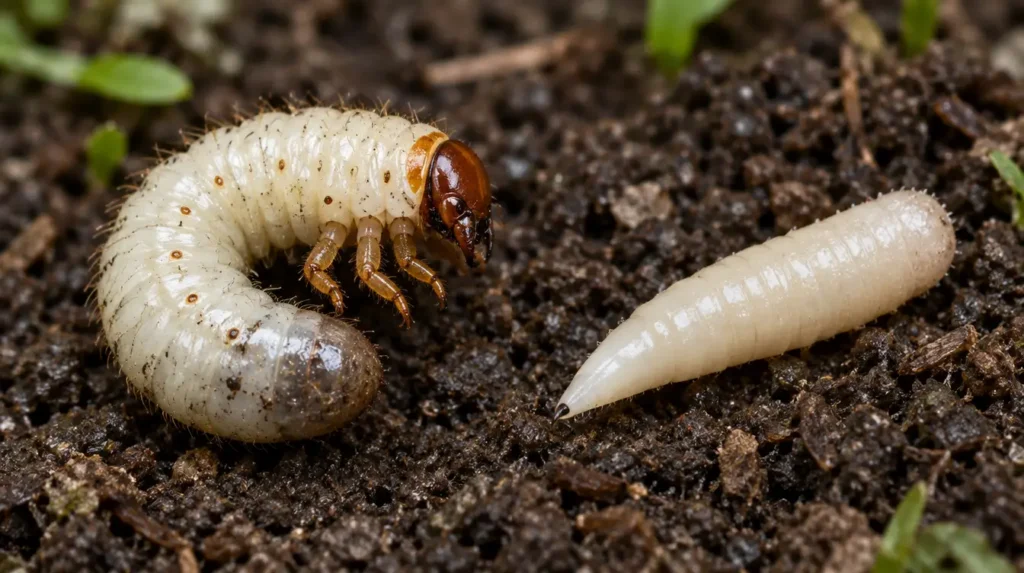
Look at the front end first. A beetle larva almost always has a distinct, hardened head, usually tan to dark brown, with chewing jaws. Most also have six short jointed legs just behind that head. A maggot has neither: its body narrows to a soft point at the front, with no visible head and no legs at all.
That one check settles most cases. The rest of this page covers the cases it does not settle, because a few beetle larvae are legless and a few fly larvae do have a visible head.
Quick comparison
| Feature | Beetle larvae | Maggots (fly larvae) |
|---|---|---|
| Insect order | Coleoptera | Diptera |
| Head | Distinct, hardened capsule, usually darker than the body | No distinct head; front end tapers to a point |
| Mouthparts | Chewing jaws that work side to side | A pair of dark mouth hooks |
| Legs | Usually six jointed legs behind the head; some groups legless | Never any jointed legs |
| Body shape | Varies widely: C-shaped, wiry, flattened, bristly, or elongated | Usually carrot-shaped: pointed in front, blunt behind |
| Skin | Often partly hardened or plated; some hairy | Soft, smooth, and moist looking |
| Typical places | Soil, roots, wood, seeds, stored food, fabrics, leaves | Wet decaying matter, garbage, manure, carrion, rotting fruit, some roots |
| Next stage | Pale pupa with legs and wing pads visible | Smooth brown capsule called a puparium |
What “maggot” and “beetle larva” actually mean
“Maggot” is a common name, not a scientific category. It normally refers to the legless, headless larvae of flies such as house flies, blow flies, fruit flies, and root maggots. All flies belong to the order Diptera.
Beetle larvae are the immature stage of beetles, order Coleoptera. “Grub” is the everyday word for the plump, pale ones, especially the C-shaped larvae of scarab beetles. Other beetle larvae look nothing like a grub: wireworms are thin and hard, lady beetle larvae are spiny and active, and carpet beetle larvae are bristly.
Both groups go through complete metamorphosis (egg, larva, pupa, adult), which is why neither larva resembles its adult. The beetle life cycle page explains those four stages in more detail.
Check 1: Is there a distinct head?
Hold the larva under good light, with a 10x hand lens if you have one.
Beetle larva: The head is a separate capsule, clearly set off from the body and harder than the skin behind it. On a white grub it is chestnut brown against a white body. On a weevil larva it is yellow to light brown. You can usually see a pair of jaws.
Maggot: The front end simply narrows. There is no capsule, no eyes, and no jaws. What you may see through the skin is a small dark mark at the tip. Those are the mouth hooks, which the maggot uses to feed and to pull itself forward.
The University of Kentucky’s larval key uses the same split: legless larvae with a distinct head on one side, and larvae with no visible head, or a head withdrawn into the body, on the other. Typical fly maggots are described there as having no head and a cream to white body that tapers toward the front.
Check 2: Are there jointed legs?
Look just behind the head, on the first three body segments.
- Six jointed legs: it is not a fly. No fly larva has jointed legs. It may be a beetle larva, but check for fleshy, unjointed legs farther back on the body as well. Caterpillars and sawfly larvae have those; beetle larvae do not.
- No legs at all: it could be a maggot, or one of the legless beetle larvae described below. Go back to the head.
Leg length is a useful extra clue among beetles. Long legs on a slender, fast-moving larva suggest a predator such as a lady beetle or ground beetle larva. Short, thick legs on a slow, stout larva suggest a root or plant feeder such as a white grub or wireworm.
Check 3: What shape is the body?
Maggots are fairly uniform. Most are cream to white, smooth, and carrot-shaped, with the narrow end in front and a blunt rear. House fly maggots are roughly 2.5–8 mm long (about 1/10–1/3 inch). Blow fly maggots are larger but share the same outline.
Beetle larvae come in several distinct forms:
- C-shaped white grubs. White, soft, curled into a C at rest, with a chestnut head and three pairs of clearly visible legs. Older grubs range from about 6 to 38 mm (1/4 to 1 1/2 inches) depending on species. These are the larvae of scarab beetles.
- Wireworms. Hard, cylindrical, yellowish to brown, with short legs near the head. These are click beetle larvae.
- Active predators. Elongated, often dark, with a pointed body and fairly long legs. Ground beetle and lady beetle larvae fit here.
- Bristly larvae. Carpet beetle and other dermestid larvae are light brown and visibly hairy, and can reach about 13 mm (1/2 inch).
A larva that is hairy, armored, wiry, or striped is not a maggot.
Check 4: Where did you find it?
Location is supporting evidence, not proof, but it narrows the options.
In garbage, compost, manure, pet waste, or on a dead animal. Most likely maggots. House flies and blow flies lay eggs in moist, decaying material, and the larvae appear in large numbers within days.
In lawn or garden soil. C-shaped larvae with legs are white grubs. Grayish brown, legless, tube-shaped larvae with no obvious head are probably crane fly larvae, often called leatherjackets. They grow to about 30 mm (1 1/4 inches). The beetles in soil guide covers what else turns up when you dig.
In houseplant soil. Tiny, slender, translucent larvae with a shiny black head are fungus gnat larvae. Legless, C-shaped larvae with a brown head feeding on roots are more consistent with a weevil.
In roots, bulbs, or seedlings. Small white headless larvae tunneling in onions, cabbage-family roots, or germinating seeds are root maggots. Hard, wiry larvae in the same spot are wireworms.
On leaves among aphids. Small, headless, slug-like larvae are hover fly maggots, which eat aphids. Spiny, six-legged larvae on the same plant are lady beetle larvae. Both are beneficial. More examples are in the garden beetles guide.
Inside nuts, seeds, fruit, or stems. Either group is possible, and the head decides it. Pepper growers face exactly this choice: pepper weevil (Anthonomus eugenii) larvae are C-shaped with a yellow to light brown head, while pepper maggots (Zonosemata electa) are straight and tapered.
Inside wood. Legless, pale larvae in tunnels under bark or in timber are almost always beetle larvae, not maggots.
In the pantry or on fabrics. Small “worms” in flour, cereal, or dried fruit are usually beetle larvae or moth caterpillars. Bristly larvae on wool, fur, or along baseboards are consistent with carpet beetles.
Beetle larvae that look like maggots
These are the cases where the leg check fails.
Weevil larvae. Legless, pale, plump, and usually curved. The head is still a distinct, colored capsule. The underside tends to be flat and the upper side rounded. They are nearly always inside or against their food: a nut, a seed, a stem, a root.
Wood-boring larvae. Flatheaded borers have a noticeably wide, flattened area just behind the head. Roundheaded borers, the larvae of longhorn beetles, lack that wide area and are more evenly cylindrical. In both, the head is partly drawn into the body, so it can be hard to see. Look for dark jaws at the front and for the setting: tunnels packed with sawdust-like frass.
Fly larvae that look like beetle grubs
Soldier fly larvae. Common in compost bins. Young larvae are gray-white; mature ones are dark brown, flattened, and torpedo-shaped, with tough-looking skin and a small head narrower than the body. They reach about 25 mm (1 inch). People often take them for beetle grubs because of the leathery skin, but they have no legs. The species usually involved is Hermetia illucens, and it is harmless in compost.
Crane fly larvae (leatherjackets). Grayish brown, tough-skinned, legless, with no obvious head and fleshy lobes at the rear end. Found in turf and damp soil, in the same places as white grubs.
Fungus gnat larvae. These break the “no head” rule: they have a distinct dark head. They are far thinner than any grub, translucent, legless, and live in wet potting mix.
Rat-tailed maggots. Found in stagnant, foul water. The long, extendable breathing tube at the rear is unmistakable.
Larvae that are neither
Two other groups are regularly called maggots or grubs.
Caterpillars have a distinct head and six jointed legs like many beetle larvae, plus up to five pairs of fleshy legs on the abdomen. Indian meal moth (Plodia interpunctella) larvae are the usual pantry example: about 13 mm (1/2 inch) when mature, with a brownish head, leaving silk webbing through the food.
Sawfly larvae look like caterpillars but have more pairs of fleshy abdominal legs. They feed openly on leaves.
If you found pupae instead
Fly maggots pupate inside their own hardened last larval skin. The result is a smooth, oval, seed-like capsule with rounded ends, dark brown when mature. A house fly puparium is about 8 mm (1/3 inch) long.
Most beetle pupae are pale and soft, and you can see the adult taking shape: legs, antennae, and wing pads lie folded against the body. They are usually hidden in a soil cell, in wood, or inside the food source.
When you cannot tell
Small, damaged, or very young larvae may not show these features clearly, and species-level identification of larvae often requires a microscope or rearing the insect to adulthood. Identification to “beetle or fly” is usually achievable; identification to species often is not.
For a larva feeding on crops, turning up repeatedly in stored food, or found in structural wood, take a specimen or sharp close-up photos (head end, side view, underside) to your local Cooperative Extension office or a university insect diagnostic lab. Note exactly where it was found and how many there were.
If the head and legs tell you it is a beetle larva, the beetle larva identification guide is the next step for narrowing down the group. For adult beetles, start at the beetle identification hub.
FAQ
Are maggots beetle larvae?
No. Maggots are fly larvae (order Diptera). Beetle larvae belong to a separate order, Coleoptera. The two are not closely related, although both have a larval stage that looks nothing like the adult.
Do maggots turn into beetles?
No. A maggot becomes a fly. A beetle larva becomes a beetle.
Is a grub the same as a maggot?
Not in normal usage. “Grub” usually means a beetle larva, especially a C-shaped scarab larva with a brown head and six legs. “Maggot” means a legless, headless fly larva.
Do maggots have legs?
No jointed legs. Some fly larvae have small fleshy bumps that help them grip, but nothing like the segmented legs behind the head of most beetle larvae.
What are the white worms in my compost bin?
In most bins they are fly larvae. Pale, tapered ones are ordinary maggots; larger, flattened, gray to dark brown ones are soldier fly larvae. C-shaped larvae with a brown head and six legs are beetle grubs, which also live in decaying plant material.