

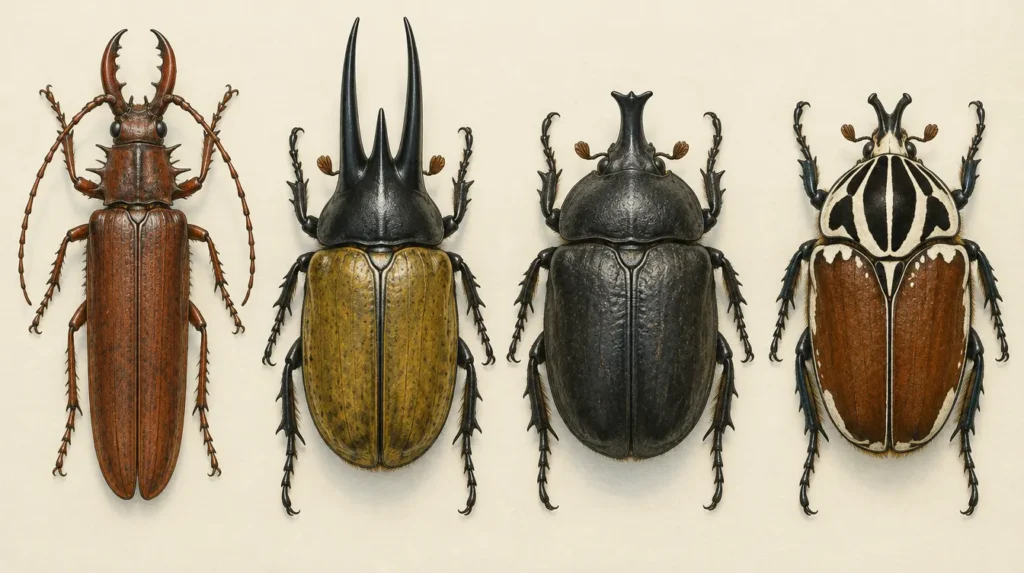
There is no single biggest beetle. There are several record holders, and which one wins depends on what you measure.
If you mean the longest body, the answer is the titan beetle (Titanus giganteus) of South America. The largest reliably measured specimen is 16.7 cm (about 6.5 inches) long. If you count horns and jaws, the Hercules beetle (Dynastes hercules) and a giant longhorn called Macrodontia cervicornis can be even longer. If you mean the heaviest, the title goes to the grub of the Actaeon beetle (Megasoma actaeon). One captive-bred larva weighed 228 g (about 8 oz), roughly the weight of a pet hamster. Among adults, Africa’s Goliath beetles (Goliathus) and the Megasoma rhinoceros beetles are the heavyweights.
The rest of this guide explains each contender, why the records are harder to pin down than they look, and why even the largest beetles stop at around the size of a human hand.
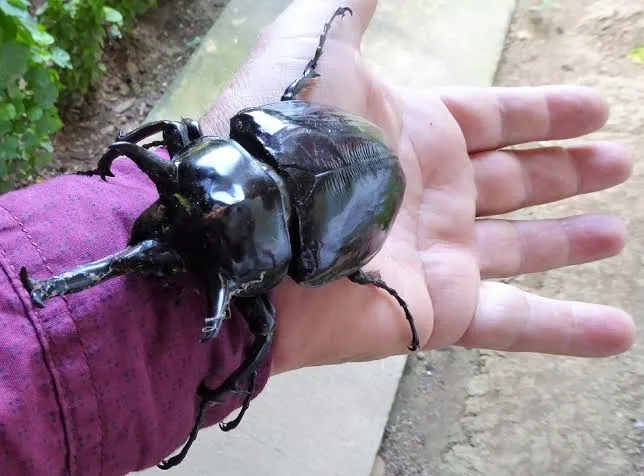
Biggest by What Measure? A Quick Comparison
Size records in beetles are slippery. One beetle may have a long body, another a long horn, and a third a heavy, rounded body. Here is how the main titles break down.
| What “biggest” means | Record holder | Figure | What it actually measures |
|---|---|---|---|
| Longest body | Titan beetle (Titanus giganteus) | 16.7 cm (6.5 in) | Head to tip of abdomen, no horns |
| Longest including horn | Hercules beetle (Dynastes hercules) | 17.2 cm (6.8 in) verified | Includes the long horns of males |
| Longest including jaws | Macrodontia cervicornis | 17.7 cm (7 in) | Includes the enlarged male jaws |
| Heaviest at any life stage | Actaeon beetle larva (Megasoma actaeon) | 228 g (8 oz) | A captive-bred grub, not an adult |
| Heaviest adults | Goliath beetles (Goliathus) and Megasoma rhinoceros beetles | Roughly 40–50 g reliably recorded; higher figures circulate | Live weight varies with feeding and condition |
Every record holder in this table lives in tropical Africa, Central America, or South America. None of them is a beetle you would find in a backyard in North America or Europe.
The Titan Beetle: Longest Body
The titan beetle is a longhorn beetle (family Cerambycidae), the group known for long antennae and wood-boring larvae. Learning how to recognize a longhorn beetle helps put the titan in context. It looks like an ordinary longhorn, scaled up to an extraordinary size.
How big it gets. Guinness World Records lists the largest reliably measured male at 16.7 cm (6.5 inches). That specimen was collected in French Guiana in 1989 and measured after drying, so it was probably slightly longer when alive. Most titan beetles are smaller. Reported averages fall around 13.5–15 cm (about 5.3–6 inches). Stories of 20 cm or “nine-inch” titans have never been verified. They may come from old measurements that included the antennae.
Where it lives. The species is found in tropical rainforests of northern South America. The Smithsonian lists Colombia, Ecuador, Peru, Bolivia, the Guianas, and north-central Brazil.
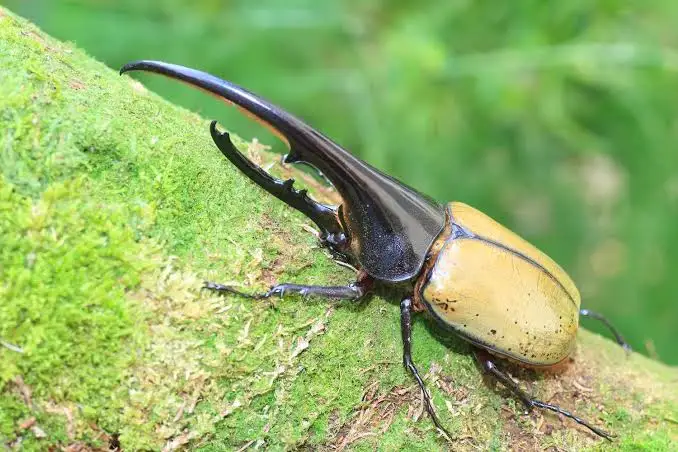
What it looks like. The body is long, flattened, and reddish-brown to dark brown. It has strong, curved jaws (mandibles) and sharp spines along the sides of the pronotum, the plate just behind the head. The Natural History Museum, London, notes that a disturbed titan can hiss by forcing air out of its spiracles, the small breathing openings along its body.
What we still don’t know. The titan’s larval stage has never been properly described. Scientists assume the grubs develop inside decaying wood, as other giant longhorns do, but nobody has documented one in the wild. Adults appear to feed little or not at all, live only a few weeks, and spend that time searching for mates. The Smithsonian notes that adults locate each other by flight and by sensing chemical signals called pheromones.
The Hercules Beetle: Longest Beetle Overall
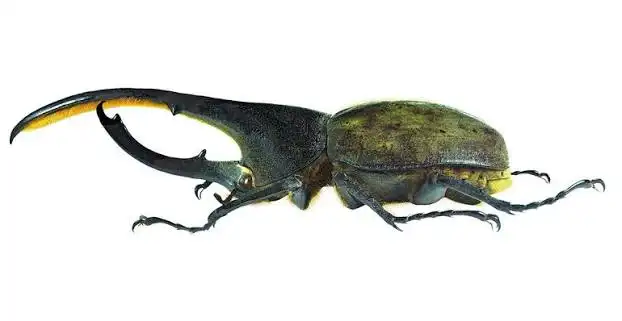
If you measure a beetle from the tip of its horn to the end of its body, the Hercules beetle comes out on top. It is a rhinoceros beetle (subfamily Dynastinae, family Scarabaeidae), part of the same broad group covered in our rhinoceros beetle guide.
How big it gets. Guinness lists a verified record of 17.2 cm (6.77 inches). That male came from the subspecies found on Guadeloupe and Dominica. Claims of 18–19 cm appear in many sources, including some museum and university pages, but Guinness treats 18 cm specimens as unconfirmed. Whichever figure you use, much of the length is horn. The University of Florida gives an adult body length of only about 5–8.5 cm without the horns. The Natural History Museum notes that more than half of a large male’s total length is horn.
Males vs. females. Only males carry the two long horns, one from the head and one from the thorax. They use them to wrestle rivals off branches during contests for females. Females are hornless and usually all black. Males have olive-green to yellowish wing covers (elytra) that can darken toward black in humid conditions.
Where it lives. The Hercules beetle ranges through rainforests from southern Mexico to Bolivia, including the Lesser Antilles in the Caribbean.
Life cycle. The grubs feed on rotting wood inside decaying logs and trunks. The University of Florida reports that development from egg to adult takes roughly 19–21 months under laboratory conditions. Adults feed on rotting fallen fruit.
A Note on Jaws: Macrodontia cervicornis
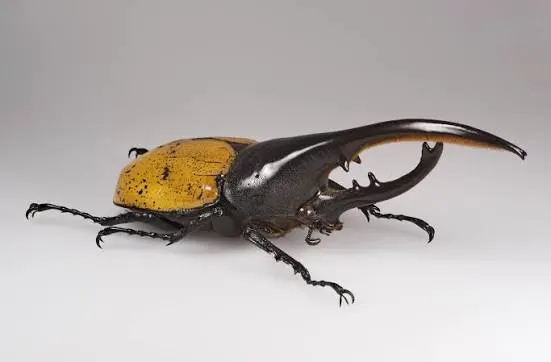
Horns are not the only way to stretch a record. Guinness lists a 17.7 cm (7 inch) male of Macrodontia cervicornis, a giant South American longhorn sometimes called the sabertooth longhorn or giant sawyer. About a third of that length is the male’s huge, toothed jaws. The specimen was recorded in Peru in 2007. The species is native to northern Venezuela, the Amazon basin, and eastern Brazil.
So by total length, Macrodontia can edge past both the titan and the Hercules beetle. This is why size claims depend so heavily on what is included.
The Heaviest Beetle: Actaeon and Elephant Beetles
Weight is a different contest, and here the giant rhinoceros beetles of the genus Megasoma lead.
The record grub. The heaviest beetle at any life stage, and the heaviest insect Guinness recognizes, is a male Actaeon beetle larva weighing 228 g (8.04 oz). It was bred in captivity in Japan in 2009 from a mother collected in Peru. Large Actaeon larvae commonly reach around 200 g. The Natural History Museum compares that to the weight of a Syrian hamster. The larval stage can last around three years.
Why the grub outweighs the adult. A beetle larva is the stage that eats and grows. During pupation, it reorganizes into the adult body and loses much of that bulk. Adult giants are still heavy, but nowhere near the weight of the fattest grubs. If you have ever dug up a fat white C-shaped grub in a garden, you have seen a miniature version of the same body plan. Our beetle larva identification guide shows how scarab grubs differ from other beetle larvae.
The adults. Adult male Actaeon beetles can reach about 13.5 cm (5.3 inches) long. Its close relative, the elephant beetle (Megasoma elephas), reaches about 13.7 cm (5.4 inches). Both are massive, broad, heavily armored rhinoceros beetles with dense bodies. The elephant beetle lives from southern Mexico through Central America into northern South America. The Actaeon beetle is found in northern and central South America.
Goliath Beetles: The Classic Heavyweights
Goliath beetles (genus Goliathus) are the beetles most often called “the heaviest insect” in older books. They belong to the flower chafers (subfamily Cetoniinae), another branch of the scarab beetle family.
Size and appearance. Males of the largest species, Goliathus goliatus and Goliathus regius, reach about 11 cm (4.3 inches). Females are smaller. Adults are broad and boldly patterned in black, white, and brown or cream. Males carry a short, forked horn on the head.
Where they live. Goliath beetles live in tropical forests of equatorial Africa. Adults feed on tree sap and ripe fruit.
How heavy are they really? This is where the numbers get messy. Guinness lists adult Goliath beetles at 70–100 g (2.5–3.5 oz). The Natural History Museum gives larvae at 80–100 g and adults at about half that. A detailed review in the University of Florida Book of Insect Records found much lower documented weights. A live 10 cm Goliath beetle weighed 42 g, and live Actaeon adults were in the same range. The author concluded that the five largest species (two Goliaths, two Megasoma, and the titan) are so close in bulk that no single one can be named the heaviest adult with confidence.
The careful answer is that Goliath beetles are among the heaviest adult insects, alongside the giant Megasoma beetles. The often-quoted 100 g figure for adults is poorly documented.
Why Beetle Size Records Are So Hard to Settle
Even experts disagree about which beetle is biggest. Several practical problems explain why.
- Horns and jaws. Total length favors beetles with long horns or mandibles. Body length favors the titan beetle.
- Life stage. Larvae and adults are not comparable. The heaviest grub becomes a much lighter adult.
- Preparation. Pinned and dried specimens can be stretched or shrink, and the head can tilt at different angles. The University of Florida review notes that width may be a more reliable measurement than length for this reason.
- Live vs. dry weight. A recently fed living beetle weighs far more than a dried museum specimen.
- Captive-bred records. The heaviest larvae on record were raised in captivity with abundant food. Wild individuals may never reach the same weight.
- Unverified claims. Collectors and old books report many larger specimens that were never independently measured.
So when a website names a single “biggest beetle,” check whether it means longest body, total length, or weight. Also check whether the figure refers to an adult or a larva.
Why Don’t Beetles Get Even Bigger?
The largest beetles stop at around 17–18 cm, and there is a physical reason that may help explain the limit.
Insects do not have lungs. They breathe through a network of air tubes called tracheae, which carry oxygen directly to tissues through openings in the body wall. A 2007 study in the Proceedings of the National Academy of Sciences used X-ray imaging of darkling beetles of different sizes. The researchers found that larger beetles devote a disproportionately larger share of their body to these tubes. Tracheae made up about 0.5% of body volume in the smallest species and nearly 5% in the largest.
The squeeze was tightest in the legs. Tracheae have to pass through the narrow joint where each leg meets the body. In the smallest beetles they filled about 2% of that opening; in the largest they filled about 18%. Extrapolating from this pattern, the authors estimated that a beetle could not exceed roughly 16 cm before its leg joints ran out of room for air tubes. That is very close to the size of the titan beetle.
The same study links this to Earth’s past. During parts of the Carboniferous and Permian periods, roughly 300 million years ago, the atmosphere held considerably more oxygen than today. With more oxygen in the air, an insect would need fewer air tubes to supply the same tissues. That could have allowed the giant insects known from that era. The oxygen-limitation idea is well supported but still a hypothesis. Other factors, such as predators, flight mechanics, and the cost of molting a large exoskeleton, may also play a role.
The Biggest Beetles You Might Actually See
Most readers searching for the biggest beetle will never meet a titan or a Goliath in the wild. The large beetles closer to home are impressive in their own right.
In the eastern United States, the eastern Hercules beetle (Dynastes tityus) is one of the largest native beetles. Adults reach up to about 6 cm (2.4 inches). Males have a long thoracic horn and a curved head horn. LSU AgCenter describes its range as the eastern U.S. from New York to central Texas. The larvae develop in rotting logs and stumps of large deciduous trees.
In Britain and much of Europe, the European stag beetle (Lucanus cervus) is the standout. The Natural History Museum lists it as the UK’s largest beetle. Males reach up to 7.5 cm (3 inches), including their antler-like jaws, and females reach about 5 cm. Its larvae spend several years in rotting wood. Our stag beetle guide covers how to recognize stag beetles and their larvae.
If you find a very large beetle at a porch light or in a woodpile, size alone will not identify it. Large longhorns, stag beetles, and rhinoceros beetles can look broadly similar at first glance. Check the body shape, the antennae, and whether the “horns” grow from the head, the thorax, or the jaws. Note the location and season as well.
Are Giant Beetles Dangerous?
Giant beetles are not venomous and do not sting. Like most beetles, they are harmless unless handled roughly.
The main concern is a pinch. The titan beetle’s jaws are strong enough to break a pencil. The Smithsonian notes they can cut skin if the beetle is grabbed. Stag beetles and large longhorns can also nip in defense. Rhinoceros beetles, including the Hercules and the giant Megasoma, use their horns for fighting other males, not for attacking people.
Several of these giants are popular with collectors and beetle keepers, especially in Japan. Moving live exotic beetles across borders is regulated in many countries. Anyone considering keeping one should check with their national agriculture authority first; in the United States, that is USDA APHIS.
From Giants to Specks: The Full Range of Beetle Sizes
The extremes put the giants in perspective. The smallest known beetle, and the smallest known free-living insect, is the featherwing beetle Scydosella musawasensis from Colombia and Nicaragua. Measured adults are only 0.325–0.352 mm long, smaller than many single-celled organisms. The titan beetle is roughly 500 times longer.
That range spans about 400,000 described beetle species, more than any other animal group. For more about how beetles live, grow, and behave across this enormous variety, browse our beetle facts section.
Frequently Asked Questions
What is the biggest beetle in the world?
It depends on the measurement. The titan beetle (Titanus giganteus) has the longest body, at 16.7 cm. The Hercules beetle (Dynastes hercules) is the longest when horns are included, with a verified record of 17.2 cm. The heaviest beetle at any stage is an Actaeon beetle larva weighing 228 g.
What is the heaviest beetle?
The heaviest recorded beetle is a captive-bred Actaeon beetle (Megasoma actaeon) larva that weighed 228 g (8 oz). Among adults, Goliath beetles and the large Megasoma rhinoceros beetles are the heaviest. Reliable live weights are around 40–50 g.
Is the titan beetle bigger than the Hercules beetle?
The titan beetle has the longer body. The Hercules beetle is longer overall only because of the male’s very long horns. Without the horns, a Hercules beetle’s body is only about 5–8.5 cm long.
Is the Goliath beetle the biggest beetle?
Goliath beetles are among the heaviest adult beetles, but not the longest. At up to about 11 cm, they are shorter than titan and Hercules beetles. They are probably not heavier than the largest Megasoma adults either.
Where do the biggest beetles live?
All the record holders live in tropical forests. The titan, Hercules, Macrodontia, and Megasoma beetles are from Central and South America. Goliath beetles are from equatorial Africa.
What is the biggest beetle in the United States?
The eastern Hercules beetle (Dynastes tityus) is one of the largest native beetles in the eastern U.S., reaching about 6 cm (2.4 inches).
What is the biggest beetle in the UK?
The European stag beetle (Lucanus cervus) is the UK’s largest beetle. Males reach up to 7.5 cm (3 inches), including their jaws.
Can the titan beetle hurt you?
It has no venom and does not sting. Its strong jaws can give a painful pinch and can break skin if the beetle is handled carelessly.
Why are beetle larvae heavier than the adults?
The larva is the main feeding and growing stage. It stores energy that is then used during pupation to build the adult body. A record Actaeon grub weighs several times more than an adult of the same species.
What is the smallest beetle in the world?
The featherwing beetle Scydosella musawasensis is the smallest known beetle, at about 0.33 mm long. It is also the smallest known free-living insect.
References
- Guinness World Records. “Longest beetle body (specimen),” “Longest beetle (species),” “Heaviest beetle specimen in larval form,” and “Heaviest adult beetle.”
- Osterloff, E. “How big can beetles get?” Natural History Museum, London.
- Williams, D. M. (2001). “Chapter 30: Largest.” University of Florida Book of Insect Records.
- Keller, O. & Cave, R. D. (2016). “Hercules Beetle Dynastes hercules.” UF/IFAS Extension, EENY659.
- Smithsonian Institution (2011). “Titan Beetle (Titanus giganteus).” Smithsonian Snapshot.
- Kaiser, A., Klok, C. J., Socha, J. J., Lee, W.-K., Quinlan, M. C., & Harrison, J. F. (2007). “Increase in tracheal investment with beetle size supports hypothesis of oxygen limitation on insect gigantism.” PNAS 104(32). https://pmc.ncbi.nlm.nih.gov/articles/PMC1941816
- Hudnall, C. & Carlton, C. E. (2026). “Dynastes tityus, Eastern Hercules Beetle.” LSU AgCenter.
- Polilov, A. (2015). “How small is the smallest? New record and remeasuring of Scydosella musawasensis Hall, 1999 (Coleoptera, Ptiliidae), the smallest known free-living insect.” ZooKeys 526: 61–64.