

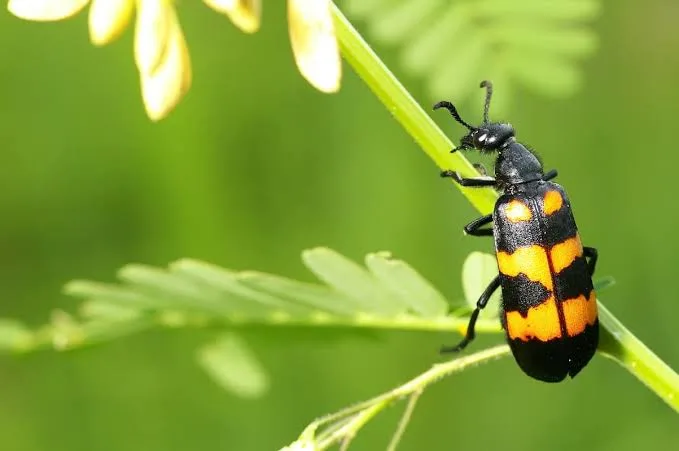
Blister beetles are long, soft-bodied beetles whose head sits on a distinctly narrow “neck.” Their wing covers are flexible rather than hard, and they often feed in groups on flowers or garden plants in summer. If you see a slender, leathery-looking beetle with a wide head, a skinny section behind it, and wing covers that wrap loosely around the body, a blister beetle is a strong possibility.
The name is a warning. Blister beetles (family Meloidae) carry a chemical called cantharidin in their body fluid. Squeezing, slapping, or crushing one against bare skin can release that fluid, and a blister may appear some hours later. The best response is simple: don’t crush it. Blow it off, brush it away with a leaf or a piece of paper, or let it walk off on its own.
This guide covers the features that identify a blister beetle, the colors you are likely to see, the beetles most often mistaken for them, and what to do if you have already touched one.
Quick Identification Checklist
A beetle is consistent with a blister beetle when several of these features appear together:
- Narrow “neck”: the head is broad, and the body pinches in sharply right behind it.
- Small pronotum: the segment behind the head is narrower than both the head and the wing covers.
- Soft, flexible wing covers: they look leathery rather than shell-like, and the abdomen may stick out past their tips.
- Long, slender legs and threadlike or beaded antennae.
- Elongated, cylindrical body, most often about 12–20 mm (roughly 1/2–3/4 inch) long.
- Group feeding on flowers or foliage, especially in summer.
- Plain or warning colors: black, gray, striped, or sometimes metallic.
No single feature settles the identification. The neck and the soft body together are the most reliable combination for beginners.
Body Shape: The Features That Matter Most
The head and the “neck”
The most useful blister beetle feature is the shape directly behind the head. Blister beetles have a rounded or squarish head that tilts slightly downward and narrows sharply into a neck-like constriction. From above, the head often looks wider than the section right behind it.
Many beetles that look similar at a glance lack this constriction. In those beetles the head tucks back into a broad thorax, or the thorax actually extends over the base of the head.
The pronotum
The pronotum is the plate-covered segment between the head and the wing covers (in beetles it is often called the “thorax”). In blister beetles the pronotum is narrower than the head and narrower than the base of the wing covers. This produces the characteristic pinched look: wide head, narrow middle, wider body.
Soft, flexible wing covers
Most beetles have elytra, hardened front wings that work as protective wing covers. In blister beetles the elytra are soft and somewhat leathery. They tend to curve around the sides of the body instead of lying flat, and in many species they cover the abdomen loosely. A heavy female may show part of her abdomen past the wing tips.
Oil beetles (genus Meloe) are blister beetles that take this to an extreme. Their wing covers are very short, and a large, swollen abdomen protrudes well beyond them. Oil beetles cannot fly and are usually seen walking on the ground, especially in spring.
Antennae, legs, and feet
Blister beetle antennae are usually threadlike (filiform) or made of bead-like segments (moniliform). They never form the clubs of a scarab or the extremely long whips of a longhorn beetle. The legs are long and thin, which gives many species a lanky, slightly awkward look as they walk.
There is also a feature you can only check with a magnifier. The tarsi, the segmented “feet” at the ends of the legs, have five segments on the front and middle legs but only four on the hind legs. Darkling beetles share this pattern, so it helps narrow the options rather than confirm a blister beetle by itself.
Size
Most blister beetles that people notice in North America are about 1/2 to 3/4 inch (roughly 12–20 mm) long. The family as a whole ranges from under 1/4 inch to more than 2 inches. Within a single species, size varies with how well the larva fed, so treat any size range as a guide, not a rule.
Colors and Patterns (and Why Color Alone Isn’t Enough)
Blister beetle colors vary a great deal. Many species are plain black, gray, or brown. Others have yellow, orange, or red heads, or striped wing covers. A few are metallic blue, bronze, or green. Some species even come in more than one color form; Epicauta cinerea, for example, occurs as gray, black, and margined forms.
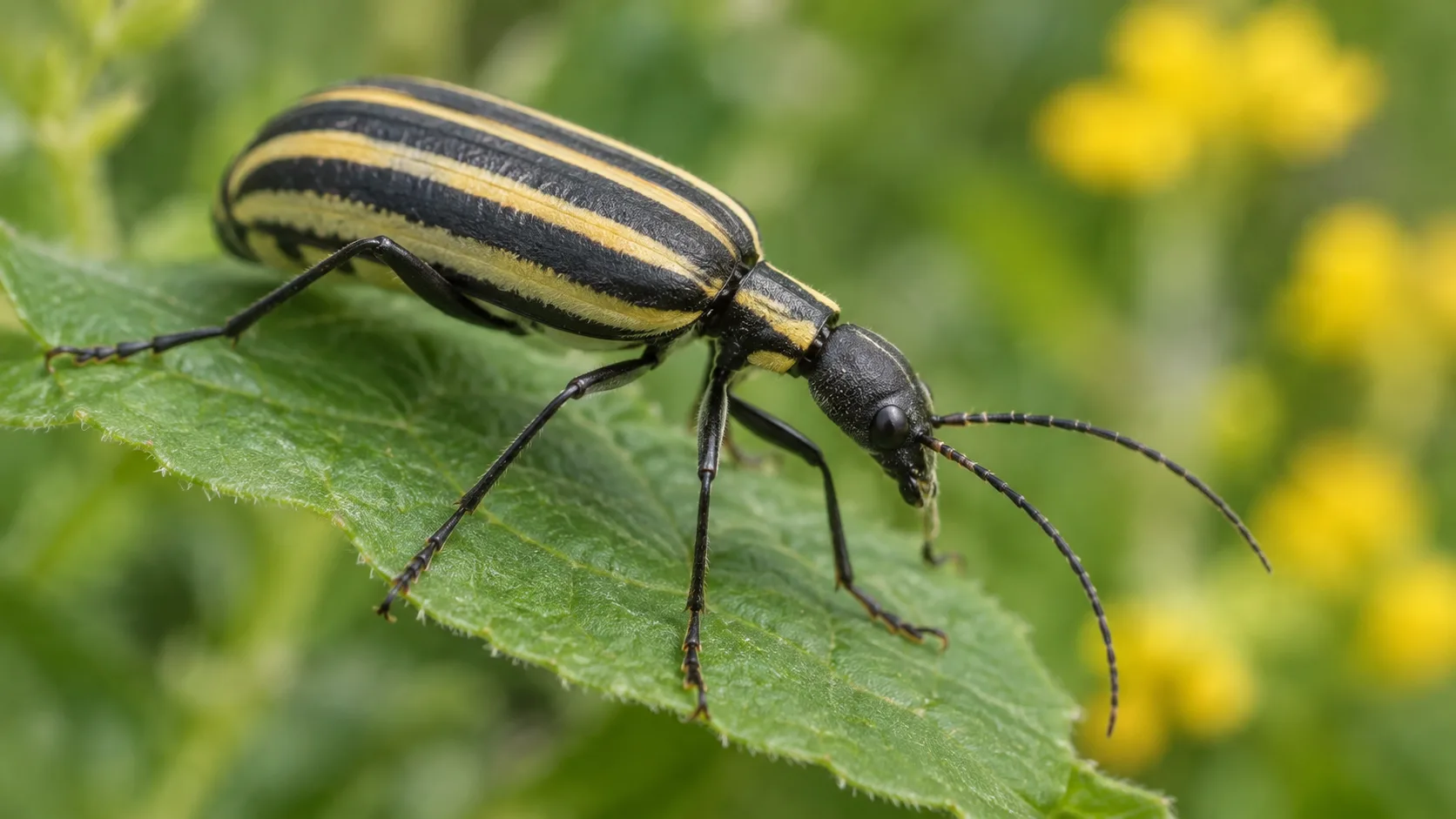
Because of this variation, color only helps once body shape already points toward Meloidae. Here are some commonly encountered examples:
| Beetle | Scientific name | Typical size | What to notice | Where / when |
|---|---|---|---|---|
| Striped blister beetle | Epicauta vittata | 12–18 mm | Long, slender body with pale yellowish and dark lengthwise stripes | Foliage of many crops; often in groups |
| Ash-gray blister beetle | Epicauta fabricii | 10–15 mm | Gray color comes from dense fine hairs over a dark body | Legumes such as alfalfa |
| Black blister beetle | Epicauta pensylvanica | 7–15 mm | Sturdier and entirely black | Pollen and nectar of yellow flowers like goldenrod; active as late as October |
| Oil beetles | Meloe spp. | Up to about 30 mm | Very short wing covers, swollen abdomen, flightless; often shiny black or blue-black | On the ground in grassland and meadows, often in spring |
| Bronze blister beetle | Lytta polita | Varies | Bronze-toned body | Southeastern U.S., including Florida |
| Spanish fly | Lytta vesicatoria | Varies | Bright metallic green | Europe and Asia, not North America |
Two cautions apply. A black beetle with a narrow neck may be a blister beetle, but many black beetles are something else (see our black beetle identification guide for the broader picture). And a striped, soft-bodied beetle on flowers may be a harmless soldier beetle, covered in the lookalikes section below.
Where and When You’ll Find Them
Adult blister beetles feed mainly on flowers and, in some species, on leaves. They are especially common on plants in the aster/sunflower family (Asteraceae), the bean/pea family (Fabaceae), the potato/tomato family (Solanaceae), and the amaranth family (Amaranthaceae). In gardens they often appear on tomatoes, potatoes, beans, beets, and chard. In farm country they gather in flowering alfalfa and along weedy field edges.
Their behavior is a useful clue. Blister beetles are gregarious: you often find several, sometimes dozens, on the same plant, and a group can strip foliage quickly in one spot and leave nearby plants untouched. Some species also come to outdoor lights at night.
Seasonal timing depends on species and region. In much of the U.S., adults appear in early summer, peak around midsummer, and some species stay active into fall. The black blister beetle can still be seen on goldenrod in October. European oil beetles, by contrast, are mostly spring insects.
Why Not to Crush Them: Cantharidin
What cantharidin is
Cantharidin is an odorless compound in the blister beetle’s hemolymph, the insect equivalent of blood. When a blister beetle is pressed, squeezed, or rubbed against skin, it often “bleeds” droplets of this fluid from its leg joints. This defensive behavior is called reflex bleeding. Oil beetles are named for the yellowish, oily droplets they release this way.
Cantharidin is a vesicant, meaning it raises blisters on contact with skin. Notably, it is not a venom delivered by a bite or sting. The beetle does not inject anything; the problem starts only when its fluid ends up on your skin. (For what beetles actually do with their jaws, see Do Beetles Bite?)
What contact can do
Typical blister beetle exposures look like this:
- The blister is often delayed. Redness and blistering can appear immediately, but often show up hours later, so people may not connect the blister to the beetle.
- Location tells the story. Blisters often appear on the neck and arms, where beetles attracted to lights land and get swatted.
- Thin skin is more sensitive. The skin between the fingers reacts more readily than a calloused palm.
- Gentle handling rarely causes problems. A beetle that walks across your hand without being squeezed usually leaves no blister. Swatting and crushing cause the trouble.
- Eyes are a real concern. Rubbing your eyes after touching a blister beetle can cause pain, tearing, blurred vision, and damage to the surface of the eye.
- Swallowing is the most serious risk. Cantharidin is highly toxic to mammals when eaten, which matters for curious children, pets, and especially horses.
For most people who brush against a blister beetle in the garden, the realistic outcome is an uncomfortable blister that heals on its own. The risk is real but manageable, and it is easy to avoid. For a broader look at which beetles pose genuine risks and which only look alarming, see Are Beetles Dangerous?
A chemical with a long history
Cantharidin has a long and mixed reputation. Dried, ground blister beetles (“cantharides”) were once used as a blistering agent in human and veterinary medicine. The European Lytta vesicatoria was the source of “Spanish fly,” a poisonous substance once sold as an aphrodisiac. Today, purified cantharidin is used under medical supervision to treat some warts.
In the beetles themselves, cantharidin is believed to deter predators, though the evidence is limited. Males transfer cantharidin to females during mating, and females coat their eggs with it.
What to Do Instead
If a blister beetle lands on you
Don’t slap it. Blow it off, nudge it onto a leaf or piece of paper, or take off the clothing it landed on and shake it out outdoors.
If you touched or crushed one
- Wash the skin with soap and water as soon as possible.
- Keep your hands away from your eyes until you have washed.
- Rinse your eyes gently with clean water if any fluid may have reached them.
- Leave a blister covered and watch it for signs of infection.
When to get help
Get medical advice if fluid got into an eye, if blistering is extensive, or if a child may have swallowed a beetle. In the U.S., Poison Control (1-800-222-1222 or the webPOISONCONTROL online tool) offers free, confidential help 24 hours a day. If a pet or livestock animal may have eaten blister beetles, contact a veterinarian promptly.
In the garden
A few blister beetles on a plant are usually not worth a fight. When a group starts stripping one plant, extension services suggest hand-picking while wearing gloves and dropping the beetles into a container of soapy water. Long sleeves help if you are working among dense foliage. Our garden beetles guide explains how to read plant damage and decide whether any action is needed. For large-scale or commercial crop problems, your local extension office can give region-specific advice.
Blister Beetles and Horses
Blister beetles are best known among farmers for a hazard that most gardeners never face. When alfalfa is cut and crimped (passed through rollers to speed drying) while beetles are feeding in it, the beetles can be killed and baled into the hay. Dead beetles keep their cantharidin. Horses are very sensitive to it, and even a few beetles in one feeding can be fatal. Cattle and sheep are affected less often.
Species differ widely here. In Nebraska testing, striped blister beetles carried many times more cantharidin per beetle than black blister beetles, and males generally carried more than females. Because striped beetles move in swarms, a single bale can contain a concentrated cluster.
If you keep horses, buy hay from producers who harvest with blister beetles in mind, inspect flakes as you feed, and call a veterinarian immediately if you suspect poisoning.
Common Lookalikes
Several beetle groups share one or two blister beetle features. Check the neck and the pronotum first.
| Lookalike | Similar because | How to separate it |
|---|---|---|
| Soldier beetles (Cantharidae) | Soft, leathery wing covers; often on flowers; some are yellow and black | Flatter body; the pronotum is wider than the head and extends over its base. No narrow neck. |
| False blister beetles (Oedemeridae) | Soft, slender body; often at lights | Head lacks the sharp blister-beetle neck. They also contain cantharidin, so the same “don’t crush” rule applies. |
| Darkling beetles (Tenebrionidae) | Also have four segments on the hind feet; often black | Hard, shell-like body; pronotum wider than the head. |
| Ground beetles (Carabidae) | Often black, long-legged, found on the ground | Hard body, often grooved wing covers, pronotum wider than the head. |
| Checkered beetles (Cleridae) | Can look neck-like | Cylindrical pronotum; hard body covered in bristly hairs. |
| Longhorn beetles (Cerambycidae) | Elongated and long-legged | Hard wing covers and much longer antennae, often as long as the body or longer. See our longhorn beetle identification guide. |
The soldier beetle comparison matters most for gardeners. Soldier beetles feed on pollen and nectar, are considered harmless to people, and need no control. Mistaking them for blister beetles is a common, and avoidable, error.
Life Cycle: Why the Larvae Look Nothing Like the Adults
Blister beetles go through hypermetamorphosis, a form of complete metamorphosis in which the larva changes shape dramatically between stages.
- Triungulin. The newly hatched larva is tiny, active, and long-legged, with a relatively large head. Its job is to find food.
- Grub stages. After feeding begins, it molts into a plump, slow, scarab-like grub.
- Coarctate stage. Many species then enter a hardened, nearly immobile resting stage, which is how most species survive the winter.
- Final grub, pupa, and adult. Development resumes, and the adult emerges the following warm season.
What the larvae eat varies by group. Most Epicauta larvae, including the common striped, ash-gray, and black blister beetles, hunt for grasshopper egg pods in the soil. Blister beetle numbers can rise the year after a grasshopper outbreak. Many other blister beetles, including oil beetles, develop in the nests of solitary ground-nesting bees, where they eat the bee’s egg or larva and its stored pollen and nectar. Oil beetle triungulins climb onto flowers and hitch a ride to the nest on a visiting bee.
Blister beetles are therefore neither simply “good” nor “bad.” Adults can defoliate crops when they swarm, while the larvae of many species destroy large numbers of grasshopper eggs. You are unlikely to recognize a blister beetle larva in the soil, but our beetle larva identification guide can help you narrow down grubs you do find.
When Species-Level Identification Is Difficult
There are roughly 2,500 described blister beetle species worldwide, and more than 400 in North America north of Mexico. Many Epicauta species are closely similar, and some vary in color within a single species. A clear photo is often enough to place a beetle in the family Meloidae. Naming the species may require a specialist, a regional key, or a museum collection.
To improve your chances, photograph the beetle from above and from the side so the neck and pronotum are visible, and note the plant, the date, and your region. For a beetle that doesn’t fit this profile at all, start with our main beetle identification hub. If identification matters for livestock or crops, a local extension office is the right next step.
Frequently Asked Questions
Do blister beetles bite?
Blister beetles are not known for biting people. The blisters come from cantharidin in their body fluid reaching your skin, usually after the beetle is squeezed or crushed. They do not sting either.
How long after contact does a blister appear?
It varies. Some people notice redness quickly, but blisters often appear hours later. This delay is why many people never realize a beetle caused the blister.
Is it safe to pick up a blister beetle?
Gentle, brief handling rarely causes blistering, but there is no reason to risk it. Use a leaf, paper, or gloves, and wash your hands afterward.
Are blister beetles dangerous to pets?
Swallowing blister beetles is dangerous to animals. Horses are the best-documented victims. If a dog, cat, or other animal may have eaten one, contact a veterinarian.
Can blister beetles fly?
Most can fly, and some species come to lights at night. Oil beetles are the main exception: their wing covers are very short and they cannot fly.
Is Spanish fly a blister beetle?
Yes. “Spanish fly” traditionally refers to Lytta vesicatoria, a metallic green European blister beetle, and to the toxic preparation once made from it.
Should I kill blister beetles in my garden?
Usually not. Small numbers seldom cause lasting harm, and many species’ larvae eat grasshopper eggs. If a group is stripping a plant, hand-pick with gloves into soapy water.
Why do blister beetles cause blisters on my neck at night?
Some species fly to porch and outdoor lights. When one lands on your neck or arm and you swat it, the crushed beetle releases cantharidin onto your skin. Brushing or blowing them away avoids this.
References
- Selander, R. B., and T. R. Fasulo. Blister Beetles (Insecta: Coleoptera: Meloidae). EENY166, UF/IFAS Featured Creatures, University of Florida. https://ask.ifas.ufl.edu/publication/IN323
- Wright, R., K. Koch, and D. Boxler. Management of Blister Beetles in Alfalfa. NebGuide G1645, University of Nebraska–Lincoln Extension (rev. 2022). https://extensionpubs.unl.edu/publication/g1645/2022/html/view
- Virginia Cooperative Extension. Blister Beetles. ENTO-526NP (2022). https://pubs.ext.vt.edu/ENTO/ento-526/ento-526.html
- Missouri Department of Conservation. Blister Beetles (Meloids). https://mdc.mo.gov/node/219248
- University of Arizona, Arizona Pest Management Center. Blister Beetle Basics. https://acis.cals.arizona.edu/all-publications/publications-view/blister-beetle-basics
- National Capital Poison Center (Poison Control). Blister Beetles: Do Not Touch. https://poison.org/articles/blister-beetles-do-not-touch-194
- Buglife. Black Oil Beetle. https://www.buglife.org.uk/bugs/bug-directory/black-oil-beetle/
- GBIF. Epicauta pensylvanica (DeGeer, 1775). https://www.gbif.org/species/1046516