

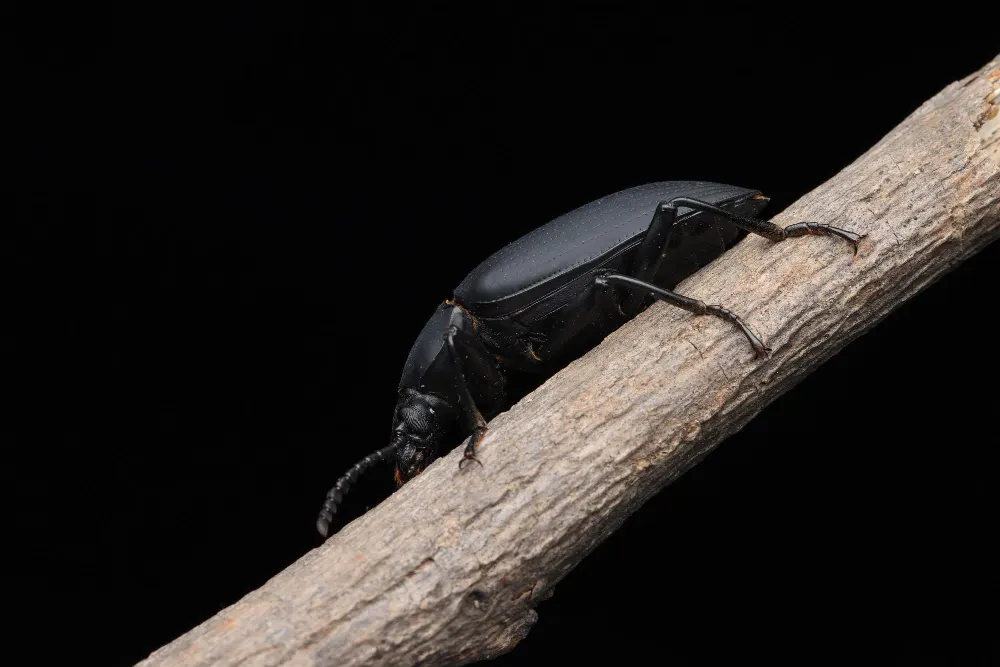
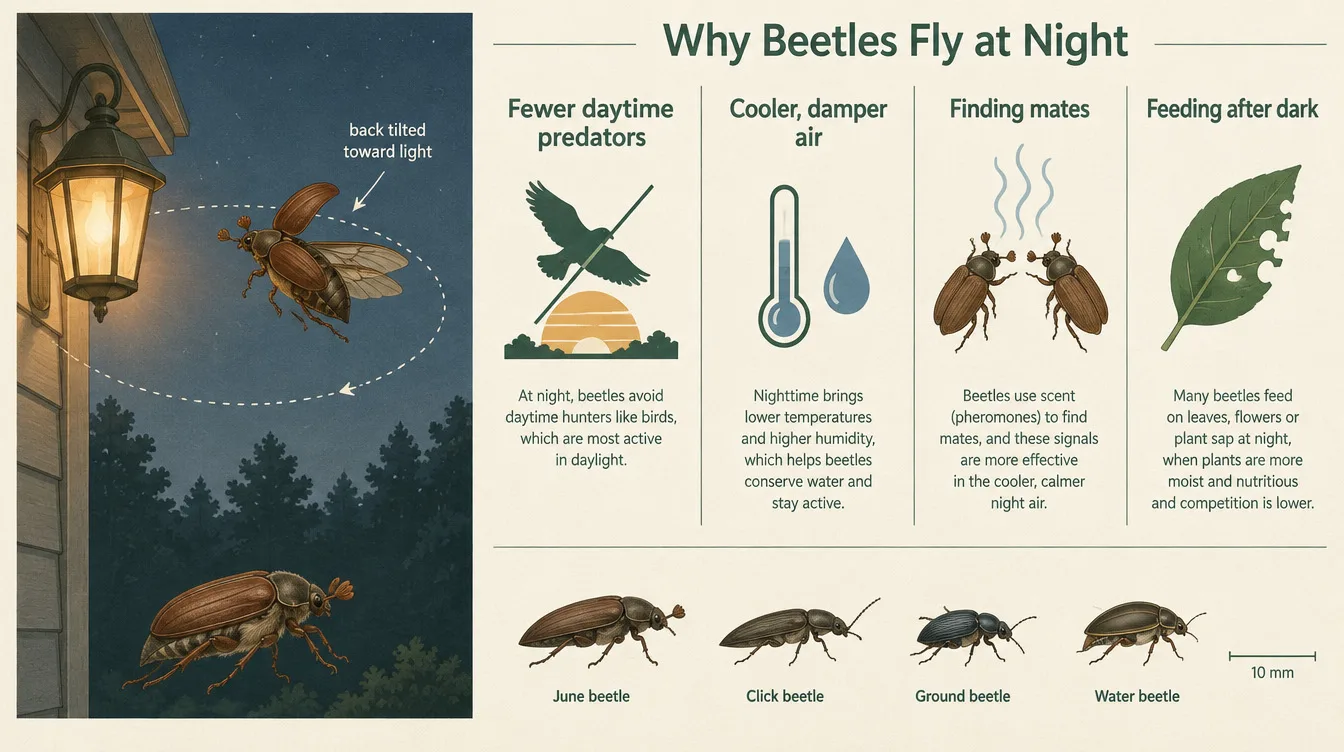
Most beetles that fly at night do it for practical reasons: the air is cooler and damper, most bird predators have stopped hunting, mates are easier to locate by scent in still evening air, and the food they want is safest to reach after dark. Night flight is a schedule, not a mystery.
The part that confuses people is what happens next. A beetle that was flying calmly across a lawn suddenly starts circling a porch light, bumps into the glass, drops onto the doormat, and is still lying there in the morning. That behavior has a separate explanation, and recent research has changed how scientists describe it.
Not all beetles fly at night
Before assuming that beetles are night insects, it helps to notice how much variation exists inside the order Coleoptera.
Japanese beetles feed on roses and linden leaves in full sun. Lady beetles hunt aphids during the day. Tiger beetles chase prey across hot sand at midday. Flower-visiting beetles are active whenever their flowers are open.
Others split the difference. Stag beetles are usually described as crepuscular, meaning most active in the twilight window around dusk rather than in full darkness. Many click beetles and longhorn beetles fly in the last light of the evening.
Then there are the true night fliers: May and June beetles, many other scarabs, several ground beetles, diving beetles moving between ponds, and a long list of wood-boring and soil-dwelling species.
So the accurate version of the question is not “why do beetles fly at night” but “why do some beetles fly at night.” Three broad pressures explain most of it.
Reason 1: Fewer daytime predators
A large brown beetle in flight is a slow, noisy, high-calorie target. Birds take them readily, and most insect-eating birds hunt in daylight. Flying after sunset removes a large share of that risk.
Night flight is not risk-free. Bats hunt in exactly that window, and several nocturnal insect groups have evolved hearing organs tuned to bat echolocation calls, allowing them to dive or swerve when a bat approaches. Some scarabs and tiger beetles are documented examples. Predation pressure does not disappear at night; it changes shape.
Toads, spiders, ground-dwelling predators, and other beetles also work the night shift. What darkness mainly buys a beetle is a break from visual hunters.
Reason 2: Cooler air, less water loss
Insects lose water through their cuticle and through the spiracles they breathe with. A small animal with a large surface area relative to its volume can dry out quickly on a hot, dry afternoon.
Flight makes this worse. Beetle flight muscles generate a lot of heat, and many larger beetles have to warm their flight muscles up before takeoff, which is why a June beetle sometimes buzzes in place for a few seconds before it gets airborne. Doing that work at 2 p.m. in July, in dry air, is expensive.
Evening air is usually cooler and more humid, and it is often calmer. For a heavy-bodied, clumsy flier, still air matters. This is one reason people notice May/June beetles and stag beetles on warm, humid, windless evenings and barely see them when it is breezy or cold.
Reason 3: Mating and feeding schedules
For many beetles, the adult stage is short and has one job: reproduce. Night is when that job gets done.
Finding a mate by scent. Many beetles locate mates using pheromones, chemical signals released into the air. Still, humid, stable night air holds a scent plume together instead of shredding it, so a male following that plume upwind has a better chance of arriving somewhere useful. Female stag beetles, for example, release pheromones while males patrol the air looking for them.
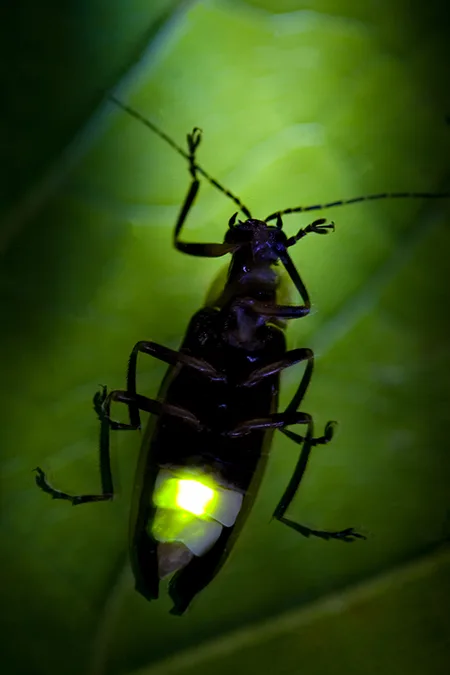
Finding a mate by light. Fireflies are beetles, and their flash codes only work in darkness. Their courtship schedule is set by the light level, not by the clock.
Feeding after dark. Adult May and June beetles (Phyllophaga spp.) spend the day underground and come out after dusk to feed on tree foliage, mate, and lay eggs. Gardeners often notice the result before they notice the insect: chewed leaf margins on oak, crabapple, or ash in late spring, with no visible culprit during the day.
Emerging together. Mass emergences after warm rains concentrate a lot of beetles into a few evenings. That is why a porch can go from quiet to crowded in one night and back to quiet a week later.
Dispersal flights. Water beetles fly between ponds and ditches at night. Wood-boring beetles fly to locate stressed trees. Bark beetles, ambrosia beetles, and many others use flight almost entirely to relocate, not to forage. Nights that are warm and calm are the ones they use.
So why do they end up at the porch light?
This is the question most readers actually arrive with, and the honest answer is that the popular explanation is probably wrong.
The old explanation. For decades, the standard story was that night-flying insects navigate by the moon, keeping it at a fixed angle, and that a nearby lamp breaks that system and pulls them into a spiral. A second version said insects flee toward light as an escape response.
What the flight data showed. In a 2024 study published in Nature Communications, researchers used high-speed motion capture in the lab and stereo videography in the field to reconstruct the three-dimensional flight paths of insects around artificial lights. Insects did not steer directly at the lamp. Instead, they turned their backs toward it and flew roughly perpendicular to the source.
Why that produces circling. Most flying insects use what is called the dorsal light response: they keep their back pointed toward the brightest part of the visual field. Over evolutionary time, the brightest area has always been the sky, so this is a reliable way to know which way is up. A bright lamp on a dark night hijacks that reference. The insect keeps banking to hold its back toward the bulb, and the resulting path is an orbit, a stall, or a crash landing. It looks like attraction. Mechanically, it is a failed attempt to stay level.
What this means in practice. A beetle under your porch light is not seeking your house, your food, or your family. It is stuck in a lighting error. Many of them simply sit still on the wall or the ground once they land, which is why they are still there at breakfast.
Wavelength matters too. Lights rich in ultraviolet and blue draw far more night-flying insects than warmer, longer-wavelength light. Field comparisons of household bulbs have found that LEDs attract fewer insects than tungsten or compact fluorescent lamps, and that amber-filtered light draws fewer insects than white light. This is useful practical information later in this article.
Which beetles show up at lights, and what they usually mean
| Beetle group | When you see them | What it looks like at the light | Usual significance indoors |
|---|---|---|---|
| May/June beetles (Phyllophaga spp.) | Late spring, early summer evenings | Heavy brown beetles, 12–25 mm (about 1/2–1 inch), clumsy flight, loud thuds against glass and screens | Accidental visitor; larvae are lawn grubs, not an indoor problem |
| Masked chafers and other scarabs | Early to midsummer nights | Smaller tan or brown beetles, rounded, clubbed antennae | Accidental visitor; see scarab beetles |
| Click beetles (Elateridae) | Late spring through summer | Narrow, elongated beetles that click and flip when placed on their backs | Harmless indoors |
| Ground beetles (Carabidae) | Warm nights, often near lit doorways | Flat, dark, fast-running beetles; many run rather than fly | Accidental visitor; predators outdoors. See ground beetles |
| Longhorn beetles (Cerambycidae) | Early summer evenings, often near wooded areas | Long-bodied beetles with very long antennae | Usually came from outdoor wood, not your furniture |
| Water beetles (Dytiscidae and relatives) | Warm nights, especially after rain | Smooth, oval, glossy beetles found on wet pavement, pool covers, car hoods | Dispersing between water bodies; not a household pest |
| Rove beetles (Staphylinidae) | Warm humid nights | Very short wing covers, exposed flexible abdomen, often mistaken for earwigs | Harmless outdoor predators |
| Carpet beetles (adults) | Spring, often at windows rather than porch lights | Tiny rounded beetles, 2–4 mm, mottled or plain | Worth attention: the larvae, not the adults, damage fabrics |
Note the last row. Almost everything on this list is a visitor. Carpet beetles are the exception where an indoor finding may point to something worth investigating. For sorting a dark beetle you found by the door, black beetle identification walks through the common candidates.
Does a beetle at the light mean an infestation?
No. One beetle at a light means one beetle was flying past a light.
Signs that would actually matter are different, and they are almost never about the porch:
- repeated finds of the same small beetle indoors over weeks, away from doors and windows;
- damage that matches a known feeding pattern, such as irregular grazed patches on wool, felt, or stored animal-fiber items;
- larvae, shed larval skins, or fine powdery frass indoors;
- beetles emerging from a specific piece of furniture, flooring, or stored food rather than appearing near entry points.
A pile of large brown beetles under a garage light in June is a seasonal event, not an infestation. The relevant page for context is Beetles Around the Home.
Weather, season, and timing
Night beetle activity is not evenly spread across the summer or across the night.
Season. Most temperate night-flying beetles have a narrow adult window. May and June beetles are active for a few weeks in late spring and early summer. Stag beetles in Europe are typically seen from mid-May through July. After that, the same porch light goes quiet.
Temperature. Warm nights produce more flight. Cool nights produce very little. Large beetles need warm flight muscles.
Humidity and rain. Warm, humid evenings, especially after rain has softened the soil, often bring the biggest emergences.
Time of night. Light-trap studies on tropical scarabs found that the first hours after dark captured more individuals and more species than the last hours before dawn. Anecdotally, most homeowners see the same pattern: the busy window is the first two or three hours after sunset.
Practical steps if beetles at your lights bother you
None of this requires pesticides, and none of it requires panic.
Change the bulb. Warm-toned or amber outdoor lighting attracts fewer night-flying insects than cool white, blue-rich, or UV-emitting sources. Warm white LEDs around 2700K are a reasonable everyday choice.
Shield and aim it. A fixture that throws light downward onto a path, rather than sideways into open air, is visible to far fewer flying insects.
Use less of it. Motion sensors and timers cut the total hours a light is broadcasting.
Move the light away from the door. A lamp a few meters off to the side keeps the landing zone away from the threshold.
Close the gap. Intact window screens, weather stripping, and a closed door during the first hours after dark handle most of what is left.
Leave them alone if they are outside. Most of the beetles at your light are harmless, and several of them are useful predators or decomposers. If one is on its back on the porch in the morning, flipping it upright and moving it into the garden is a complete solution.
A note on why this matters beyond convenience: artificial light at night is now recognized as a genuine pressure on nocturnal insect populations, since insects caught in the orbit around a lamp can be picked off by predators, exhaust themselves, or fail to find mates. Shielded, dimmer, warmer outdoor lighting is a small change with a real effect.
When you cannot tell what it was
A beetle seen at night, in motion, under artificial light, is one of the harder identification situations. Color shifts under a bulb, size is easy to overestimate, and many night-flying beetles are brown and rounded.
If you want a usable identification, photograph the beetle at rest in daylight if possible, get the antennae and wing covers in focus, include something for scale, and note the date, the habitat, and what it was doing. Even then, many groups can only be taken to family or genus from a photograph. Species-level confirmation often needs a specimen and a specialist.
For anything with real stakes, such as suspected wood-boring activity in structural timber, damage to a commercial crop, or a beetle you think might be a regulated or newly introduced species, contact your local extension office, agriculture department, or a natural history museum. Those organizations want the reports.
For general questions about flight itself, including which beetles fly well and which barely fly at all, see flying beetles.
Frequently asked questions
Are beetles attracted to light, or confused by it?
Current evidence points toward confusion rather than attraction. The 2024 flight-path study found that insects near a lamp turn their backs toward it and fly perpendicular to it, which produces orbiting and crash landings without any steering toward the source.
Is the moon-navigation explanation wrong?
It is no longer the leading explanation. It was a plausible hypothesis that had never been tested with three-dimensional flight data. When that data was collected, the flight paths did not match the prediction.
Why do June bugs bang into windows and screens?
May and June beetles are heavy and poor at fine flight control, and near a light their orientation system is compromised. The result is collisions with lit glass and screens, followed by clinging to the mesh.
Do beetles at my porch light bite?
Almost none of them will. A few large beetles can pinch defensively if you grab them, which is different from biting to feed. The subject is covered in more detail in do beetles bite.
Why are there suddenly dozens on one night and none the next?
Emergence is synchronized by temperature, soil moisture, and season. A warm rainy spell can trigger a mass emergence that lasts a few nights and then ends.
Do LED lights attract fewer beetles?
Generally yes, compared with UV-rich sources like mercury vapor lamps, and field tests have found LEDs attracting fewer insects than tungsten or compact fluorescent bulbs. Color matters as well: warm and amber light draws fewer insects than blue-rich cool white.
Why do beetles land on my wet driveway or pool cover at night?
Aquatic insects, including many water beetles, locate water by detecting the horizontally polarized light reflected off its surface. Smooth, dark, wet artificial surfaces reflect light the same way, so a beetle looking for a pond can end up on asphalt, a car hood, or a pool cover.
Do beetles fly at night in winter?
In temperate regions, very little. Most species overwinter as eggs, larvae, pupae, or dormant adults, and flight activity restarts with warm weather.
Will turning off the light make them go away?
Usually within minutes for the ones still flying, though beetles that have already landed often stay put until morning.
Are night-flying beetles dangerous to my house?
The ones circling porch lights are overwhelmingly outdoor beetles that will not breed indoors. Household concerns come from a different set of beetles, usually associated with fabrics, stored food, or wood, and they are recognized by damage and repeated indoor finds rather than by a single beetle at a lamp.
References
- Fabian, S. T., Sondhi, Y., Allen, P. E., Theobald, J. C., & Lin, H.-T. (2024). Why flying insects gather at artificial light. Nature Communications, 15, 689. https://www.nature.com/articles/s41467-024-44785-3
- University of Wisconsin–Madison Division of Extension, Wisconsin Horticulture. May/June Beetles. https://hort.extension.wisc.edu/articles/mayjune-beetles/
- University of Illinois Extension, Home, Yard & Garden Pest Newsletter. May Beetles. https://hyg.ipm.illinois.edu/article.php?id=894
- Missouri Department of Conservation Field Guide. May Beetles (June Bugs). https://mdc.mo.gov/discover-nature/field-guide/may-beetles-june-bugs
- Colorado State University, Agricultural Biology. Ground Beetles. https://agsci.colostate.edu/agbio/ipm-pests/ground-beetles
- Natural History Museum, London. Stag beetle facts: the UK’s largest beetle and where to see it. https://www.nhm.ac.uk/discover/stag-beetles.html
- Wakefield, A., Broyles, M., Stone, E. L., Jones, G., & Harris, S. (2016). Experimentally comparing the attractiveness of domestic lights to insects: Do LEDs attract fewer insects than conventional light types? Ecology and Evolution, 6(22), 8028–8036. https://www.ncbi.nlm.nih.gov/pmc/articles/PMC5108255/
- Szaz, D., Horvath, G., Barta, A., et al. (2015). Lamp-lit bridges as dual light-traps for the night-swarming mayfly, Ephoron virgo: interaction of polarized and unpolarized light pollution. PLOS ONE, 10(3), e0121194. https://journals.plos.org/plosone/article?id=10.1371/journal.pone.0121194