

Color is a good place to start identifying a beetle and a poor place to stop. It can shrink a very long list of possibilities to a manageable one, and a distinctive pattern can sometimes point straight at a single species. But a plain “black,” “brown,” or “green” almost never names a beetle on its own. Many unrelated beetles share the same color, some species come in several colors, and a beetle’s color can shift with age, moisture, viewing angle, and even death.
The practical approach is to treat color as one clue among several. Note it carefully, then check body shape, size, antennae, wing covers, and where the beetle was found before settling on a name.
The short version
| What color can do | What color cannot do |
|---|---|
| Narrow a long list of candidates | Name a species when the beetle is a plain, common color |
| Flag a few species with fixed, distinctive patterns | Separate unrelated beetles that share a color |
| Hint at a defense, such as warning colors | Tell you whether a beetle is harmful or helpful |
| Help confirm an ID made from other features | Stay constant across age, sex, region, or lighting |
| Suggest which guide to read next | Say anything about larvae, which look nothing like adults |
Where beetle color comes from
Beetle color has two sources, and they behave differently.
Pigment color comes from chemicals in the cuticle, the beetle’s hard outer shell. Dark pigments such as melanin produce the blacks and browns that dominate the beetle world. Pigment color looks roughly the same from every direction.
Structural color comes from the physical build of the cuticle rather than from a dye. In many metallic beetles, the shell contains stacks of extremely thin layers. Light reflecting off those layers interferes with itself, strengthening some wavelengths and canceling others. The result is the mirror-like green, gold, copper, or blue of jewel beetles, many scarabs, and tiger beetles. Because the effect depends on the path light takes through the layers, the color shifts as the viewing angle changes. The two systems are often combined in the same beetle.
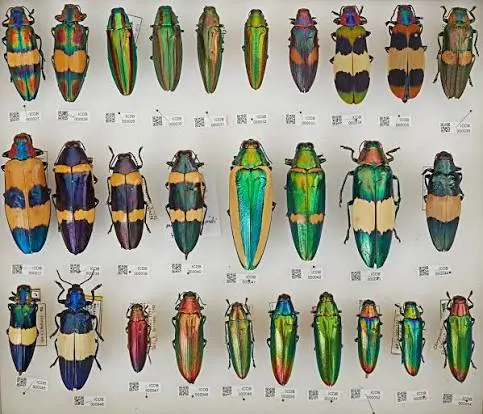
This is why a shiny green beetle may look blue-green, bronze, or nearly black as it turns, and why two photos of one beetle can seem to show two different animals.
What color can tell you
It narrows the field
There are far too many beetle species to compare one by one. Color is a fast first filter. A metallic green beetle on a garden plant belongs to a much shorter list than “a beetle on a garden plant.” That is the idea behind color-based starting points such as our guides to black beetles and green beetles. They use color to gather the likely candidates, then separate them with other features.
Fixed patterns can be strong evidence
Solid colors are weak clues. Specific, stable patterns are much stronger, especially when they sit in a particular place on the body.
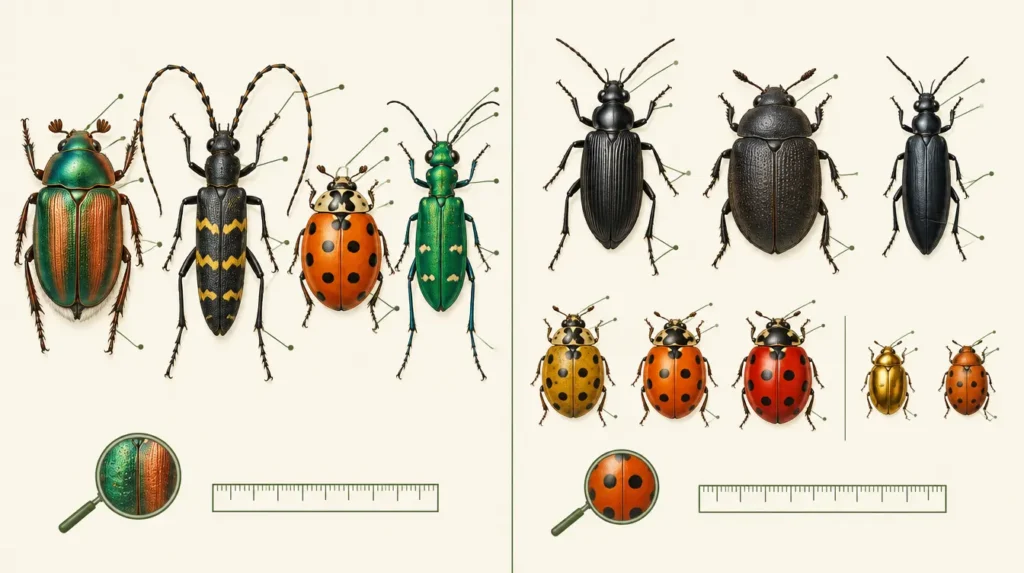
- Japanese beetle (Popillia japonica). Adults are about 8–13 mm (1/3 to 1/2 inch) long, with a metallic green head and thorax and copper-brown wing covers. The detail that matters most is small: five patches of white hair along each side of the abdomen and two more at the tip. Plenty of beetles are green and copper. Very few have that row of white tufts.
- Locust borer (Megacyllene robiniae). This longhorn beetle, about 19 mm (3/4 inch) long, is black with yellow bands across the thorax and zigzag yellow bands on the wing covers, plus reddish-yellow legs and antennae. Adults are often found on goldenrod flowers. The banding is often compared to a wasp’s, but the long antennae and hard wing covers show it is a beetle.
- Six-spotted tiger beetle (Cicindela sexguttata). A shiny emerald green to blue beetle with small pale spots near the rear edge of the wing covers, long legs, bulging eyes, and sickle-shaped jaws. The combination is distinctive even though the spot count varies.
In each case the pattern only works because it is paired with shape, size, or behavior.
Color can hint at how a beetle defends itself
Bold contrasts such as red and black or yellow and black are often warning colors, a signal to predators that the insect tastes bad or carries defensive chemicals. Lady beetles are a familiar example. Treat this as a hint and nothing more. Some harmless beetles copy warning patterns, and some chemically defended beetles are plain. Blister beetles (family Meloidae) contain cantharidin, a defensive chemical that can blister skin if a beetle is crushed against it, yet common species range from plain black to gray to striped. They are recognized by shape: a long narrow body, a broad head, and soft, flexible wing covers.
Where color lets you down
Unrelated beetles share the same colors
Black is the best example. Most ground beetles (family Carabidae) are glossy black or dark brown. So are many darkling beetles (family Tenebrionidae), along with a long list of scarabs, rove beetles, and others. Ground beetles and darkling beetles can look alike at a glance, and telling them apart depends on structure. Ground beetles have long, prominent legs with enlarged segments at the base of the hind pair, and long antennae that are not clubbed. Darkling beetles lack those enlarged leg segments, and their antennae attach beneath a ridge on each side of the head. Color plays no part in that separation. Our ground beetle guide covers the group in more detail.
Metallic green causes the same trouble. The emerald ash borer (Agrilus planipennis), an invasive wood-boring beetle that attacks ash trees, is bright metallic green. So are several native beetles that are regularly mistaken for it. One extension fact sheet on lookalikes lists the Japanese beetle, green June beetle, dogbane beetle, six-spotted tiger beetle, caterpillar hunters, and others. Shape and size do the sorting here. The emerald ash borer is slender and bullet-shaped, and about 8.5 mm (1/3 inch) long. A tiger beetle is long-legged and fast on the ground. A June beetle is broad and heavy. For a side-by-side look at these, see metallic green beetle identification.
One species can come in many colors
The multicolored Asian lady beetle (Harmonia axyridis) earned its name. Adults are roughly 5–8 mm (0.2 to 0.3 inch) long and range from pale yellowish brown through orange to bright orange-red. Some carry 19 black spots. Others have faint spots or none. The more reliable mark is on the pronotum, the shield-like plate just behind the head. It is pale with a dark mark shaped like an “M” or a “W,” depending on which direction you view it from. That mark usually stays visible even on worn, older beetles.
The lesson applies well beyond lady beetles. Counting spots or matching a shade to a photo can lead you to the wrong species, or convince you that two color forms of one species are different beetles.
Ground beetles show the reverse situation. The family is mostly dark, but some members are brightly colored or iridescent blue or green. A beetle’s color does not reliably place it inside or outside a family.
Color changes during a beetle’s life
A newly emerged adult beetle is pale. Entomologists call this stage teneral. In lady beetles, for example, the freshly emerged adult has a pale body, and it takes several hours for the cuticle to harden and the usual pattern to appear. Even then, new adults can stay noticeably lighter than older ones for some time. A pale tan beetle found next to dark ones of the same shape may simply be younger.
Wear works in the other direction. Older multicolored Asian lady beetles can look dull, with both their gloss and their spots abraded.
Some beetles change color while you watch
- Golden tortoise beetle (Charidotella sexpunctata). About 6 mm (1/4 inch) long and brilliant brassy or greenish gold when undisturbed. When disturbed, it turns orange with black spots.
- Eastern Hercules beetle (Dynastes tityus). This large scarab reaches about 60 mm (roughly 2.4 inches). Its thorax and wing covers are greenish gray to tan with black spots that differ on every individual. The shell is lighter in dry conditions and turns dark brown under high humidity.
These are unusual cases, but they show that the color you see is not always fixed.
Dead beetles and photos distort color
The golden tortoise beetle loses its metallic color completely after death, leaving a dull reddish-yellow specimen. A dried beetle on a windowsill may not match photos of the living insect.
Photos add their own problems. Flash creates glare that washes out glossy black beetles and overexposes metallic ones. Indoor lighting shifts tones toward yellow or blue. Structural colors change with camera angle. A phone photo is useful evidence, but its color is the least dependable part of it.
Color says nothing about larvae or about risk
Beetle larvae look nothing like the adults. A metallic green and copper Japanese beetle starts life as a C-shaped, white to cream-colored grub with a tan head, and it looks much like the grubs of other scarabs. Adult color is no help with a larva. Use body form and location, as explained in the beetle larva identification guide.
Color also does not sort beetles into pests and non-pests. Black beetles include garden predators and pantry pests. Green beetles include native hunters and an invasive tree killer. Whether a beetle matters depends on what it is and what it is doing.
How to use color properly
Use color to describe the beetle, and use the other clues to identify it.
1. Describe the color precisely. “Green” is weak. “Metallic green head and thorax with duller copper-brown wing covers” is useful. Note:
- whether the surface is matte, glossy, or metallic;
- whether the color is uniform or differs between head, pronotum, and wing covers;
- any spots, bands, stripes, or margins, and exactly where they sit;
- the color of the legs, antennae, and underside, if you can see them;
- hairs or scales, which can make a beetle look mottled or dusty.
2. Add shape and size. Is the body round, oval, long and narrow, flattened, or domed? Measure it or photograph it beside a coin or ruler. Size alone rules out many candidates.
3. Look at the antennae. Threadlike, clubbed, fan-like, elbowed, or longer than the body: antenna form often places a beetle in a family faster than color does. See identifying beetles by their antennae.
4. Check the wing covers. Elytra, the hardened front wings that cover the back, may be smooth, grooved, pitted, hairy, soft, or shortened so that part of the abdomen shows.
5. Record the context. Where was it: on a flower, under a log, in a pantry, at a porch light, on a specific plant? What month? What was it doing? Which state or region? Location and season often settle a choice between two lookalikes.
6. Stop at the level the evidence supports. A clear photo and good notes will often get you to a family or group. Getting to species may need a specialist, magnification, or the actual specimen. “Consistent with a ground beetle” is an honest, useful answer.
Once you have these notes, the beetle identification hub can route you to the guide that fits.
Taking photos that preserve color
- Use daylight in open shade. Avoid direct flash and harsh sun.
- Shoot straight down on the back, then from the side, then the underside if the beetle allows.
- Take several angles of metallic beetles, since the color will shift.
- Include a scale object.
- Place the beetle on a neutral background such as white or gray paper.
- Write down the color you see with your own eyes, in case the photo disagrees.
When to ask for help
If you think you have found an invasive or regulated species, such as a possible emerald ash borer, do not rely on color or on a web page. Take clear photos, note the location and host plant, and contact your state or county extension office or state department of agriculture. Many run reporting programs and can confirm an identification. The same applies when beetles are damaging stored food, fabrics, structural wood, or valued plants and you need a confirmed ID before acting. A local extension office, natural history museum, or university entomology department can usually help.
Frequently asked questions
Can I identify a beetle from color alone?
Rarely. A handful of species have patterns distinctive enough to be recognized on sight, but even those are confirmed by shape and size. For plain black, brown, or green beetles, color only narrows the list.
Why does my beetle look green in one photo and bronze in another?
Its color is probably structural, produced by thin layers in the shell rather than by pigment. That kind of color changes with the angle of light and view.
Do male and female beetles differ in color?
In some species they do, though differences in size, horns, jaws, or antennae are more often the visible distinction. Check a species-specific source before using color to sex a beetle.
Are brightly colored beetles dangerous?
Bright color is sometimes a warning signal, but it is not a reliable guide to risk. Some chemically defended beetles are dull, and many bright ones are harmless. Avoid crushing any unfamiliar beetle against your skin.
I found a pale, soft version of a beetle I know. Is it a different species?
It may be a newly emerged adult that has not yet hardened and darkened. Shape and size will match the mature form.
Do color-matching apps work for beetles?
Photo identification tools can suggest candidates, and some are quite good at common, distinctive species. They work from the same images you do, so glare, angle, and faded specimens affect them too. Treat a suggestion as a lead to check against shape, size, and location.
References
- Lenau, T., & Barfoed, M. (2008). Colours and metallic sheen in beetle shells: A biomimetic search for material structuring principles causing light interference. Advanced Engineering Materials, 10(4), 299–314.
- Ohio State University Extension. Multicolored Asian Lady Beetle (Ohioline ENT-44).
- University of Maryland Extension. Multicolored Asian Lady Beetle.
- Texas A&M AgriLife Extension, Field Guide to Common Texas Insects. Tortoise Beetle.
- LSU AgCenter. Dynastes tityus, Eastern Hercules Beetle (Coleoptera: Scarabaeidae).
- University of Minnesota Extension. Japanese Beetles in Yards and Gardens.
- Penn State Extension. Emerald Ash Borer; and Oklahoma State University Extension. Native Woodborers and Emerald Ash Borer Lookalikes.
- UC Statewide IPM Program. Predaceous Ground Beetles (Natural Enemies Gallery).
- CSIRO Entomology. Ladybirds of Australia: Life History.
- NC State Extension. Locust Borer; and University of Kentucky Entomology. Blister Beetles (EntFact-102).